Thursday, 21 November 2013

Axarquia Bird Group visit to the Rio Velez, Torre del Mar


Thursday 21 November

Bluethroat Ruisenor Pechiazul Luscinia svecica

It might have started cold and cloudy but, as the sun forced its way through, it certainly started to warm up.  Eleven of us this morning for a relatively short visit to the Rio Velez in Torre del Mar and, as usual, we were welcomed by the local Rock Dove and Moorhen population as we gathered under the N340 road bridge at the start of the track down to the beach fir the November meet of the Axarquia Bird Group.  Now that during this past month saplings have been planted and a new hide erected opposite the pump house, the track itself has been widened at the start so giving ample parking space.  And it was here that we were able to welcome Tony and Karen Scott to our group for their first, of many we hope, monthly sorties with us.  Tony and Karen only yesterday moved in to their new home above Lake Vinuela having "transferred" from Dave and Gilly's Arboleas Bird Group.  Anyway, you are both very welcome.  After what seems a long break it was also good to see Gerry Collins from Salobrena and Leslie Lave for Nerja back with us.  Also present were Pat and Eric Lyon from Sayalonga, Steve Powell from Frigiliana, the Triana trio of Jim Moore, Dan Wilkinson and Brian Greene plus myself.

One of scores of Chiffchaff Mosquitero Comun Phylloscopus collybita at the Rio Velez
Introductions completed under the watchful eyes of yet more Rock Doves, Collared Doves and a male Blackbird, not to mention a rather handsome male Black Redstart on the field behind us, it was time to go birding.  At the water's edge below us we had both White and Grey Wagtails and at least a dozen Mallards were drifting about on what was left of the river.  A Heron flew by and a Kestrel was picked up above the trees on the opposite bank but, most of all, there ere Chiffchaffse everywhere.  Trying to hang onto their traditional territory, the few Cetti's Warblers were screaming their heads off and we did mange to find a single Zitting Cisticola.  A "swarm" of raucous Monk Parakeets flew over s we walked down toward the pump house.

A "peek-aboo" Water Pipit Bisbita Alpino Anthus spinoletta
Before reaching the above and taking a look at the newly- installed wooden hide, we had both Water Pipit, at least three seen during the morning, and a handful of Meadow Pipits.  The latter were found all the way down the grassy side of the river but, on this occasion, only as singles or pairs rather then the usual handful.  A number of Ringed Plovers were also found and my only single Little Ringed Plover remained absent until we return walk to the cars.  A Snipe took off in its crazy zig-zag flight upsteam and then a small flock of sixteen Sanderlings but this week with out their solitary Dunlin friend.

Sanderlings Correlimos Tridactilo Calidris alba at play

Also seen on the walk down to the pump house were Serin, Goldfinch and Greenfinch along with large flocks of Spotless Starlings, all making good use of the available drinking water at the river's edge.  More Black Redstarts and then a couple of Black-winged Stilts along with a pair of Dunlin.  Whilst the nearby Stonechats were rather cute they could not possibly compare with the lone Golden Plover that posed at the riverside immediately in font of us.

A lone Golden Plover Chorlito Dorado Europeo Pluvialis apicaria at the Rio Velez
Time to leave the Chiffchaffs behind and pause at the new hide.  What a noise but from where?  It would appear that the local secondary school had decided that this would be a good morning for their teenage pupils to undertake a little practical field work.  Unfortunately, the accompanying teachers had take their charges for a walk along the river's bank so disturbing and driving away any birds in the vicinity, if not by presence then certainly by noise.  We did encourage them up away from the river and into the hide; not necessarily a good move.  The moreso when we discovered that this was only a third of the number present.  But, on the other hand, they were all polite and welcoming, just not used to being quiet and observant.

A most handsome male Black Redstart Colirrojo Tizon Phoenicurus ochruros
From the hide we had further views of both Meadow and Water Pipit, Black Redstart, Robin, White Wagtail and another Heron.  A number of Coots had found sufficient dept to justify a stay and on the distant lagoon we were able to identify four gull species; Black-headed, Mediterranean, Lesser Black-backed and Yellow-legged Gulls.  A Cormorant or two were also seen whilst, once on the beach, we even managed to pick out a distant adult Gannet on the horizon.

Record shot of the lone, late Red-rumped Swallow Golondrina Daurica Hirundo daurica
But our stay on the beach was to prove very rewarding.  Not just the single Black-necked Grebe that a couple of members saw or even the Crested Larks on the far shore but the two hirundines.  The grebe matched the low-departing Osprey that was seen by a couple of the group as it headed up river shaded by the tall rushes.  Whilst we were not surprised to see the single Crag Martin that had come down from the hills we were certainly not expecting the lone Red-rumped Swallow that fed over the water and flew around our heads.  However, it was the Bluethroat, not the House Sparrows, that really kept our undivided attention.  Indeed, there must have been at least three individuals present.  We thought we were lucky with one feeding in the long grass then a well-exposed individual in front of us and finally a bird that flew in behind us to feed at the water's edge within ten metres.  This was certainly one bird that expressed no fear.

Bluethroat Ruisenor Pechiazul Luscinia svecica


Considering that we were on site for little more than a couple of hours and had up to thirty teenagers wandering around at the lower end of the track, we ought to be very gratified to have recorded at least 42 species.

An ever watchful Little Egret Garceta Comun Egretta garzetta


Birds seen:
Mallard, Black-necked Grebe, Gannet, Cormorant, Little Egret, Heron,Osprey, Kestrel, Moorhen, Coot, Black-winged Stilt, Golden Plover, Little Ringed Plover, Ringed Plover, Sanderling, Dunlin, Snipe, Black-headed Gull, Mediterranean Gull, Lesser Black-backed Gull, Yellow-legged Gull, Rock Dove, Collared Dove, Monk Parakeet, Crested Lark, Crag Martin, Red-rumped Swallow, Meadow Pipit, Water Pipit, Grey Wagtail, White Wagtail, Robin, Bluethroat, Black Redstart, Stonechat, Blackbird, Cetti's Warbler, Zitting Cisticola, Chiffchaff, Spotless Starling, House Sparrow, Serin, Greenfinch, Goldfinch.
 
Now what could be possibly capturing everybody's attention?  Look carefully at the lower picture.


Check out the accompanying website at http://www.birdingaxarquia.weebly.com for the latest sightings, photographs and additional information.

No John with Jenny to Fuente de Piedra

Wednesday 20 November

I am sure that you will all be pleased to know that John Wainwright, whilst still unable to walk, is making excellent progress following his operation and hopes to be out with the Axarquia Bird Group once again come next January.  Merry Christmas and a Happy  New Year John and Jenny in case I forget!
Bluethroat Ruisenor Pechiazul Luscinia svecica (Jenny Wainwright)

Meanwhile, not to be left on the sidelines feeding grapes to John as he reclines in front of the television, Jenny managed to coax, cajole, threaten her brother into talking her over to Fuente de Piedra.  I am not sure where the Cranes were but John reports that only a handful were seen.  On the other hand, perhaps in preparation for the Axaquia Bird Group's visit to the Rio Velez on the morrow, they did get splendid views of both male and female Bluethroats.  Enjoy Jenny's photograph and I wonder what we will see in the morning?


Check out the accompanying website at http://www.birdingaxarquia.weebly.com for the latest sightings, photographs and additional information.

Sunday, 17 November 2013

Andalucia Bird Society visit to Ventas de Zafarraya and its hinterland

Saturday 16 November

The ever-watchful Ibex (PHOTO: Steve Powell)
The coldest night of the winter so far this year where we live and here I was taking a party of ten members up to the mirador at Ventas de Zafarraya to join the rest of the members of the Andalucia Bird Society on their November field meet.  Lovely to see so many interested birders, I think the final count was twenty-five, and this large number was, indeed to prove somewhat problematical once we started on he third part of our day's venture.  And, by jove, it was even colder as we prepared to start our walk along the old railway track and through the tunnel into the sun and onwards before returning to the (many) cars.  Definitely a case of putting on as many clothes as could be found in the car!  Butthe watching Ibex did not seem to mind as they peered down upon us.

Black Redstart Colirrojo Tizon Phoenicurus ochruros (PHOTO: Steve Powell)
We had already had White Wagtail, Thekla Lark, Collared and Rock Dove, not to mention numerous Black Redstarts and a single male Blackcap as we approached the meeting point to be greeted by more Black Redstarts and the first of very many Blue Rock Thrushes during our stay.  Mick Richardson had already seen and photographed a magnificent Peregrine Falcon as he approached the site so we all pleased when, eventually, we all managed to find another.  However, strange to relate, we only had a single Black Wheatear before the tunnel and only one more on the other side but a couple more as we returned to the cars where further individuals were seen.  Steve managed to get a shot of the Meadow Pipit that had decided to perch on the wires above and, of course, there were a small number feeding on the grass. There were, of course, other great birds seen including Wren, Sardinian and Dartford Warblers, Great Tit, a number of Stonechat, Crag Martins in, out and around the tunnel and a final total of eight Griffon Vultures drifted over.  However, the best sighting, and probably the "bird of the day"  was the Alpine Accentor, even better than the Ring Ouzel seen by one of the members..  Following a distant sighting on the cliff face before the tunnel, as we started our return walk most were surprised and privileged to then find an individual on the rocks immediately to the right and within ten metres.  Then add on a couple of Northern Wheatears, Rock Sparrow and Bunting and a fly-over Peregrine Falcon, even a Sparrowhawk was seen on the other side of the valley, and we really had been treated well.  Wow!

Alpine Accentor Acentor Alpino Prunella collaris (PHOTO: Steve Powell)
Leaving the mirador, we next drove through the "Magpie Woods" where most recorded Azure-winged Magpie after a short stop which also revealed Mistles Thrushes, Red-legged Partridge, Robin and Chaffinch.  Next it was to the arable fields, passing charms of Goldfinches plus Serins and a Corn Bunting, before our successful search for both Calandra and Short-toed Lark.  We even recorded a couple of Sky Larks, saw both Kestrel and another Peregrine Falcon along with House Sparrows.  Not long after mid-day and we had recorded five species of lark when you add on both Thekla and Crested Lark.  As we drove away a (common) Magpie flew over.

Thekla Lark Cogujada Montesina Galerida theklae  (PHOTO: Steve Powell)
Between here and the pantaneta above Alhama de Granada all seemed to fall apart as we managed to lose three cars towards the rear of our ten-car convoy.  I was later to hear that the "missing cars" had managed to find Brambling at the same site where the Mistle Thrushes had been previously see.  For those us who reach the small laguna, very useful for warming coffee and much appreciated facilities, we duly recorded Moorhen and Coot along with Little Grebe, Mallard, Shoveler and Pochard on the water.  A Cetti's Warbler dashed past below the hide.  A little later a short walk to the adjoining spinney produced Coal and Long-tailed Tit, Firecrest and Short-toed Treecreeper.  On the outskirts we also had three Grey Herons, Wood Pigeon and a couple of Song Thrushes along with the expected Blackbird.

Rapidly departing Stonechat Tarabilla Comun Saxicola torquatus (PHOTO: Steve Powell)
Our final stop of the day was at the woods of El Robledal.  No sooner had we arrived and we were both hearing and seeing Crested Tits, Coal Tits, Chaffinches and the first Nuthatch.  In addition, many if not most, had also seen Jay and Great Spotted Woodpecker  as we approached the car park.  Indeed, some also had views of Green Woodpecker and Crossbill.  The hour-long circular walk, as well as more of the above, also confirmed Buzzard and Jackdaws were seen from the car park.  Finally, another Southern Grey Shrike and a Nuthatch were seen on the drive back down the track to the main road and home.

Crested Tit Herrerillo Capuchino Parus cristatus  (PHOTO: Steve Powell)

It may have started out very cold but the day had certainly warmed up, both in terms of heat and the number and quality of birds recorded.  Most enjoyable and a final total of 68 species - until I am corrected!

Now where did that Alpine Accentor go?
With my computer on the "blink" and unable to access my photographs, I am most grateful to my friend Steve Powell in providing the illustrations, all take on the day.

Griffon Vultures Buitre Leonado Gyps fulvus over Ventas de Zafarraya
Grey Heron Garza Real Ardea cinerea resting in the trees at the pantaneta
One of many Blue Rock Thrushes Roquero Solitario Monticola solitaries seen from the old railway track
Good news; Computer now fixed and, all being well, a couple of more photos to add as well as the additional photo from Steve of a Crested Tit.


Now how's this for a cheeky Long-tailed Tit Mito Aegithalos caudatus?

Birds seen:
Mallard, Shoveler, Pochard, Red-legged Partridge, Little Grebe, Little Egret, Heron, Griffon Vulture, Sparrowhawk, Buzzard, Kestrel, Peregrine Falcon, Moorhen, Coot, Rock Dove, Wood Pigeon, Collared Dove, Green Woodpecker, Great Spotted Woodpecker, Calandra Lark, Short-toed Lark, Crested Lark, Thekla Lark, Sky Lark, Crag Martin, Meadow Pipit, White Wagtail, Wren, Alpine Accentor, Robin, Black Redstart, Stonechat, Northern Wheatear, Black Wheatear, Blue Rock Thrush, Ring Ouzel, Blackbird, Song Thrush, Mistle Thrush, Cetti's Warbler, Dartfrd Warbler, Sardinian Warbler, Blackcap, Firecrest, Long-tailed Tit, Crested Tit, Coal Tit, Blue Tit, Great Tit, Nuthatch, Short-toed Treecreeper, Southern Grey Shrike, Jay, Azure-winged Magpie, Magpie, Chough, Jackdaw, Spotless Starling, House Sparrow, Rock Sparrow, Chaffinch, Greenfinch, Goldfinch, Linnet, Crossbill, Rock Bunting, Reed Bunting, Corn Bunting.


Check out the accompanying website at http://www.birdingaxarquia.weebly.com for the latest sightings, photographs and additional information.

Thursday, 14 November 2013

The "New" Rio Velez, Torre del Mar

Chiffchaff  Mosquitero Comun  Phylloscopus collybita
Thursday 14 November

I needed to refuel the car so any excuse to get in a little more birding.  In this case, ninety minutes down at the Rio Velez in Torre del Mar where I was welcomed under the bridge and on to the track by the usual Rock Doves and Moorhens plus a new car park.   Somebody has been really busy and found some money somewhere in order to plane a number of saplings at the start of the track down to the beach and, at the same time, creating a "proper" car parking space.  I am not sure whether or not this was intended for we birders in the Axarquia or the farmers working opposite!  Alas, I suspect the latter.  Even better, I had already encountered the resident Thekla Larks and a Black Redstart as I drove down the mountain.

Grey Heron  Garza Real  Ardea cinerea
Once I took a closer look I could see that the water levels were now well down but here were plenty of Chiffchaffs to be seen everywhere and then both a Grey Heron and a Little Egret flew past.  So, off towards the pump house where I immediately came across ten Mallards and ere long a flock of two dozen Sanderlings with a single Common Sandpiper for company.  Feeding in and around the area were the first of very many White Wagtails but also a Robin skulking in the undergrowth and lower tree branches in front of me.  Clearing the short stretch of trees I could see that the Coots had returned in force and a number of Yellow-legged Gulls were in the air.  Another Little Egret and Heron plus the first of a few Ringed Plovers.  Within minutes I had also found a feeding Little Ringed Plover.


Reaching the pump house I then discovered the latest addition to our local "reserve" with the newly-built hide immediately opposite.  And wonder of wonders, the builders either used a non-Spaniard, certainly not a child this time, as the seats line up with the windows and , unlike so many hides out here in Spain, you do not need to fold you back in two to be able to look out at the habitat in front of you!  This also probably explains all the beach excavations earlier in the year as the "reserve" now would appear to have a permanent lagoon set back from the beach which could develop very nicely - if left alone and allowed to settle without any human interference.  Naturally, I tried out the hide - and also on the return walk.  I was able to look out meadows in front and two small, parallel stream jut beyond which revealed both Coots and MoorhensChiffchaffs were feeding all around me and lots of White Wagtails on the grass but also a handful of Meadow Pipits.  A Robin put in an appearance followed by a score of Spotless Starlings that came down to drink and bathe.  But a closer look revealed that there was also a Common Starling in with his southerly cousins so this hide is OK by me!  I could even see to the northern end of the lagoon and the resting gulls which were mainly Black-headed with a number of Yellow-legged Gulls.  A scope from here is going to be very useful but the temptation will be to drive straight to the hide and miss out the river stretch.  Opposite the hide a cycle rack to hold up to eight bicycles has also been created from wood and the new information board is erected and awaiting its message.  All looking very good and something for which the town can take pride.

A quintet of the two dozen Sanderlings Correlimos Tridactilo Calidris alba
Continuing on I had a number of raucous Monk Parakeets pass over followed by a handful of Blackbirds in and out of the bushes and reeds.  To my right there were feeding Goldfinches and Serins on the meadow and then I was on the beach.  Quite a number of gulls resting on the sea but with no scope and sun in my face there was no point in trying to make any sensible identification.  However, looking inland towards the reeds at the back of the first small pool and I did pick up a solitary Bluethroat plus more very active Chiffchaffs.  Strange as it may seem, this was also the only place where I recorded House Sparrows.

Grey Wagtail  Lavandera Cascadena  Motacilla cinerea
The walk back to the car did reveal one or two additions; first a single Grey Wagtail and a winter plumage Dunlin had dropped in to join the feeding Sanderlings.  The same male Stonechat was sunning himself and the Meadow Pipits were freely moving about.  At last a couple of both Cattle Egret and Crested Larks with the last bird of the morning at the river being a Collared Dove that decided to take a rest on the path immediately in front of the car as I started the engine.

Can you spot the Dunlin Correlimos Comun Calidris alpina amongst these Sanderlings?
So back up the mountain, where I encountered the usual small flock of Chaffinches, in time for a well-earned cup of coffee having recorded a total of 33 species for the morning.


Birds seen:
Mallard, Cattle Egret, Little Egret, Heron, Moorhen, Coot, Little Ringed Plover, Ringed Plover, Sanderling, Dunlin, Common Sandpiper, Black-headed Gull, Yellow-legged Gull, Rock Dove, Collared Dove, Monk Parakeet, Crested Lark, Thekla Lark, Meadow Pipit, Grey Wagtail, White Wagtail, Robin, Bluethroat, Black Redstart, Stonechat, Blackbird, Chiffchaff, Common Starling, Spotless Starling, House Sparrow, Chaffinch, Serin, Goldfinch.


Check out the accompanying website at http://www.birdingaxarquia.weebly.com for the latest sightings, photographs and additional information.

Monday, 11 November 2013

Guadalhorce, Malaga

Monday 11 November
Female Penduline Tit Pajaro Moscon Remiz pendulinus


I met up with my friend Micha Fager from Finland outside the Guadalmar church at 9.30 so that we could spend the morning in the Guadlahorce Reserve, Malaga.  A beautiful clear and sunny morning with no breeze which certainly got hotter and hotter as the morning progressed.  And what a morning it was, too, with Spoonbill, Little Bittern and Penduline Tit.  By the time we got back to our cards and departed from the church we had recorded 49 species; not a lot of anything but a steady trickle of most of the expected birds about at the moment.  Sadly, the only raptor we saw was  Kestrel with at least a quartet being observed during our stay.  Similarly, waders were thin on the ground although on count back I see that we actually recorded eight species.

House Sparrow and Collared Dove were noted as we approached the entrance and the resident Rock Doves were in their usual place below the road bridge, despite the works going on above their heads.  The first Cormorants flew into the site and, already, we could see that a number had taken up their roosting perches at the back of the main water.  There were a couple of Coots on the river and many more on the ponds themselves, but not in the numbers to be seen at Laguna Dulce, along with a number of Sardinian Warblers working the edges to the paths as they flitted from bush to bush.  The first Stonechat put in an appearance followed by a male Black Redstart and then we were at the Lugana Casillas.  Very quiet with just a handful of Coots and a quartet of Little Grebes.  Overhead, a number of very high Crag Martins were observed.  Two Mallards were located and then a very brief view of a Little Bittern as if flew five metres across the top of the opposite reed fringe and rapidly disappeared within.  Thank goodness, albeit not known at the time, we were to get another, better, view later on.

One of six Snipe Agachadiza Comun Gallinago gallinago of the Wader Pool
The Wader Pool produced a handful of Black-winged Stilts and about a dozen small plovers, mainly juvenile Little Ringed but also a few Ringed Plovers.  A single Greenshank was working the waters and then a lone Common Sandpiper was found.  Meanwhile, a half-dozen Snipe had their long beaks in the water and mud as they sort out tasty morsel for breakfast.  Not only had we recorded our first Grey Heron for the morning as it flew over and then alighted at the far end but also a trio of Little Egrets.  The main duck here was Teal of which there were about a dozen.  A Greenfinch was moving about the trees along with a number of Chiffchaff and the first of the Serins and Goldfinches to be seen.  We were joined in the hide by Micky Smith for a short while and, whilst with us, a single Spoonbill dropped in for a visit and remained the whole time including our return call on the way back from the sea; a visit that also resulted in finding a Green Sandpiper.  Finally, jut as we were about to leave, a single Lapwing landed a the far end of the water.

Juvenile Spoonbill Espatula Comun Platalea leucorodia


Very little on the old river, the Rio Viejo, just the three juvenile Flamingos and another Little Egret.  The eastern canal behind us held a number of sheltering gulls including Yellow-legged, Black-headed and a couple of Mediterranean Gulls.  Closer inspection when we reached the Sea Watch revealed that this little group also included a handful of Mallards and two pairs of Gadwall.  Out at sea a few more gulls were resting on the calm waters and these were mainly Lesser Black-backed with more Black-headed Gulls.  A single Great Crested Grebe was near their company and two adult Gannets flew over at a fair distance from the shore.

Little Bittern Avetorillo Comun Ixobrychus minutus hunting at the Laguna Escondida
Eventually reaching the Laguna Escondida we were greeted by a score or more Little Grebes.  We shall have to rename this water if this happens every time I come here!  Only one, female, White-headed Duck but a few more Shovelers and a couple of Mallards.  More Coots and the occasional Moorhen but then the reappearance of our, assuming it was the same bird, Little Bittern.  It posed for a while on the edge albeit mostly masked by the reeds themselves.  Just to add to the fun and excitement, a male Penduline Tit flew across the water form right left  but I then proceeded to find the female.  Both eventually returned from whence they had come.  Finally, two appearances for the Kingfisher that flashed across the water before we set off.

The solitary (female/juvenile) White-headed Duck Malvasia Cabeciblanca Oxyura leucocephala on the Laguna Escondida
As was expected, the Laguna Grande held the main colony of Cormorants along with a number of Grey Herons.  Gulls were represented by Black-headed and Yellow-legged Gulls and we managed to find three Black-necked Grebes.  A single Flamingo fed in the centre of the laguna whilst a quartet of Lapwing could be seen at the far end.  A White Wagtail put in the occasional appearance and there were still Coots and Moorhens to be seen.  Chiffchaffs fed in the bushes and raucous Monk Parakeets flew about overhead.  We had e seen our first Zitting Cisticola whilst walking between the last two lagunas and now we were to also record a single Robin as we set off for the footbridge.

One Grey Heron Garza Real Ardea cinerea that had decided he had seen enough of one day!

Birds seen:
Gadwall, Mallard, Shoveler, Teal, White-headed Duck, Little Grebe, Great Crested Grebe, Back-necked Grebe, Gannet, Cormorant, Little Bittern, Little Egret, Heron, Spoonbill, Flamingo, Kestrel, Moorhen, Coot, Black-winged Stilt, Little Ringed Plover, Ringed Plover, Lapwing, Snipe, Greenshank, Green Sandpiper, Common Sandpiper, Black-headed Gull, Mediterranean Gull, Lesser Black-backed Gull, Yellow-legged Gull, Rock Dove, Collared Dove, Monk Parakeet, Kingfisher, Crag Martin, White Wagtail, Robin, Black Redstart, Stonechat, Zitting Cisticola, Sardinian Warbler, Chiffchaff, Penduline Tit, Spotless Starling, House Sparrow, Serin, Greenfinch, Goldfinch.
 
But, of course, it is always a delight to see the Little Grebes Zampullin Comun Tachybaptus ruficollis


Check out the accompanying website at http://www.birdingaxarquia.weebly.com for the latest sightings, photographs and additional information.

Sunday, 10 November 2013

Black-winged Kites & Spanish Sparrows by the Thousand

Friday & Saturday, 8 & 9 November
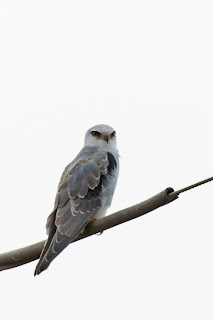
Juvenile Black-winged Kite Elanus caeruleus
Jenny feeling a lot better so decided I would actually make the journey down to the Brazo del Este in south-west Sevilla Province.  No point driving straight past Fuente de Piedra so first to the Laguna Dulce, then Fuente and, finally, arrived in Los Palacios y Villafranca just after 4pm.. Too late to do justice to the Bazo site so overnight in a basic hostal in readiness for an early morning start on the Saturday.  With tickets for the monthly dance that evening, it was a case of straight home afterwards rather than a repeat visit to the Osuna area for a second chance to check out the Great Bustards.
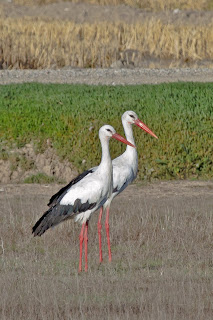
White Storks Ciconia ciconia by the score
Leaving home just after 8am the weather looked set fair with just the odd, scattered cloud in the sky but quite a strong breeze.  Thekla Larks and Goldfinches on the way down the mountain and House Sparrows, White Wagtails and Blackbirds as I passed through Los Romanes.  Then, once off the motorway and onto the Campillos road the first Spotless Starlings, Rock Doves and even a Southern Grey Shrike.  Then, arriving at Laguna Dulce, a very sleepy Buzzard resting atop one of the disused wooden electricity poles (and still there when I drove back over an hour later) and a number of Cattle Egrets in the neighbouring fields.  The water was calm and, once again, full with hundreds of Coots to be seen.  Plenty of Mallards and Shovelers about and scoping the laguna I was able to record Pochard, Gadwall and at least 150+ White-headed Ducks.  Not so many grebes, or so it seemed, but more concentration revealed all three resident species with mainly Little and Black-necked but also a few Great Crested Grebes.  A few Lesser Black-backed Gulls and three Purple Swamphens seen along with a few Moorhen.  A Stonechat popped up in front of the hide but it was the four Marsh Harriers that captured my attention.

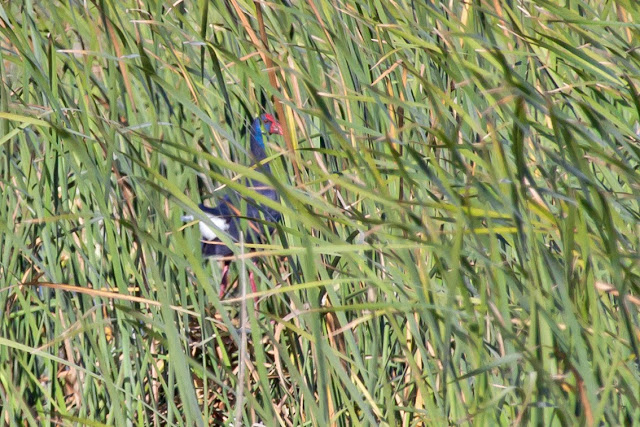
One of three Purple Swamphen Calamon Comun Porphyrio porphyria at Laguna Dulce
Next the short drive round to Fuente de Piedra with a couple of Kestrels hovering as I covered that horrible road towards the Mirador de Cantarranas.  Yes, the Cranes were back with a flock of towards 200 resting to the left of the large pool between land and the main laguna.  It certainly seemed from their behaviour that these were probably newly-arrived birds.  Just a single Black-winged Stilt to be seen. The Visitors Centre proved more active with, surprise -surprise, water in the laguneta at the back.  Here, mainly Shovelers but also Teal along with more Coots and a couple of juvenile Flamingos Chiffchaffs fed in the small path-side bushes and there were scores of Jackdaws about, the largest flock totalling over fifty individuals.  Flamingos, on the main water, could still be countered in their thousands but were now well dispersed over the water.  A pair of Shelduck were recorded along with a handful of Lapwings.  However, the field containing the newly-repaired electricity tower held more along with the above Jackdaw flock and, with careful study, I was able to pick out some of the resting Stone Curlews.

Distant Stone Curlew Alcaravan Comun Burhinus cedicnemus at Fuente de Piedra
Travelling westwards via Osuna, I hoped to find a few of the local Great Bustards but, on this occasion, I was to be unsuccessful.  However, I did have a number of Serins and Crested Larks along with many Marsh Harriers.  Stopping at the first new railway bridge I put up a Red-legged Partridge and the resting Spotless Starlings included a couple of Common Starlings.  Looking over the trees I was able to pick out the first Red Kite of the day.  Driving back to the road I had my only Little Owl; unfortunately it was on the road as a fresh-dead specimen, presumably hit by a car earlier in the morning.  Getting back into the car I looked up as a pair of Ravens passed overhead.  Breakfast?  Collared Doves and a Hoopoe were also recorded but the best sights were those of the three Black-winged Kites that I came across.  In addition to Kestrels I also found a pair of Peregrine Falcons.  Stopping to take a photograph of the remaining female, looking at the result I discovered that I had also managed to included a resting Black-winged Kite immediately above the Peregrine.
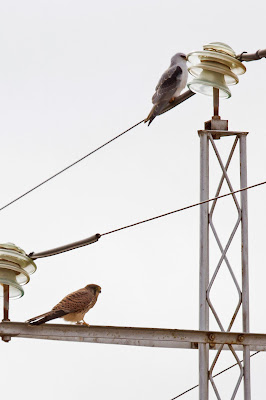


Juvenile Black-winged Kite Elanus caeruleus and then two raptors for the price of one!

Having booked into the hostal in Los Palacios y Villafranca, I took the short drive over to Los Chapetales to both make sure that I knew which road to take in the morning and check the site conditions.  The rice had been mainly combined leaving large watery expanses which held many White Storks, Herons and Little Egrets and I even had a Squacco Heron welcome me on the bend as I crossed the channel.  Meanwhile, a start had been made on harvesting the local cotton crop.
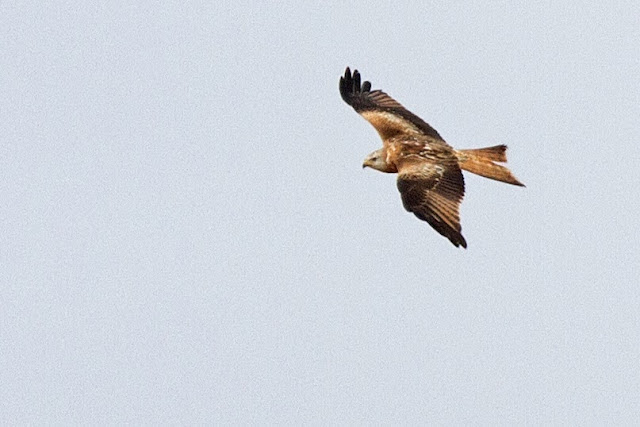
Red Kites Milano Real Milvus milvus west of Osuna


Southern Grey Shrike Alcadon Real Lanius meridionalis
Saturday morning and not a cloud in the breathless sky with the sun in readiness to create some real warmth. Coffee out of the way I was past Pinzon ready to enter the Brazo del Este site near the rice depot.  The usual Spotless Starlings, Collared Doves and House Sparrows out of the way I was soon amongst the hundreds of White Storks feeding on the former rice fields - but not before awakening the sleepy Booted Eagle on an electricity pole just before leaving the road.  But then a single, unexpected Black Stork to give me real cheer for the morning.  As the morning warmed, more and more Marsh Harriers seemed to take to the sky but, I have to admit, no one adult male in its full glory was seen all morning.
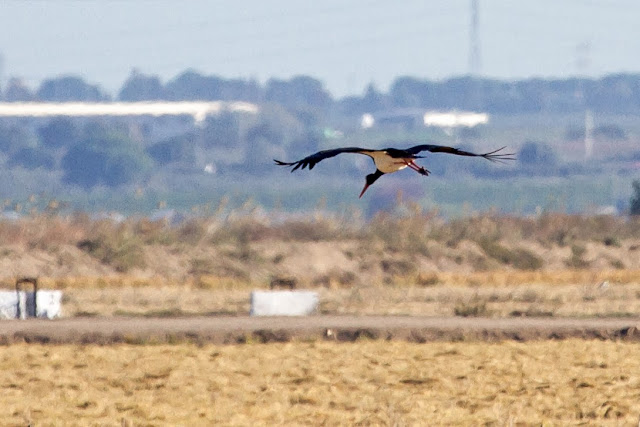

In addition to the White Storks there were numerous Yellow-legged and Black-headed Gulls and, further along, even Lesser Black-backed Gulls.  Again, no shortage of Grey Herons and scores of Little Egrets.  On the drier land, Cattle Egrets had come to feed and the first open water produced a score or more of Cormorants.  No shortage of Coots and the occasional Moorhen but ducks consisted of a few Mallards

One of scores of Purple Swamphens  Porphyrio porphyrio to be seen, both in the open and hiding, at the Brazo del Este
After the first Purple Swamphen I seem to be seeing them on every pond .  Only one water contained Little Grebes and then the first Spoonbill on the river.  A small number of Green Sandpipers was seen along with a handful of White Wagtails.  Two nearby Squacco Herons were a join to behold.  The return journey produced a fly past of formation Spoonbill which rather took me by surprise and they were mainly passed before I could get a decent photograph.  The track-side bushes contained a few feeding Chiffchaff but the overwhelming passerine was the Spanish Sparrow.  There must have been well in excess of a thousand or more in a number of sizable flocks.

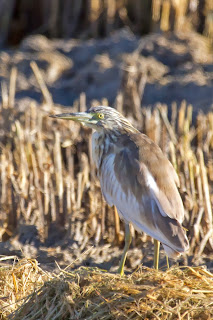
Squacco Heron Garcilla Cangrejera Ardeola ralloides
and note the mass of white when the bird takes flight


No Night Herons and the Black-headed Weavers had departed leaving their nesting trees to be occupied by a flock of over fifty Spanish Sparrows.  Returning to my starting point to take a last look at some of the more productive pools, I continued to find more and more Purple Swamphens and a flock of 150 tightly-packed Black-winged Stilts.  The Marsh Harriers continued to quarter the site and a single Kingfisher flashed past.  The return journey back to Los Palacios was by a different route and jut after the rice depot I came across a small party of Meadow Pipits feeding on some grassy wasteland.  Then I was able to add more Lapwings and another pair of Black Storks.  Not too sure about the small flock of Greylag Geese.

Male Spanish Sparrow Gorrion Moruno Passer hispaniolensis; one of thousands seen at Brazo del Este
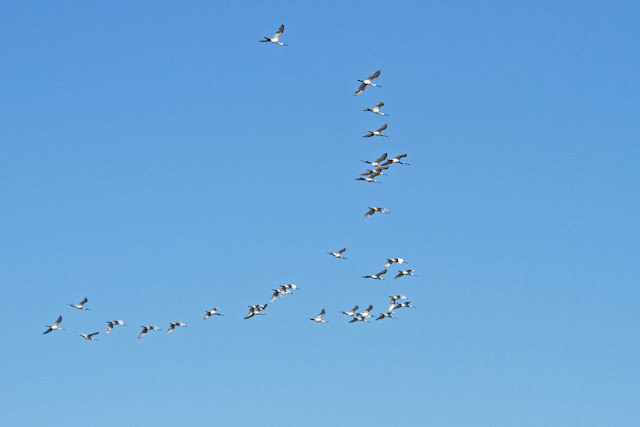
And then a flight of Spoonbills Espatula Comun Platalea leucorodia passed overhead

FOOTNOTE:
It would appear that I was wrong when I said that the Black-headed Weaver colony had been abandoned.  Looking a little close at my photographs I can now see why one of the Spanish Sparrows looks larger with a greenish tint.  Yes, you guessed correctly, a female (or maybe juvenile) Black-headed Weaver.
Female Black-headed Weaver Ploceus melanocephalas at the former breeding colony, Brazo del Este


Birds seen:
Greylag Goose, Shelduck, Gadwall, Mallard, Shoveler, Teal, Pochard, White-headed Duck, Red-legged Partridge, Little Grebe, Great Crested Grebe, Black-necked Grebe, Cormorant, Squacco Heron, Cattle Egret, Little Egret, Heron, Black Stork, White Stork, Spoonbill, Flamingo, Black-winged Kite, Red Kite, Griffon Vulture, Marsh Harrier, Booted Eagle, Buzzard, Kestrel, Peregrine Falcon, Moorhen, Purple Swamphen, Coot, Crane, Black-winged Stilt, Stone Curlew, Lapwing, Green Sandpiper, Black-headed Gull, Lesser Black-backed Gull, Yellow-legged Gull, Rock Dove, Collared Dove, Kingfisher, Hoopoe, Crested Lark, Thekla Lark, Meadow Pipit, White Wagtail, Stonechat, Blackbird, Chiffchaff, Southern Grey Shrike, Jackdaw, Raven, Common Starling, Spotless Starling, Black-headed Weaver, House Sparrow, Spanish Sparrow, Serin, Goldfinch, Linnet, Corn Bunting.


Check out the accompanying website at http://www.birdingaxarquia.weebly.com for the latest sightings, photographs and additional information.