Saturday, 16 February 2013

Great Spotted Cuckoos towards Huleva


Great Spotted Cuckoo Clamator glandarius
Friday 15 February 2013

A beautiful, sunny start to the day with clear blue skies and no wind as I set out towards Huelva Province along with Barrie and Jan Avis so that we could participate in the February field visit of the Andalucia Bird Society which was to be based on the Odiel Marshes (Marismas del Odiel) on Saturday.  With a 9.30 meet and not wishing to set off before five in the morning and arrive back near midnight, a couple of nights in El Portil was the order of the day.

A question of birding our way west so the first stop was the laguna at Fuente de Piedra but entering at the back from the Campillos road.  The farm at the junction where we took the anti-clockwise route round the lake produced the usual assortment of House Sparrows and Spotless Starlings and no sooner had we stopped at the first sign of water than it was obvious that the Flamingo numbers had continued to build, now well up in the thousands with probably in excess of 5,000, and most of the birds looking very pink in their breeding colours.  Also, the predominant duck species was certainly going to be the Shoveler with scores in sight and continued to be seen at every water observation point.  Continuing on round to the Mirador Cantarranas with regular sightings of Crested Lark we soon found part of the wintering Crane flock with approximately 120 counted feeding on the (usual) fields below the entrance to the car park.  The water itself held an assortment of Coot, Shoveler, Mallard and Little Grebe in addition to the thousands of Cranes and the occasional Black-winged Stilt whilst quartering the reeds where at least four Marsh Harriers including a rather handsome adult male bird and at least four Common Buzzards.
A family of Cranes Grulla Comun Grus grus at Fuente de Piedra
A stop at the outlet before reaching the main entrance, having already passed more Cranes and a number of Corn Buntings, produced a trio of Snipe on the flooded field to the left along with a pair of Black-tailed Godwits and more Black-winged Stilts.  Closer observation also revealed a Ringed Plover, Common Sandpiper and White Wagtails and the first of the numerous Cattle Egrets seen during the day.  A pleasant surprise was a female Blackcap in the nearby tree whilst answering a call of nature.  Why do birds suddenly turn up on these occasions?  A single Cetti’s Warbler was also heard and briefly seen.
The field to the left of the entrance drive to the Visitors Centre was still flooded and held a number of Black-headed Gulls along with the first of the Teal to be seen and a small number of Chiffchaffs feeding in the small trees at the side of the road/water.

Viewing the main laguna and small pool below from the side of the Visitors Centre once again revealed the thousands of lovely Flamingos but also numerous Shovelers and, this time, good numbers of Teal.  More Black-winged Stilts and, as expected, a large flock of Black-headed Gulls resting on the water but at least we did also manage to find a small number of Shelduck.  A single Black-tailed Godwit was feeding on the small pool (but no Avocets) and a good number of Black-necked Grebes were on the main water.  Below, on the fence, we had a visit from a female Reed Bunting and both Robin and Black Redstart were moving around the nearby bushes.  A female Marsh Harrier drifted over resulting in a mass take-off from the eater and then it was round to the Laguneta behind the centre where there was still plenty of water.  In addition to the single Snipe and a large number of Little Grebes, we also found Mallard, Shoveler, Teal, Common Pochard and Gadwall.  Before setting off again westwards we also managed to find a small flock of Serins, whilst, at the side of the entrance road pool, a number of Jackdaws had come to feed, drink and wash, a Little Egret flew past and a Chaffinch was sighted.
No sooner were we underway than we had our first sighting of Red Kites with a couple circling in front of us near the motorway.  Then the first Kestrel of the day along with more Lapwing, having seen the first whilst at Fuente de Piedra, before stopping for lunch in Osuna immediately after leaving the motorway.  The town itself also produced both Rock and Collared Doves and a stop to check out the first of the “Sevilla Lakes” produced more Flamingos but also a pair of Raven on a nearby farm roof.  Our one and only Barn Swallow flew past the car.


However, our main lake at the turn towards La Lantejuela took me completely by surprise as we were greeted by extensive reed beds but next to no water.  On the other hand, checking out the small birds immediately in front produced a small flock of Spanish Sparrows.  Taking the track from the main road to look at the back of the Nature Reserve lake did produce water on which there were a good number of both Flamingos and Shoveler along a mixed flock of Gulls, mainly Yellow-legged but also Black-headed.

Views of the pair of Great Spotted Cuckoos Crial Europeo Clamator glandarius to the south of La Lantehuela
Passing through La Lantejuela itself the next target was the Red-legged partridge and the hope that we might see one of the few resident Great Bustards.  No sign of the former and just when we thought all was lost I saw some “odd” on the ground between the trees not twenty metres from the road.  A slight back-up and bins on the object revealed a Great Spotted Cuckoo.  What a find and absolute delight!  Photographs taken before turning off the engine at which point the bird took off.  But not very far and then moved forward to a leafless tree near the road.  More photos, and at which point we discovered that there was a second bird immediately below our subject, and then moved the car slowly forward to get yet better views and more photos.  With us all in such good spirits we had hardly moved a couple of hundred metres and we had a first Red-legged Partridge of the day and then, just like the proverbial number nine bus, numerous sightings before leaving these woods and heading for the railway bridge.  Reaching the high bridge over the new high speed rail track only Ravens were heard and Crested Larks seen from the bridge itself.  We did have more Red Kites and picked up our only Southern Grey Shrike on the wires as we approached the bridge so it was onwards towards Huelva.
Before taking the last turn to the left and on towards rejoining the motorway, we noticed that the flooded fields in front and behind the new high speed rail track low viaduct contained a lot of white so we stopped to check out what was actually there.  Not only many Yellow-legged, Black-headed and a few Lesser Black-backed Gulls but at least a score of Avocets along with the Black-winged Stilts.  A White Stork came in to feed and, at the far side, a few Lapwings, about eighty Golden Plovers and a sole Grey Heron.

Knowing that we still had about two hours driving to reach our destination we finally forced ourselves back in the car to resume our journey, but not before we picked up a small charm of Goldfinches, and continued westwards along the motorway towards Sevilla and then Huelva.  The remaining journey produced more sightings of Buzzard, Red Kite and, later, White Storks but we did also add a single Hoopoe at the side of the road about midway between the two provincial capitals.  Then, approaching our destination, a (common) Magpie flew across the road.  Amazing to discover that our day had produced a final total of 58 species but no Blackbird seen all day.


Birds seen:

Shelduck, Gadwall, Mallard, Shoveler, Teal, Pochard, Red-legged Partridge, Little Grebe, Black-necked Grebe, Cattle Egret, Little Egret, Heron, White Stork, Flamingo, Red Kite, Buzzard, Kestrel, Moorhen, Coot, Crane, Black-winged Stilt, Avocet, Ringed Plover, Golden Plover, Lapwing, Snipe, Black-tailed Godwit, Black-headed Gull, Lesser Black-backed Gull, Yellow-legged Gull, Rock Dove, Collared Dove, Great Spotted Woodpecker, Hoopoe, Crested Lark, Barn Swallow, White Wagtail, Robin, Black Redstart, Stonechat, Cetti’s Warbler, Blackcap, Chiffchaff, Southern Grey Shrike, Magpie, Jackdaw, Raven, Spotless Starling, House Sparrow, Spanish Sparrow, Chaffinch, Serin, Goldfinch, Rock Bunting, Reed Bunting, Corn Bunting.


Check out the accompanying website at http://www.birdingaxarquia.weebly.com for the latest sightings, photographs and additional information.  

Thursday, 14 February 2013

Guadalhorce, Malaga

Just received a report from John and Jenny Wainwright who managed to get down to the Guadalhorce in Malaga yesterday.  Looks like they still did not manage to escape the recent windy weather but at least they saw some good birds.


Guadlahorce 13th February 2013.

It was very blustery with a lot of cloud first thing, sunshine later but still very windy.  We headed for the Parador golf course for the Splendid Starling and whilst here we did see Collared Doves, House Sparrows, masses of Monk Parakeets, Blackbirds but no Splendid Starling.  So back to Guadlahorce.

Black-tailed Godwits Aguja Colinegra Limosa limosa (PHOTO: John Wainwright)

We parked up close to the beach so as to scan the beach & sea, here we saw Cormorants, two adult Gannets, a largish flock of some thirty Common Scoters, Black-headed and Yellow-legged Gulls, and over the beach we found Turnstone, Barn Swallow, Stonechat and Sardinian Warbler.  Then we had to return to the car as one of the legs had fallen off my tripod and of course, being an ex-engineer, I didn´t have the right Allan key for the job so off to Leroy Merlins.  Repairs sorted and back on track we entered the reserve  - the wind was making it difficult to see much as it was directly in our faces - but we did see Grey Heron, Little Egret, Sardinian Warbler and Little Grebe on the way.

Spendid Starling Lamprotornis superbus (PHOTO: John Wainwright)
At the Laguna Grande, we found Great White Egrets, Grey Herons, Cormorants (most with their breeding patches), Common Sandpiper, Black-tailed Godwits (one particularly splendid male in summer plumage), Little Egrets, White-headed Ducks, Shovelers, Common Pochards, Teal, Coot, Moorhens, Black-necked and Little Grebes and a single Wigeon.  A good few hirundines started arriving including Crag Martins, Barn Swallows and House Martins.  Also around were Goldfinches, Zitting Cisticolas and Spotless Starlings.

Next we headed for the Escondida hide, here we found two Teal, three Coots and two Shovelers, but above the hide more Crag Martins and Barn Swallows and one Red-rumped Swallow.  The wind was still blowing a gale so we headed back to try to find the Splendid Starling and there he sat waiting for us just shy of the kiosk as reported by Bob.


It seems that all good things come to he (or she) who waits!


Check out the accompanying website at http://www.birdingaxarquia.weebly.com for the latest sightings, photographs and additional information.  

Wednesday, 13 February 2013

British Birding

Wednesday
Great Spotted Woodpecker Dendrocopos major

Just back from a visit to our little house in Stamford and managed to get three days birding in despite the atrocious weather.  It may be cold and windy here but t was very cold, windy and with snow back in Lincolnshire.  Although, to be fair, I did manage my birding before the snow arrived and on landing at Stansted early last week it was beautiful sunshine and remained so until I collected the rental car and set off for Stamford!

I had a final count of 71 species over the three days and whilst I did not mange to track down any Waxwings I was more than pl;eased with some of the birds that I did get a close look at including Whooper Swan, Smew (male and females), Red-breasted Merganser, Goosander, Fieldfare, Redwing, Goldcrest, Lesser Redpoll, Bullfinch and Yellowhammer.  In addition, whilst at Rutland Water I am pretty  sure that I got  distant view of both the visiting female Scaup and Long-tailed Duck.  I took very distant record shots but, alas, they are proving very inclusive.

Looking at the accompanying photograph, it reminds me of how we humans also close our eyes when really savouring something absolutely delicious!  Everyone, I suppose, to their own taste.
 
A more detailed, illustrated report has been published on my alternative blog which records birding activities away from Spain.  Those interested can check it out on: http://www.axarquiabirder.blogspot.com or simply CLICK HERE.

Monday, 11 February 2013

Donana and Home

John and Jenny were certainly busy on their last day in the Donna National Park as can be seen from the final instalment forwarded to me by John.  After all the wet and wind, not to mention the attempts to snow me in, I shall be glad to be back in Spain early next week when I, too, can catch up on some birding in more favourable climes.  My British experience will, hopefully, be written up tomorrow as the forecast is for more rain all day!


Donaña Day 5:  8th February 2013

A very pleasant day with hardly any wind.
We headed for Matlascanas beach, on the way we saw Buzzards, Chiffchaff, Common and Azure-winged Magpies, Hoopoe and Marsh Harrier.  We were hoping to pick up a few missing birds from our list,but the beach was full of fishermen and cocklers, still we did manage a distant Gannet and a flock of Black Scoter.

So we headed back for Acebuche:
After refreshments in the cafe, we made our way to the central hide here we saw Moorhen, Mallard, Raven, Stonechat, Southern Grey Shrike, Great Tit, Red Kite, Woodpigeon and Jenny saw an Egyptian Mongoose making its way along the side of the reedbed.

Penduline Tit Remiz pendulinus (PHOTO: John Wainwright)


We the moved along to the next hide right and on the way saw Dartford Warbler, Black Redstart, Chiffchaff, Hoopoe, Serins, Robins and Song Thrush. Nothing from this hide except two Little Grebe and three Mallard, so we headed for the last hide.  As we made our way along the boardwalk we saw Crested Tit, heard a Nuthatch(but couldn´t locate it), and Blackbirds.  As we entered the hide I was bemoaning that we never see Pendulines here and, lo and behold, Jenny finds one on the reedmace and the I find another to the right of the hide.  Also here we saw Chaffinch, Barn Swallow, Purple Swamphen, White Stork and House Sparrows.

We left here and decided to call into La Rocina before starting off for home.  Here we saw more Robins, Serins and Chiffchaff.  From the first hide we saw a Black Kite, harrassing  a female Marsh Harrier which had what looked like a snake in its talons.  We never saw the outcome as they disappeared out of sight over the trees.  Onto the next covered hide and here we saw Little Egret, Glossy Ibis, Grey Heron, four Purple Swamphens, Pochard,Spotless Starlings, Shoveler, Stonechats, Southern Grey Shrike, Goldfinch, Short-toed Treecreeper and Cettis Warbler. As we left the hide We located a Greater Spotted Woodpecker busily drumming away and in the same area a family of Long-tailed Tits and another Short-toed Treecreeper.

A very enjoyable visit to this marvellous area, with a total of 109 birds.

Just think, I shall be wandering these places next Sunday!


Check out the accompanying website at http://www.birdingaxarquia.weebly.com for the latest sightings, photographs and additional information.  

Friday, 8 February 2013

More Donana News

John and Jenny Wainwright continue to enjoy the experience of the Donana National Park (lovely to think that I, too, will be there next week-end along with the Odiel Marshes) and John's account of Days 3 and 4 follows:

Donaña Day 3  Huelva area

Bright sunshine, but the wind is so ferocious.
 

We came off at the 13km marker on the A422 (Matlascanas - Huelva road), this is a good spot for Common Waxbill, our first sightings were of two Purple Swamphens, then Moorhens, Shoveler, Grey Heron, Coot, Little Grebe, Azure-winged and Common Magpies, Cetti´s Warblers, Green Sandpiper, House Sparrows, Linnets and five Common Waxbills.

So onto the Odiel marshes.  The wind was horrendous and several sand-storms were seen over the main road through the marshes, but, we did see -  just prior to the centre - Shoveler, Coot, Gadwalls, Greater Flamingos, five juvenile Sandwich Terns and a Cormorant perched out on old debris, and on the shoreline we saw Yellow-legged Gull, Redshank and Black-headed Gulls.

Cormorant Phalacrocorax caro with a quintet of Sandwich Terns Sterna sandvicensis (PHOTO: John Wainwright)

At the Odiel centre we picked up Whimbrel, Black-necked Grebe, Barn Swallows and Black-tailed Godwit.  Further on in the marshes we came across one of the four Ospreys (that had been seen yesterday), hundreds of Common Redshanks, Little Stints, two Sanderlings, two Ruff, Lesser Black-backed Gulls, Yellow-legged Gulls and Herring Gulls, Little Ringed Plovers, Greater Flamingos, Turnstones and several Marsh Harriers.  We stopped for a bite to eat and here we saw Meadow Pipits, Greenshanks, Spanish and House Sparrows and as we approached a small stream a Kingfisher flashed past us.  Also in the area we saw Great White, Little and Cattle Egrets.

We then returned to the centre - but they were closed - so we parked overlooking the mudflats here and we found Grey Plovers, Black-tailed Godwits, Black-headed Gulls and amongst them we found two Slender-billed Gulls (photos nowhere near as good as Gerry´s, but shows the contrast).  As we came away from the centre a Sardinian Warbler put in a brief appearance as did several Chiffchaff.  The return journey gave us Collared Dove, Woodpigeon, Spotless Starlings, Common Kestrels, Black Redstarts and a ring-tail Hen Harrier surprised us as she flew low across the main road.


Comparison between Black-headed Larus ridibundu and Slender-billed Gulls Larus genei (PHOTO: John Wainwright)
  
I believe that a less windy day would have made quite a difference to total as small birds were at a premium. We are informed that there is a melanistic Little Egret somewhere in the area but couldn´t locate it!!


Donaña Day 4  7th February 2013

A much better day today, sunny with lighter winds.

We went to the centre at El Rocio and the male Spanish Imperial Eagle was in its usual place, and next tree along was a Red Kite.  On the marismas were Shovelers, Spoonbills, Greater Flamingos, Mallard, Greylag Geese, Marsh Harriers, Snipe, Black-tailed Godwits,Coot & Moorhens.  In the small bushes we
found Chiffchaff, House Sparrows, Goldfinches and a few Linnets.

From here we drove over to the Dehesa de Abajo.  Here we found Buzzard, Black-winged Kite, Common Kestrel, Cormorants, Glossy Ibis, Little, Cattle and Great White Egrets, male & female Marsh Harriers,
Jackdaws, Hoopoe, Ravens and Lapwings. On the lake we saw Shoveler, Mallard, Pochard, Purple Swamphen, Coot, Moorhen, Pintail and Ferruginous Duck.  A nice surprise was the Long-tailed duck which gave good views if you could keep up with it´s movements - definitely not photogenic.  Also here were the Tufted Ducks, two Avocets, Great Crested Grebe, Black-necked  and Little Grebe.  A single adult Night Heron was seen flying over the lake.  In the reed beds we saw Cetti´s Warbler and Chiffchaff, and in the fields there were Cormorants, Grey Heron and yet more Great White Egrets and the Zitting Cisticola gave us good views as he peeped his way along the hedgerow.

Then back over to the Valverde centre to try to pick up the Great Bittern and the Short-eared  and Long-eared Owls, but alas we dipped out on all three.  Never mind we did see Buzzards, Black-winged Kite, Night Herons, male & female Marsh Harriers, a ring-tail Hen Harrier, two Black Stork as well as masses of White Storks.  A nice sight was a group of seventeen Purple Swamphens all in one huge gathering (I don't know what the technical term for that is!).  In the flooded fields we found Common Cranes, Greylags, Snipe and Black-tailed Godwits.  On the wires and pylons were Common Kestrels, Corn Buntings, Black Redstarts, Stonechats, House Sparrows and Buzzards.  A Dartford Warbler flew across our path and landed on a fence rail, giving us good views of it.


While we were looking for the Great Bittern, a Fox was spotted in the deep undergrowth, and on the banks we found a Common Swallowtail and Bath Whites.  Also, as we were looking for the owls, a Spanish Imperial Eagle was seen.  We stopped at one of the many pumping stations and saw a Kingfisher.

On our return journey we saw countless Robins and Black Redstarts and Southern Grey Shrikes all lined up along the roadside fences, and above us Barn Swallows and House Martins hawked for their evening meals.

A long day but well rewarded. 


Check out the accompanying website at http://www.birdingaxarquia.weebly.com for the latest sightings, photographs and additional information. 

Wednesday, 6 February 2013

Donana National Park

As I said a few days ago, a change in weather and everyhing starts to happen.  Whilst John and Jenny Wainwright have driven down to the Donana National Park for a few days birding, Gerry Collins has just returned to Salobrena froma couple of days in Roqueta del mar where he picked up some very lovely Slender-billed Gulls - even if, as Steve would say, at least one was covered in avian bling!  For me, I have just arrived back in England for a week.  I may have landed in sunshine but by the time I collected the car it had completely clouded over and by the A1(M) I had a light drizzle and then a flurry of snow to welcome me back.  However, it did not last and I am now up bright and early, working on Spanish time to maximise the light, and trying to decide whether to make an early start to Frampton Marshes (will there be snow in the Boston area?) or pop down to my local patch at Rutland Water.  We shall see when I eventually get back.

Slender-billed Gulls  Larus genei  (PHOTO: Gerry Collins)


Meanwhile, here follows John's report for his first two days:


Donaña Day 1  Marismas area

Glossy Ibis Plegadis falcinellus (PHOTO: John Wainwright)
Purple Swamphen Porphyrio porphyrio (PHOTO: John Wainwright)
 A very bright & warm day but chilly and gusty winds every now and then.

En route to Donaña we saw Spotless Starling, lots of Black Kites & one Red Kite, White Storks, Woodpigeon and Common Buzzards.  We had to wait for our cabin to be cleaned, so we ran down to the El Rocio marismas.  A good amount of water about though still enough area for the waders, and here on the muddy verges we found a huge flock of some sixty or more Common Snipe, White Wagtails, Lapwings, two Cattle Egrets (in the grasses) and countless Glossy Ibis and Black-tailed Godwits. Over on the far banks were Greylags and above them over the trees and marsh area, several Marsh Harriers were seen.

On the water we had Spoonbills, Teal, Shovelers, Pintails, Black-headed and Yellow-legged Gulls, Grey Herons, Common Coots,  Little Egrets and White Storks.  In the reed beds or what is left of them we saw Goldfinches, House Sparrows, Blackcaps, Stonechats,Chiffchaffs, Great Tit and a Magpie. Lots of Barn Swallows about just now as were Spotless Starlings.
After getting settled in the cabin, we drove along to Acebuche, here we had coffee - hoping that a least two coaches of shouting teenagers would hurry up and go in for their lunch.  Our first sighting here was of a Dartford Warbler and another was heard in the bushes to our left, after this we saw Stonechat, Great Tit, more White Storks, Mallard, Azure-winged Magpies, several Barn Swallows and a House Martin, Moorhen, Snipe, Robin, Black Redstart, more Glossy Ibis and a very striking Southern Grey Shrike - with its pinkish blush showing well today.

Then back to Rocina where we were on our own.  Here we saw Little Grebes,  a Marsh Harrier, Little Egrets, Glossy Ibis, Coots and a nice sight was twelve Purple Swamphens in various locations to our front, also here we saw Grey Heron, Pochard and Shovelers. In the trees we spotted Blackbird, Great Tit, Robin,
Serins, Chaffinches and a Cettis Warbler was heard from within the reeds.

Back home for a bite to eat and then back down to the El Rocio marismas.

Not a lot more tonight except Greater Flamingos, three Avocets, Black-winged Stilts, Crested Larks, a Greenshank, a Common Kestrel and a Black Stork.  Two perched raptors were seen far across the main marisma but to distant for definite id.  As we parked up two Hoopoes flew out from the trees in front of our cabin.


Great White Egret Egretta alba (PHOTO: John Wainwright)
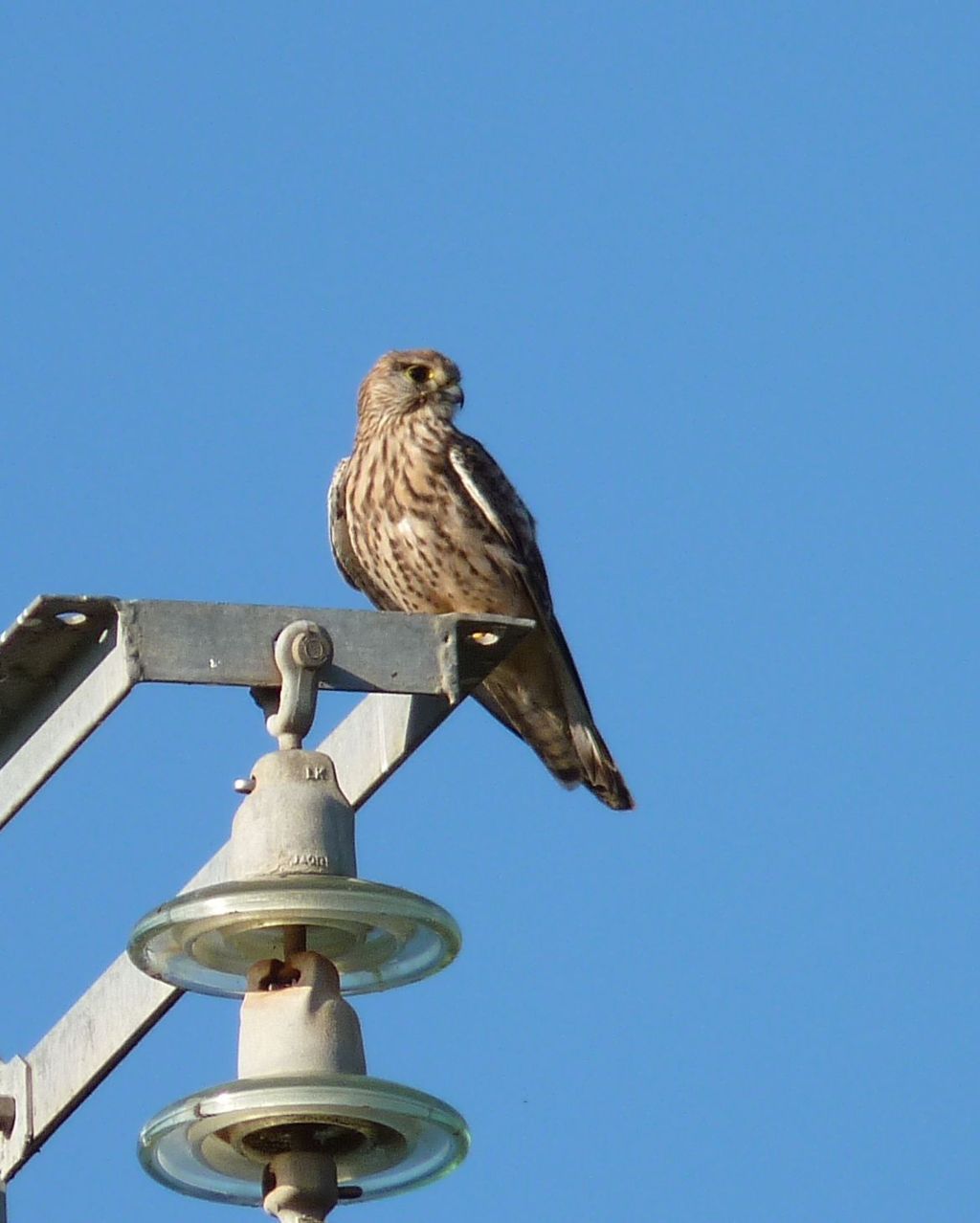
Common Kestrel Falco tinnunculus (PHOTO: John Wainwright)
Donaña Day 2... Valverde centre.

Not a bad day, although had a touch of frost last night.

On the way to the centre, we saw Grey Heron, White Storks, Common Buzzards, Corn Buntings, Crested Larks, Chiffchaffs, Little Egret, Meadow Pipits, Barn Swallows were in good numbers today, the inimitable Spotless Starling, a Lesser Kestrel, Marsh Harriers, Common Magpies, Calandra Larks - one of these birds was a pure albino, Zitting Cisticolas were well represented and their song was ever present, Stonechats - on every bush, post and tree, Linnets - not so many of these birds, Goldfinches, hundreds of Cormorants -
sitting in trees, in the fields and in the watercourses, good flocks of Lapwings, one Black Stork, Mallard, a lone Northern Starling, Moorhens, Common Kestrel, a male Hen Harrier and oodles of Glossy Ibis.

Coffee at the centre and we were told of Short-eared Owls being seen, one Long-eared Owl  and a Bittern..but alas for us a big NO!!! ....

But ,whilst we were here we did see Purple Swamphens, Glossy Ibis, two Red-crested Pochard, Common Pochards, Little Grebe, Greater Flamingos, a Great Crested Grebe, Shoveler, Mallard, Common Coot, Moorhen, Greylag Geese, Black-tailed Godwits and Grey Herons.

On the way back - and in the opposite direction - towards Isla Mayor, we picked up, fifteen Purple Swamphens, over twenty Great White Egrets, lots of Little and Cattle Egrets, about thirty Common Cranes (the centre tells us they are in short supply this year as are Greylags), a ring-tail Hen Harrier, Black Redstart, Green Sandpipers and a few Spoonbills. A nice surprise was a tree full of Night Herons (over thirty birds),
and a Sparrowhawk which took flight out of the bushes at the same time as a Common Buzzard.

 
Night Herons Nyeticorax nyeticorax in flight (PHOTO: John Wainwright)

We then went over to the lake close to Isla Mayor, a few people about today - including the Local Police
patrol , here we found Black-neck Grebes, three male Tufted Ducks, a Black-winged Kite, Cetti´s Warblers, Great Crested and Little Grebes, Glossy Ibis, Jackdaws, more Buzzards and Marsh Harriers, Shovelers, Mallard, Pochard, Gadwall, Yellow-legged and Black-headed Gulls, Greater Flamingos, Grey Herons, Spoonbills, White Storks, another ring-tail Hen Harrier, lots of Lapwings in the old rice fields and a
good number of Snipe
again today. A Southern Grey Shrike was spotted as we left the lake.

We dropped in at the El Rocio marshes and ascertained the large raptors we saw last night were the Spanish Imperial Eagles - perched in the old bare tree across the marshes, also here we had a good number of House Martins and a Praying Mantis to round it all off!!


Common Buzzard Buteo buteo (PHOTO: John Wainwright)


Looks like John and Jenny area enjoying some fabulous birding but the mention of "frost" somewhat cheers me up as I was beginning to think they were in the sunny south whilst I was preparing to enjoy the frozen north!

Saturday, 2 February 2013

More Cranes and a White Stork

Common Crane Grulla Comun Grus grus
Sunny but very, very windy and cold with it as with Graham and Sue Knight we visited Laguna Dulce followed by a relatively short stop at Fuente de Piedra.  The outward journey recorded Serin, Goldfinch and Blackbird before coming across the flooded fields at Colonia Santa Anna where there were scores, if not hundreds of Black-headed and Yellow-legged Gulls with the odd Lesser Black-backed Gull thrown in for good measure.  Add on a number of Lapwing and Black-winged Stilts and we were read for the Dulce and whatever wind it might throw at us.  And it did; right in our faces making it almost impossible to look over the water.  However, the big shock of the day was to have a single White Stork leisurely sail along side us as we approached the site; what was this bird doing here at this time of the year?

The water was very rough but it was easy to pick out the Coots and a large party of Flamingos hunkered down on the far side.  Lots of gulls resting towards the far side and then there were the ducks, mainly Pochard and Shoveler but also Mallard and Gadwall.  Even better, we recorded at least three male and one female Tufted Duck still present but no sign of either White-headed Duck or Red-crested Pochard on this occasion.  A good number of both Little and Black-necked Grebes plus the occasional Great Crested Grebe.

The far side produced a single adult female Marsh Harrier and a few Crag Martins flew over the water.  Better yet, the first Barn Swallow of the year with a couple feeding over the reeds to the right of the hide.  Meanwhile, at the far right amid the small flock of Lapwing we suddenly had at least 150 Golden Plover take to the air.

In the hope that we might get a clearer view of the plovers we drove round to the back of the laguna where, instead, we picked up Crested Lark, Cattle Egret, Whuite Wagtail and over a dozen Jackdaws.  Then it was a handful of House Sparrows and a few more Black-winged Stilts before a gorgeous Marsh Harrier rose not too far away in front of us.

On to Fuente de Piedra via the Mirador de Cantarranas passing a Kestrel atop a pylon but not before a stop at the far (shallow) end of the laguna where the Flamingos rested by their thousand.  Amongst all the nearby Shovelers and a few Mallards we also managed to pick out a couple of Shelduck with another quartering Marsh Harrier and a lone Raven going about his daily business looking for something to nibble on.  The Cranes themselves became visible as we approached the entrance to the car park and, having taken a quick look for photographic reference, we may out way to the viewing point. Loads more Flamingos and a lovely pair of Marsh Harriers including a magnificent male bird plus a pair of Purple Swamphens.  However, another first for the year, our first House Martins with at least a dozen feeding high above the nearby water.  In front of us a true pair of Black Redstarts made sure that they were noticed.

Oh for the wings of a dove?  No way, I'm far more graceful in full flight

Having eased down the road so that we could photograph the Cranes from the car we then moved on and recorded both Corn Bunting and Stonechat before reaching the entrance to the Fuente de Piedra lagoons.  The flooded field to the left of the entrance road held a number of Coots, Black-winged Stilts, Shoveler and Mallard along with the occasional Chiffchaff and when we looked back at this water from the height of the top car park we were also ab;e to pick out a solitary Ruff  and a departing pair of Pintails.

Anybody behind me?

The laguneta held a small number of ducks but at least twenty Little Grebes (must have been the annual convention!) and a lone Snipe whereas the pool to the right of the Visitors Centre, seen from above, held Moorhens and we even managed to find a single Black-tailed Godwit.  But still no Avocets to be seen.  Finally, as we left the reserve, we had a Buzzard bust feeding whilst perched atop a pylon in the field opposite the site.  Considering the very windy conditions, a final tally of 46 species was quite reasonable for the extended morning.

Hang about, son; wait for your mother.
That's it,let's go.  We don't want to be hang about here having our photos taken!


Birds seen:
Shelduck; Gadwall, Mallard, Shoveler, Teal, Pintail, Tufted Duck, Pochard, Little Grebe, Great Crested Grebe, Black-necked Grebe, Cattle Egret, Flamingo, Marsh Harrier, Buzzard, Kestrel, Moorhen, Purple Swamphen, Coot, Crane, Black-winged Stilt, Lapwing, Golden Plover, Snipe, Black-tailed Godwit, Ruff, Black-headed Gull, Lesser Black-backed Gull, Yellow-legged Gull, Crested Lark, Crag Martin, Barn Swallow, House Martin, White Wagtail, Black Redstart, Stonechat, Blackbird, Chiffchaff, Jackdaw, Raven, Spotless Starling, House Sparrow, Serin, Goldfinch, Corn Bunting.


Check out the accompanying website at http://www.birdingaxarquia.weebly.com for the latest sightings, photographs and additional information.