Tuesday, 21 May 2013

Fuente de Piedra

Monday 20 May

A reasonable morning with a very light wind and a little cloud as i set off to Fuente de Piedra for the day to meet up with Ron and Polly Maersk, visiting birders from Oregon in the USA.  I may have arrived early but Rona and Polly had allowed extra time to drive up from Mijas Costa so were extremely early and awaiting me when I arrived.  The air was full of hirundines and swifts;  mainly Common Swifts but there also a good number of Pallid Swifts to be seen during our visit and most of the hirundines were Barn Swallows with a smaller number of House Martins but no Red-rumped Swallow was recorded.  I did have a single Raven cross the motorway as I approached the slip from for Fuente and, unusually for me, there were no end of Jackdaws about the laguna during the whole of our stay.
Avocet  Avoceta Comun  Recurvirostra avosetta

The roadside field may have dried up with the loss of its pool but it still held a single Avocet and some resting, on the grass, Barn Swallows.  Crossing the boardwalk, passing the first of many Crested Larks,  it was also obvious that the land had been drained with almost no water to be seen at this particular site.  A few Black-winged Stilts were seen before we walked over to the far side to view the far edge of the main laguna.  Lots of Greater Flamingos about and very many Avocets and Black-winged Stilts.  Corn Buntings were singing and displaying on fences and hedge tops and, naturally, we found both Coots and Moorhens.  A few Mallards were seen near the reed edge along with a handful of Red-crested Pochards.  A lone female Marsh Harrier drifted over ensuring that there was a lifting of birds from below and we managed to record Black-headed, Lesser Black-backed and Yellow-legged Gulls as well as a pair of Great Crested Grebe.  Ron was in time to catch a glimpse of a Grey Heron coming in to land and promptly get lost behind the thicker vegetation.

Greater Flamingo  Flamenco Comun  Phoenicopterus roseus

Returning to the main water we had a visit from a single Cattle Egret and then a singing Sardinian Warbler as we made our way to the rear of the Visitors' Centre to check out the Laguneta.  However, not before checking the small pool on the right which produced a couple of Redshank, a lone Wood Sandpiper and a trio of Ringed Plovers along with Mallards, Moorhens, Coots, Black-winged Stilts and Avocets.  On the water at the back we added a number of Common Pochard and a couple of Little Grebes.  Lots of Spotless Starlings and Jackdaws were moving about along with the feeding hirundines and swifts.

Next it was the journey to the far end of the main laguna to see if we could find the reported pair, or even a trio, of Lesser Flamingos.  No sooner out on tot eh main road than we had a roosting Common Buzzard and the stop at the Mirador de la Vicaria produced a single Lapwing followed by Blue-headed Wagtail (Yellow wagtail of the Iberian persuasion), a singing/displaying Zitting Cisiticola and a very visible Reed Warbler that just loved to be watched from the hide.  Also present were another pair of Redshank, a few Ringed Plover and a two pairs of Kentish Plovers.  A Hoopoe was clearly heard singing away to tour left.  Once we had found our first Stonechat there were many to be seen, and even more Corn Buntings, until the first of a small number of Gull-billed Terns passed overhead.

Gull-billed Terns  Pagaza Piconegra  Sterna nilotica

No sooner had we arrived at the Mirador de Cantarranas than we had not one but two Purple Swamphens.  Lots of feeding Gull-billed Terns and then a trio of Whiskered Terns put in an appearance.  A most handsome male Marsh Harrier quartered the marsh whilst the Avocets and ducks, including both Gadwall and a pair of Shelduck, got on with their feeding.  The main water and edges were a mass of pink and white from the thousands of Greater Flamingos present, especially towards the breeding colony on our right.  A single White-headed Duck was found on the pool below and, as we returned to the car, first a Spotted Flycatcher and then a beautiful Melodious Warbler serenaded us form a nearby bush top.  Sad to say, a long stop at the far end overlooking the flamingo colony did not reveal a lesser Flamingo so it was onwards towards our final destination for the day, the Laguna Dulce.

Turning right at the farm we had a number of House Saprrows and Spotless Starlings but also a single male Woodchat Shrike on the fence.  Then it was on towards the main road and the former (?) Bee-eater colony where we recorded another Spotted Flycatcher, Stonechat, Goldfinches and both Blackbird and a Chaffinch flew across the road.  The Laguna Dulce was fuller than I had ever seen it before so no muddy edges to attract ant waders or a skulking Purple Swamphen or Water Rail.  We did have a pair of Black-necked Grebes in full breeding plumage right in front of us and also recorded both Little and Great Crested Grebes.  Lots of Coots, a few Mallards and more Common Pochards along with a pair of male White-headed Ducks.  On the way to the this water we almost ran over a pair of Turtle Doves who had decided that the centre of the main road was as good a place as any to pick up some grit; obviously they had either migrated via Japan or had it on their "Wish List" of places to visit!

When you add the Bee-eaters seen on the outskirts of Los Romanes, looks lie the road-side colony is going to be occupied again this year, the mountain Thekla Larks and Serins a day's total of almost 60 birds was very pleasing, especially when you note the birds that were not seen.


Birds seen:
Shelduck, Mallard, Red-crested Pochard, Pochard, White-headed Duck, Little Grebe, Great Crested Grebe, Black-necked Grebe, Cattle Egret, Little Egret, Heron, Marsh Harrier, Buzzard, Moorhen, Purple Swamphen, Coot, Black-winged Stilt, Avocet, Ringed Plover, Kentish Plover, Lapwing, Redshank, Wood Sandpiper, Black-headed Gull, Lesser Black-backed Gull, Yellow-legged Gull, Gull-billed Tern, Whiskered Tern, Rock Dove, Turtle Dove, Collared Dove, Common Swift, Pallid Swift, Bee-eater, Hoopoe, Crested Lark, Thekla Lark, Barn Swallow, House Martin, Blue-headed Wagtail, Stonechat, Blackbird, Zitting Cisticola, Reed warbler, Melodious Warbler, Sardinian Warbler, Spotted Flycatcher, Woodchat Shrike, Jackdaw, Raven, Spotless Starling, House Sparrow, Chaffinch, Serin, Goldfinch, Corn Bunting.


Check out the accompanying website at http://www.birdingaxarquia.weebly.com for the latest sightings, photographs and additional information.

Friday, 17 May 2013

Axarquia Bird Group visit to Sierra Loja

Thursday 16 May

A magnificent adult Eagle Owl Buho Real Bubo bubo


The day started bright and sunny with not a cloud in the sky.  Having collected Mary-Ann Murphy, Lesley Laver, Bryan Stapley (our birthday boy!) and James Moore at Puente don Manuel we set off up the mountain towards Loja for the monthly visit of the Axarquia Bird Group.  Once over the pass we then confronted some very dark cloud; just as the forecast promised, a mixture of cloud and sun.  What I think we did not make allowance for was how cold it was going to be once we had driven up the Sierra Loja and with all twelve of us rapidly searching for extra layers to try and keep reasonably warm in the cold wind.  Joined by Eric and Pat Lyon, Gerry Collins, Mick Richardson and his neighbour Steve Forster we set off up to towards the first, small quarry.  No sooner had we started the climb than we came across old friend, Michael McLaine who we had not seen for, perhaps, three years when last holidaying in this area.  People messing about at the quarry so straight on up to park the two cars at the turning point so that we could walk the short track to the main, lower, quarry where Eric and pat awaited us.  Indeed, just as we left the cars a quick telephone from Ellie Wallbank informed us that she had now arrived and was on on her way up the track; the "Dirty Dozen" were complete.

Eagle Owl Buho Real Bubo bubo at nest
So here started what was to be a  very good day's birding with just on 50 species recorded plus some lovely orchids identified by Mick.  And no rain; that is unless you count the couple of heavy spots when we returned to the lower quarry on the way home to find one of the two, much to our surprise, species that we had not seen all day, a Blue Rock Thrush and Norther Wheatear.  (I should point out here that Eric and Pat had arrived a good half-hour before the rest of us and, whilst awaiting our arrival, had actually seen a Blue Rock Thrush plus Blue Tit and Greenfinch).

The quarry produced Black Wheatears, Black Redstart and Crag Martins whilst Barn Swallows and House Martins fed overhead and Blackbirds pecked about near the ruins below buy by far the sight of the site (what an expression!) was the adult Eagle Owl resting in the small hole immediately above its nest.  No sign of the , we think, single chick today but the adult remained on station the whole time we were there giving excellent views through the scopes to all present.  Indeed, the bird was still on station when we returned on the way home to record the group's first and only Blue Rock Thrush of the day.  In addition to the above, we had the odd Jackdaw and Chough pass over the top along with a hunting Common Kestrel and both Goldfinch and Serin were recorded.

Red-legged Partridge  Perdiz Roja  Alectoris rufa

Walking back to the cars, with lots of flowers to be identified and photographed, we quickly added a number of Azure-winged Magpies, the first having been recorded along with the resident House Sparrows whilst at the service station car park, and then a first Spotted Flycatcher (for me) of the year.  A number of Red-legged Partridges were also seen with many more added during the day whilst up on the mountain tracks.  Wood Pigeons put in regular appearances and, having been first heard by Mick, a little searching soon found the Short-toed Treecreeper.  Naturally, Chaffinches were everywhere.  A surprise for Mick, this being one of his local and regular patch sites, was the Great Spotted Woodpecker heard by Michael as he started his walk up from the car park until we picked him up then left our cars to walk to the main quarry.

Young Stonechat Tarabilla Comun Saxicola torquatus waiting for food

So on up the track toward the tree-line where first Great Tit was seen and then a stop to see the first of the Stonechats.  Lovely to record a feeding family with one  youngster quite happy to sit exposed at the very top of a small tree in close proximity of the road. A large party of thirty plus Jackdaws passed overhead and around us followed by a handful of Choughs.  More Black Wheatears and Red-legged Partridges and then the appearance of the fist of a regular supply of Thekla Larks.  An Orphean Warbler was heard and then, immediately below us, the appearance of a rather splendid Bonelli's Eagle.  A Hoopoe flew rapidly down and awy from us.  Moving a little higher we stopped and waited until we successfully found a pair of Spectacled Warblers whist, above the opposite side of the track a single Griffon Vulture worked its way over the summit and the first of our Little Owls was seen resting on a low pile of rocks.  Onwards and upwards and a stop to check out a handful of small birds resting on the fence in front produced a a couple of Linnets, a Rock Sparrow and a single Southern Grey Shrike.

Red-billed Chough Chova Piquiroja Pyrrhocorax pyrrhocorax on nest
Having recorded our first Black-eared Wheatears we made our way up to the Charco de Negro pond and nearby cliff face in which a Chough had once more built its nest in the usual hole and our first Rock Thrush was seen, albeit rather distance sitting on an orange-coloured rock so giving it some considerable camouflage.  However, the unexpected of unexpecteds.  We simply look the other way and saw that another male Rock Thrush had actually alighted on the fence post not thirty yards away.  Off too soon to raise the cameras but then landed on the grass near the water and remained in the area for most of our picnic lunch time.  Very nice!  We even had another Black-eared Wheatear alight on the same fence and remain long enough to be photographed whilst all around we continued to record both Rock Sparrows and Rock Buntings plus a few Linnets.

Rock Sparrow  Gorrion Chillon  Petronia petronia

Whilst looking at the Black-eared Wheatears, in addition to seeing both male and females it was interesting to note both the variation ion colouring on the back and the extent of the face masks.  We had what would appear to be very yellow/golden backs suggesting younger males but also some examples that were almost white, perhaps suggesting birds of at least four or five years of age.  Similarly with the face masks, some with a simple mask and others with extensive black as can be seen from the examples below.


Black-eared Wheatear Collalba Rubia Oenanthe hispanica

This area near the summit continued to produce large numbers of both Choughs and Spotless Starlings, especially in the stony fields near the electricity sub-station, and, being somewhat cold and having probably recorded all the birds we were likely to see, we decided to return to the main quarry in the belief that we would have more chance of finding a Blue Rock Thrush at this site.  We were not to be disappointed with a single male found almost as soon as we entered the quarry area, watched over by the adult Eagle Owl which was still stationed on the same rock as when we first arrived in the morning.  On the other hand, it was rather disappointing not to find a single Northern Wheatear during the day.


One of a number of Rock Thrushes Roquero Rojo Monticola saxatilis seen during the day


Having seen a number of female Ibex with their kids on the way up the mountain, a splendid male seen on the grass at the top rather completed the picture.

Male Ibex  Cabra Montes  Capra pyrenaica

And so we started on our various ways home but still the birds continued to come.  Returning to the main track down Eric and Pat managed to record a Pied Flycatcher and the we five, no sooner having taken the Zafarraya road from the motorway stopped at the fist large field of cereal where we were delighted to watch two male and a single female Montagu's Harrier quartering the area.  Continuing on along the road, next up were a pair of Mistle Thrushes, another Hoopoe and we almost ran over a White Wagtail which seemed to take forever to get off the road.  Stopping for the ladies to find, identify and photograph more orchids, Bryan and I watched a Bee-eater and Corn Bunting on the wires before finally having a male Woodchat Shrike fly across in front of us as we started to make our decent from the pass at Ventas de Zagfarraya.

Quartering male Monagu's Harrier Aguilucho Cenizo Circus pygargus

And so ended a rather lovely day's birding spent in dry, if somewhat cold, weather in great company.  The burning question now will be what have I missed from the above account; who saw what else on their respective homeward journeys?  I await your replies.

Bathiong/drinking Linnets Pardillo Comun Carduelis cannabina

One of the many flowers seen during the day

Birds seen:
Red-legged Partridge, Bonelli's Eagle, Montagu's Harrier, Kestrel, Wood Pigeon, Collared Dove, Eagle Owl, Little Owl, Bee-eater, Hoopoe, Great Spotted Woodpecker, Thekla Lark, Crag Martin, Barn Swallow, House Martin, White Wagtail, Black Redstart, Stonechat, Black-eared Wheatear, Black Wheatear, Rock Thrush, Blue Rock Thrush, Blackbird, Mistle Thrush, Spectacled Warbler, Orphean Warbler, Spotted Flycatcher, Pied Flycatcher, Blue Tit, Great Tit, Short-toed Treecreeper, Southern Grey Shrike, Woodchat Shrike, Azure-winged Magpie, Chough, Jackdaw, Spotless Starling, House Sparrow, Rock Sparrow, Chaffinch, Serin, Greenfinch, Goldfinch, Linnet, Rock Bunting, Corn Bunting.


Check out the accompanying website at http://www.birdingaxarquia.weebly.com for the latest sightings, photographs and additional information.

Tuesday, 14 May 2013

Sierra Loja with John and Jenny

Not being able to join the Axarquia Bird Group visit up the Sierra Loja this Thursday, John and Jenny Wainwright took the opportunity to make their visit today.  Good to see that the Eagle Owl chick (is there only the one?) continues to progress very nicely and the male Rock Thrushes are becoming more accustomed to visitors judging by the way they posed for photographs this morning.


Sierra Loja 14th May 2013

Just a small trip report up the Sierra Lojas. I cannot be there on Thursday as the consultant has seen fit to see me that day (so inconsiderate these professionals).   Regardless of this have a great day all of you, I hope the weather that is forecast doesn´t materialise (rain and thunderstorms).

Spectacled Warbler Curruca Tomillera Sylvia conspicilata (PHOTO: John Wainwright)
Bright to start but heavy showers of rain on the way up.  We had only a couple of hours today as Jenny had a meeting to go to. En route we saw Spotless Starlings, Chaffinches, Serins, Azure-winged Magpies, Wood Pigeon and Mistle Thrushes.  We parked on the main track and looked back for the Eagle Owl - it was in the normal area - but next opening up.

In and around the wooded area we saw Short-toed Treecreepers, Rock Buntings  and two Wood Larks were heard singing.  Also seen were Great and Coal Tits plus more Azure-winged Magpies.

Up at the cliff areas Jackdaws and Chough were in good numbers and a Common Kestrel was seen here also.  In the bushes on the downslope here we located a Spectacled Warbler, several Red-legged Partridges, Linnets and a Green Woodpecker was heard.

It started spitting with rain and the sky turned very dark, but this didn´t stop a male Stonechat from carrying on with his display, and we still managed a few Thekla Larks, a very bedraggled Little Owl and a Northern Wheatear.  The rain bucketed down but we carried on to the pond (Charca de Negro) area.  The rain had passed over but the chilly wind persisted.  In the area we saw Rock Sparrows, Chough, a Crag Martin, Black-eared and Northern Wheatears and some Linnets.


Rock Thrush Roquero Rojo Monticola saxatilia (PHOTO: Jenny wainwright)
We then drove round to the fossil cave and beyond for the Rock Thrush - a big dip, but we did see Black Wheatear, Blue Rock Thrush, Black Redstarts, Rock Buntings, Rock Sparrows, House Sparrow, Thekla Larks, Spotless Starlings, two Chough having an argument with a Lesser Kestrel, Blackbirds and a small flock of Linnets flew over.

Rock Thrush Roquero Rojo Monticola saxatilia (PHOTO: Jenny wainwright)


On the return to the ponds we stopped to watch a Blue Rock Thrush displaying over the small cliff, then Jenny spotted the Rock Thrush.  We were in a hurry but we couldn´t miss this opportunity for some great photos.

The rest of the way down held much as before, although we did have Collared Dove, Goldfinches and Nightingale.


Check out the accompanying website at http://www.birdingaxarquia.weebly.com for the latest sightings, photographs and additional information.

Friday, 10 May 2013

Broad-billed Sandpiper in Malaga!

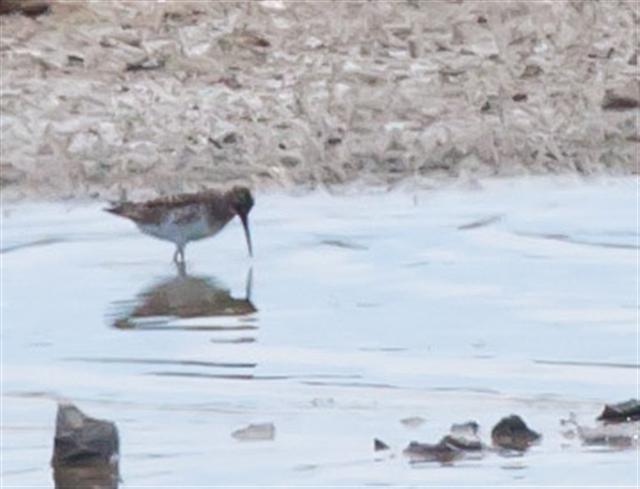
Broad-billed Sandpiper  Correlimos Falcinelo  Limicola falcinellus
Super, sunny weather and the cold and winds of late are a thing of the past - and just in time to welcome my Belgian friend, Marieke Berkvens who will be staying with me for three days on her way back from Tarifa to Belgium.  Somehow, Marieke not only manages to bring the warm sunshine with her but you can guarantee her visit will coincide with something special on the birding front!  Last year it was my first and only, so far, very close-up views of a Red-necked Nightjar on our track with the bird happily sitting next to the car door and just moving on five metres at a time as we made our way home from an evening meal at the local restaurant (no camera of course and I never thought at the time that I could simply have used the telephone!).  This year even better; Marieke' visit coincided with the unexpected arrival of a single Broad-billed Sandpiper at the Guadalhorce and she even had a very late Yellow Wagtail of the British subspecies (another first for Marieke) and a lone Honey Buzzard passing overhead.  But more about these later.


Gorgeous Black-necked Grebe  Zampullin Cuellinegro  Podiceps nigricollis

 Wednesday 8 May

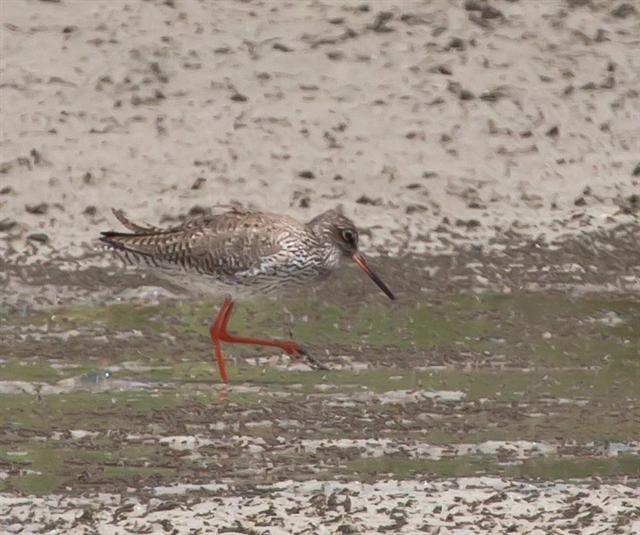
Common Redshank  Archibebe Comun  Tringa totanus

With Marieke due to arrive at the airport by noon on Wednesday, I drove over to the city and arrived early enough to pop down to the Guadalhorce for thirty minutes on the way.  Earlier, I had received a quick phone call from my friend Andy Paterson to let me know that a Broad-billed Sandpiper had been seen the previous afternoon on the old river and that he was on his way down to, hopefully, discover that the bird was still present.  Left me in a bit of a dilemma as I had arranged to take Marieke to Fuente de Piedra and Laguna Herrera on the way back to Casa Collado; what to do, re-arrange plans or hope that the bird, if still present, would stay at least another day so that we could catch up with it on Thursday after dropping Jenny off at the airport on her way back to a very wet UK?
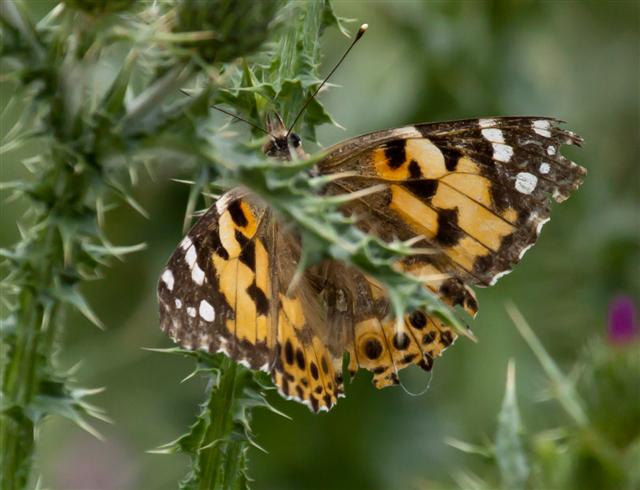
Lots of butterflies including this Painted Lady Vanessa cardui
I had already recorded Thekla Lark, Serin, Goldfinch, House Sparrow and Collared Dove as I drove down the mountain and no sooner at the river than I was able to add Barn Swallow, both Common and Pallid Swift, House Martin and a disappearing single Jackdaw.  I only walked as far as the footbridge where I also recorded a couple of Red-rumped Swallows, the resident Rock Doves and a Little Egret.  Spotless Starlings were flying around the area and, as I left the area, I had a male Woodchat Shrike sitting on the school football field's crossbar.
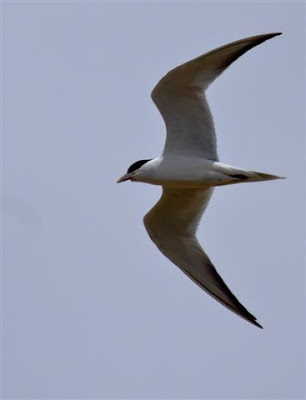
Gull-billed Tern Pagaza Piconegra Sterna nilotica
Then it was back to the airport where I collected Marieke and we set off for Fuente de Piedra.  But, Marieka had not stopped on her drive up from Tarifa so we called in a the service station as soon as we joined the Sevilla motorway at Antequera.  Suitably refreshed and already off the motorway we changed our plans to take in the Laguna Herrera before driving on to Fuente de Piedra.  Still lots of Corn Buntings about but it was really hot now and the middle of the day so not all the birds I expected.  Most of the flooded fields had either dried up in the past week or, as a minimum, seen their water levels severely drop.  Just the odd Redshank and not so many Black-winged Stilts but there were still a couple of Wood Sandpipers to be seen.  Reed Warblers were singing away in the ditches and pool-side vegetation and then, on the laguna itself, a number of Coots plus a quartet of Black-necked Grebes, a few Great Crested Grebes and the odd Moorhen.  Overhead no end of screaming Gull-billed Terns as they went about their fishing ritual.  A Hoopoe was heard and then it was back into the car for the drive over to Fuente de Piedra.
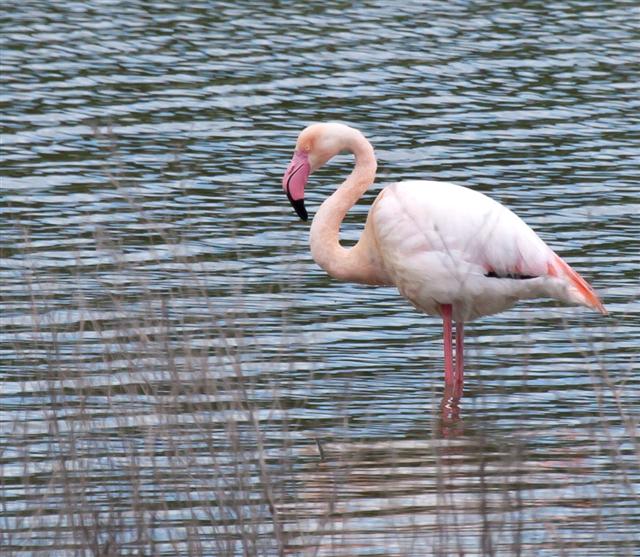
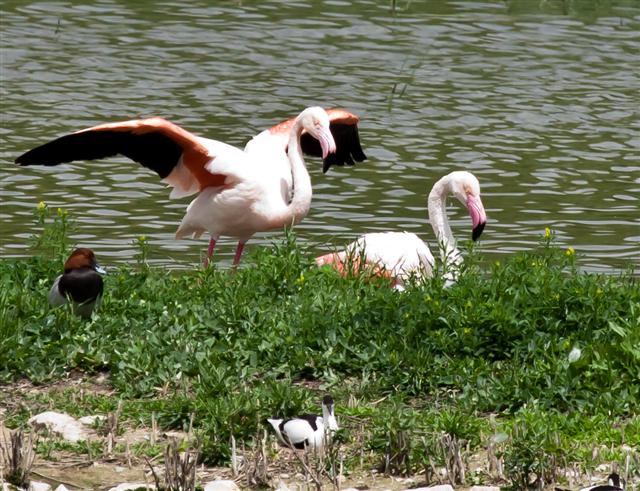
Greater Flamingo Flamenco Comun Phoenicopterus roseus and below with Common Pochard Porron Europeo Aythya ferina  and Avocet Avoceta Comun  Recurvirostra avosetta


Here, again, the pool levels had dropped and most of the flooded fields were no more, albeit still plenty of water in both the main laguna and the laguneta at the back of the Visitors' Centre.  More, but not o many as usual, Black-winged Stilts and a small number of Avocets.  Lots of Flamingos on the water but numbers were down on my last visit and the main flock was at the far end in or near the nesting site. The small pool below the Visitors' Centre held pairs of Gadwall and Shoveler along with a number of Black-winged Stilts and Avocets.  A Blue-headed (Iberiae) Wagtail was also recorded here. 

Avocet  Avoceta Comun  Recurvirostra avosetta
Moving round the laguna we managed to record a male Montagu's Harrier as we rejoined the main road then Crested Lark, Linnet and a Red-legged Partridge before reaching the Mirador de Cantarranas where we were able to watch and follow a rather magnificent male Marsh Harrier.  Finally, time to head off back home for the evening meal that Jenny was cooking but, no sooner back on the road than we had our first Turtle Dove followed by a Blackbird.  A Stonechat completed the list of 48 species as we drove back up our mountain track.


Thursday 9 May 

Our Broad-billed Sandpiper  Correlimos Falcinelo  Limicola falcinellus
Back to the airport once again, this time to deliver Jenny for her onward flight back to the East Midlands.  Having already arranged to meet Andy at the church by 2.15 pm we then walked down to the Guadalhorce and, fingers crossed, the prospect of seeing a new "lifer" bird for both Marieke and myself.  Approaching the entrance tot he track up to the river we were greeted by vision of goodness knows what, almost beyond description!  Not so much the beautiful young lady hiding under a very delicate wide-brimmed sun hat but the impressive strongman walking alongside with his huge cowboy hat, sleeveless body warmer over a bare chest, a rather natty pair of shorts in a delightful pastel shade of yellow and great big walking boots (I almost said "hob-nailed" boots).  With a large camera slung over his shoulder and a pair of bins round his neck he was obviously of the birding persuasion but it was only when we were within ten metres of this apparition that we recognised the couple as our special friends Steve and Elena Powell.  They, too, had been down tot he old river to try and find the newly-arrived scarcity, the Broad-billed Sandpiper - but without a telescope to get that rally close look at the individuals on display.  (And, yes, I will have to have a word with Elena re Steve's dress code!!!!!)

There then followed a short interlude whilst we all re-introduced ourselves before taking our separate ways - but not before we had watched a Woodchat Shrike on the opposite fence around the school playing field.  Also in the area we had both Collared Doves and House Sparrows and a male Blackbird flew across in front of us as we reached the top path.  Next followed very many Barn Swallows and House Martins along with large numbers of Swifts, all appearing to be of the Pallid variety albeit we did manage to record a few Common Swifts as we crossed the reserve.  Crossing the footbridge we had the resident Rock Doves, a single Jackdaw and a pair of the nesting Red-rumped Swallows.

A selection of waders including Ringed Plover Chorlitejo Grande Charadrius hiaticula, Dunlin Correlimos Comun Calidris alpina and Curlew Sandpiper Correlimos Zarapitin Calidris ferruginea
So on to the Laguna Casillas where only a single male White-headed Duck was recorded along with a pair of Gadwall and a small number of Pochards.  Similarly, just the single Moorhen seen along with the handful of Coots.  A couple of Black-winged Stilts were below us and then a handful of squawking Monk Parakeets flew over whilst, nearby, a Reed Warbler could be heard singing his little heart out.  Hopefully, no strange eggs deposited in this nest!
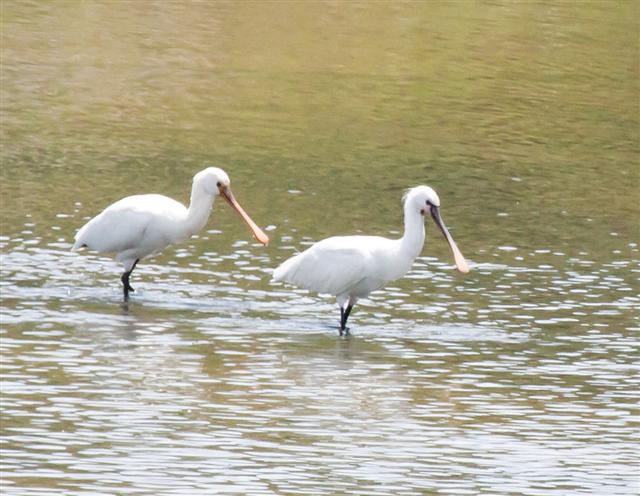
Adult and immature Spoonbill Espatula Comun Platalea leucorodia
Goldfinches and Serins as we approached the Wader Pool where we found, not only a pair of Spoonbill but fifteen resting Little Egrets.  Just the one Redshanks and a couple of Ringed Plovers but also more Pochards, a Gadwall and single Mallard.  Naturally, there were also a good number of Black-winged Stilts.
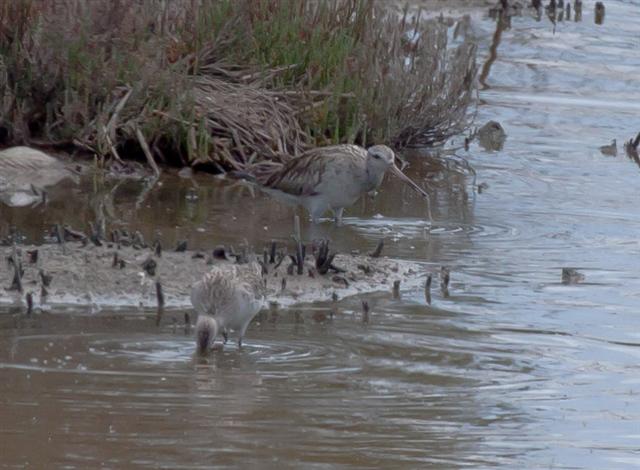
Two of three Bar-tailed Godwits Aguja Colipinta Limosa lapponica
And so onto the Old River, the Rio Veijo; would the main attraction still be here, a third day, or would we be too late?  Would, also, there still be a the variety of small waders seen the previous day?  Now was the moment of decision.  A pair of Bar-tailed Godwits then a good number of Dunlin and Ringed Plovers.  The first Little Ringed Plover was recorded quickly followed by a Little Stint.  Another Bar-tailed Godwit roosting on the opposite side of the river and then a good number of Sanderling ranging in plumage from what looked very much like mid-winter white to full breeding colours.  Where was the bird; keep looking Andy because, as yet, I can find no diminutive Dunlin with a long beak.

Broad-billed Sandpiper  Correlimos Falcinelo  Limicola falcinellus

Yes, yes, yes!  Well done Andy for finding the little bird busy feeding relatively close-by on our side of the river.  And just to make things a little easier, the Broad-billed Sandpiper was actually feeding quite close to a Dunlin, so offering great comparison facilities. What a strange little bird was this single Broad-billed Sandpiper that seemed to stretch up his neck and creative a considerable "bend" on occasions as it continued to feed.  Studying the bird as closely as we could it even appeared to have different flank markings on each side of its body (see photos below).  After all the excitement we even managed to record a trio of Avocets in the river nearer to the sea plus more Redshanks until something spooked all the waders and they took to the air before re-settling.
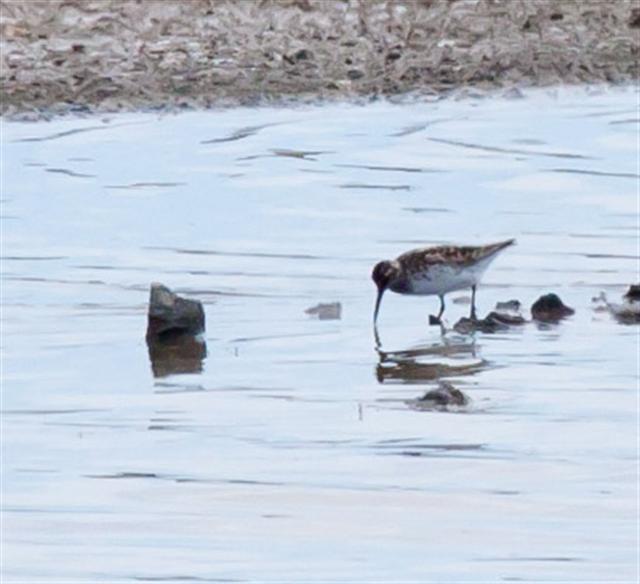


So, all excitement over and a most wonderful afternoon spent in such pleasant company we started to make our way back, having decided to give the beach and other hides a miss.  Well, how do you follow seeing a "lifer" such as this?  The answer, for Marieke, by being shown a second "lifer" in so many minutes!  Whilst busy watching the Broad-billed Sandpiper a Yellow Wagtail put in an appearance on the sand just behind the bird; a very late arriving member of the British sub species, Motacilla Flava flavisima.  Annual birds for Andy and I but a first for Marieke from Belgium.

But the afternoon visit was still not over.  A quick look in at the Wader Pool as we passed by revealed a newly-arrived immature Grey Heron quickly followed by a single Gull-billed Tern and then, as we left, looking up we had one of Marieke' specials, her whole purpose for coming to Spain and visiting Tarifa, a Honey Buzzard.  Just the single bird which must have come in from the sea and of the dark morph variety.  Finally, as we walked back to the main road alongside the river, a single Zitting Cisiticola took to the air to bid us farewell and a safe journey home.
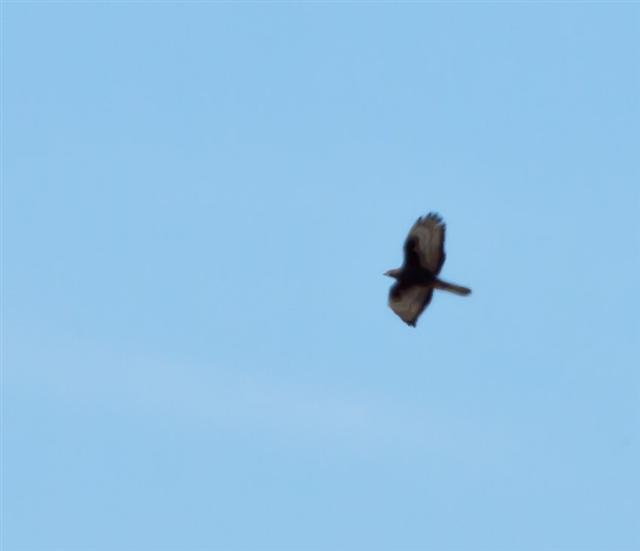
The high, departing Honey Buzzard Abejero  Europeo Pernis apivorus on his way, no doubt to Marieke in Belgium!
Back at the cars, Andy drove away and I thought to myself, how can you improve on two new lifers?  Obvious really, go for the hat-trick!  So off home via the Parador Golf to see if we could locate the Superb Starling that is the sole remaining ember of the previous small flock.  Even as we walked up to the kiosk Marieke was still giving me funny looks as to why would somebody describe (an ordinary) starling as superb or splendid?  Finally, the penny dropped and she realised that I was talking about a different species of starling, not our own resident Spotless Starlings.  Lots and lots of Monk Parakeets and even a Hoopoe flew right by in front of us.  We saw a female House Sparrow happily drinking from the beer drip tray as the attendant was busy shutting up shop for the day.  Obviously, she must have thrown out some bread crumbs because suddenly the Superb Starling was right in front of us both feeding and keeping away the other birds; obvious who is top of the pecking order here.  Seeing us watching the bird, we were then informed that the starling also had a name.  Welcome to Pepe!  If I come back as a bird in a next life than I think I will be a starling on this golf course where you can guarantee warm, sunny weather, lots of protection from the general riff-raff, hand-fed food on call and access to free beer whenever the fancy takes you!  Forget Passer Elenus and welcome to Sturnus Robertus!  Kestrel, Thekla Lark and Sardinian Warbler as we approached home so a very welcome 44 species for a marvellous afternoon.

Superb Starling Estornino Soberbio Lamprotornis superbus named "Pepe" at the Parador Golf, Malaga


Birds seen Wednesday:
Shelduck, Gadwall, Mallard, Shoveler, Red-crested Pochard, Pochard, White-headed Duck, Red-legged Partridge, Great Crested Grebe, Black-necked Grebe, Cattle Egret, Little Egret, Flamingo, Marsh Harrier, Montagu's Harrier, Kestrel, Moorhen, Coot, Black-winged Stilt, Avocet, Redshank, Green Sandpiper, Wood Sandpiper, Black-headed Gull, Yellow-legged Gull, Gull-billed Tern, Whiskered Tern, Stock Dove,, Turtle Dove, Collared Dove, Swift, pallid Swift, Hoopoe, Crested Lark, Thekla Lark, Barn Swallow, House martin, Red-rumped Swallow, Blue-headed Wagtail (Iberiae), Stonechat, Blackbird, Reed Warbler, Sardinian Warbler, Woodchat Shrike, Jackdaw, Raven, Spotless Starling, House Sparrow, Serin, Goldfinch, Linnet, Corn Bunting.


Birds seen Thursday:
Gadwall, mallard, Pochard, White-headed Duck, Little Egret, Heron, Spoonbill, Honey Buzzard, Kestrel, Moorhen, Coot, Black-winged Stilt, Avocet, Little Ringed Plover, Ringed Plover, Kentish Plover, Sanderling, Little Stint, Curlew Sandpiper, Dunlin, Broad-billed Sandpiper, Bar-tailed Godwit, Redshank, Black-headed Gull, Yellow-legged Gull, Gull-billed Tern, Rock Dove, Collared Dove, Monk Parakeet, Swift, Pallid Swift, Hoopoe, Thekla lark, Barn Swallow, House Martin, Red-rumped Swallow, Yellow wagtail (British flavisima), Blackbird, Zitting Cisticola, Sardinian Warbler, Woodchat Shrike, Jackdaw, Spotless Starling, Superb Starling, House Sparrow, Serin, Goldfinch.


Check out the accompanying website at http://www.birdingaxarquia.weebly.com for the latest sightings, photographs and additional information.

Thursday, 9 May 2013

Arroyo Marin near Archidona

Ever active, John and Jenny were able to visit that lovley little birding spot near Archidona, the Arroyo Marin on Tuesday.  As John states in his covering email, "Another nice day - a bit hot for birding - but quality not quantity today..."


Arroyo Marin 7th May 2013

A hot day (30C) but quite a bit of shade luckily.

As we entered the area and unloaded the cameras and binos, a Melodious Warbler, Barn Swallow and a House Martin were seen.

On our drive down to our usual parking spot at the ruin we were serenaded by Nightingales and Blackcaps.  Also seen down the track were Chaffinches, Blabkbirds, House Sparrows and Great Tits.


Nightingale Ruisenor Comun Luscinia megarhynchos (PHOTO: John Wainwwright)

After parking up we walked the upstream path, here we saw Hawfinches, Golden Orioles, Greater Spotted Woodpecker, Wrens, Azure-winged Magpies, Red-legged Partridges and Short-toed Treecreepers.   On the return journey a couple of Robins were seen displaying and the grasses were full of Spotless Starlings.  A few Wood Pigeon were about as were Collared Doves, a Green Woodpecker was heard as was a Raven.  In the small bushes we noted Greenfinches and Goldfinches, Serins and yet more Nightingales.

Back to the car for refreshment and then a walk downstream.  Plenty of water about and a lot of debris from the earlier floods - no shortage of nesting material here!   A Rock Bunting was interrupted bathing and a Wryneck was heard over on the opposite bank (still not managed to see one yet this year), one Hoopoe, a few more House Sparrows, Blackcaps and Robins. 


Golden-ringed Dragaonfly Cordulegaster Boltonii (PHOTO: John Wainwwright)

At the first ford we disturbed a Viperine snake, sunning itself on the concrete.  Nothing extra - to what we had already seen - was seen - as we made our way down to the second concrete ford.  It is still impassible except for walkers and possibly cycles as a huge swathe of the bank has been swept away.  A nice find for the day was a Golden-ringed Dragonfly.


Booted Eagle Aguililla Calzada Hieraetus pennatus (PHOTO: John Wainwwright)

On our way out, a Blue Rock Thrush flew from the ruin and as we got close to the exit, two shadows passed over the car bonnet, it was a pair of Booted Eagles - a nice finish to the afternoon.


Check out the accompanying website at http://www.birdingaxarquia.weebly.com for the latest sightings, photographs and additional information. 


Tuesday, 7 May 2013

Latest development on the Frigiliana building site!

Just received some lovely photos from Steve Powell to show how well the new Martin Estate is coming on in Frigiliana with, I am told, a 100% occupancy rate.  Is there any wonder with all the mod cons laid on; close to a plentiful supply of food, gated security and a female warden that will not tolerate any interference with the homes, feathered or otherwise, etc.  One of the Passer Elanus's tried her luck but she soon got short shift.


Now first we take a summer lease and then adapt the new home to meet our personal requirements:


 Next, check it out size and view from the front door.  Can I see the neighbours?


 That's fine.  Now, settle back and wait for the postman to call - well, hubby with the shopping!

Hullo, what's this?  Looks like one of those Passer Elanus girls from round the corner is trying to do a smash and grab job and take over one of the new houses on the Martin estate.

Not just the warden who is going to be upset.  Even the nosey neighbour's giving the interloper a mouth full of useful advice and what she can expect if caught.


Now then, what's all this palaver about then?  Somebody say there was an intruder on our estate?  Well, they're certainly not going to be taking a look at my little house, thank you very much!


All photographs courtesy of Steve Powell and with many thanks.  To take a closer look at some of Steve's photos check out his new website at www.wildaboutspain.com


Check out the accompanying website at http://www.birdingaxarquia.weebly.com for the latest sightings, photographs and additional information.

Monday, 6 May 2013

Beyond the old road to Zafarraya

I received a interesting birding report from John and Jenny Wainwright last evening outlining their day's exploits in the hinterland between Zafarraya and Salar that contains the old, now abandoned, road linking the two towns.  Visit this fields at the right time of the year and there is every chance that you might actually record five different species of larks.  It is usually very reliable for producing Northern Wheatears and the occasional Black-eared Wheatear not to mention passing raptors such as Booted and Short-toed Eagles.  However, on this occasion John and Jenny manged to pick up an immature Golden Eagle.


Old Zafaraya Road 5th May 2013

A really warm day today with a fresh - and very welcome - breeze every now and then.


Corn Bunting Triguero Embeiza calandra (PHOTO: John Wainwright)

As we drove up to the turn off at 16km we saw Bee-eaters, Common Kestrel, Corn Buntings, Woodchat Shrike, House Sparrows and Chaffinch.  We stopped to get the cameras out of the back of the car and there Jenny heard a Quail, as we listened again for the bird, a Calandra Lark flew over.  Further on we saw a Little Owl, a huge Ocellated Lizard, Great Tits and Common Magpie.


Bonelli's Warbler Mosquitero Papialbo Phylloscopius boneli (PHOTO: John Wainwright)


Turning right at the crossroads and in the small groves to our left we found Melodious and Bonelli´s Warblers, Blackbird, Spotless Starlings, a Cuckoo was heard, a few Wood Pigeon, Corn Buntings and a couple of Nightingales.

Down at the ford we parked up, here we saw Hoopoes, heard Green Woodpecker, Crested Larks, House Sparrows, Great Tits, more Nightingales and Blackbirds.  Quails were calling here - at least three of them. A Cuckoo was seen flying over a rock formation in the distance and around the farm a few Jackdaws were seen. We followed the stream - downstream – for a while and here we found Cirl Bunting, Short-toed Treecreeper, Linnets, Sardinian Warblers, a few Barn Swallows and House Martins.  Goldfinches, Serins, Greenfinches, Mistle Thrush, and a Lesser Kestrel were noted as well as a Rock Bunting and a few Turtle Doves.

Turtle Dove Tortola Europea  Streptopelia turtur  (PHOTO: John Wainwright)

As we drove up the track on the way home a juvenile Golden Eagle circled overhead, before picking up the thermals and climbing well out of sight.  Three more Bonelli´s were seen in the oak trees as well as Chaffinches, Blackbirds and another Cirl Bunting.


Immature Golden Eagle Aguila Real Aquila chrysaetos (PHOTO: John Wainwright)

Lots of butterflies including Small Heath, Pale Clouded Yellow, Common Blue, Spanish Festoon, Moroccan Orange Tip, Cleopatra, Painted Lady and Green Hairstreak.


Check out the accompanying website at http://www.birdingaxarquia.weebly.com for the latest sightings, photographs and additional information.