Wednesday, 9 February 2022

Lower Hamble River, Warsash

Tuesday 8 February

Back in Blighty and time to hit the birding road once again, even if my leg has still not recovered from my trip in Valencia a fortnight ago.  Clear, still and cloudy as Jenny and I set off for a leisurely, slow walk up the Hamble river with the tide right out and about to turn.  The temperature may have been reading 10 but it felt more like 6 as we hit the riverside path and began to wonder whether it would have been better to put on an extra layer!  Straight away a dozen Brent Geese and the first of very many many Black-headed Gulls.  Indeed, no other gull species was recorded during the next hour or so.  There had been a resting Wood Pigeon in the trees as we approached the river but no others were seen until we were on the return journey.

Curlew Numenius arquata

A Cormorant flew up river and we were to see a further four as we made our way upstream On the shoreline a Redshank, Curlew and the first of the Wigeon.  A lone Oystercatcher was also foraging at the water's edge. 

Great Cormorant Phalacrocorax carbo

Further on we cam across more Brent Geese and a large flock of Dunlin.  having counted at least a hundred of the last, it was interesting to note the gradual moult into breeding plumage with many of the Dunlin showing signs of a growing black chest.  On the muddy wastes of the meadow a dozen of Shelduck with a further two on the river pools.  More Dunlin and Brent Geese and the first good-sized flock of Wigeon.  Just off shore a trio of Little Grebe were fishing and in an empty inlet on the shire side the arrival of a lone Little Egret.

Little Egret Egretta garzetta

At last our first of four Grey Plover along with a solitary Carrion Crow.  Approaching the conservation rea we noted a flock of 14 Canada Geese in the garden of one of the large properties overlooking the river and then  six Rock Doves resting on the bank of the conservation area itself.  A pair of Jackdaw flew away south and then it was time to concentrate on the large mixed flock of Wigeon and Teal. Also in the mix a Curlew and a first Greenshank of the morning.  We were to see two more, sleeping, Greenshanks on the return walk.  Opposite the conservation area a quartet of Black-tailed Godwits were feeding at the water's edge.  Nothing new seen on the return journey and a final tally of 20 species for the short walk.  And my leg is now giving me all sorts of gip!

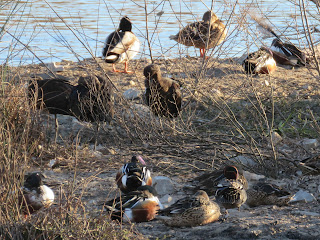
Mainly Wigeon Anas penelope but also at least a dozen Teal Anas crecca. 
 But can you find the Curlew?

Birds seen:

Brent Goose, Canada Goose, Shelduck, Wigeon, Teal, Little Grebe, Cormorant, Little Egret, Oystercatcher, Grey Plover, Dunlin, Black-tailed Godwit, Curlew, Redshank, Greenshank, Black-headed Gull, Rock Dove, Wood Pigeon, Jackdaw, Carrion Crow.

Greenshank Tringa nebularia

Black-tailed Godwit Limosa limosa

Grey Plover Pluvialis squatarola

A few of the Shelduck Tadorna tadorna

Two Teal Anas crecca with Wigeon and Curlew

Resting Wigeon Anas penelope

Check out the accompanying website at http://www.birdingaxarquia.weebly.com for the latest sightings, photographs and additional information

Thursday, 3 February 2022

Charca de Suarez, Motril

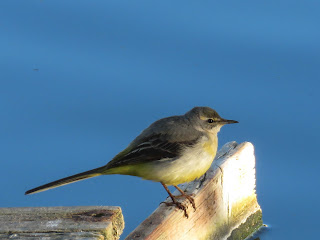
Grey Wagtail Motacilla cinerea

 Wednesday 2 February

The phrase, "It's an ill wind......." comes to mind as I write this report on the visit to the Charca de Suarez in Motril.  Having left later than I intended for the afternoon opening and only a quick dash down Camino Patria to the entrance I arrived just a few minutes after 4 to only discover that come February the opening times go back an hour and, as a result, I now had just about an hour to occupy myself before the gates were opened by Manu.  No brainer really as it meant I could both visit the entrance to Salobrena golf course and check out the lake and then carry on and make a much slower drive down my favourite camino, even a one way drive down Turtle, hence forth Crap, Alley and back to the Charca entrance.  And all in brilliant sunshine, calm and very warm.

Entering Camino Patria I had a Kestrel on the wires quickly followed by a couple of Collared Doves. Making a short stop near the recently planted fields I picked a lovely male Stonechat and watched the mixed feeding flock of Serin and Goldfinches. My attention was drawn to the dark specs in the sky which gradually lost height and came closer and not only identified the raptors as a Booted Eagle and a Buzzard but the former seemed determined to drive the latter away.  Then moving on the Charca I passed both Blackbird and Spotless Starlings and discovered that the gates were firmly locked.

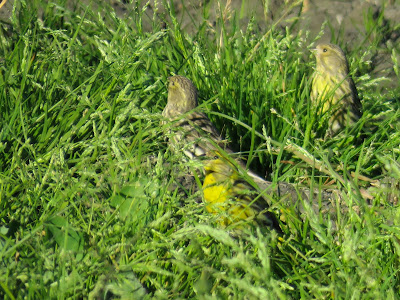
Serin Serinu serinus

Back in the car and the very short drive along the beach front to the golf course.  The site looked beautiful as I counted about 50 Black-headed and maybe a dozen Yellow-legged Gulls. Grazing on the grass at least three score Common Coot and the occasional White Wagtail.  On the far side a score of Spotless Starlings and then, on the water at the far side, a Little Grebe.

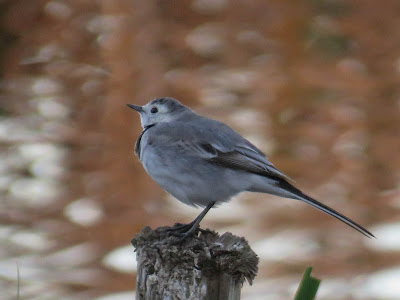
White Wagtail Motacilla alba

No sooner had I restarted my drive eastwards along Camino Patria than I had Rock Doves and a regular supply of Chiffchaff.  Stopping at the same spot as less than thirty minutes ago the Goldfinches and Serins were still active and there were a couple of Stonechat on display.  The larger raptors had moved on but I was pleased to welcome a quartering Marsh Harrier on my left. A stop just before Crap Alley produced a good-sized feeding flock of mainly Common Waxbill but including a few Red Avadavats. All very quiet making my way down Crap Alley trying to avoid the massive amount of fly-tipping and rewarded with both Collared Doves and House Sparrows as I reached the main road.

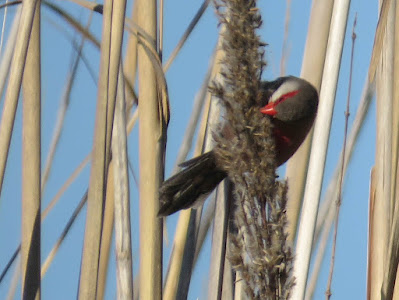
Common Waxbill Estrilda astrild

Before entering the reserve I took a quick look at the beach which now seemed to hold a number of large, shallow ponds; from whence they came who knows!  But nothing to add other than more White Wagtails. As soon as the gates were opened I went straight to the Laguna Taraje where I found a very large flock of Mallard. Also present a couple of Shoveler and both Moorhen and Coot along with a single Little Grebe.  Even the lone Purple Swamphen was resting at the top of the tall reeds.

Purple Swamphen Porphyrio porphyrio

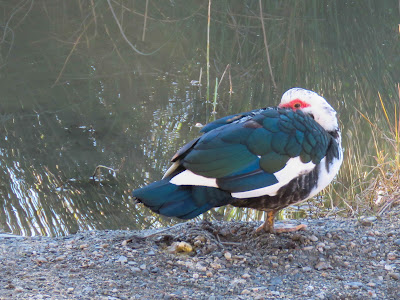
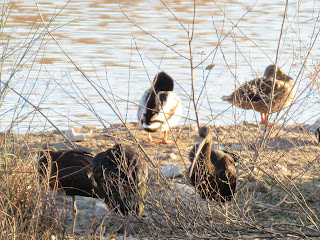
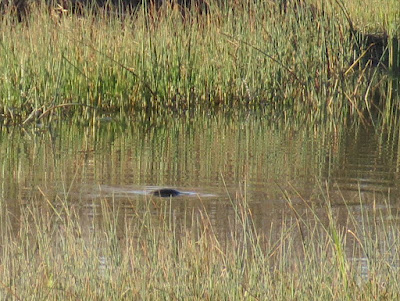
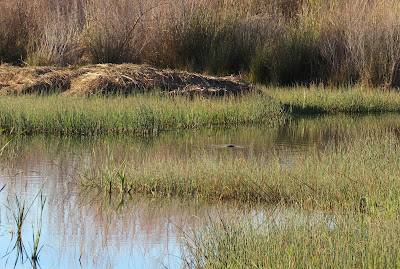
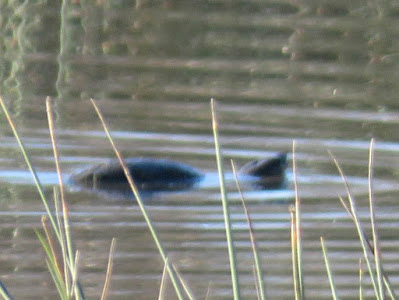
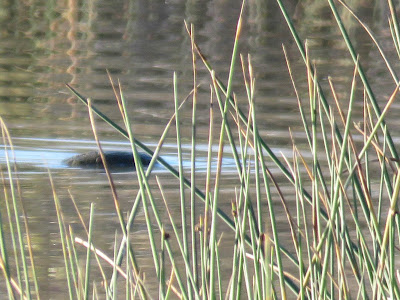
Just a handful of Shoveler at the far end hide so straight on the Laguna del Alamo Blanco.  Not the sunning Terrapin in front of the hide but a resting Muscovey Duck.  First time I have seen this species here or anywhere else nearby so can only presume it has flown in rather than escaped some local property.  At the back a couple of Teal and then the Snipe relocated from hidden grasses giving a better view.  Searching the far back I found a lone Heron and then watched a dark shape swimming, mainly submerged across the water to the far right.  What on Earth could it possibly be; an Otter perhaps?  (See pictures below and draw your own conclusions.)

Muscovey Duck 

Walking towards the main hide overlooking the Laguna de las Aneas I had a Robin on the path and upon arriving was surprised to see well over sixty Cormorants on the water, taking up every perching spot available.  Los of Common and few Red-knobbed Coots plus more Moorhen and a couple of Little Grebe.  Duck species were mainly Mallard but also a good number of Shoveler and a single Pochard at the back.  However, centre of attention was the island immediately on front of the hide where, in addition to Mallards and Shoveler there rested three Glossy Ibis.  To their right a quartet of Little Egret and another individual towards the back along with a Heron.

The three resting Glossy Ibis Plegadis falcinellus

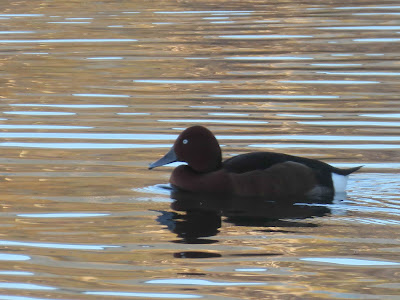
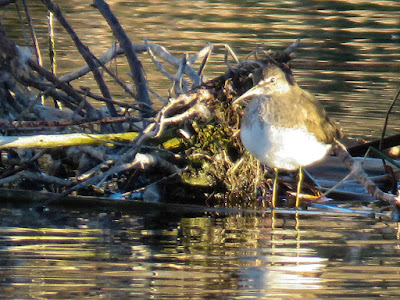
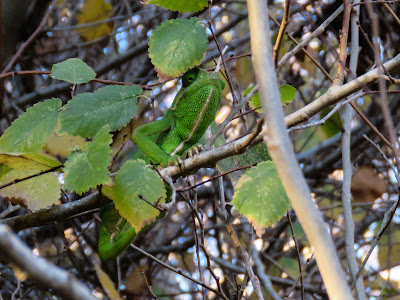
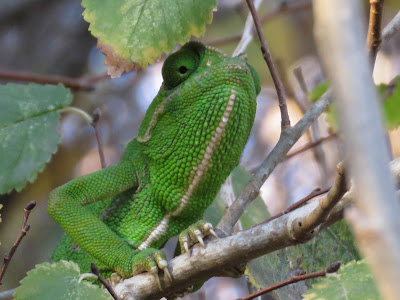
Leaving the main hide I stopped to admire the Chameleon that was so completely camouflaged it took me ages to see it even though its was barely four feet away.  About six inches, fifteen centimetres, in length and completely green amongst the similar coloured leaves. So on to the northern hide overlooking the Laguna del Trebol where I found mainly Red-knobbed rather than Common Coot.  More Moorhen and lots of Chiffchaff in addition to a plentiful supply of White Wagtails.  Not too many Shoveler but then the appearance of three Ferruginous Duck to liven up the early evening. On the far island with the Shoveler a resting Green Sandpiper and then the arrival of a Grey Wagtail before I walked round to the hide at the other side of the water.

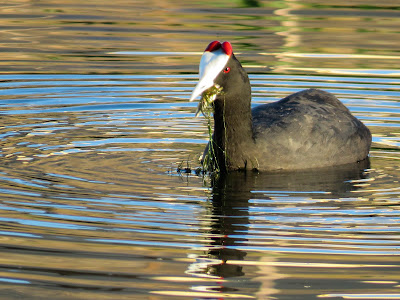
Red-knobbed Coot Fulica cristata

Relatively quiet other than the White Wagtails and occasional Red-knobbed Coot but, after patiently waiting, a Cetti's Warbler put in an appearance.  The final hide at the Laguna del Lirio not only produced a half-dozen Gadwall but also a further four Ferruginous Ducks - not to mention White Wagtails and Chiffchaff.

Ferruginous Duck Aythya fuligula

Finally. on my way back to the exit I stopped to join a few others observing three tiny Leaf Frogs, no larger than half the size of little finger.  At this point, and with the light going, the camera battery gave up so took a chance with the phone, the result of which looked fine on the phone but poor when emailed over.  And as I left the reserve two large flocks of Cattle Egret were entering for their night roost. Nevertheless, a most enjoyable afternoon with 40 species recorded.

Leaf Frog Phyllomedusa venusta

Birds seen:

Muscovey Duck, Gadwall, Mallard, Shoveler, Teal, Pochard, Ferruginous Duck, Little Grebe, Cormorant, Glossy Ibis, Cattle Egret, Little Egret, Heron, Marsh Harrier, Booted Eagle, Buzzard, Kestrel, Moorhen, Purple Swamphen, Common Coot, Red-knobbed Coot, Snipe, Green Sandpiper, Black-headed Gull, Yellow-legged Gull, Rock Dove, Collared Dove, Grey Wagtail, White Wagtail, Robin, Stonechat, Blackbird, Cetti's Warbler, Chiffchaff, Spotless Starling, House Sparrow, Common Waxbill, Red Avadavat, Serin, Goldfinch.

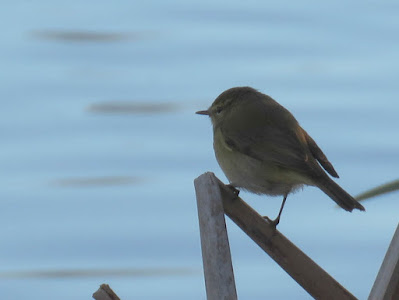
Chiffchaff Phylloscopus collybita

Cetti's Warbler Cettia cetti

Green Sandpiper Tringa ochropus

Spot the Chameleon Chamaelo chamaeleon


Is it or is it not an Otter?


Check out the accompanying website at http://www.birdingaxarquia.weebly.com for the latest sightings, photographs and additional information

Rambla de Almanzora with the Arboleas Birding Group

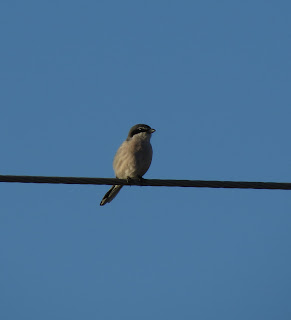
Iberian Grey Shrike (David Elliott-Binns)

 Wednesday 2 February

Looks very much as if Dave and his Arboleas Birding Group had a great birding day at the Ramble de Almanzora and Vera Playa with some good sightings in decent weather.  And I have to admit Dave and his groups seem to keep finding birds that I regularly miss, not least the Water Pipit.  I shall just have to keep trying albeit some will have to wait until my return to Spain in late April


Rambla de Almanzora & Vera Playa: Wednesday 2nd February


Normal service resumed today as I picked up Juda from the Ballabona services and headed towards the Rambla de Almanzora.  We joined at the Desert Springs golf complex end and stopped overlooking the first pool.  Not a lot in there.  Saw a couple of Moorhen and a Robin and a Water Pipit around the waters edge.  We drove slowly down. Juda spotted the first of about twenty Teal.  I then spotted some Snipe with a Wood Sandpiper.  We then had a Lapwing, Redshank and Green Sandpiper.  One White Wagtail was seen as well as a flock of Linnet.  Juda spotted a couple of Black Winged Stilt as 14 Mallard flew over.  I found a Black Redstart and Juda, an Iberian Grey Shrike.  Some Northern Starling were seen.  The ford only had a Mallard and a Coot.

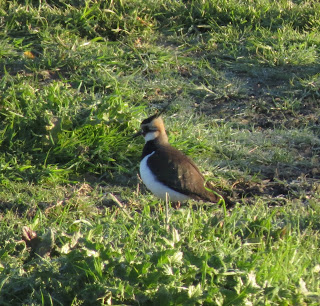
Lapwing Vanellus vanellus (PHOTO: David Elliott-Binns)

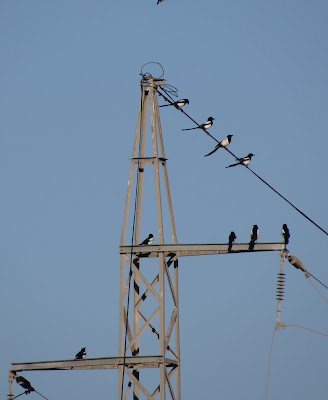
We met up with Peter, Richard, Michael, Karen, Val, and Alan.  Alan saw a Snipe and Richard, a Grey Heron and Greenshank.  As we walked up towards the sewage plant, a number of Chiffchaff were seen. A Collared Dove and Woodpigeon flew over.  Alan heard a Serin before it flew over.  Peter saw a Black Redstart.  At the small pools we saw a pair of Black Winged Stilt and a Common Sandpiper.  The large pool had numerous Mallard swimming and amongst them I discovered some Gadwall.  There were four Grey Herons standing on the far side.  We'd been joined by Trevor and Kevin who added Spotless Starling to the days list.  There were at least 10 Magpies perched on a distant pylon.  On the way back to the vehicles we heard at least two Cetti's Warblers.

A pylon of Magpies Pica pica (PHOTO: David Elliott-Binns)

After a refreshing cup of coffee, kindly paid for by Val to celebrate passing her French citizenship exams, (Well done!) we headed for the beach.  There were three Cormorants on the harbour rocks. A lan has taken over from John as our Gannet spotter.  There was only the one.  There was a 40 strong raft of gulls out to sea.  Alan identified some of them if not all to be Mediterranean Gulls. 

We drove round to the far estuary embankment.  The sun was not in a good place, but Alan identified Dunlin, Little Stint and Ringed Plover. I found a Kentish.  There was a large flock of 200+ what appeared to be more Mediterranean Gulls resting on the beach.  There were a couple of Black Headed Gulls closer to hand.  Kevin, who'd rejoined us after checking out the other side of the estuary, spotted half a dozen Audouin's Gulls on the beach as well.  Richard added a Blackbird.

We then convoyed down to the dual carriageway opposite the Consum supermarket.  As well as Mallard and teal, we saw Shoveler and Shelduck plus some Little Grebe.  Moving beyond the hump we added Black Winged Stilt and Yellow Legged Gull.  Karen was first to see one of the 8 Greater Flamingos. Kevin spotted a Common Pochard and a Stonechat.  I found a flying flock of Greenfinch whilst checking the housing estate behind us for Black Wheatear, (failed!).  We moved round to the smaller pool after saying goodbye to Val.  There were more Common Pochard.  Behind a pair of Shelduck I found a Purple Swamphen.  I counted 31 White Headed Duck.

Purple Swamphen Porphyrio porphyrio behind a pair of Shelduck Tadorna tadorna (PHOTO: David Elliott-Binns)

We then said our goodbyes to the good company of friends.  Juda spotted a Kestrel near Puerto Rey as we headed home.  We saw 50 species today.  The weather was lovely and sunny.
Regards
Dave
3 Snipe and a Wood Sandpiper (PHOTO: David Elliott-Binns)

Gadwall Anas strepera (PHOTO: David Elliott-Binns)

Check out the accompanying website at http://www.birdingaxarquia.weebly.com for the latest sightings, photographs and additional information

Tuesday, 1 February 2022

Upper Cacin Valley and Area, Granada

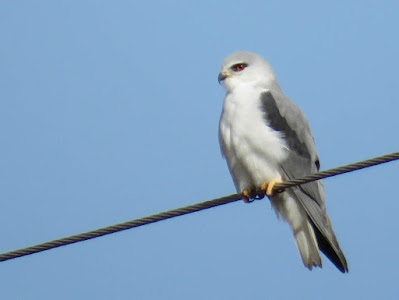
Black-shouldered Kite Elanus caeruleus

 Monday 31 January

Following a n early morning coffee with my dear friend, Mick Richardson near Moraleda, we set off for a morning's birding in the Upper Cacin Valley with a number of target species in mind and by the time we returned to Huetor Tajar all and more had been recorded. The morning was calm and completely clear with a warming sun, albeit only 1C when we set off but by mid-afternoon in the mid-twenties.  As soon as we left the small road and headed along our first track we immediately had a bush full of Blackcaps, House Sparrows and Serin. Collared Doves on the roof of the neighbouring building and then on to quickly stop as we recorded both Greenfinch and the fist o very many Chaffinch for the day.  Next the first Great Tit then many Goldfinches along with a Sardinian Warbler as we made our way through the open almond fields and olive groves.

Stopping to observe both Black Redstart and Robin along with more Blackcaps our attention was drawn to the small raptor in the sky immediately on front of the car.  Normally a Merlin is off like greased-lightening but this individual seemed to cope with the mobbing by a couple of Jackdaw and then a Magpie by circling, flying up then down as it tried to get rid of the pesky individuals.  All, of course, to our benefit a we had long and clear views of the nearby action.  Continuing on we were to see many more Magpies plus numerous Linnets and Goldfinches along with Corn Bunting and even three Iberian Grey Shrikes.  A few Mistle Thrushes made a change along with Stonechat, Thekla Lark and Meadow Pipit.
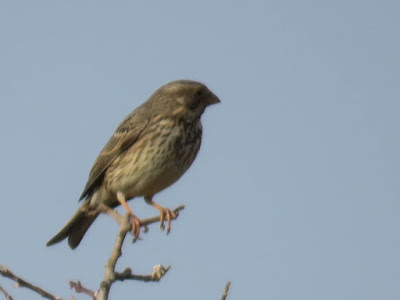
Corn Bunting Emberiza calandra

Approaching the old farm ruin I was able to spot the resident Little Owl as we searched for the local Black-bellied Sandgrouse we had many White Wagtails and Calandra Larks.  Then the Sandgrouse were in the air.  First a trio followed by a quartet and finally a singleton.   As you will see from my attempt using a small bridge camera, nothing more than a distant record shot but Mick managed to get some gorgeous shots and even identify all the birds as female other than the singleton male.  My thanks to Mick for permitting me to use some of his shots.
My distant record shots of the Black-bellied Sandgrouse!

Now for those taken by Mick Richardson:
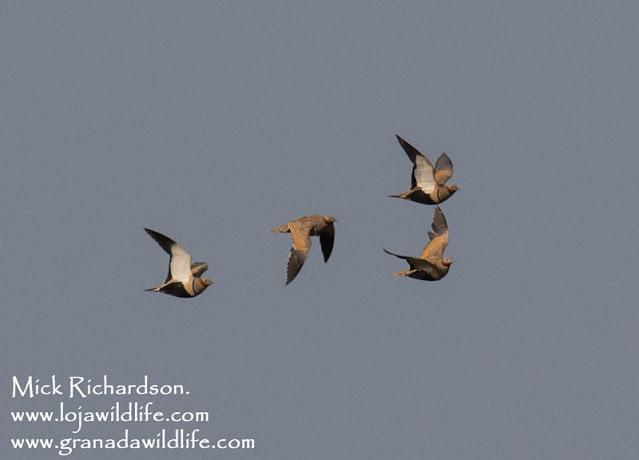
Black-bellied Sandgrouse Pterocles orientalis (Above 3 photos by Mick Richardson)

Moving on we came across a single, looking lost, Lapwing and then the first Sky Lark. By now we seemed to be seeing more Song Thrushes than we might otherwise have thought and then stopped to check a large mixed gather of starlings on the wires at a crossroad.  Mainly Spotless but at least eight Common Starlings. A Jay flashed across the narrow road and then we were at the next ruined farm with open views around.. Not so much the many Jackdaws, a couple of Black Redstarts but the distant soaring Golden Eagle was the main talking point.  A stop at a favourite site on this occasion only produced one Little Owl to add t the four already observed.
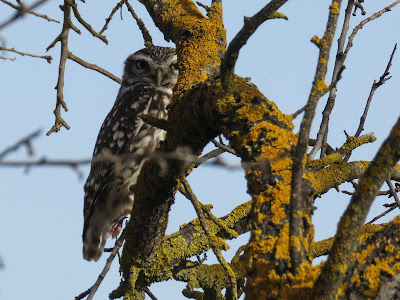
Little Owl Athene noctua

The usual viewpoint produced no raptors but, rather than many Feral Pigeons, we had the sight of over a dozen "pure" Rock Doves on the roof of an isolated farm building.  Needless to say we had already seen hundreds of Wood Pigeons during our travels.  Leaving a Hoopoe watching us from afar we set off but then stopped to check the small shape atop a pylon and, sure enough, a Black-winged Kite. The bird even remained whilst we circled round and found a concealed track amongst the olive trees to get a closer look.
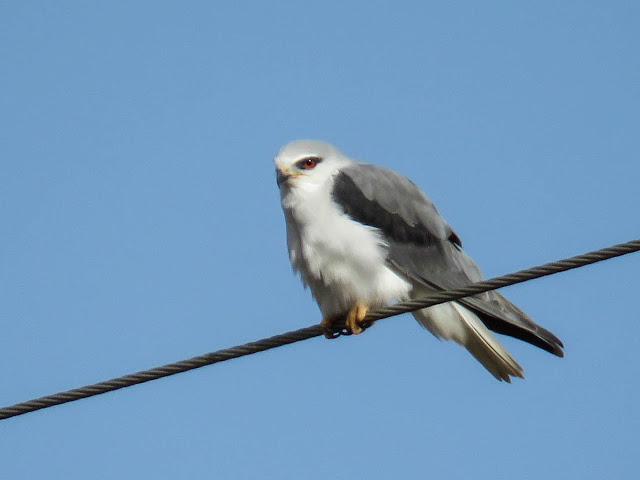
The magnificent and handsome Black-shouldered Kite Elanus caeruleus

Working our way round the hill tops above Cacin we eventually found a number of Buzzards and even a Sparrowhawk.  Finally a Kestrel and then, on very close study, the only Blue Rock Thrush of the day.  Lots of Chiffchaff about along with our first Blackbird but just the one Crag Martin.  Finally, a few more Blue Tits before heading towards the reservoir and thank goodness we had been fortunate enough to also see a Bonelli's Eagle.

Looking at the water immediately after an Iberian Green Woodpecker had crossed the road in front of us, the most obvious observation was that of the large number of White Wagtails, but soon we had added a trio of Green Sandpiper along with both Moorhens and Coots.  The first of three Marsh Harriers drifted across and, using the scope, picked out good numbers of Shoveler, Pochard and Teal.  Double-checking, we found that the single Snipe had now increased to seventeen individuals.  After much searching to find the calling bird we did both get a short but clear of the Water Rail.  At the far end just the single Cormorant.

heading on to stop at the bridge over the outflow, we picked up our first "obvious" Redwing along with Long-tailed, Great and Blue Tit.  There were also many Blackcaps as we walked the edges of the track. The final stop in this area was to check for small birds amongst the pine trees but not before finding a Brambling watching us as we got out of the car.  Firecrests, Crossbill and Crested Tits were added to our sightings of the day.  Lovely to see the many flowering Broad-leaved Irises in the hills.
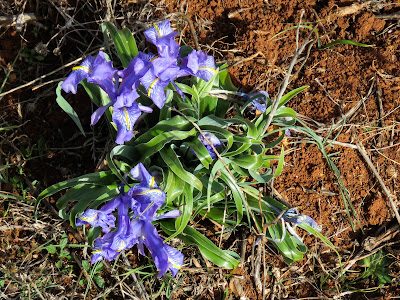
Broad-leaved Iris Iris plantifolia

Time to head back to Huetor Tajar where we stopped to find a pair of Stone Curlew before travelling up past Mick's house to Cerro Hacho. Here we heard Red-legged Partridge bur saw numerous Chaffinches along with many Serin and Siskins.  A Wren and Sardinian Warbler put in appearances along with both Meadow Pipit and Stonechat.  Naturally, there were also many Blackcaps and a plentiful supply of Great Tits.  We could hear the Crossbill and finally located a pair on the very high wire above us.  This was also the site that finally delivered a supply of Iberian Magpies along with Coal Tits, a Short-toed Tree-creeper and a Rock Bunting.
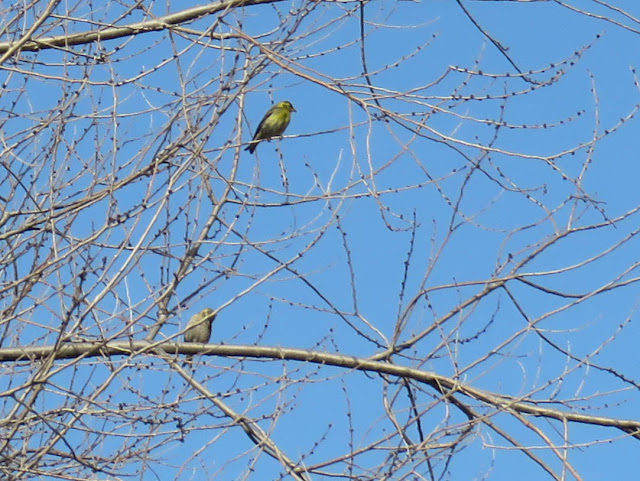
Male (above) and female Siskin Carduelis spinus

Time to head back down to Huetor Tajar for our final bird of the day.  No sooner had we started to cross the river than we met John and Jenny Wainwright driving down the riverbed.  Time for a welcome break and exchange sightings and views, etc before parking up to find a trio of Little Bustards just past the single Grey Heron.  The riverbed behind us held many Chiffchaff and White wagtails plus another Green Sandpiper.  Apart form the small number of Lapwing we also found a single Cattle Egret.  This area also produced a Tree Sparrow and many Crested Larks and whilst looking for a possible Great Woodpecker I noticed the Bluethroat foraging further on at the side of the road.

Discovering that we were only two short of eighty species for the da and John and Jenny had seen a pair of Mallards near the parking are above the ford, we moved back in the hope that the site would also provide a local Cetti's Warbler.  Neither was forthcoming so we decided to end our day in the town near the main bridge across the river where there was bound to be a Mallard.  As we set off we stopped to identify the Reed Bunting perched just above a Goldfinch on a roadside bush and noted the pair of Red-legged Partridges next to the ploughed field.  Arriving at the river still no Mallard but we did find the Cetti's Warbler and the added bonus of six Muscovey Ducks resting alongside the resident feral geese.  So all targets achieved with 82 species and 22 new additions to the the list.

Birds seen:

Muscovey Duck, Shoveler, Teal, Pochard, Red-legged Partridge, Little Grebe, Cormorant, Cattle Egret, Heron, Black-winged Kite, Marsh Harrier, Golden Eagle, Bonelli's Eagle, Sparrowhawk, Buzzard, Kestrel, Merlin, Water Rail, Moorhen, Coot, Little Bustard, Stone Curlew, Lapwing, Snipe, Green Sandpiper, Black-bellied Sandpiper, Rock Dove, Feral Pigeon, Wood Pigeon, Collared Dove, Little Owl, Hoopoe, Iberian Green Woodpecker, Calandra Lark, Crested Lark, Thekla Lark, Sky Lark, Crag Martin, Meadow Pipit, Grey Wagtail, White Wagtail, Wren, Robin, Bluethroat, Black Redstart, Stonechat, Blue Rock Thrush, Blackbird, Song Thrush, Redwing, Mistle Thrush, Cetti's Warbler, Sardinian Warbler, Blackcap, Chiffchaff, Firecrest, Long-tailed Tit, Crested Tit, Coal Tit, Blue Tit, Great Tit, Short-toed Treecreeper, Iberian Grey Shrike, Jay, Iberian Magpie, Magpie, Jackdaw, Common Starling, Spotless Starling, House Sparrow, Tree Sparrow, Chaffinch, Brambling, Serin, Greenfinch, Goldfinch, Siskin, Linnet, Crossbill, Rock Bunting, Reed Bunting, Corn Bunting.


Check out the accompanying website at http://www.birdingaxarquia.weebly.com for the latest sightings, photographs and additional information

Sierra de Marie with Dave Elliott-Binns

 Monday 31 January

So, whilst I was over near Loja in Granada province starting a day's birding with Mick Richardson, Dave and friends were making a sorte over the Sierra de Marie in Almeria province.  I suspect, probably due to the location, weather and length of time in the field, that we certainly had more variety albeit pleased to see the birds that Dave and friends found in more difficult circumstances.

Sierra de Maria: Monday 31st January 2022

Lucky me had an extra days birding as Alan, a holidaying birder, contacted me to take him out.  At 9 o'clock I picked him up from the Overa hotel and headed towards Los Velez and the Sierra de Maria. We headed straight to the La Piza forest cafe, seeing Woodpigeon, White Wagtail, Collared Dove and Jay en route.  Upon arrival we were greeted with the sight of Crossbill drinking from the deposito adjacent to the "carpark".  I'd bought peanuts with me so we replenished the feeders.  I'd also brought a bottle of hot water to de-ice the water bath.  We sat down for a coffee and watched Great Tit, Long Tailed Tit, Crested Tit and Chaffinch have their nutty breakfast. 

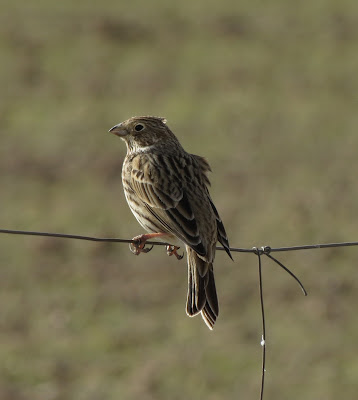
Corn Bunting Emberiza calandra (PHOTO: David Elliott-Binns)

We left there and started to do the loop.  No birds were seen during the forest section, but when we came out onto the agricultural fields we began to see small flocks of Greenfinch, Goldfinch and Linnet. There were numerous sightings of Corn Buntings and a few of Carrion Crows.  A Kestrel posed well on a traffic sign but departed before I could say "Cheese"!   Also seen were Thekla Larks, House Sparrows and a pair of flying Red-billed Chough.  I spotted a pair of displaying Calandra Lark and a couple of Stonechat.  Alan spotted a distant Griffon Vulture which was heading away from us.  As much as I tried I couldn't get close to it.  Near the cliff face there were large groups of resting Jackdaw.  As we passed the runway I managed to snap a posing Kestrel.  Our final bird before getting to the hamlet was a female Black Redstart.
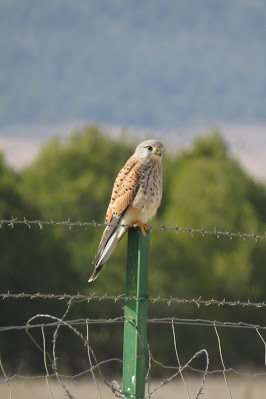
Kestrel Falco tinnunculus (PHOTO: David Elliott-Binns)

No signs yet of any Lesser Kestrels, but we had a good view of a Little Owl sat on top of one of the newer large sheds.

As we headed along the plain we saw a huge flock, 50+, of Calandra Lark flying low over the fields. We spotted some distant Griffon Vultures soaring over to our left.  As luck would have it, we came across a left turn and headed towards them.  We had good views of two plumes of approximately 6 birds a piece.  Alan spotted a smaller bird of prey soaring with them.  I'm pretty sure it was a Sparrowhawk, but couldn't confirm it.  The other plume had a pair of noisy Ravens with it.

We headed back to the La Piza forest restaurant for lunch, only adding Blue Tit to the nut feeding list.  Some Crossbill came for a drink.  From there we popped up to the Botanical gardens to be greeted by the ranger.  He reminded me that the gardens were closed Mondays, but allowed us in for a quick 15 minute wander.  We only heard Crossbill before departing.  Our last bird on the list was a Mistle Thrush.

A good days birding which I think Alan enjoyed. 27 species in total. Good weather and company.
Regards,
Dave


Check out the accompanying website at http://www.birdingaxarquia.weebly.com for the latest sightings, photographs and additional information