Monday, 10 January 2022

Eyeworth & Fishlake Meadow

Male Mandarin Duck  Aix galericulata

 Monday 10 January

Our last day in the UK before returning to Spain and with so many reports coming in about the Mandarin Ducks at Eyeworth Pond I just felt I had to make an early morning visit to the New Forest, especially as the site is less than forty minutes away.  Arriving on scene with the children now back at school and hoping for a site devoid of all others, I was somewhat disappointed to not only find a dog-walker but the beast off-lead and running around.  However, by the time I was set up in the car park to walk all of five metres to the water's edge the dog was under control and within five minute dog and owner had departed to an alternative car park,  Great!

Once at the water's edge it was obvious that the two score of Mallard at the water's edge were used to receiving their daily bread, so to speak, and a little further away I could see a lone male Goosander.  Whilst a couple of Wood Pigeons wandered about soon to be joined by both a Magpie and a passing Jay I watched a couple of Moorhens heading for the tall grasses.  But where were the Mandarin Ducks?  A walk to the far end and look back through the bins soon found a drake and right opposite where I had been standing.  So back to the original position and found not one but a total of five individuals, three males and a couple of females.

Male Goosander Mergus merganser

Meanwhile, a couple of Robins were bobbing about between shore and neighbouring bushes which drew my attention to the number of garden birds in the same area.  Later I discovered a couple of feeders albeit both were empty having presumably been stocked for the week-end.  At one point no less than five Dunnocks feeding on the gravel and later joined by a couple of House Sparrows whilst to my immediate right there was a constant movement of Blue Tits.  

Robin Erithacus rubecula

Blue Tit Parus caeruleus

Having got used to the Blue Tits it  was a lovely surprise to see the visit of a single Marsh Tit before both Great Tits and Chaffinches put in an appearance.  Time to take a little walk along the wide path into the woods as I waited in the hope that the Mandarin Ducks might venture further from their resting place under a large bush. The walk revealed not just the local Blackbirds but a passing flock of about a score of Redwing.  Further on, after the Redwings had moved off, I found a single Song Thrush.  As I returned to the pond a couple of Carrion Crows had appeared but the Goosander had disappeared into a reedy section of the pond which did not lend itself to a photograph and all five of the Mandarin Ducks seemed more than happy to reman in their sheltered spot.  Time to move on if I was to be home before midday and as I left the pond area first a couple of Starlings and then a Mistle Thrush flew across the road.

Three of the five Mandarin Ducks Aix galericulata

Being well ahead of time, a very short deviation allowed me to travel back via Romsey so that I could stop in the main road as it ran along the broad edge of Fishlake Meadows.  The water looked white there were so many roosting Black-headed Gulls but a little searching soon found a handful of Herring Gulls.  Lots of Coots at the front of the water and a number of Cormorants roosting in the trees at the back.  On the water between the flooded trees and the back mainly Wigeon and Mallard but also a pair of Shoveler, a handful of Gadwall and about a dozen Tufted Duck.  The Pochards seen when I first arrived seemed to have moved behind the reeds but the I found the huge flock of Teal.  What put up most of the ducks?  Certainly not the few Greylag Geese but not long in finding the culprit as a Marsh Harrier eased its way to the left.  Just the two Mute Swans and also a couple of Wood Pigeon and a solitary Robin to make up the total of sixteen species at this site. And after fifteen minutes checking the water and surrounds, still home by 11.35 to make a start on packing the car and sorting out the Spanish health form in readiness for tomorrow's departure.  

Carrion Crow Corvus corone

Birds seen:

Greylag Goose, Mute Swan, Mandarin Duck, Gadwall, Wigeon, Mallard, Shoveler, Teal, Pochard, Goosander, Cormorant, Marsh Harrier, Moorhen, Coot, Black-headed Gull, Herring Gull, Wood Pigeon, Dunnock, Robin, Blackbird, Redwing, Song Thrush, Mistle Thrush, Marsh Tit, Blue Tit, Great Tit, Jay, Magpie, Carrion Crow, Starling, Starling, House Sparrow, Chaffinch.


Male (below) and female Chaffinch Fringilla coelebs

Dunnock Prunella modularis

A final look at our Mandarin Ducks Aix galericulata

Check out the accompanying website at http://www.birdingaxarquia.weebly.com for the latest sightings, photographs and additional information

Sunday, 9 January 2022

Lower Hamble River

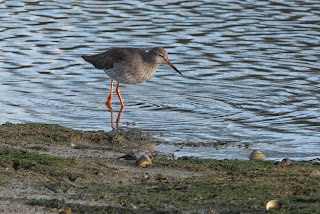
Redshank Tringa totanus

Sunday 9 January

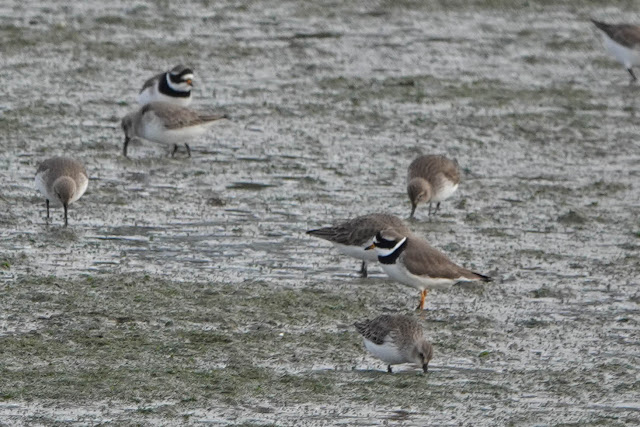
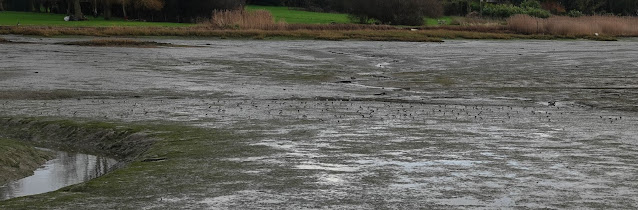
Beautiful, sunny start to the day with lovely blue skies but by the time we were ready for a late morning walk, some cloud had arrived to partially block the sky and it still felt much colder than the reported temperature. By 1 o'clock Jenny and I were by the ferry pier having already seen both Magpie and the first of many Black-headed Gulls.  A Little Egret was sleeping on the bank of an empty muddy creek on the meadow side of the path and ere long we were also seeing regular Redshanks. With the tide almost in and relatively little exposed left for the feeding waders we saw a good number of Dunlin and the main flock, probably exceeding an hundred individuals, was further upstream on the mud flats to the meadow side of the path.  Amongst the Dunlin the occasional Ringed Plover and a couple of Greenshank.  

Ringed Plovers T.totanus with 5 Dunlin Calidris alpina

Near the water's edge we had our first sighting and counted fifty Wigeon.  On the opposite side of the inlet almost as many Teal along with a Curlew and an Oystercatcher.  Moving on we had a couple of Brent Geese and then at the seaward end on a neighbouring large garden fourteen Canada Geese and a half-dozen Wood Pigeon.  Lots of Carrion Crows moving about the general area as we made our way to the conservation area.

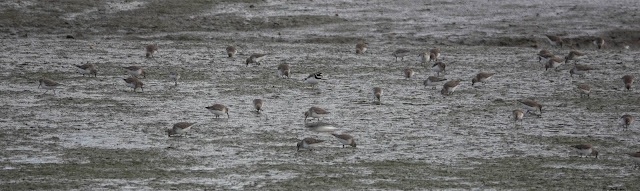
A section of the large feeding Dunlin C.alpina flock

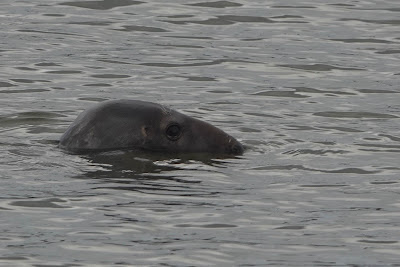
Once at the conservation area I thought I had a distant glimpse of a Little Grebe on the main river but is seemed to disappear for more than the expected time under water.  Eventually the "shape" reappeared to reveal itself as a Grey Seal and whilst waiting for a second, longer surface a Little Grebe did appear on the scene.

Grey Seal Halichoerus grypus in the Hamble river

Meanwhile, on the mudflats on the meadow side of the path hundreds of Dunlin with a smattering of both Ringed and Grey Plovers.  In addition a couple of Oystercatchers and more Curlew along with the main resting flock of both Wigeon and Teal. A lone Heron was eventually found hiding in the long grass at the back o0f the meadow and as we mad our way home, not only a pair of Greenshank just waiting to be photographed but also a Great Spotted Woodpecker hammering away in the trees at the back.  Nineteen species but still an enjoyable walk and that sighting of both the close Greenshanks and the Common Seal made it all most worthwhile.

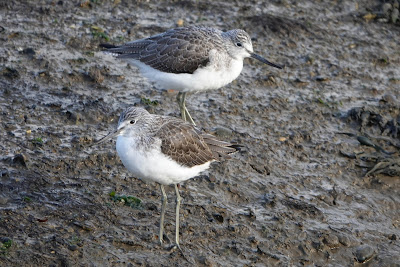
Greenshanks Tringa nebularia

Birds seen:

Brent Goose, Canada Goose, Wigeon, Teal, Little Grebe, Little Egret, Heron, Oystercatcher, Ringed Plover, Grey Plover, Dunlin, Curlew, Black-headed Gull, Herring Gull, Wood Pigeon, Great Spotted Woodpecker, Magpie, Carrion Crow.

Feeding Dunlin and Ringed Plover on Bunny Meadow

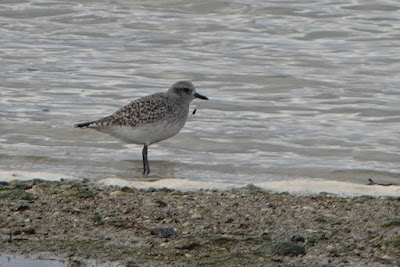
Grey Plover Pluvialis squatarola

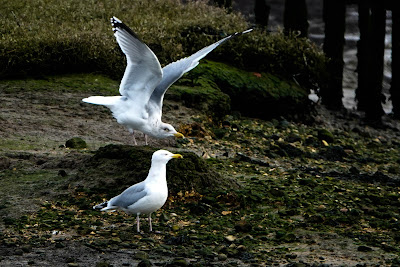
Herring Gulls Larus argentatus

Distant record shot of the Little Grebe Tachybaptus ruficollis

Check out the accompanying website at http://www.birdingaxarquia.weebly.com for the latest sightings, photographs and additional information

Friday, 7 January 2022

Hook with Warsash Nature Reserve

 Friday 7 January

A little later leaving than I had hoped but the sun was shining in some blue sky as I finished my breakfast but when Jenny dropped me off at the top of Workman's lane to walk a complete circuit around the perimeter of Hook with Warsash Nature Reserve it had clouded over somewhat and you could really feel the chill factor in the light, but increasing, wind reducing the temperature to nearer 1C.  Thank good ness for the jumper, sleeved fleece and sleeveless birding coat on top, not to forget the beany to keep my head warm!  Immediately a small flock of Jackdaw along with both Blue and Great Tits in the hedges on the way towards the sea.  By the time I reached the end of the road to take the narrow lane I had also recorded a trio of Curlew foraging a small pool to my right whilst on the main field to the left a dozen or more Black-tailed Godwits were feeding in the flooded dips.  Also present over a score of Carrion Crow along with the first Magpie of the day and a couple of Wood Pigeon.  A Pied Wagtail made a hurried departure as did the flock of forty Starlings.

Curlew Numenius arquata

Once on the shore of Southampton Water I immediately had a feeding flock of over forty Sanderling accompanied by almost fifty resting Oystercatchers.  On the water to my left a flock of 70 Canada Geese were paddling out to sea and eventually arrived at a very small shingle island where they tried to join the Cormorant and a pair of Greater Black-backed Gulls.  Interestingly, it was whilst the Canada Geese were paddling out to sea that I picked up the two smaller "black blobs" and quickly identified a pair of Common Scoter.

Sanderling Calidris alba

Continuing along the shore with the now cold and strong breeze coming in straight off the water, I soon also added a few Redshank and a dozen or more Turnstone.  Approaching the scrape I found a single Little Egret on the small, meandering pond and quickly followed by a (true) pair of Stonechat.  The scape itself was fuller than I had ever seen on previous visits with no islands exposed.  Black-headed Gulls were perched on the few exposed post tops and a number of the Canada Geese had arrived. Just before moving on s I brought the notebook up to date a Little Grebe surfaced on the water to my right.

Oystercatcher Haemantopus ostralegus

All then very quiet until I reached the mudflats between the spit and School of Navigation where, after noting the two score Wigeon and a Curlew on the inlet stream, I found the main Brent Geese flock along with many more Oystercatchers and Black-headed Gulls.  Also present a number of Teal, a few Mallard and the occasional Carrion Crow.  However, the highlight was most probably the lone Bar-tailed Godwit at quite close quarters.  Amazing the birds you see when you deliberately leave the camera at home!  As I assed the slipway a Rock Pipit landed then flew across the track in front of me and the footpath past the Strawberry Fields produced a Dunnock and I was not surprised that there was still a Robin singing away from the top of the lobster pots opposite the sailing club.

Brent Geese Branta bernicla

With the circuit completed in ninety minutes and still no sign of the expected rain. rather than straight into the house I took the footpath down to he lower Hamble and walked up river as far as the conservation area and back.  Another thirty-five minutes to try and locate some of the birds I had not seen on the above circuit.  And I was certainly not disappointed as I added a further eleven species. First the flock of seventy Dunlin gradually being pushed up by the rising tide and quickly followed by a couple of Herring Gulls.  A little longer before I located three Grey Plover and then a mixed flock of Ringed Plover and Dunlin on the muds in front of Bunny Meadow.  But of all the birds seen in this final half-hour including very many Wigeon and Teal, more Curlew, Brent Geese and lots of Turnstones and Redshanks, the pick of my selection was probably the pair of resting Greenshank. A lovely morning's birding and still no rain, even if very cold.

Greenshank Tringa nebularia

Birds seen:

Brent Goose, Canada Goose, Gadwall, Wigeon, Mallard, Teal, Common Scoter, Cormorant, Little Egret, Oystercatcher, Ringed Plover, Grey Plover, Sanderling, Dunlin, Black-tailed Godwit, Bar-tailed Godwit, Curlew, Redshank, Greenshank, Turnstone, Black-headed Gull, Greater Black-backed Gull, Herring Gull, Wood Pigeon, Rock Pipit, Pied Wagtail, Dunnock, Robin, Stonechat, Blue Tit, Great Tit, Magpie, Jackdaw, Carrion Crow, Starling.

 Check out the accompanying website at http://www.birdingaxarquia.weebly.com for the latest sightings, photographs and additional information

Thursday, 6 January 2022

Lower Hamble River

Black-tailed Godwit Limosa limosa

 Thursday 6 January

Something by way of a change this morning in order to get my birding walk in before the expected rain arrives around midday.  Rather than a return walk from home up the Hamble River I left the Robin happily eating breakfast on the garden feeder and caught the Southampton bus to Bursledon, where the main A27 crosses the Hamble.  Then a straight forward walk down to Warsash, almost at the confluence with Southampton Water.  Cloudy but calm weather but whilst the temperature might be stated as being as high as 4C, the overnight hard frost, still lots of ice about, and the chill factor made it seem nearer zero.

Male and female Teal Anas crecca

As soon as alongside the river a quartet of Black-tailed Godwits along with a couple of Teal and Mallard plus the ever-present Black-headed Gull.  A Carrion Crow was foraging in the lawn in front of me and once round the first bend, where I found both Blue and Great Tit, I came across a mixed collection at the water's edge including a Mute Swan, pair of Gadwall and more Black-tailed Godwit, Teal and Mallards.  

Mute Swan Cygnus olor entering "Teal creek"

Onwards and ere long I had found the first of many feeding Brent Geese but today in small rather than large groups.  The occasional Redshank on the mud and then the first of many regular sightings of the large Wigeon flock along the lower river.

Brent Goose Branta bernicla

Lovely to come across the first of the morning's Curlews and away to my left a Great Spotted Woodpecker was banging away in the old trees.  Arriving at the conservation area I found the usual occupants plus a single Little Egret and a couple of Oystercatchers.  Interesting to see the seven Canada Geese (where were the rest f the flock?) but they departed as I approached along the main path. In the grass next to the little creek a trio of resting Herons.

Herons Ardea cinerea

Having caught the briefest of sighting of the Rock Pipit that had been disturbed by a walker approaching me, I next stopped to take a prolonged look at the small waders feeding on the muddy flat of Bunny Meadow.  Tightly grouped, there must have ben over fifty Ringed Plovers along with maybe a score more of Dunlin.  And when they decided that they preferred the water's edge, what a lovely sight to follow the massed flight.

Ringed Plovers Charadrius hiaticula and Dunlins Calidris alpina

The rest of the walk produced many more of the same but eventually the first Grey Plover and three Little Grebes fishing on the open river.  A Pied Wagtail flew out from beneath my feet and over the exposed mud which led me to discover almost a score of foraging Turnstone.  And so back to the bungalow having recorded 26 species in my slow walk downstream from Bursledon.

Turnstone Arenaria interpres

Birds seen:

Brent Goose, Canada Goose, Mute Swan, Gadwall, Wigeon, Mallard, Teal, Little Grebe, Little Egret, Heron, Oystercatcher, Ringed Plover, Grey Plover, Dunlin, Black-tailed Godwit, Curlew, Redshank, Turnstone, Black-headed Gull, Wood Pigeon, Great Spotted Woodpecker, Rock Pipit, Pied Wagtail, Robin, Blue Tit, Great Tit, Carrion Crow.

Curlew Numenius arquata


Gadwall Anas strepera with Black-headed Gull Larus ridibundus and Black-tailed Godwit

Feeding Dunlin Calidris alpina

A Brent Goose lost amongst the foraging Dunlin

Check out the accompanying website at http://www.birdingaxarquia.weebly.com for the latest sightings, photographs and additional information

Wednesday, 5 January 2022

Titchfield Area, Hampshire

Eider Ducks Somateria mollissima at Meon shore

 Wednesday 5 January

I knew it was going to be cold this morning so lots of thick jumpers on before venturing out to the car and clearing the ice off the windscreen.  Just the bare 5C when I set off for Titchfield to walk the canal path to the coast - and wearing gloves!  However, it was not to be as about 1500 metres into the walk the path became just too muddy to continued so returned to the car park and drove to the Mean shore at Titchwell Haven on the Southampton Water for a forty-five minutes stay as the water was approaching high tide.

As I arrived at the car park there were Jackdaws in the neighbouring field and a couple of Starlings on the nearby houses.  Certainly no shortage of Wood Pigeons, most still resting in the trees alongside the narrow canal along with very regular sightings of the many Robins and Blackbirds.  No sooner had I assed through the double gates than a small charm of Goldfinches flew into the tree on the other side of he canal, so revealing the feeding Long-tailed Tit.  Further back a small party of Brent Geese were heading towards the shore and a couple of Carrion Crows could be seen.  Time then to stop and admire the resting Barn Owl in its favoured hole in the dead tree at the back of the meadow.  (What a shame that there are so many small twigs on the trees on the far bank so preventing  clear line of sight of for the camera.)

Barn Owl Tyto alba

On the large pond away to my left at least seventy Canada Geese along with very many Black-headed and a few Herring Gulls.  the return walk also saw me find a quartet of Lesser Black-backed Gulls.  Along with the gulls and geese maybe as many as thirty Wigeon and a handful of Teal, not to mention the Coots.  Continuing on down the path a number of Dunnock and Wrens plus a male Chaffinch. Also noted many Blue, Great and Long-tailed Tits.  On the way back I was to see a surprising Chiffchaff feeding in the tree top and as I pondered why another quintet were found feeding in the low vegetation on the other side of the canal.  This time it was Greenfinch that provided the variety. 

Approaching the car park on the return walk I found a couple of Common Gulls feeding in an empty field of grass and then stopped for another long look at the Barn Owls, yes two in the roosting hole, and noted the Stonechat midway from canal to dead tree.  At the same time a flock of twenty Lapwing flew down to the large pool behind me where they were greeted by a few Mallard and many Wigeon.

Many of the Turnstone Arenaria interpres roosting flock

Driving to relatively nearby Titchfield I parked above the shore on Cliff Road so giving a panoramic view over the Solent below.  With the use of the scope I soon found the quintet of Eider Ducks and, having taken my photograph, continued on down the hill to check the shore birds. Walking through the Titchfield haven Visitors Centre I encountered more Robins along with both Dunnock and House Sparrows.  The harbour beach was almost under water so pushing the Mallards and over forty Turnstones up nearer to the road.

Dunnock Prunella modularis

Next across the road to the viewing point overlooking the large pool at the end of the Meon river where I found Mallards, Gadwall, Shelduck, Shoveler and Coots.  A couple of Oystercatchers on the small island along with many Lapwing and Black-headed Gulls.  Also present a single Little Grebe, a single sleeping Black-tailed Godwit and a trio of Cormorant plus, further upstream, a handful of Canada Geese.

Can you find at east five species including Oystercatcher Haematopus ostrallegus?

Meanwhile, the harbour was rapidly filling and I noted the two Mute Swans.  On the beach behind, the photographer at the water's edge was rather a "give away" as he was trying to photograph a sleeping flock of about forty Sanderling.  Fortunately, I managed to get a record shot before the gentleman continued to approach the birds so moving them to the next section of beach where I was also able to identify a number of Ringed Plovers in the flock but then the step too far, so preventing me getting my more distant photograph as the whole flock took to the air and moved out to sea and away south.  Only forty-five minutes on site but a total of 25 birds recorded to make a morning total of 41 species.

Record shot f the sleeping Sanderling Calidris alba

Birds seen:

Brent Goose, Canada Goose, Mute Swan, Shelduck, Gadwall, Wigeon, Mallard, Shoveler, Teal, Little Grebe, Cormorant, Coot, Oystercatcher, Ringed Plover, Lapwing, Sanderling, Black-tailed Godwit, Turnstone, Black-headed Gull, Lesser Black-backed Gull, Herring Gull, Feral Pigeon, Wood Pigeon, Barn Owl, Wren, Dunnock, Robin, Stonechat, Blackbird, Chiffchaff, Long-tailed Tit, Blue Tit, Great Tit, Magpie, Jackdaw, Carrion Crow, Starling, House Sparrow, Chaffinch, Greenfinch, Goldfinch.

Female House Sparrow Passer domesticus

Shelduck Tadorna tadorna

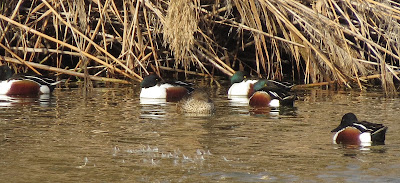
Male Shoveler Anas clypeata

Check out the accompanying website at http://www.birdingaxarquia.weebly.com for the latest sightings, photographs and additional information

Rambla de Almanzora & Vera Playa

 Wednesday 5 January

The start of a new year and Dave and his Arboleas Birding Group were once more out and about.  Reading Dave's report, it sound a s if he is experiencing some of the strong winds that seem to been with us here in the UK for the past fortnight. A smile on my face having just returned from some local birding around Warsash on the south cost of Hampshire this morning to see the number of same specis seen in the two far-apart countries.  Likewise, those common to each other, in my case birds like Dunnock and Wren and with Dave, Black-winged Stilts and Flamingo.  But I shall be back on home territory within the fortnight!

Rambla de Almanzora & Vera Playa: Wednesday 5th January

I hope you all had a lovely Christmas and New Year.  For our first trip of the year we returned to the Rambla de Almanzora.  I travelled alone to the Desert Springs end of it.  It was just after first light.  The wind was howling, but there were lots of pools and puddles in the rambla below me.  I saw Mallard, Teal, a Snipe and Moorhen to start with.  Movement in a shrub revealed a Chiffchaff.  Further along I saw a large shrub with 12 Magpies perched. (12 is for wealth according to Google....hope so!)  Next I had a Collared Dove, followed by an Iberian Grey Shrike.  Seeing lots more Teal . On one of the shallow pools there was a White Wagtail, Little Ringed Plover and Black-winged Stilt.  A Kestrel flew by as did a flock of Northern Starlings.   One of the last pools contained some Shoveler.

Shoveler Anas clypeata

I met Kevin in his campervan travelling the opposite way.  A quick chat, then I continued to the ford where I only had Coot and a Teal.  I parked up and was met by Peter, Kevin and Pete Thom.  Kevin had added a Black Redstart.  A female was seen on the fence posts.

Due to the high winds I decided we'd forgo the walk to the sewage plant and headed to the estuary. From above, Kevin soon spotted a small flock of Dunlin and some Grey Heron.  A Cormorant flew seaward.  I spotted a Sandwich Tern which landed by some gulls.  Mostly Black-headed but also one Mediterranean, a couple of Slender-bills and Yellow-legs.  Peter spotted a Little Egret, then a Greenshank.  We drove round to the beach.  The sea was much calmer here.  There was a Cormorant and a Yellow-legged Gull on the rocks nearest the harbour.  There were about 6 Sandwich Terns on a nearer group of rocks.  I found a Turnstone.  We made for the village for a cup of coffee.

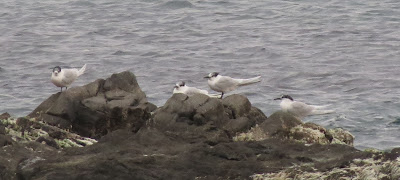
Sandwich Terns Sterna sandvicensis

We then headed for the dual carriageway behind Vera Playa.  Overlooking the shallow pools we saw more Shoveler, Mallard and Teal.  There were numerous Shelduck.  After a bit of a search I managed to find the sole immature Greater Flamingo.  There were at least 4 Little Grebe seen.  I spotted a Marsh Harrier over the far reeds, Peter found a second one.  A small number of Crag Martins were seen.  Kevin spotted a Black-winged Stilt.  I found another Snipe.

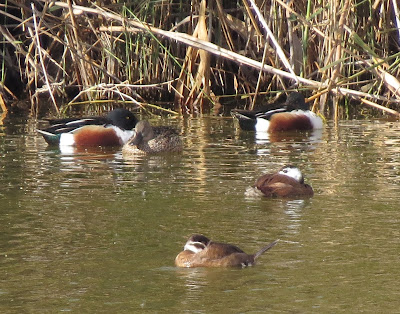
Moving round to the elevated viewing platform by the AcuaParc overlooking the large pool we saw a large number of Shoveler sheltering from the winds.  Peter found some White-headed Ducks.  I identified a female Common Pochard.

White-headed Ducks Oxyura leucocephala (in front)

As the wind was cold and some asking, "Can we go home now?"  we decided enough was enough!
We ended with 33 species.  Despite the cold, windy conditions we had a good day. 
I'm sure some of you older members will remember Norman.  He sadly lost his wife, Gill, over Christmas.  We send our deepest sympathies.
Regards, Dave


Check out the accompanying website at http://www.birdingaxarquia.weebly.com for the latest sightings, photographs and additional information