Thursday, 24 January 2019

Fuente de Piedra & Laguna Dulce with John & Jenny

Wednesday 23 January

Again, whilst down in the Barbate/La Janda area John and Jenny have been out and about and turned up t the  two lagunas the day after me.  However, we saw neither Ferruginous Duck nor Red-crested Pochard but did have Lapwing, Buzzard and Hoopoe.  Great report John.  Now I just have to get my Cadiz province reports completed.

Wednesday 23 January: Piedra & Dulce Lagunas

A very overcast and cold day.

As we had an early appointment in Mollina we arrived at Piedra at 08.45.  As we drove down the access road a female Bluethroat was noted in one of the many boggy areas also here were  Chiffchaff and Chaffinch.  On the flood (or better still ) the flooded meadow to the right of the road we saw Black-winged Stilt, White Wagtails, Meadow Pipits and a Common Sandpiper.

A very cold blustery wind greeted us as we left the car for the boardwalk, above us a large flock of some sixty Jackdaws  swirled  around before landing in the "Stone Curlew" field and Mallard and Shovelers took flight as a female Marsh Harrier came into sight from the laguna direction.  At the boardwalk the water was still very high and the only sightings here were three Chiffchaffs hopping about in the almost submerged bushes.  As we headed towards the laguneto hide another Marsh Harrier came overhead while on the main laguna hundreds of Greater Flamingos were up to their breasts here and also about were Shovelers, Mallard, Teal, Black-winged Stilts and a couple of Shelduck.

Ferruginous Duck Aythya nyroca (PHOTO: Jenny Wainwright)
In the hide and out of the very cold wind we spotted at the back of the laguneto two Ferruginous Ducks, several Little Grebes, Gadwall, Common and Red-crested Pochard, White-headed Ducks, Common Coots and Moorhens along with three or four dozen Greater Flamingos.  Again the ducks took flight as another female Marsh Harrier flew parallel to the railway track.  In the bushes to our front Stonechats, Sardinian and Cetti´s Warblers were logged as well as Robin and Black Redstart.

Distant Red-crested Pochard Netta rufina (PHOTO: Jenny Wainwright)
As we left the reserve a Common Kestrel was seen on the power lines and in the trees by the main road, we spotted Spanish and House Sparrows, Linnets and yet more Chiffchaffs, while on the fields to our left a large number of Stone Curlews were hunkered down in the plough.

Spanish Sparrows Passer hispaniolensis (PHOTO: John Wainwright)
On the way round to the Cantaranas mirador good numbers of Common Cranes were logged as were Crested Larks and more Jackdaws.  At the mirador the wind was really blowing here but we did get some good views of Redwings, Linnets and in the distance Red-crested Pochard and Common Coots were seen.  Not many small birds here as there was men collecting the olives.  We then took the road across to Campillos and Laguna Dulce, en route we spotted a pair of Ravens feeding near the farmhouse, at the laguna the wind was ripping through the hide and all we could see on the water - which is almost up to the hide itself - were a few White-headed Ducks and Common Coots, with Yellow-legged and Lesser Black-backed Gulls overhead.  Then a huge flock of some four or five hundred Common Cranes took off from the fields across the main road from us, and as we drove along to have a look where they were, the birds joined others and landed in flooded field across from the laguna.  

Common Crane Grus grus PHOTO: John Wainwright)
We then took the track round the back of the laguna, here we found two Great White Egrets, Cattle Egrets, more Common Cranes, Lapwings, Mallard and Shovelers.  Across the track Red-legged Partridges were noted and in the olives Blackcaps, Corn Buntings and Iberian Grey Shrike were seen.

Great White Egret Egretta alba PHOTO: John Wainwright)
Another quite productive visit to the lagunas, a pity about the very cold wind, as it kept a lot of the small passerines hidden.


Check out the accompanying website at http://www.birdingaxarquia.weebly.com for the latest sightings, photographs and additional information

Sierra Maria & Villaricos with the Arboleas Birding Group

Wednesday 23 January

Double report from Dave and his Arboleas Birding Group this week whilst I was down in barbate/La Janda, Cadiz province.

Day one  -  Sierra Maria day trip with Paul   -   Tuesday 22nd January
Day two  -  Villaricos & Vera Playa with Arboleas Birding Group  - Wednesday 23rd January

Well, it had to be done. Gilly's away for the week and Reyna is still in the Philippines, so Paul and I hatched a plan to have a days birding in the Sierra de Maria.  I picked Paul up from his house in Cerro Gordo.  We took the road from Partaloa towards Chirivel.  We hadn't even reached Oria when a juvenile Golden Eagle, which must have been perched close to the road, took off and crossed the road in front of us at about 6 metre altitude!  A great start to the day.  We carried on to Chirivel and took the road under the motorway and up towards the mountain ridge.  On some fields to our right I spotted a group of feeding black birds.  Red-billed Chough.  One of our target birds of the day...and there were 120 of them!  As we watched and took photos from about 200 metres away, they all suddenly took off.  We couldn't see any reason.  A bit further on we did see a few Griffon Vultures above the ridge, one gliding low along the slope.  We also added a Black Redstart.  It was very cold which may explain the lack of birds.  We reached the farm water trough, one of our usual stops.  The small water deposit had a thin layer of ice covering it.  Apart from Chaffinch and some perched Corn Buntings, Paul spotted an Iberian Green Woodpecker flying away.  Some Linnet came to rest on the fence surrounding the water.
Corn Bunting Emberiza calandra (PHOTO: David Elliott-Binns)
We moved on to the plain, seeing more flocks of Linnet, Northern Starlings, Carrion Crows and a Hoopoe.  Down at the hamlet we found Thekla Lark, Rock and House Sparrow.  We headed back to the La Piza forest cafe for a reviving cup of coffee.  There was still no food in the bird feeders but we did see Greenfinch, Chaffinch, Crossbill and Robin.   Paul spotted a Blue Tit.
Leaving La Piza, we turned left towards Maria town, but turned left again towards La Canada de Canepla.  Driving there and beyond we added a Magpie and a flock of 100+ Calandra Lark.  We returned to the village and took a well made track to the right which took us back via the runway to the road a few kilometres past the hamlet.  This road had lots of varying habitats including running streams, reed beds and cliff faces, on which Paul spotted a Black Wheatear.  Also seen were numerous Magpies and a Kestrel.  Heading back to the hamlet we saw more Griffon Vultures and a Stonechat.  Now hungry, we thought we'd go to the campsite for lunch only to discover the cafe was closed Tuesdays!  So it was back to La Piza where we added a Great Tit to the list.  We then headed back over the mountain track seeing the Griffon Vultures again but no Red-billed Chough.  We did however flush two Red-legged Partridge to complete our list for the day.
Red-billed Choughs Pyrrhocorax pyrrhocorax (PHOTO: David Elliott-Binns)
 A modest 26 species, but we did source more places to visit. It was very cold.  Roll on the spring!
   - - - - - - - - - - - -
Day two started with Richard driving round to my house.  I drove his car to pick up Alec and then Paul.  We then made our way to the Rambla de Almanzora.  We checked it out from the road bridge to the ford.  We saw Magpie, White Wagtail, Mallard and Moorhen.  As we waited in the car for the others to arrive, we spotted Stonechat, Carrion Crow, Serin and Collared Dove.  Alan and John arrived next.  They'd also seen a Booted Eagle whilst passing the Consum Supermarket, a Grey Wagtail in the rambla and a Green Sandpiper at the ford. Once Jacky, together with her in laws, David and April arrived, we walked up the rambla towards the sewage works.  The weather was chilly with a bitter wind, which might explain the lack of small birds, but we did manage to see a Chaffinch, Chiffchaff, Grey Heron and Wood Pigeon.  Paul heard a Blackbird and John spotted a Hoopoe.
At the large pool, there were Mallard, Common Pochard and a pair of Teal.  Two pairs of Black-winged Stilt were on the water's edge.  I spotted a female Blue Rock Thrush on the far embankment. Paul had a Goldfinch.  As we walked back we saw a Green and Common Sandpiper in the water channel together with a Robin.  Alan and John saw a Water Pipit.  We'd seen various flocks of Northern Starlings flying over.
After a cup of coffee in the Lucky Bar in Villaricos village centre, we made our way to the beach.  On the harbour rocks we saw Yellow-legged Gull and Cormorant.  Alan found a Turnstone and a Sandwich Tern was seen fishing.
Cormorants Phalacrocorax carbo (PHOTO: David Elliott-Binns)
We wandered over to the estuary.  Apart from more Cormorant we added Coot and Little Grebe.  Alan and I headed for the beach end where we saw Mediterranean and Audouin's Gull together with resting Sandwich Terns.  Meanwhile Jacky had spotted a Purple Swamphen in the reeds.  Joining us on the beach we checked out the beach rocks and found singles of Kentish and Ringed Plover.  Jacky spotted a Black-necked Grebe on the sea as we got back to the vehicles.
Audouin's Gulls Larus audouinii with Sandwich Terns Sterna sandvicensis (PHOTO: David Elliott-Binns)
We convoyed down to the dual carriageway.   Richard, Paul and I quickly spotted a Grey Wagtail. Ducks included Shoveler, Mallard, Teal and Shelduck.  Numerous Crag Martins were flying around. John and Alan found a Redshank and some Little Stint.   I found a Black-tailed Godwit.  Alan also spotted a Kestrel.  All at once the large flock of mainly Mediterranean Gulls took to the air as an adult light phase Booted Eagle glided slowly over them.
Booted Eagle Hieraaetus pennatus (PHOTO: David Elliott-Binns)
Moving round to the new platform opposite the Acuapark entrance we found more Shoveler and about 35 White Headed Duck.  I spotted another Purple Swamphen on the reed line.  Alan had a pair of Gadwall.  Meanwhile Jacky, who'd walked from the dual carriageway, had seen "her" Red-knobbed Coot.
Purple Swamphen Porphyrio porphyrio [right] (PHOTO: David Elliott-Binns)
We then left, but Alan and John went to the "Millionaires" lagoon where they had Sanderling and a Gannet out to sea.
We saw a grand total of 52 species in good company, but bitterly cold winds!
 
Check out the accompanying website at http://www.birdingaxarquia.weebly.com for the latest sightings, photographs and additional information

Monday, 21 January 2019

Charca de Suarez

Monday 21 January

Running ahead of schedule on my way to an appointment at nearby Velez de Benaudalla so took the opportunity to swing over to the Charca de Suarez reserve near Motril, even if for only ten minutes.  Usual suspects as I approached and entered including White Wagtail and House Sparrow and on departure managed to pick up both a Buzzard feeding on road kill and a trio of over-flying Cattle Egret.

Common Teal Cerceta Comun Anas crecca

However, the the main hide overlooking the Laguna del Alamo Blanco produced a range of water birds including 9 Moorhen, 7 Teal and a couple of Mallards.  Three Snipe bust feeding along the edges and a pair of Purple Swamphens strolled out of the tall grass with that look of love in their eyes - but I think the fellow got the proverbial brush off.  meanwhile, the solitary White Stork remained standing aloof on its reedy island keeping an eye on what the little fellows were up to.

Common Snipe Agachadiza Comun Gallinago gallinago

Making my way back to the car, not only a number of feeding Chiffchafff but a couple of male Blackbirds.  Eleven species in ten minutes.  I wonder if that would equate to 60 if I had an hour to spare!

Birds seen:
Mallard, Teal, Cattle Egret, White Stork, Buzzard, Moorhen, Purple Swamphen, White Wagtail, Blackbird, Chiffchaff, House Sparrow.
 

Check out the accompanying website at http://www.birdingaxarquia.weebly.com for the latest sightings, photographs and additional information

Sunday, 20 January 2019

Fuente de Piedra

Saturday 19 January

Collected visiting neighbour and birder from Holland, Lissette and drove over to Fuente de Piedra for the January meeting of the Andalucia Bird Society.  Cloudy and a coll 12C when we left and still very cloudy and a much colder 7C for the morning.  Approaching the village we recorded both a Red Kite and a Buzzard along with a field of, maybe, 60 or so Cattle Egrets and a single Heron.  A couple of Azure-winged Magpie crossed the road in front of us and the first White Wagtail of the morning was also seen.

Once on site we immediately encountered a mas of gulls on the ploughed field to our right.  Hundreds of both Black-headed and Lesser Black-backed Gulls along with about an hundred Jackdaw.  And patiently roosting in front, in almost a straight line, about fifty Stone Curlew.  The flooded scrape on the opposite side of the road was empty apart from a trio of Black-winged Stilts and a Chiffchaff flitting about in the roadside trees.
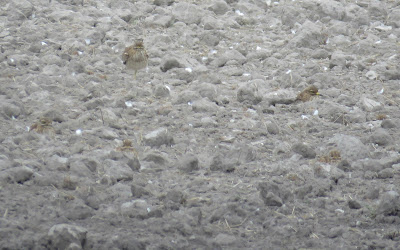
Stone Curlews Alcaravan Comun Burhinus oedicnemus

Once in the car park we picked up both House Sparrows and Black Redstart and could see the resident Rock Doves on the far buildings.  With most of the group heading off for the boardwalk I took myself along the bottom path and up to the laguneta at the back of the Visitors Centre.  So much water at the moment and I have never seen this capacity before; no wonder there were no waders to be seen apart from the Back-winged Stilts.  Thousands of Flamingos on the misty main water along with more gulls.  To the right a score or more of Shoveler plus Shelduck, a few Moorhen and Coot.

Walking to the main hide at the back I came first across a single male Chaffinch and then a fleeting glimpse of a Redwing as it made a hurried departure plus more House Sparrows.  The small pool was not as active as I might have imagined but, in addition to the many Shoveler and Mallard, I did manage to record a quartet of Teal and seven White-headed Duck.  Just the one Little Grebe and more Coots.
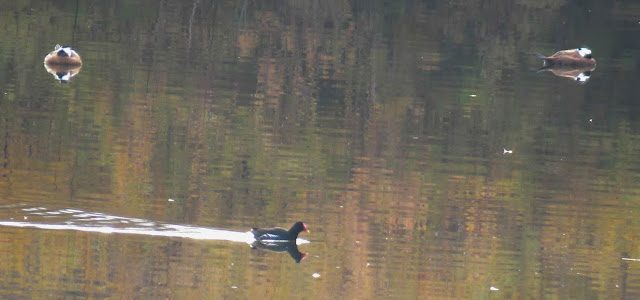
Moorhen Gallinula chloropus with White-headed Ducks Malvasia cabeciblanca Oxyura leucocephala behind

Once back outside the hide I watched the passage of Spotless Starlings and then a Marsh Harrier.  A couple of Blackbirds were resting atop the taller trees and then a charm of Goldfinch and a single female Greenfinch in addition to the feeding Blackcap.  A Sardinan Warbler dashed past in front of me.
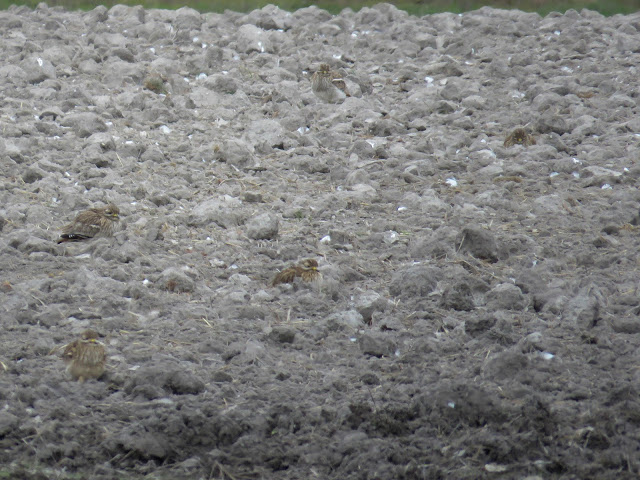
How many Stone Curlews can you find?


A long break for the Annual meeting of the Society and then Lisette and I made our way round the back of the site towards the Laguna Dulce near Campillas.  A Lapwing was at the edge of the flooded field, now on our right, and we we stopped to check out the Stone Curlews, the gulls having already departed to the main water.  A Hoopoe flew through the orchard at the end of the entrance road and no sooner round towards the Mirador Vicaria than we stopped to look at a tree full of Spanish Sparrows.  The posts on newly-planted olive grove produced our first a Iberian Grey Shrike and then a Black Redstart before spotting our first Cranes to the left.   Just a family of three with a further handful a little further on.
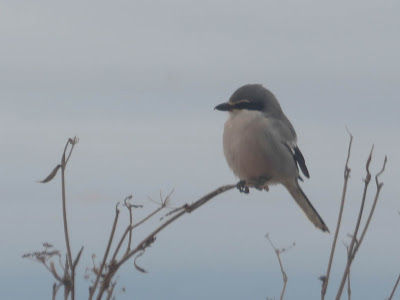
Iberian Grey Shrike Alcaudon Real Lanius meridionalis through the car windscreen
More Buzzards then next up in rapid order was a Wood Pigeon to our right followed by a pair of Linnets.  Stopping to check out a bird on top of a pylon in the misty distance, I took a photo as we could not identify the strange outline.  On enlarging it was quite rewarding to find that we had found our only Mistle Thrush of the day and it became much clearer when it took to the air.  Just before reaching the main road we had a tree full of Corn Buntings and then on to the Laguna Dulce.
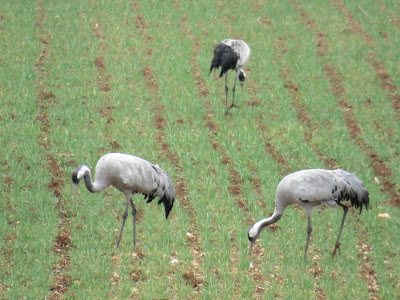
The first Cranes Grulla Comun Grus grus seen this year

My word this lake was full to overflowing; never seen so much water in my sixteen years here.  Mainly Coots on the water but diligent searching with scope and bins soon found at least a quartet of Great Crested Grebes and a large flock of Common Pochard.  At the far back to our right we also managed to find a tight group f about eight Red-crested Pochard.
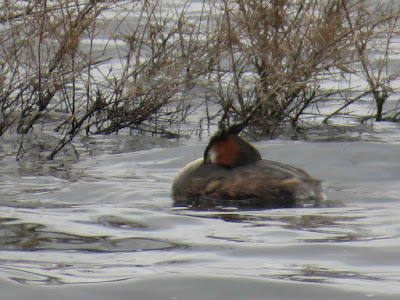
Sleeping Great Crested Grebe Somormujo Lavanco Podiceps cristatus

Looking across to the far side we could see three cars form our group and behind where they had stopped a large flock of Cranes.  What better o do than drive round to the back of this now very large and flooded laguna.  As we left we had a Great Tit and Chaffinch in the neighbouring trees and picked up a Crested Lark once we had entered the track to the back of the water.  The first of two Stonechats were seen and then a Kestrel.  Very late in the day but we were to see three more before our departure for home.  We certainly found the Crane flock.  Fist a group of about thirty but upon turning to drive back along the track and towards the main road we saw another flock of at least 250.  Maybe a hundred metres further on we stopped for another look at what we though t might be the other side of the flock and estimated not hundreds but probably in excess of a thousand individuals.  Wow!  Continuing on we duly picked up the splitting flock of Calandra Larks along with many more White Wagtails.

Cranes Grulla Comun Grus grus seen on the horizon
Given that whilst I was in a committee meeting Lisette manage to record both Bluethroat and Meadow Pipit, we ended the day with a very respectable 51 species and the promised rain did not arrive.
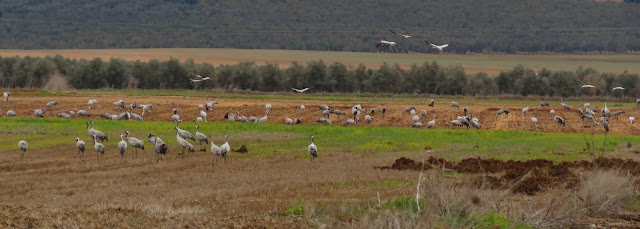
Part of the thousand-plus Crane Grulla Comun Grus grus flock seen in the late afternoon


Birds seen:
Shelduck, Mallard, Shelduck, Teal, Red-crested Pochard, Common Pochard, White-headed Duck, Little Grebe, Great Crested Grebe, Cattle Egret, Heron, Flamingo, Red Kite, Marsh Harrier, Buzzard, Kestrel, Moorhen, Coot, Crane, Black-winged Stilt, Stone Curlew, Lapwing, Black-headed Gull, Lesser Black-backed Gull, Rock Dove, Hoopoe, Calandra Lark, Crested Lark, Meadow Pipit, White Wagtail, Bluethroat, Black Redstart, Sonechat, Blackbird, Redwing, Mistle Thrush, Sardinian Warbler, Blackcap, Chiffchaff, Great Tit, Iberian Grey Shrike, Azure-winged Magpie, Jackdaw, Spotless Starling, House Sparrow, Spanish Sparrow, Chaffinch, Greenfinch, Goldfinch, Linet, Corn Bunting.


Check out the accompanying website at http://www.birdingaxarquia.weebly.com for the latest sightings, photographs and additional information

Thursday, 17 January 2019

Snow Bunting at Last - within Five Minutes of Arriving

Thursday 17 January

Interview with the doctor at the Immunisation Centre in Malaga commenced early and took longer than expected when it turned out that the lovely young doctor was the sister of a local birder who I recognised from her photograph and that we both knew Juan Ramirez who often turns up to my local Rio Velez to undertake some ringing (banding in the USA).  Small world as they say.

Anyway, back on the train to Plaza Mayor where I picked up my car and drove down to the Cabopino Marina well beyond Fuengirola to have a second crack of the whip in trying to locate the visiting Snow Bunting, given that it had been seen again yesterday.

My very first Snow Bunting Escribano Nival Plectrophenax nivalis in Spain

Arriving on site at 1.05 I noticed that there were already ten birders present with their bins, scopes and cameras and all relaxing indicating that the bird might be about but not on site at present.  It seemed an appropriate time to wander back past some of the luxury cruisers whilst I ate my role.  Turning to come back one of the birders was heading towards me and, I assumed, on her way home.  Having asked if she had seen the Snow Bunting, she informed me that it had just flown this way and settled on one of the boats.  Naturally, turned round and got the bins busy.

Found it on the far end of the boat and almost hidden by a railing but I managed to get a quick record shot before it took leave and headed back from whence it had just come.  Therefore, I continued back to the car to discover that the bird was happily feeding with about eight House Sparrows right in front of me; not five metres away.  Now I don't know about you but the name of the boat on which the Snow Bunting alighted was "Captain 4Play" so you can imagine what went through my mind to discover that it led to such close views a minute or two later.  What a little tease this bunting is.


Snow Bunting Escribano Nival Plectrophenax nivalis feeding and rear view
Change camera to Canon EOS 7D: 


In addition to the target bird and House Sparrows I also saw White Wagtail, Cormorant and Rock and Collared Doves.  Leaving for home I stopped at the lighthouse to the west of Fuengirola and also picked up an Audouin's Gull.


Audouin's Gull Gaviota de Audouin Larus audouinii


Check out the accompanying website at http://www.birdingaxarquia.weebly.com for the latest sightings, photographs and additional information

Sierra Tejeda area around Robledal

Wednesday 16 January

John and Jenny Wainwright managed to get up to the woods at El Robledal in the Sierra Tejeda and seem to have found all the specials for this site except, perhaps, Short-toed Treecreeper and Jay - and also no mention of Red-legged Partridge which seems most unusual.  But, nevertheless, lots of lovely sightings.


Robedal area 16th January

A fresh morning but warmed up later.

Rock Bunting Emberiza cia (PHOTO: John Wainwright)
As we left the village of Salar, Collared Doves and Spotless Starlings were noted, along the power lines Mistle Thrushes were in good numbers as were Woodpigeons.  As we neared the first picnic sight a male Sparrowhawk left its pine tree perch and a Common Kestrel was seen.  It was very quiet on the way to Alcazar site, here the usual Crossbills were seen as were Nuthatches, Crested Tits, Coal Tits, Great Spotted Woodpecker and Green Woodpecker.  Walking part of the Botanical route we spotted more Crested Tits, then Blackcaps, Blackbirds, Chaffinches and yet more Crossbills.
Leaving Alcazar towards Vinuela, Rock Buntings and Chaffinches were seen feeding on the banks as was a Robin, while above them in the firs Blue, Coal and Great Tits were logged.

Male Chaffinch Fringilla coelebs (PHOTO: John Wainwright)
We then cut across country to Las Palomas laguna, where we found Mallard, Common Pochard, Little Grebe and Common Coot.

Leaving  Alhama de Granada, we took the old Zafaraya road where we noted Corn Buntings, Crested Larks, Mistle Thrushes and a Sardinian Warbler.  As we reached the top of the hill a female Hen Harrier took off from the field and continued quartering the fields to our left.  In the trees that line the bulldozered rutted track, Chaffinches, Robins and Serins were spotted.  Regaining the Salar road Common Kestrels, Black Redstarts and Jackdaws were noted.

Female Hen Harrier Circus cyaneus (PHOTO: John Wainwright)


Thanks John and quite a few birds in your report that I have yet to see this year.  Ignoring our stay in Germany for the first week of the year, I am yet still to see a corvid but, no doubt, there will be plenty of Jackdaws at Fuente de Piedra on Saturday and maybe a Raven will drift over.  Be good (to see) if there are any Lesser Flamingos on site at the moment.


Check out the accompanying website at http://www.birdingaxarquia.weebly.com for the latest sightings, photographs and additional information

Wednesday, 16 January 2019

Las Norias & Roquetas with Dave

Wednesday 16 January

This week saw Dave and his Arboleas Birding Group visiting that bloomin's awful area that holds the large lake at Las Norias and a follow-om to the waters and salinas of Roquetas de Mar.  Lots of lovely birds and, no doubt, the rubbish will still be about when I visit in mid-February on the way up to Cabo de Gata.


Las Norias & Roquetas   -   Wednesday 16 January

For a change I drove Richard's smart and comfortable vehicle with Paul in the spacious rear seats down to Jct 420, our coffee stop-over and meeting point on the way to Las Norias.  There, we met up with Alan, John and Val. Suitably refreshed we followed them through the back roads to the first causeway.  We immediately saw Collared Dove, Serin, Crag Martinand  Chiffchaff. Richard spotted a Black Redstart.  I scanned the far end of the left hand lake.  There was a long line of "Barnsley penguins" ( Cormorants!) sitting on posts and other perches.  I counted 142.  That number did not include any on the water or more we saw later.  In all there must have been at least 300 spread between the three lakes.  Also seen were Black-headed, Yellow-legged and Lesser Black-backed Gulls, Coot, Little Grebe, Grey Heron and Mallard.  Paul spotted a lovely female Marsh Harrier.  He was also first to spot one of the two Whiskered Terns feeding nearby.  Moving over to the right hand lake, Alan reeled off Black-necked and Great Crested Grebes plus Shoveler.  He next found a Grey Wagtail.  John added a Stonechat.  Also seen were House Sparrow, White Wagtail and Moorhen.
Moving to the viewing point half way round the right hand lake, we were disgusted by the amount of plastic and tin rubbish in the area.  The amount of discarded tyres by the waters edge was beyond belief.  We added Northern Starling.  John, Alan and Val also had Snipe and Kingfisher before we got into position.

Great Crested Grebe Podiceps cristatus (PHOTO: David Elliott-Binns)
We moved onto the opposite end of the Plastic Recycling factory pool.  Here again there were huge piles of discarded plastic sheeting not 400 metres from factory.  We added Red-crested and Common Pochard.  We also saw Grey Heron and heard Cetti's Warbler.  Driving to the small bridge end, 6 Teal flew over.  John saw a Black-winged Stilt and Richard, a Wren.

Red-crested Pochard Netta rufina (PHOTO: David Elliott-Binns)
We then followed the others to Roquetas via a coffee stop in San Augustin.  We added Jackdaw and Magpie on the way.  We commenced birding at the far end of the salinas.  As we started to drive across the causeway towards the lighthouse we could see two raptors above us dogfighting in front of the sun.  Stopping we had great views of a dark phase Booted Eagle putting a valiant defense against a Peregrine Falcon, but it did lose a few feathers!  The Greater Flamingos ignored them.  As we drove on, a Water Pipit was seen nicely perched.  Before we got to the small parking area, Paul had already seen a Purple Swamphen.  Getting out of the vehicles, we got attacked by mosquitoes.  Paul eventually managed to show me the elusive bird hiding in the reeds.  The rest wandered further along seeing two more. We then retraced our steps and headed to the next stop, seeing a Kestrel perched on a power line.  Getting out of the vehicles, we saw a Zitting Cisticola.  Moving on to the causeway, Alan found a Redshank and John, an Audouin's Gull amongst the hundreds of resting Lesser Black-backs. About half a dozen Marsh Harriers were quartering in the area, putting up various flocks of birds.  We struck gold when a flushed group of 11 Spoonbill flew over.  Amazingly I got a good photo with a point and hope shot!

Spoonbills Platalea leucorodia in flight (PHOTO: David Elliott-Binns)
We then moved round to the main lake nearest the hotels, seeing Iberian Grey Shrike and Hoopoe on the way.  There must have been a thousand Black-headed Gulls and five hundred Coot on the water, but the biggest surprise was the 100+ Gadwall.  Also seen were Little Grebe, Mallard and Common Pochard.  Last bird on the list was a Blackbird.
Gadwall Anas strepera (PHOTO: David Elliott-Binns)

We ended with 49 species. A very good days birding in good company.
Regards, Dave
Sounds like yet another good day out Dave and in special company.
Check out the accompanying website at http://www.birdingaxarquia.weebly.com for the latest sightings, photographs and additional information