Monday, 9 May 2022

El Fondo, Elche

 Monday 9 May

Looks like friend Dave Elliott-Binns had a bonus birding visit s a result of a visit to Alicante airport!  All being well, I shall have a very similar experience when I drop Jenny off at the same airport around 5pm on 25th of this month.  Unlike Dave, I shall be staying overnight in a nearby hotel so, all being well, might get in both an evening and morning visit to the El Fondo reserve before driving back to Granada province.

El Fondo, near Elche:  Monday 9th May

A friend of ours was flying out of Alicante so I reluctantly volunteered to drive him there (ha, ha!).  As I was passing El Fondo it would've been rude not to pop in.  A reasonably early start from Arboleas saw me at the airport by 9am.  I headed back to Jct 526 and headed for the El Fondo Bird Reserve's information centre.  En route there I observed a Woodpigeon, Collared Doves, House Sparrows, a single (and my only) Barn Swallow and the first of a number of flying Glossy Ibis.  I parked up in the carpark for a Thermos coffee.  I could hear very noisy Black-winged Stilts.  Suitably refreshed and covered in anti mosquito spray, I checked out the wetland opposite.  Sure enough I found the Stilts together with Coot, Moorhen and a solitary male Red-crested Pochard.  I carried on round toward the Information Centre seeing some flying Black-headed Gulls.  From the observation area by the picnic tables I was disappointed to see the small pool was covered in blanket weed.  As well as more Coot and Moorhen I saw one Marbled Duck and the backside of a Purple Swamphen disappearing into the reeds!

A vociferous Great Reed Warbler  (PHOTO: David Elliott-Binns)

I carried on, walking along the wooden walkway.  A Blackbird flew by.  On the water there were more Coot and Moorhen, Common Pochard and  a swimming Avocet.  It was impossible not to hear the Great Reed Warblers.  There seemed to be one singing from each reed patch.  Some showed well from reed tops, but of course the sun was in the wrong place!  I found a Little Egret which was joined by a Squacco Heron. 

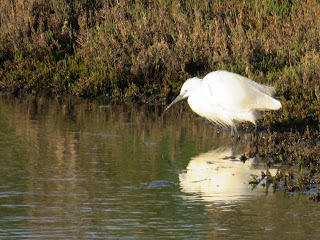
Little Egret Egretta garzetta (PHOTO: David Elliott-Binns)

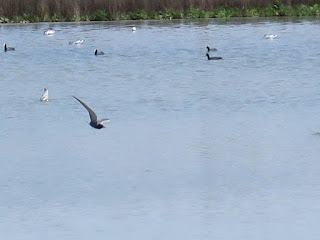
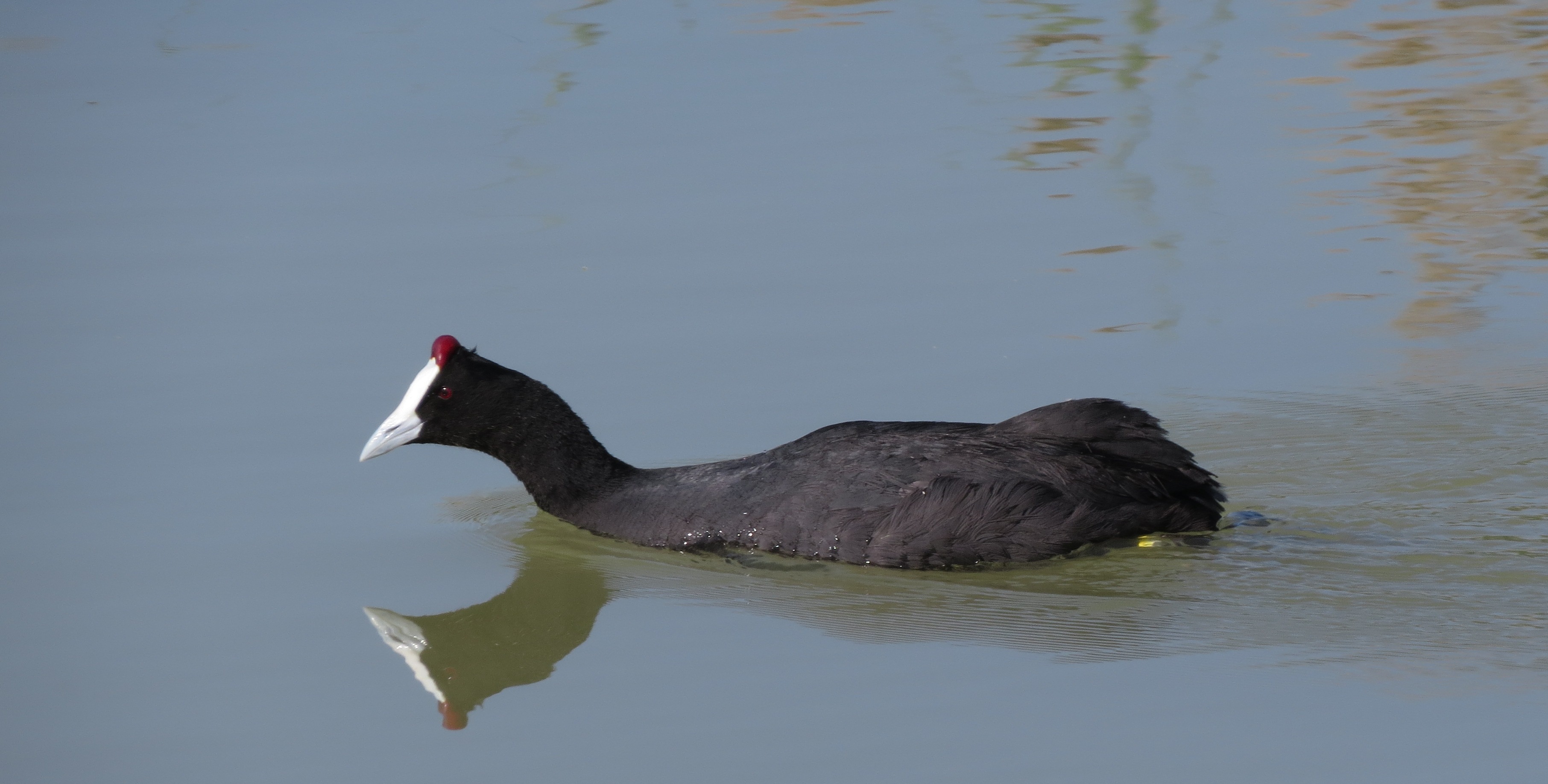
A single Whiskered Tern was quartering the water.  I heard some Cetti's Warblers.  A Shelduck landed on the water.  Further round, near the observation platform, I had close views of Red-knobbed Coot and three Marbled Duck.  Also seen were flights of Glossy Ibis, Common Swifts and Crested Larks.

Red-knobbed Coot Fulica cristata (PHOTO: David Elliott-Binns)

I walked to the far hide first.  There was a good number of Greater Flamingos feeding and Avocets nesting on the nearby island.  A Whiskered Tern was perched on a post.  On the water I saw White-headed Duck, more Marbled Duck, Shoveler and a Black-necked Grebe with a chick's head poking out of its back.
Whiskered Tern Chlidonias hybrida (PHOTO: David Elliott-Binns)

Moving back to the other hide I added Grey Heron and a Little Grebe.  Nice to see more Marbled Duck. On the way back to the car I saw a Reed Warbler, an overflying Cattle Egret and a Corn Bunting resting on a fence post.

Marbled Duck Marmaronetta angustirostris (PHOTO: David Elliott-Binns)

In the hour and a half I was there I accumulated 33 species.  It was quite hot.  Glad I was there early!
Regards
Dave


For the latest news follow the Axarquia Birds and Wildlife Facebook page for more photos and comments and the opportunity to share with the wider birding world.

Friday, 6 May 2022

Guadalhorce, Malaga

Thursday 5 May

A very warm and sunny late afternoon so not the best time of day to be visiting the Guadalhorce in Malaga. But with Jenny arriving the airport at 7.30 an opportunity not to ne missed as I arrived ion site a few minutes after 5pm. Crossing the footbridge still plenty of House Martins collecting mud to build/reinforce their nests under and on the lower part of the bridge.  A handful of Monk Parakeets crossed over above me as I made my way to the eastern canal and hides along with the first of very many Spotless Starlings.  Approaching the Casillas Hide some feeding House Sparrows but very little on the pool itself; a couple of Coot and a Moorhen plus three drake Mallards. A Little Egret was glimpsed at the far left-hand edge.

Spoonbill Platalea leucorodia

Moving on to the Wader Hide a Cetti’s Warbler was calling to my left and once settled in the hide immediate close views of both a Spoonbill and Great White Egret.  A Little Egret was resting in the tree on the main island and a second individual at the back of the water. 26 Black-winged Stilts were counted.  Reed Warblers seemed to be calling from every reeded area on the reserve as a Collared Dove flew across the water.

Great White Egret Egretta alba

Once opposite the Rio Viejo (Old River) another dozen Black-winged Stilts along with a couple of Shelduck and small waders including Redshank, Dunlin, Curlew Sandpiper and Ringed Plover. On to the Sea Watch passing a couple of Goldfinch but all that was revealed were the eight Sanderling working the nearby beach.

Little Egret Egretta garzetta

Making my way back by the same route I encountered a Common Sandpiper at the Wader Pool plus recording Greenfinch, a male Sardinian Warbler and an over-flying Yellow-legged Gull. So on to the Escondida Hide with a Blackbird on the approach track and many more Spotless Starlings. The main attraction here was the flock of fifteen male Pochard along with a couple of White-headed Ducks and the occasional Moorhen and Coot.

Common Pochards Aythya ferina on the Laguna Escondida

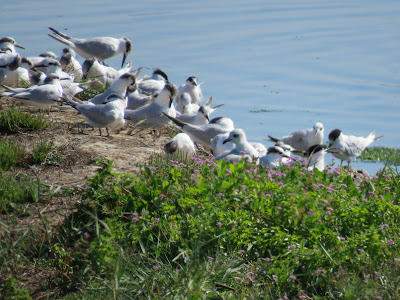
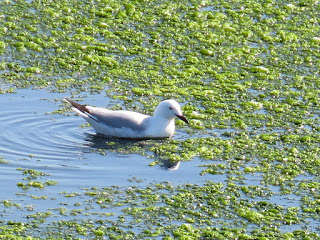
Come the Laguna Grande and, once again, the massed resting flock of Sandwich Terns on the island immediately in front of the hide.  A couple of Whiskered Terns were working the water and a further36 Black-winged Stilts noted.  Dotted around were a number of Black-headed Gulls and even a quartet of Cormorant.  Still a couple of Slender-billed Gulls and a single Flamingo flew across the trees at the back.

Mainly Sandwich Terns Sterna sandvicensis

Then the specific, closer check of the resting Sandwich Terns produced first a Common Sandpiper then a single Collared Pratincole.  

Collared Pratincole Glareola pratincola

Meanwhile, at the very back of the water, a Kestrel alighted in the top of the tallest bare tree and to the right of the small island at the far right, now under water, a movement in the overhanging branches resting in the green water revealed a Squacco Heron. A Red-  rumped Swallow made a pass in front of the hide returning with a couple of minutes but not to be seen again.  And so time came to make my way back and onwards to my appointment with the arriving plane from Bournemouth when a Great Tit crossed the track to the bush in front of me and notched up the 40th species in just two hours at the reserve.

Whiskered Tern Childonias hybrida

Birds seen:

Shelduck, Mallard, Pochard, White-headed Duck, Cormorant, Squacco Heron, Little Egret, Great White Egret, Spoonbill, Flamingo, Kestrel, Moorhen, Coot, Black-winged Stilt, Collared Pratincole, Ringed Plover, Sanderling, Curlew Sandpiper, Dunlin, Redshank, Common Sandpiper, Black-headed Gull, Slender-billed Gull, Yellow-legged Gull, Sandwich Tern, Whiskered Tern, Collared Dove, Monk Parakeet, Barn Swallow, Red-rumped Swallow, House Martin, Blackbird, Cetti’s Warbler, Reed Warbler, Sardinian Warbler, Great Tit, Spotless Starling, House Sparrow, Greenfinch, Goldfinch.

Black-winged Stilt Himantopus himantopus


For the latest news follow the Axarquia Birds and Wildlife Facebook page for more photos and comments and the opportunity to share with the wider birding world.

Thursday, 5 May 2022

Rio Guadalfeo, Velez de Benaudalla

Thursday 5 May

At last the sun has reappeared and we have lost the cloudy, very wet weather. Down to the northern end of the village to drive the track from the main road alongside the western side of the Rio Guadalfeo to the end, about 400 metres beyond the water control at the southern exit from Velez de Benaudalla.  As soon as I started I had numerous calling Chaffinches along with White Wagtail, Blackbird and Collared Dove.  Stopping at the picnic area no Dipper but both Hoopoe and the first of five Golden Orioles. No shortage of House Sparrows plus a smattering of Spotless Starlings and the occasional Great Tit.  However, bird of the site and morning was the Short-toed Treecreeper that appeared immediately on front of me.

Male Blackbird Turdus merula

Continuing on down the track a few Cetti’s Warblers and at the turn back to the main road a small flock of Serin and another White Wagtail alongside the many House Sparrows.  Approaching the water control works a Little Ringed Plover was patiently waiting for me to pass and I suspect is actually nesting on the gravelled area, presumably a former car park.  A Common Sandpiper flew away in front of me as I climbed the steps to check out the holding ponds and, once on top, recorded a second Common Sandpiper along with a male Mallard and pair of Coot.

Little Ringed Plover Charadrius dubius

A first of two Grey Wagtails was seen on the far side with the second on the track itself on my return journey. A number of Reed Warblers were singing/calling from the reed bed and having reached the end of the track and turned to return the same way, I found a couple of Goldfinch at the turn to the main road.  Back on to the picnic area where I was able to find my first Spotted Flycatcher of the year at this site plus a singing Nightingale.  Then it was back to the apartment in the village where, as when I set off, the House Martins seemed to be extremely active.

Spotted Flycatcher Muscicapa striata 

 Birds seen:

Mallard, Coot, Little Ringed Plover, Common Sandpiper, Rock Dove, Collared Dove, Hoopoe, House Martin, Grey Wagtail, White Wagtail, Nightingale, Blackbird, Cetti’s Warbler, Reed Warbler, Great Tit, Short-toed Treecreeper, Spotted Flycatcher, Golden Oriole, Spotless Starling, House Sparrow, Chaffinch, Serin, Goldfinch.

For the latest news follow the Axarquia Birds and Wildlife Facebook page for more photos and comments and the opportunity to share with the wider birding world.

Wednesday, 4 May 2022

Las Campinuelas, Algarrobo

 Wednesday 4 May

Car serviced by midday and the rain appearing to ease back so decided I would return home via the Camino de Algarrobo which takes me through a former enjoyed birding site, Las Campinuelas.  But would the Bee-eaters be using this site once again?  They certainly would!  Arriving at the western end near Velez Malaga i stopped to admire a Kestrel on top of a pylon and looking quite forlorn following all the heavy rain.  Looking around me I also found many Collared Doves and Wood Pigeons and a Hoopoe was calling nearby.

Bee-eater Merops apiaster

As I eased down the hill I started to hear the calling Bee-eaters and then found my first well-concealed in a leafy tree.  But once one found scores were to follow either flying around the area or resting on the nearby wires.  Below them a couple of Crested Lark and then a single Blackbird. A single Goldfinch was also on the wires and as I drove along the gravel track next to the dry river bed a number of Barn Swallows were busy hunting their late lunch.  Turning up from the river bed to take the road on towards Algarrobo and the motorway home I immediately came across a handful of House Sparrows and a single Spotted Flycatcher on the top of the low fence.  On the opposite side of the road a Serin then followed by a half-zen Spotless Starlings.  Amazing to think that a short deviation last less than twenty minutes in poor weather produced two new species for the year.

Birds seen:

Kestrel, Wood Pigeon, Collared Dove, Bee-eater, Hoopoe, Crested Lark, Barn Swallow, Blackbird, Spotted Flycatcher, Spotless Starling, House Sparrow, Serin, Goldfinch.


For the latest news follow the Axarquia Birds and Wildlife Facebook page for more photos and comments and the opportunity to share with the wider birding world.

Ventas de Zafarraya

 Tuesday 3 May

With annual paperwork sorted and handed in at Torre del Mar left the town with friends Barbra and Derek Etherton to pay a morning visit to Ventas de Zafarraya followed by the woods at El Robledal after tapas between sites.  Very cloudy and temperature at the top recording 10C but, with the wind, feeling more like 6 or 7C and continuous rain forecast for the most pf the day and possibly including some thunder. However, walk up the old railway line and back followed by a visit to the pond at Vereda de Almendral was all accomplished before the first spots arrived.  Rather more steady as a we approached the track to El Robledal and once out of the nearby restaurant certainly more persistent, so much so that we decided to abandon any further birding and returned to the coast so that I could pick up my car whilst Derek and Barbara heading back to Alhaurin de la Torre.  Ironically, the coast had received not a spot of rain and the sun was shining brightly and the temperature in mid-afternoon up into the low twenties.

Arriving at the mirador at Ventas de Zafarraya we immediately had a female Stonechat in front of us and the first of many Choughs was seen on and above the facing cliff.  House Sparrows were scurrying around as were a couple of Serin and a Black Wheatear on the wires as a Blue Tit alighted in a nearby tree.  Greenfinches on the bank below us and a Collared Dove behind as we set off up the old railway track to the tunnel. Sardinian Warbler, Goldfinch and Linnets were seen before we reached the tunnel and then a male Black Redstart.  Both Derek and Barbara manage to find the passing distant Alpine Swift but not for me.

Linnet Carduelis cannabina (PHOTO: Derek Etherton)

Once the other side of the tunnel, strangely not a single Crag Martin seen all morning, Derek was able to focus in on a distant bird with the new camera and confirm a Wren.  A Kestrel atop a pylon was not the main raptor attention as first a male then both male and female Peregrine Falcons left their cliff-side nesting site to  make a lazy circled before deciding it was time to mob the two Griffon Vultures rapidly approaching their territory.  A total of six Griffons and a little later a Booted Eagle.

Wren Troglodytes troglodytes (PHOTO: Derek Etherton)

More activity as Derek recognised the call of a Spectacled Warbler and ere long the bird was almost on top of us giving a wonderful view.  Plenty of Great Tits about and many carrying nesting material! Finally the first of a number of Blue Rock Thrush sightings and a first Thekla Lark.

Male Blue Rock Thrush Turdus torquatus (PHOTO: Derek Etherton)

Other species noted included Spotless Starling and Chaffinch before our first of two Woodchat Shrikes.  A Nightingale was singing below us and Blackbird to the front before we finally manged to find a Rock Bunting.  So back to the car and move on to the growing fields at the far end of the village.

Rock Bunting Emberiza cia (PHOTO: Derek Etherton)

Just after mid-day saw us at the pond in Vereda de Almendral where  handful of Mallard were on the water and the local House Sparrows we bust going about their ablutions and then drying themselves on the nearby fence. A male Stonechat was on the fence behind us whilst a selection of small birds arrived to drink and wash including a good number of Serin and Greenfinch along with Linnets, A lone Blue-headed (Iberian)Yellow Wagtail was also present and on the far side a couple of Common Sandpiper.

Wood Sandpiper Tringa glareola (PHOTO: Derek Etherton)

The far end produced a single Wood Sandpiper that leisurely worked its way round the edges and so revealed the feeding Snipe.  A Crested Lark flew up on to the wires and another landed on a fence at the back of the pond. Rather surprising to see the Little Ringed Plover then departed the pond for the neighbouring field before once more returning to the water’s edge.  Other than more Blackbirds, Spotless Starlings and Collared Doves, the final species was a White Wagtail.

Little Ringed Plover Charadrius dubius (PHOTO: Derek Etherton)

And that was it, as after our tapas we decided we were better off heading home and avoiding the rain which seemed to have set in for the afternoon.

Snipe Gallinago gallinago (PHOTO: Derek Etherton)

Birds seen:

Mallard, Griffon Vulture, Booted Eagle, Kestrel, Peregrine Falcon, Little Ringed Plover, Snipe, Wood Sandpiper, Common Sandpiper, Collared Dove, Alpine Swift, Crested Lark, Thekla Lark, Blue-headed Wagtail, White Wagtail, Wren, Nightingale, Black Redstart, Stonechat, Black Wheatear, Blue Rock Thrush, Blackbird, Spectacled Warbler, Sardinian Warbler, Blue Tit, Great Tit, Woodchat Shrike, Chough, Spotless Starling, House Sparrow, Chaffinch, Serin, Greenfinch, Goldfinch, Linnet, Rock Bunting.


Check out the accompanying website at http://www.birdingaxarquia.weebly.com for the latest sightings, photographs and additional information


Monday, 2 May 2022

A Full Day's Birding in Malaga Province

Bar-tailed Godwit


Saturday 30 April

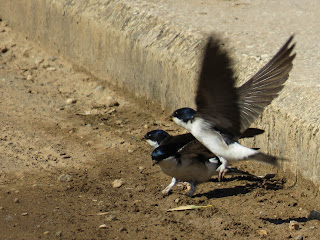
Out of the apartment at 6.45 and ready to start my visit at the Guadalhorce, Malaga at 8.10 and a bright sunny morning, with clear blue skies and the promise of day getting warmer by the hour. Last day of the month and the expectation of some new birds for both month and year, and starting this early before the massed visitors associated with a bank holiday week-end arrive in droves.  Welcomed by both Collared Doves and Blackbird I was soon crossing over the footbridge into the reserve with House Martins all around me, mainly to access the small puddle on the bridge itself for much needed nest-building mud.

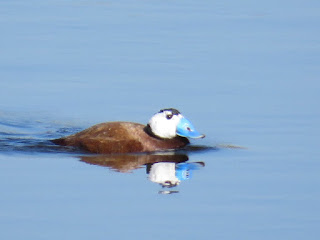
Cetti’s and Reed Warblers were calling as I made my way from the bridge and the resident Rock Doves to the Laguna Casillas where I found a quartet of male White-headed Ducks, Little Grebe, Coot and Moorhen.  A couple of drake Common Pochards put in an appearance and over the water the first of the morning’s Barn Swallows.  Greenfinch were calling behind me and then a Sardinian Warbler crossed the track as I moved on the Wader Hide.

House Martins gathering mud

Once settled in the hide I managed to undertake a count of the Black-winged Stilts and also note the resting Little Egret and a couple of Redshank.  A Yellow-legged Gull flew over the water and a pair of Serins in the trees behind me. A Kestrel was resting atop a nearby tower.
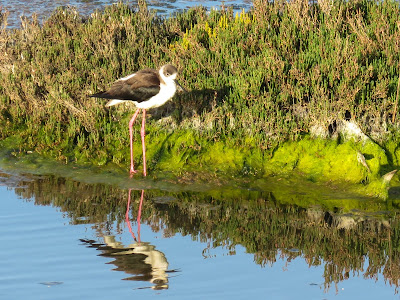
Black-winged Stilt Himantopus himantopus

Much time was spent checking out the old river, Rio Viejo, with, despite the high water level and no exposed islands held a number of wader species.  Half a dozen Dunlin on the near water’s edge along with a single Curlew Sandpiper.  Plenty of Ringed Plovers and watching them scurrying back and forth led me to find the pair of sleeping Grey Plover. On the other hand, perhaps the best sighting was that of the single Bar-tailed Godwit in full summer plumage.  Out on the water itself more Black-winged Stilts and a pair of Shelduck before finding the Purple Heron.  This individual was joined by a second at the wider, northern end of the pool on my return walk from the Sea Watch – but nothing to see on the open water nor beaches.
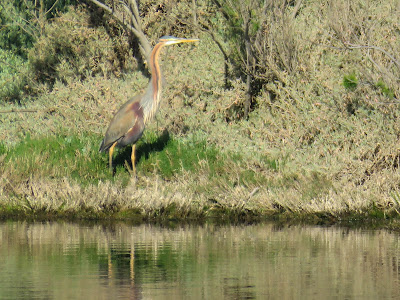
Purple Heron

A Crested Lark was on the meadow between the two canals along with a small flock of Monk Parakeets. A pair of Kentish Plover were on the ir breeding grounds on the opposite side of the track.  The return check of the Rio Viejo enabled to find fort a single then a pair of Marbled Duck on the far side.
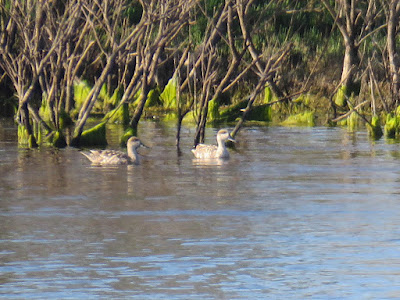
Marbled Ducks

Little to add at the Laguna Escidida other than another couple of White-headed Ducks so straight on to the main hide overlooking the Laguna Grande.  Here a glut of resting Sandwich Terns of which I counted 44 along with a few Black-headed Gulls and more Black-winged Stilts.  Lovely to see a mix of adult and last year’s juvenile Flamingos and then a lone Spoonbill dropped in for all of five minutes, so revealing the foraging Common Sandpiper.

A group (mainly) of 44 Sandwich Terns

Just after 11.30 and time to move on to my second main venue of the day, the Salinas at Fuente de Piedra but not before taking a slight detour along the upper Guadalhorce through to Zapata where I also added Common Swift, Little Ringed Plover and a singing Nightingale.
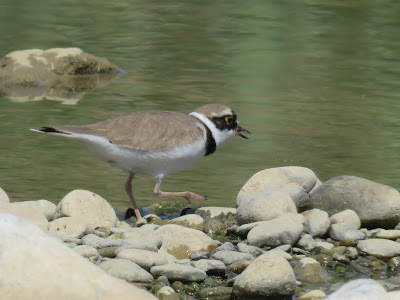
Little Ringed Plover

Given that I would be passing the confluence of the rivers Guadalhorce and Grande, I decided to make a quick visit along the main track next to the river. All looked very quiet at first with much water until spotting a pair of Little Egret and, almost immediately afterwards, a pair of Great White Egrets.  Continuing on as far as the ford and back I added Black-winged Stilt, Mallard and a couple of Little Ringed Plovers.  But a stop to check the brown-looking wader resting on the far side island revealed itself to be a Collared Pratincole which then joined another couple to work the waters in search of a meal or two.
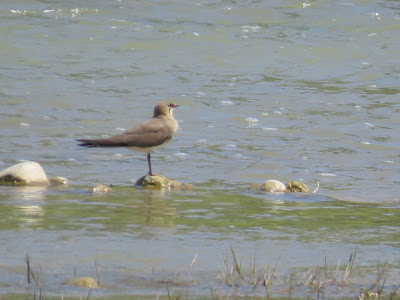
One of three Collared Praticole at the Rio Grande

Finally, reaching Campillos I stopped at the, also full, Laguna Dulce where I found very many Flamingo and Coot.  On the far side a small number of Red-crested Pochard and Gadwall plus the occasional Shoveler and Mallard. Little Ringed and Ringed Plovers along with a single Sanderling were working the edges to my right and over the water the occasional Gull-billed Tern and a number of Barn Swallows. A Hoopoe was calling from the far side and a Corn Bunting was in full voice atop a small tree to my left.
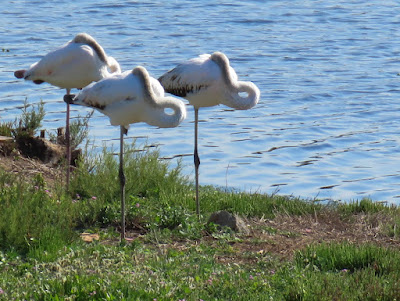
Year old Flamingos

Finally on to Fuente de Piedra for my last hour passing Wood Pigeon, Corn Buntings, Serin and Crested Lark and the main action would appear to have been on the flooded entrance field to the left.  Raven on a pylon at the entrance and a Blackbird in the copse at the on the left and many Barn Swallows in the air around the water whilst on the flooded field were a number of both Flamingos and Avocets.

A few of the many Avocet at Fuente de Piedra

The constant movement of feeding Black and Whiskered terns over the water was a wonderful distraction from what else was visible including Shelduck, Redshank, a single Ruff, Black-winged Stilt and a Common Sandpiper. Even a couple of Turtle Doves to add to the collection of species at this entrance point.
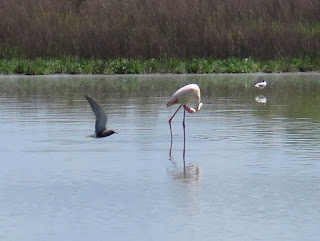
Record shots of Black Terns in flight

Moving round to the hide overlooking the Laguneta, I soon added more Shelduck and Avocets along with Red-crested and Common Pochard, Mallard, Shoveler and White-headed Duck.  Just the one Great Crested and another Little Grebe.  But then, on the far side, yet another couple of Marbled Duck.  A few Moorhen were present and as I made my way back to walk across the boardwalk Goldfinch, Great Tit and Jackdaw were observed.

Male Common Pochard

On the main salina a large, distant raft of gulls but nearer a few Lesser Black-backed Gulls along with scores and scores of resting Gull-billed Terns.  Lots of calling Reed Warblers and taking the back track alongside the railway line I found not only many Spotless Starlings but a closer sighting of the nest-sitting White Stork on top of its tall chimney.  Crossing the level crossing the flash held more gulls and Gull-billed Terns but also a few Mediterranean Gulls.  Finally, in the village itself, my last species of the day was my first Red-rumped Swallow so giving a finally tally of 66 species.
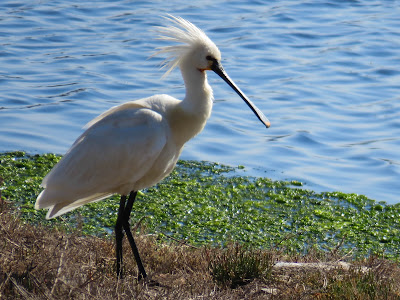
Spoonbill

Birds seen:

Shelduck, Gadwall, Mallard, Shoveler, Marbled Duck, Red-crested Pochard, Common Pochard, White-headed Duck, Little Grebe, Great Crested Grebe, Little Egret, Great White Egret, Purple Heron, White Stork, Spoonbill, Flamingo, Kestrel, Moorhen, Coot, Black-winged Stilt, Avocet, Collared Pratincole, Little Ringed Plover, Ringed Plover, Kentish Plover, Grey Plover, Sanderling, Purple Sandpiper, Dunlin, Ruff, Bar-tailed Godwit, Redshank, Common Sandpiper, Mediterranean Gull, Black-headed Gull, Lesser Black-backed Gull, Yellow-legged Gull, Gull-billed Tern, Sandwich Tern, Whiskered Tern, Black Tern, Rock Dove, Wood Pigeon, Turtle Dove, Collared Dove, Monk Parakeet, Common Swift, Hoopoe, Crested Lark, Barn Swallow, Red-rumped Swallow, House Martin, Nightingale, Blackbird, Cetti’s Warbler, Reed Warbler, Sardinian Warbler, Great Tit, Jackdaw, Raven, Spotless Starling, House Sparrow, Serin, Greenfinch, Goldfinch, Corn Bunting.

Curlew Sandpiper
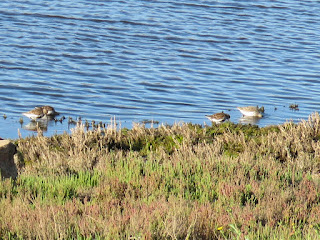
Dunlin with Curlew Sandpiper extreme right


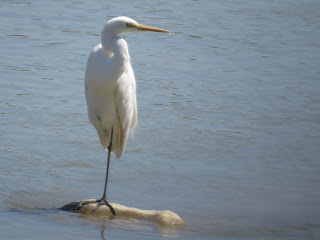
Great White Egret

Little Egret

Sandwich Terns

Slender-billed Gull

Spoonbill

House Martins

Male White-headed Duck

Check out the accompanying website at http://www.birdingaxarquia.weebly.com for the latest sightings, photographs and additional information