Wednesday, 16 February 2022

Rambla de Almanzora & Vera Playa

Wednesday 16 February

Well our David may be up and about birding again but it sounds to me as if his leg is like mine; on the mend but not completely better yet.  I suspect we are both about 10% off being to take part in the next Olympic sprint for oldies! Along with the rest of the Arboleas Birding Group they certainly had a good morning's birding and it's one thing having to wait for an Audouin's Gull until I return to Spain in late April but, more to the point, in which country will I see my first Barn Swallow of the year?

Rambla de Almanzora & Vera Playa: Wednesday 16th February

Doing my usual thing, I left home early and made my way to the Desert Springs end of the Rambla de Almanzora.  Overlooking the pools below me, my first bird was a male Shoveler, closely followed by Coot, Moorhen and a White Wagtail.  As before the majority of wildfowl were Teal with a number of Mallard.  I then saw about 5 Snipe, a Green Sandpiper together with a Wood Sandpiper.  Small birds included Meadow Pipit (more later), Thekla Lark and Chiffchaff.  The following pools added a single Lapwing, Redshank and some amorous Black-winged Stilts.  At the ford I saw a Common Sandpiper with Coot and Moorhen.  I parked up in the limited space left by a group of French motor vans and waited for the rest to arrive.  I saw a female Black Redstart, Northern Starlings and Collared Doves.
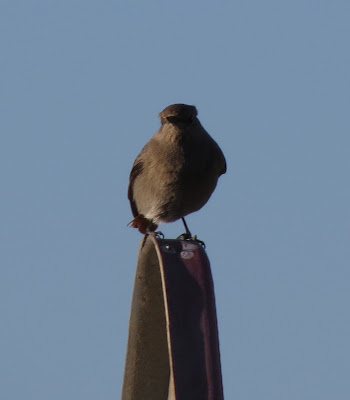
Female Black Redstart Phoenicurus ochruros (PHOTO: David Elliott-Binns)

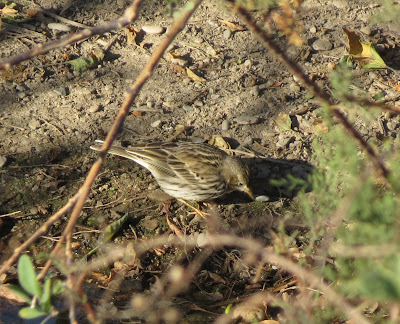
Nine other members turned up including Ab who was last with me about 3 years ago. (He did attend last week's trip). Richard had seen a Woodpigeon and Kevin, who'd also done the far end of the Rambla, had seen five Little Ringed and one Ringed Plover.  Richard and I stayed where we were due to our temporary and permanent disabilities whilst the others under Alan's leadership walked up to the sewage works.  Richard spotted a Barn Swallow, Robin and Grey Wagtail while I added Sardinian Warbler and Yellow-legged Gull.  We observed and (luckily) photographed what we thought was a Water Pipit directly below us.  Later, looking at the colour of the legs on the photo, it was a Meadow Pipit!  The others returned having added Gadwall, Grey Heron, Serin and a heard Cetti's Warbler. On our way to the Villaricos "Lucky" bar I saw an Iberian Grey Shrike perched on a power line.  Kevin also saw a Kestrel.  House Sparrows surrounded us hoping for a scrap of tostada!  The owners informed us they won't be open on Wednesday for the foreseeable future. (John..they asked how you were.)

Meadow Pipit Anthus pratensis (PHOTO: David Elliott-Binns)

We moved on to the beach.  On the harbour rocks were a pair of Sandwich Terns and two Audouin's Gulls.  They were joined by a Cormorant. Richard spotted a Gannet and some flying Cattle Egrets.  Alan found three more Gannets. 
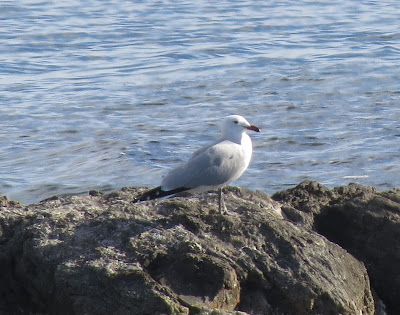
Audouin's Gull Larus audouinii (PHOTO: David Elliott-Binns)

We moved round to the Estuary.  A large flock of wildfowl took off on our approach.  A search out to sea revealed 26 Shelducks in a raft.  There were numerous little waders.  Alan and Kevin identified them as Ringed and Kentish Plovers, Little Stints and numerous Dunlin.
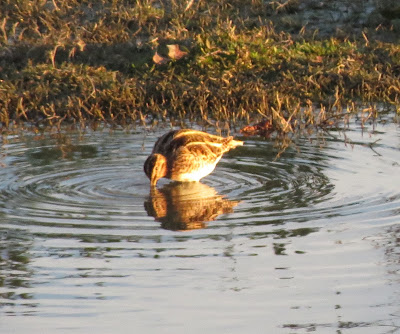
Snipe Gallinago gallinago (PHOTO: David Elliott-Binns)

We convoyed to the dual carriageway opposite the Consum supermarket at the back of Vera Playa.  Alan added Stonechat and Little Grebe.  A Little Egret was also seen.  Beyond the hump I found some Common Pochard.  Kevin identified some Mediterranean Gulls amongst the Black-headed group.  There were 14 Greater Flamingos.  We moved round to the elevated platform opposite the AguaParc. There were 45 White-headed Ducks, Little Grebes, a single Black-necked Grebe, Shelducks, Common Pochards, Shovelers and Mallards.  Two Marsh Harriers were seen, the first being spotted by Kevin.  A distant raptor was seen.  Alan got his scope on to it.  It was possibly a Common Buzzard.
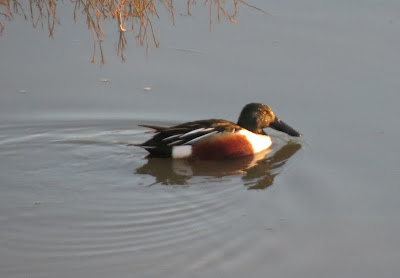
Male Shoveler Anas clypeata (PHOTO: David Elliott-Binns)

We ended up with 54 species.  A great day in good company.  Lovely weather as well.
Regards
Dave ( My left leg is 90% better. Identified as a trapped sciatic nerve in my pelvis. Being careful as still tender)

Check out the accompanying website at http://www.birdingaxarquia.weebly.com for the latest sightings, photographs and additional information


Weston Shore, Southampton

 Wednesday 16 February

With all the recent reported sightings of a Great Northern Diver, Red-breasted Merganser and Shag in the area, Jenny and I took the short drive to Weston Shore, Southampton to see what we might find.  With national forecasts about extremely strong winds and much rain, hopefully the relatively early morning visit, albeit high tide, might prove worthwhile.

Arriving at the northern end of the shore nothing to be seen but a few Carrion Crow and a number of Black-headed Gulls, either on the water or being blown around in the strengthening wind.  So off and up to the car park at the southern end of shore line.  Here we were greeted by not only more Black-headed Gulls but also at least thirty Carrion Crow.  (Certainly a case of not listening to the old saying, "If you see a single Rook it's Crow and if you see twenty Crows they're Rooks.")  In addition a couple of foraging Rock Doves and a small number of Wood Pigeon in the trees at the other side of the road plus the lone Mute Swan that was paddling along a couple of metres off shore in front of us.

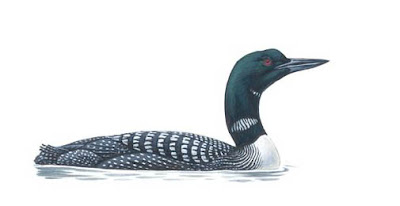
With nothing happening on with another layer of clothes and a walk along the cycle track/path to Weston Sailing Club on the other side of  copse.  Not expecting to find anything I rather silly to leave the camera in the car with jenny.  Nothing extra so started on the return journey.  Almost immediately some dark on the water about five metres out n addition to the Black-headed Gulls.  Rather surprised to see the single Great Crested Grebe but when I rechecked the sighting about twenty metres on I found that there were now two individuals and they were slowly progressing in the same direction.  However, my constant scans of the sea were to pay off as, more by luck than judgement, I saw a dark shape almost in front of the distant buoy; and by "distant" I mean distant.  Fortunately the bird remained on the water long enough to really focus and get a clear view of the Great Northern Diver that had been recently reported from the area.  And to me that means a Great Northern Diver rather than "Common Loon!"

Summer plumage Great Northern Diver Gavia immer from Internet

So, around 45 minutes in the area for just 7 species but what class!

Birds seen:

Mute Swan, Great Crested Grebe, Great Northern Diver, Black-headed Gull, Rock Dove, Wood Pigeon, Carrion Crow.

Check out the accompanying website at http://www.birdingaxarquia.weebly.com for the latest sightings, photographs and additional information
Tuesday, 15 February 2022

Titchfield Floods

Tuesday 15 February

Jenny and I attended a Tea dance in Titchfield village this afternoon.  It had rained non-stop all day and still hammering it down as set about exercising our legs after such along layoff from any form of dancing.  However, come 4 o'clock and time to go home the rain had finally stopped albeit everywhere very wet, dam and generally miserable.  Undeterred, we drove the 500 metres round the corner to Titchfield Floods (what a strange name for a birding site!) where at least there was a solid path leading to a clear view of the resident Barn Owls' roosting tree.  Somebody at last saw sense and removed one bush to give a clearer view and so save any potential disturbance by people trying to get closer than the present 100 metres or so away from the public path.

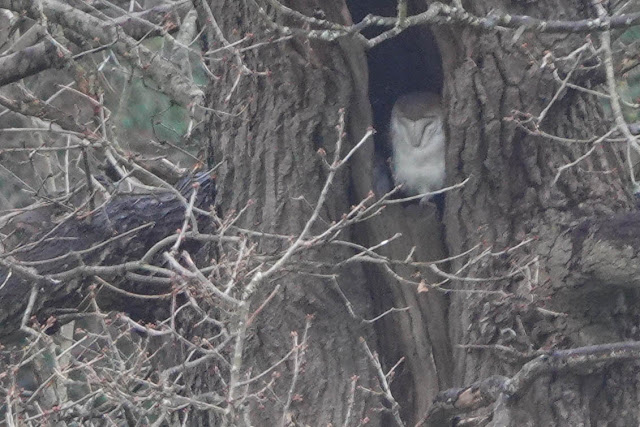
Sleepy old Barn Owl Tyto alba (Look carefully; could that be its mate at bottom left of the owl?)

Jenny had seen a Blackbird as soon as we got out of the car and arriving at the dedicated spot on the path we had a clear view of the sleepy Barn Owl.  Poor chap looked thoroughly miserable and fed-up and looking closely at the distant photograph, could that be the lady wife snuggled down in the bottom left of the recess seen from the path?  Whilst using the scope also had a single Green Woodpecker and the trees at the back had more than a score of resting Wood Pigeons.

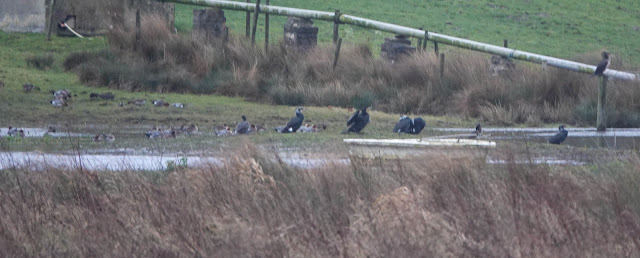
Looking in the opposite direction at the water (Titchfield Flood?) a dozen resting Cormorant at the far right along with sixty or so Wigeon, mainly on the bank rather than the water's edge.  Also amongst them at least six foraging Magpie.

Resting Wigeon Anas penelope and Cormorants Phalacrocorax carbo

Making our way back to the adjacent car park the only birds on the main water were a (true) pair of Pintail and a single Great Black-backed Gull but at least a quartet of Back-headed Gulls were seen overhead.  Back in the car park not only a couple of male Blackbirds but also a Song Thrush before the single Chaffinch put in a brief appearance.  Other sightings included both Carrion Crow and the local Jackdaws.

Birds seen:

Wigeon, Pintail, Cormorant, Black-headed Gull, Great Black-backed Gull, Wood Pigeon, Barn Owl, Green Woodpecker, Blackbird, Song Thrush, Magpie, Jackdaw, Carrion Crow, Chaffinch.

Check out the accompanying website at http://www.birdingaxarquia.weebly.com for the latest sightings, photographs and additional information
Monday, 14 February 2022

Almost the St valentine's Disaster - if not Massacre!

Monday 14 February

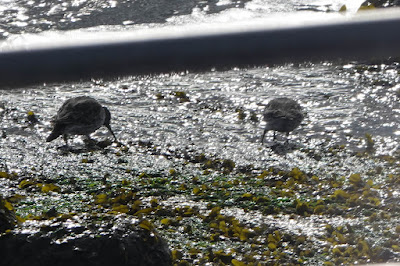
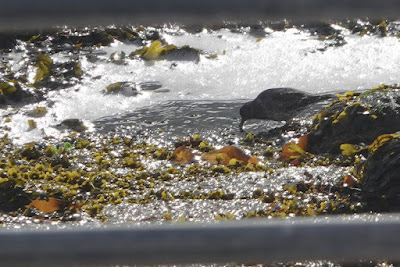
Purple Sandpiper Calidris maritima in poor light

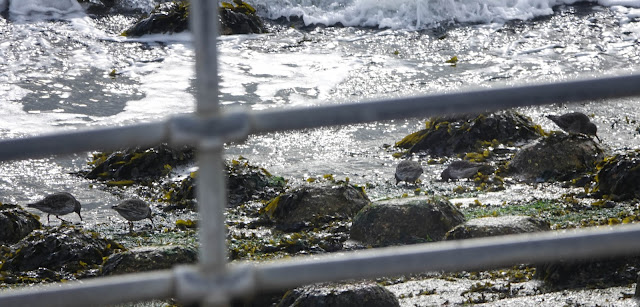
What a Valentine's Day! The forecast said more rain and strong winds but come the morning bright sunshine, little cloud and relatively calm as I decided to take the bus from Warsash to Southsea via a change at Fareham. All going well till somebody told me there was a direct route rather than changing at Portsmouth Harbour. What a disaster. The bus went all round the house and took and hour and a half to reach the destination and, having arrived, I discovered that the prom [path was sealed off because of building works near the castle. Was this all in vain, two and a half hours to record a few Black-headed and Herring Gulls along with a lonely Carrion Crow and small flock of Starlings? With the leg seeming more comfortable I found a way round to the far side of the castle and was able to look down on the rocks below and to my great delight was able to find a quintet of Purple Sandpipers, albeit in shadow as they frolicked around the sea's edge and the sun pointing straight into the camera lens. Now that put the smile back on my face!

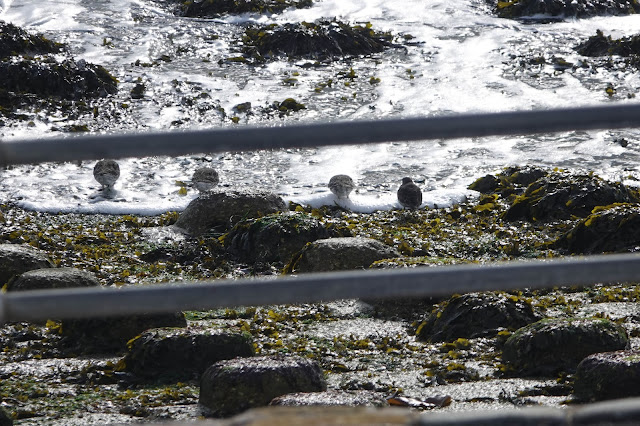
The quintet of Purple Sandpipers Calidris maritima

Having seen the Purple Sandpipers birding took a change for the better. Heading back down to the park to make my way to the main road I encountered more Carrion Crows before coming across a handful of House Sparrows and a pair of Blackbirds. The next grassy area then produced ten Wood Pigeon, a couple of magpies and the expected resident Feral Pigeons.

Carrion Crow Corvus corone on the restriction fence

Now, if I play my cards right, per chance to call in at Titchfield Floods to check out the local Barn Owls and water birds on the flooded meadow following my afternoon dance session in the neighbouring Community Centre!

Distant views of the Purple sandpipers in poor light

Purple Sandpipers Calidris maritima

Birds seen:

Purple Sandpiper, Black-headed Gull, Herring Gull, Rock Dove, Wood Pigeon, Blackbird, Magpie, Carrion Crow, Starling, House Sparrow.

Check out the accompanying website at http://www.birdingaxarquia.weebly.com for the latest sightings, photographs and additional information
Sunday, 13 February 2022

Warsash Shore, Southampton Water

Oystercatcher Haematopus ostralegus

 12 February 2022

At last, finally to not only try out the new, waterproof walking shoes but actually go for a walk with virtually no pain.  Hopefully, now fully fit by the time the present few rainy days are completed.  So gone noon when I set out along the shore at Warsash and on past the Spit to the "Scrape" and "Meandering Pool" behind the shore on Southampton Water.  The temperature said 9C but in the strong wind, and sun in my face as I walked southwards, it felt more like 3 or 4C!  All very quiet initially with just the odd Redshank and occasional Black-headed Gull plus a Carrion Crow.

However, reaching the School of Navigation a flock of 18 foraging Ringed Plover on the exposed mud at low tide and then, approaching the spit with the channel in front, the first of the massed packs of feeding birds.  A few Oystercatchers, Curlews and Redshank along with a couple of Grey Plover and scores of Black-headed Gulls.  Just the single Turnstone but a dozen of Shelduck feeding in the distance.

Ringed Plover Charadrius hiaticula

On the stream itself a large flock of Wigeon which were later joined by a handful of Teal.  In addition to the Black-headed Gulls, a few Herring and a couple of Common Gulls.

Male (above) and female Wigeon Anas penelope

Once at the Spit and able to check the uncovered beach on the seaward side, a large flock of Brent Geese and very many Oystercatchers along with mainly Herring Gulls.

Brent Geese Branta bernicla with Oystercatchers and Black-haeded Gull Larus ridibundus

The walk along the shore to the Scrape, noting the singing Sky Lark on the way, produced not only a couple of Mute Swans and Canada Geese but also 26 Pintail.  Also on the water a Coot and a few Brent Geese.  By contrast, the Meandering Pool held just a trio of Shoveler.

Female and male Pintail Anas acuta

A few of the Pintail flock

So back the same way to Warsash.  A visiting group from the Wokingham Bird Club had informed me at the Spit  that there was a feeding Red-breasted Merganser in the stream I had just passed when they were passing less than thirty minutes previous.  A keen watch-out as I walked around the track and then, just before reaching the School on Navigation pier, my scanning paid off as I found the bird way out at the edge of the main water. Way to far away to photograph, especially as it was spending most of the time below water but, nevertheless, seen through the bins.  No sooner seen than I added both Wood Pigeon and Cormorant and a female Kestrel came to rest in the tree immediately in front of me.  Strangely, the raptor remained long enough for me to actually get  photograph; what an obliging lady!

Female Kestrel Falco tinnunculus

Birds seen:

Brent Goose, Canada Goose, Mute Swan, Shelduck, Wigeon, Shoveler, Teal, Pintail, Pochard, Red-breasted Merganser, Cormorant, Coot, Oystercatcher, Ringed Plover, Grey Plover, Curlew, Redshank, Turnstone, Black-headed Gull, Common Gull, Herring Gull, Rock Dove, Wood Pigeon, Kestrel, Sky Lark, Magpie, Carrion Crow.

Shelduck Tadorna tadorna and Mute Swan Cygnus olor

Almost the whole resting Pintail Anas acuta flock


Check out the accompanying website at 
http://www.birdingaxarquia.weebly.com for the latest sightings, photographs and additional information
Saturday, 12 February 2022

New Forest Birding

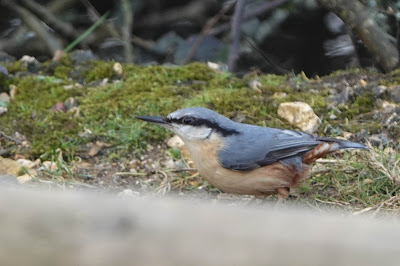
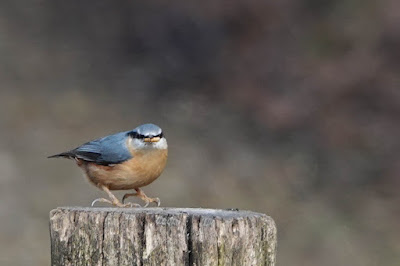
Nuthatch Sitta europaea

Friday 11 February

Leg feeling a little better, so once jobs sorted jenny and I set out for the new Forest just after11.30.  However, not willing to take the risk so a day of mostly stationary birding by visiting three well-known sites starting with Fishlake Meadows in Romsey as we headed west along the M27.  Rather that walk the actual site itself I was dropped off on the main road for twenty minutes with a view overlooking the main water whilst Jenny parked the car.  Lots of Black-headed Gulls about along with Coots and still a good-sized flock of Greylag Geese.

Roadside view of Fishlake Meadow pond

Initial thoughts completed time to use both bins and scope to see what else was on or around the water.  A number of resting Cormorants at the back along with a lone Heron and even a distant pair of resting Magpie in the trees at the far back.  at the water's edge on the far side I soon picked up both Gadwall, Shoveler and Common Pochard and nearer to me, as well as at the back, a number of Tufted Duck.  Checking the resting gulls I was also able to ad both Common and Herring Gulls.  Whilst watching a few Teal paddled into sight and even a closer Pochard.  Whilst a Wood Pigeon flew over me, the neighbouring bushes and trees produced Blackbird, Blue Tit, Chaffinch and male Blackcap.

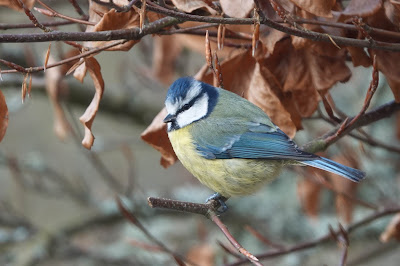
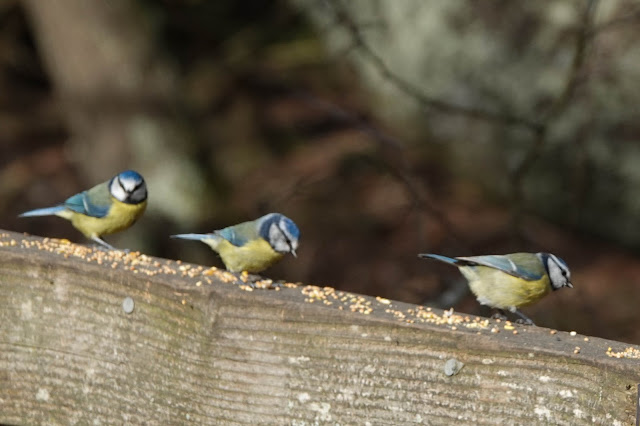
Blue Tit Parus caeruleus

Time to move on and into the new Forest with our next stop at Eyeworth Pond at the far edge of Fritham. Approaching the site both Blackbirds and a single Redwing flew up from the roadside verge into the neighbouring trees and as soon as we arrived to reverse into a parking space overlooking the pond the quartet of Mandarin Ducks were moving away from the main Mallard flock at the water's edge where they had, presumably, been feeding on food thrown down by previous visitors.  Once parked time to find the Manadarins but only two located, one of which had settled down on a mossy bank below the trees not too far distant.  Other than the Mallard and Mandarin Duck the only other water birds present were a pair of Moorhen.

Mandarin Duck Aix galericulata

Meanwhile, the bushes and shrubs in front of us were alive with small birds, no doubt as a result of food put out by interested parties.  Lots of Robins and Chaffinches along with a few Dunnock but mainly members of the tit family. Scores of Blue Tits were expected along with almost as many Great Tits but its was good to also find a few Coal Tits along with a least a trio of Marsh Tits.

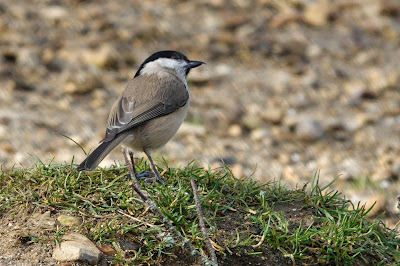
Marsh Tit Parus palustris

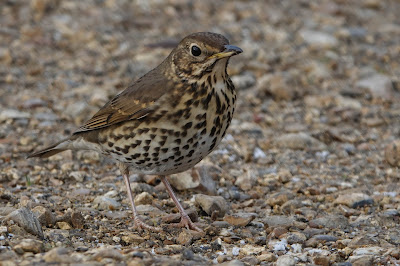
No sooner had the first Blackbirds arrived than we were also presented with a very friendly Song Thrush.  At the same time, one of the local Nuthatches paid a repeated visit to the site. It was also her that I took a chance to walk a couple of hundred metres along the main track into the wood and was rewarded by a feeding flock of Chaffinches working the leaves on the ground and accompanied by a handful of Brambling.  After an hour we made our way towards the nearby Royal Oak pub for a ploughman's lunch and also recording a couple of Starling as we made our way from the pond.

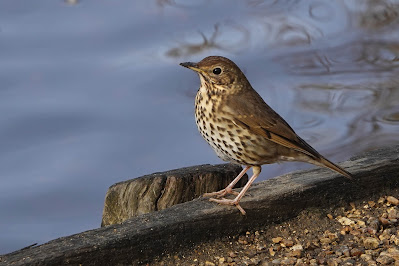
Song Thrush Turdus philomelos

After a late lunch a pleasant drive through the eastern side of the New Forest to the Solent shore at Lepe, possibly the closest place to the isle of Wight just across the water but no sig of a drifting White-tailed Eagle!  However, the tide was out so lots of waders and gulls along with a few Carrion Crow.  mainly Black-headed but still a handful of Herring Gulls.  Over a score of Brent Geese were recorded and waders were almost exclusively Oystercatcher albeit we did find a roosting flock of about twenty Curlew.  The occasional Cormorant and a number of duck species including Mallard and Gadwall but mainly Wigeon.  A Pheasant walked down the road.  On the other hand we were favoured with the visit of a Little Egret.  And so back to Warsash having recorded a total of 40 Species during our three stops.

Very "Mikadoian!" Three little tits from school are we, etc!

Birds seen:

Greylag Goose, Brent Goose, Shelduck, Mandarin Duck, Wigeon, Gadwall, Mallard, Shoveler, Teal, Pochard, Tufted Duck, Pheasant, Cormorant, Little Egret, Heron, Moorhen, Coot, Oystercatcher, Curlew, Black-headed Gull, Common Gull, Herring Gull, Wood Pigeon, Dunnock, Robin, Blackbird, Song Thrush, Redwing, Blackcap. Marsh Tit, Coal Tit, Blue Tit, Great Tit, Nuthatch, Magpie, carrion Crow, Starling, House Sparrow, Chaffinch, Brambling.

Nuthatch Sitta europaea

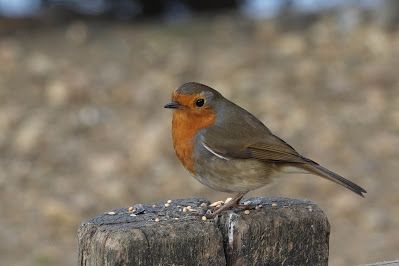
Robin Erithacus rubecula

Song Thrush Turdus philomelos


Check out the accompanying website at 
http://www.birdingaxarquia.weebly.com for the latest sightings, photographs and additional information
Thursday, 10 February 2022

Cabo de Gata with the Arboleas Birding Group

 Wednesday 9 February

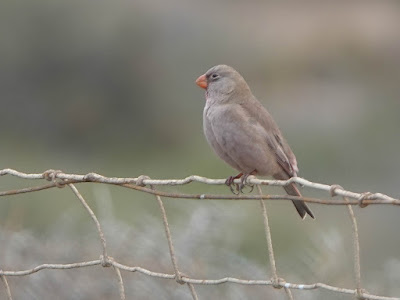
Oh dear, oh dear!  It would seem that the dreaded left-leg syndrome is striking us all down,  Not only Dave on crutches but me still hobbling about, as little as possible, following my staircase encounter two weeks ago in Valencia.  In my case I came downstairs and walked away only to discover that there was still one step to go!  Managed to save myself falling buts suspect that I have pulled/torn either/both tendon/ligament in the back of my left leg.  Very painful and my first birding outing was a slow and leisurely 3km walk alongside the River Hamble in Warsash followed by two days to recover.  But I refuse to lie down, as they say.  Back to the birding.  Please to see that Alan and members of the Arboleas Birding Group found the Trumpeter Finch and that all present managed to get a good sighting.  Certainly seems as if all had a very pleasant morning's birding at one of my favourite sites.  Saw the message but uploading a photo so will included one from my personal library.

Now then Dave, here's hoping for a speedy recovery so that you can once again get out and about.  But if you're going to make a habit of breaking your legs then please do not burn the crutches yet!!!


Cabo de Gata: Wednesday 9 February

Report by Alan in Dave’s absence because of a painful leg condition.  We wish him a speedy recovery.

I met Trevor and Val at Los Gallardos to drive to Cabo de Gata.  We arrived quite early so decided to have a coffee at Pujaire in the bar opposite the one we usually frequented before Covid (which was closed).  Waiting at the first hide were Peter, Mike and Karen, and Alb and Jeni (from the Netherlands, via La Piedra de Zahors in Los Filabres).  Mike had already seen Avocet and Trevor soon added Shelduck.  I saw Slender-billed Gulls and a Thekla Lark landed on a low shrub in front of the hide and began to sing.  Karen had spotted a group of Dunlin feeding and I saw a couple of Redshank.  Val identified a distant Sanderling.  I thought some distant duck were probably Wigeon and we added Greater Flamingo and Stonechat to the list. 

We then adjourned for a coffee, a second one for some whilst others indulged in a tostada fest, in the village.  On the drive towards the other hides a couple of small birds dropped onto the wooden fence on the seaward side and Val, Trevor and I knew quickly that they were Trumpeter Finch so we stopped the car and told the others following behind. Everyone had pretty good views and they were ‘lifers’ for Alb and Jeni.  They were joined by a Greenfinch spotted by Peter and a Pipit was briefly seen although not positively identified. 

Trumpeter Finch Bucanetes githagineus (Photographed at Cabo de Gata)

On the approach to the second hide a group of Spotless Starlings was active in the larger bushes.  In the hide, Trevor pointed out about forty Spoonbill and he soon spotted a hovering Kestrel followed by a Raven dive-bombing a gull.  Peter needed to go back to his car and on return he had heard, but not seen, a Hoopoe.  Val saw a Grey Heron.  Continuing along the coastal road, Trevor found an Iberian Grey Shrike on the seaward wooden fencing. 

As we accessed the public hide, two Goldfinches were seen in flight.  Alb found a singing Sardinian Warbler.  Val found a Little Egret and others seen were Lesser Black-backed Gull and Cormorant.  The final addition here were a few Audouin’s Gulls.  We had decided not to do the river Morales as there wasn’t a four-wheel drive vehicle to accompany us and there had been cases of vehicles getting stuck in the soft sand.  Instead, we went up to the lighthouse.  Only the odd gull was seen but on the way down Trevor, Val and I saw a Blue Rock Thrush dart across the road.  Twenty-eight species seen but an enjoyable morning in the sun with some good folk.

Check out the accompanying website at http://www.birdingaxarquia.weebly.com for the latest sightings, photographs and additional information