Tuesday, 15 January 2019

Guadalhorce, Malaga

Monday 14 January

Having driven down to the Cabopino marina east of Marbella with Steve Powell in the hope of seeing the visiting Snow Bunting and dipped, we came home via the Guadalhorce reserve in Malaga in the hope that the late afternoon arrival might coincide with sight of the wintering Short-eared Owls recently reported.  Again, we were unsuccessful so carried on to the Laguna Grande to see what might be about.  Quite encouraging to think that we recorded 33 species in our stray of well less than an hour.

Greenshank Archebebe Claro Tringa nebularia
We were greeted by House Sparrow and Monk Parakeet and as soon above the western arm our first couple of Plack Redstarts.  Cormorants travelled to and from the main water and in with the Spotless Starlings in a nearby dead tree a single Common Starling.  Having crossed the footbridge to make our way to the main hide overlooking the Laguna Grande the Spotless Starlings took off one way as a Sparrowhawk dashed away in the opposite direction.  Another Black Redstart and then a couple of White Wagtails on the track before we reached the hide.

Common Sandpiper Andarrios Chico Actitis hypoleucos (Canon EOS 7D)

From the hide it was obvious that the Cormorant colony counted over one hundred individuals and we managed also to find both Cattle and Little Egrets plus a single Grey Heron.  Collared Doves on the trees along with more Spotless Starlings and then to look at the water

Part of the Cormorant Cormoran Grande Phalacrocorax carbo roost (Canon SX60 bridge camera)
Eleven Shelduck and ten Black-necked Grebes counted but the Shoveler population had diminished since my last visit and just a couple of Mallard and Common Coot.  Immediately below the hide we had a single Greenshank along with a Common Sandpiper and half-dozen Black-winged Stilts.  Both Chiffchaff and Spotless Starling were probing the grasses.  A little further back a quartet of Dunlin were feeding with a single Ringed Plover.

Ringed Plover Chorlitejo Grande Charadrius hiaticula with 3 Dunlin Correlimos Comun Calidris alpina behind
At the far island with the dead tree a Whimbrel was feeding close by and, on checking the photos, I was able to establish that the two smaller waders were Black-tailed Godwits along with a single Kentish Plover.

By way of excitement we watched a Buzzard hovering and then a male Marsh Harrier trying to take a Cormorant from the top of the "Osprey " pole.  Obviously a bird with bigger eyes than stomach as the Cormorant seemed not to be too bothered by the harrier's efforts.

Marsh Harrier Aguilucho lagunero Circus aeruginosus and sizing up a Cormorant below

There was small a number of Yellow-legged Gulls on the water when we arrived and before departure a larger number of Black-headed Gulls had arrived.  Just the occasional Crag Martin feeding over the water and as we set off back to the car a Robin put in a brief appearance on the track.  Finally, not just a female Kestrel roosting but a Booted Eagle passed over.

Booted Eagle Aguililla Calzada Hieraaetus pennatus in the setting sun
Birds seen:    
Shelduck, Mallard, Shoveler, Black-necked Grebe, Cormorant, Cattle Egret, Little Egret, Heron, Marsh Harrier, Booted Eagle, Buzzard, Sparrowhawk, Kestrel, Coot, Black-winged Stilt, Ringed Plover, Kentish Plover, Dunlin, Black-tailed Godwit, Whimbrel, Greenshank, Common Sandpiper, Black-headed Gull, Yellow-legged Gull, Collared Dove, Monk Parakeet, Crag Martin, White Wagtail, Robin, Black Redstart, Chiffchaff, Common Starling, Spotless Starling, House Sparrow


Shelduck Tarro Blanco Tadorna tadorna (Canon SX60 bridge camera)

Black-winged Stilt Ciguenuela Comun Himantopus himantopus

Camera comparison

I used both my EOS 7D with 100-400 lens and the small, lightweight canon SX60 on the same subject to make a comparison before deciding which, or both, cameras to take on my upcoming visit to Borneo.  Impressed when I saw the results of the small camera and, I must admit, disappointed with the results from the larger camera.

(Canon SX60)
(Canon EOS 7D)

(Canon SX60)


Greenshank Archebebe Claro Tringa nebularia (Canon EOS 7D)


Part of the Cormorant Cormoran Grande Phalacrocorax carbo roost (Canon SX60 bridge camera)                       


Same subject with Cann EOS 7D

 Very much tempted just to take the small, lightweigh Canon SX60


   Check out the accompanying website at http://www.birdingaxarquia.weebly.com for the latest sightings, photographs and additional information

Sunday, 13 January 2019

Charca de Suarez

12 January 2019

Birding has resumed; all is back to normal!  Beautiful clear start to the day with full sun albeit a little on the cold side till mid-morning, so off to Charca de Suarez, Motril for the January meting of the Axarquia Bird Group.  In the end a total of five of us present though we did see Mick Richardson late in the morning and all of us got excellent views of the Spotted Crake.
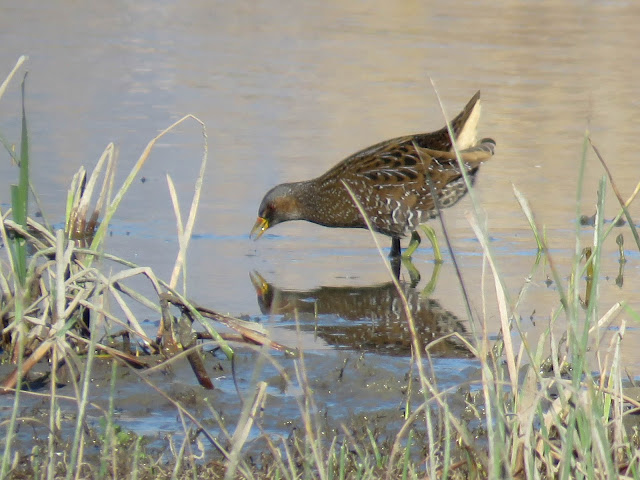
Spotted Crake Polluela Pintoja Porzana porzana


Turning into Turtle Dove Alley I had a Collared Dove resting on the wires and then quickly came across a small flock of Common Waxbill followed by a handful of Serin.  As I left the road to drive the shot distance to the Charca de Suarez entrance a lone Heron slowly flew over and a male Black Redstart seemed to be giving me the evil eye.  Once inside the reserve another Black Redstart was feeding on the path, John and jenny also saw a Hoopoe, as I made my way to the bamboo hide overlooking the Laguna del Taraje recording a pair of Great Tit on the way where I found mainly Mallards and Moorhens on show along with both a single Red-knobbed Coot and Little Grebe.  Just the odd Chiffchaff and a single Robin before I moved on recording a couple of Blackbirds as I left the hide.
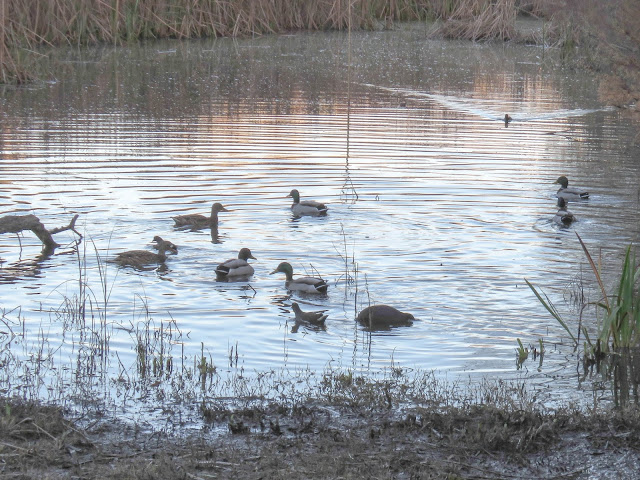
Mallards Anas platyrhynchos, Moorhens Gallinula chloropus and a Red-knobbed Coot Fulica cristata in the early morning mist
Nothing to see at the far end of this laguna other than  male Teal but I did meet up with John and Jenny Wainwright who were approaching from the opposite direction and recorded a small charm of Goldfinch.  Whilst together we watched a Marsh Harrier drift over and then I made my way to the Launa del Alamo Blanco where, as just informed, I found the hide chock-a-block with photographers and not a scope in sight.  Looking at the range of equipment, and the that of others seen later on, there must have been more than 250,000 pounds worth of equipment on the reserve!  The resident White Stork was hiding at the back of the water so I decided to move on to the main hide overlooking the Laguna de las Aneas.
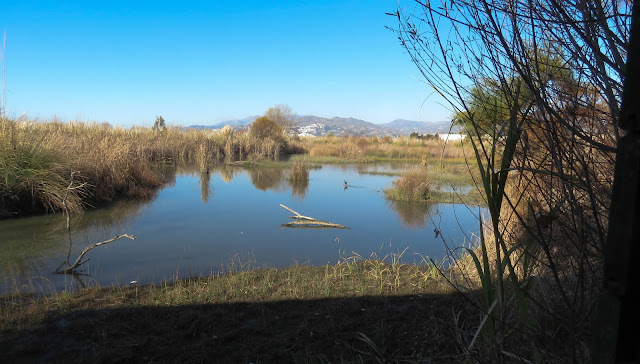
Laguna del Alamo Blanco as seen by the miriards of photographers
Lots of Common Coots and a handful of the Red-knobbed Coots along wot the duck population made up of mainly Mallard and Shoveler but also a few, hiding Teal, Common Pochard and at least seven Ferruginous Ducks.  In front a Grey and a pair of White Wagtails plus a few Little Grebe.  No shortage of resting Cormorant and a single Yellow-legged Gulls.  A small number of House Sparrows were feeding in front of the hide to my left along with a few Chiffchaff and a Bluethroat put in a brief appearance.  And all the while a constant supply of feeding Crag Martins.

Bluethroat Luscinia svecica (PHOTO: John & Jenny Wainwright)

Time to move on and with the northern hide overlooking the Laguna del Trebol also full of photographers, but still able to note the good number of Red-knobbed Coots and Chiffchaffs, I made my way to the southern hide overlooking the water. 
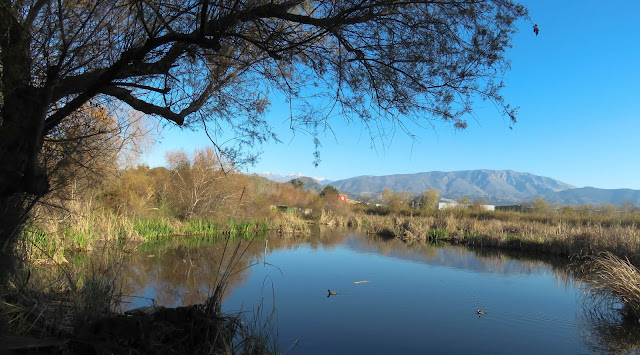
Laguna del Trebol looking towards the snow-capped peaks in the far distance

Here, finally, I had the hide to myself.  Lovely to watch the active Red-knobbed Coots and in front of me both Cetti's Warbler and Bluethroat feeding at the edge below me.  A Robin put in a brief appearance and a Grey Wagtail flew across towards the hide.  Finally, a male Stonechat was seen away to my right.
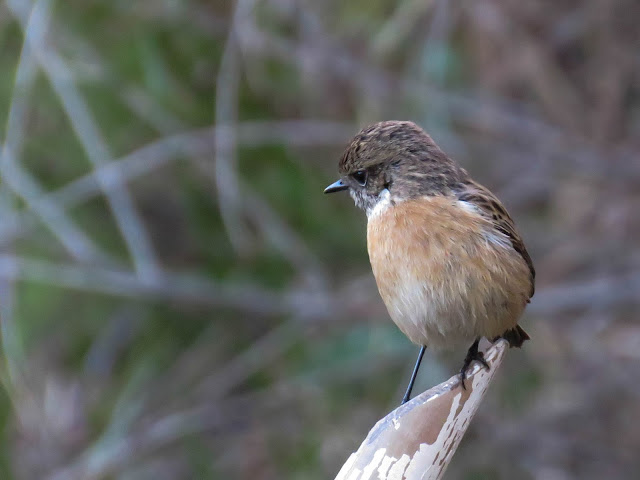
Stonechat Tarabilla Comun Saxicola torquatus

The Laguna del Lirio was relatively quiet other than the many Chffchaff but, eventually, another Red-knobbed Coot and a second Stonechat.  My estimation is that, presently, there my be a minimum of twenty Red-knobbed Coots on site.
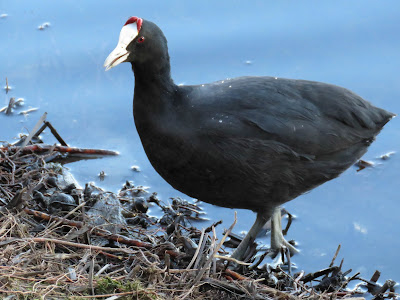
Red-knobbed Coot Focha Moruna Fulica cristata

To end my morning back to the Laguna del Alamo Blanco where, finally, a little more room.  John and Jenny had just seen the Spotted Crake immediately in front of the hide.  John Ross and his wife finally found us and even Mick Richardson was suddenly in the hide.  As a result we moved round to the edge of the water to look at the back of the water where we were successful in getting good views of the Spotted Crake.

Cetti's Warbler Ruisenor Bastardo Cettia cetti

Back in the hide we watched a Buzzard being mobbed by a pair of Kestrel and then a couple of Purple Swamphen paddles across the water in front of us.  John saw the flight of the Snipe across the water and the White Stork could be seen along with a heron.
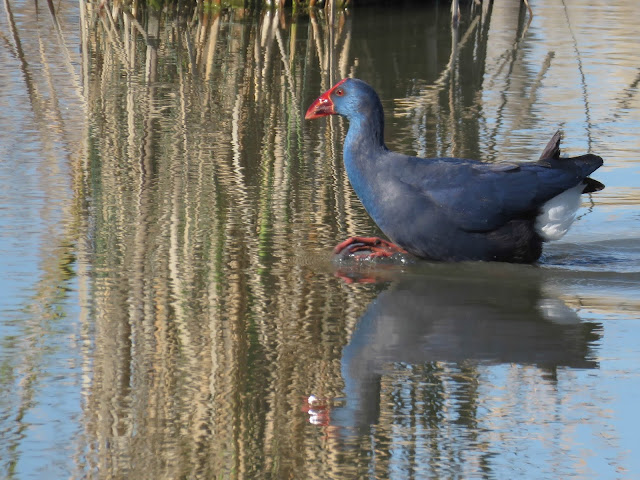
Purple Swamphen Calamon Comun Porphyrio porphyrio
Making my way back through Turtle Dove Alley I stopped to watch a pair of dark morph Booted Eagles overhead and then a couple of Spotless Starling.  A Rock Dove was seen at the end of the lane along with a flying Cattle Egret.  A final total of 38 species
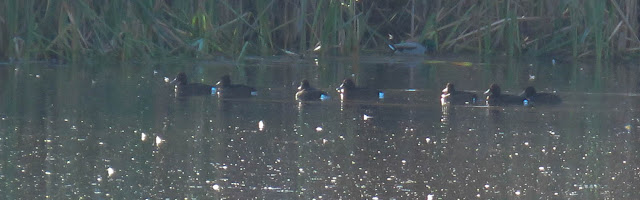

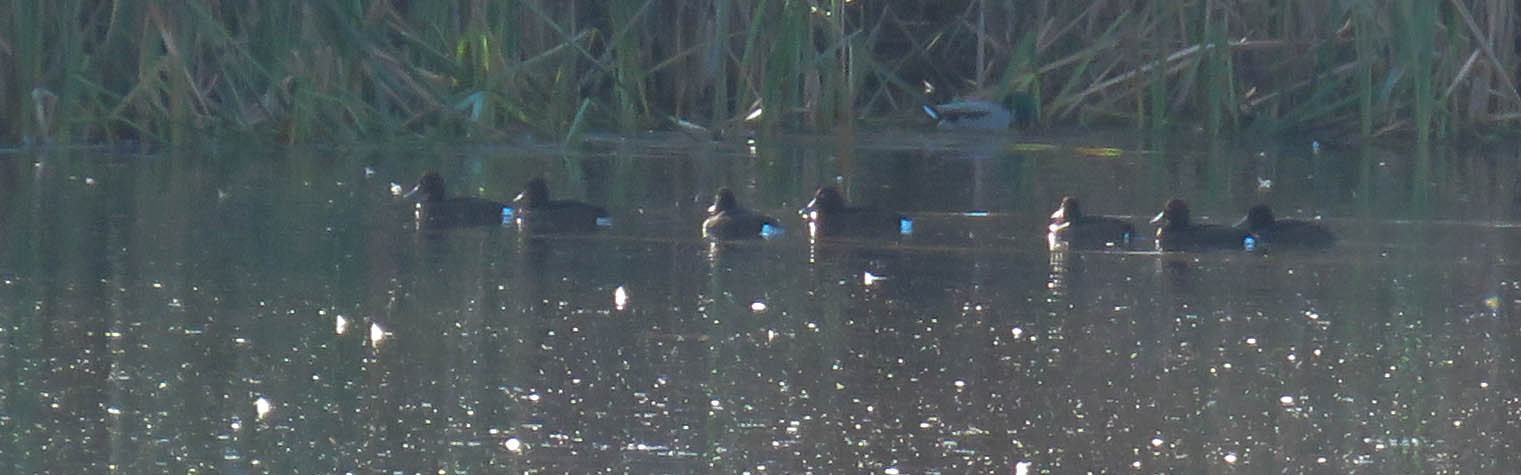
Distant record shot of seven Ferruginous Ducks Porron Pardo Aythya nyroca
Whilst I made my way back to Mezquitilla, John and Jenny Wainwright called in at Padul on their way back to Salar.  John. report follows.


Padul Laguna 

A bright and warm day here.  We parked up and headed for the small area where the Dunnocks were usually seen, but there was a tree down across in front of the feeders, where they are noted.

We then carried on round the laguna seeing Common Magpie, Collared Doves, Spotless Starlings and a Marsh Harrier.


By a stream we spotted a couple of Tree Sparrows in a small bush, while further on we noted Serins, Spanish Sparrows, Sardinian Warblers and an Iberian Grey Shrike.  Lots of Corn Buntings and

Chiffchaffs about as well as Stonechats.  Another female Marsh Harrier came past us and a Grey
Heron flew off from one of the fields.
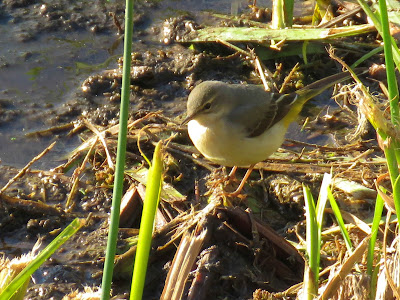
Grey Wagtail Lavandera Cascadena Motacilla cinerea
As we made our way along the boardwalk - which is now closed off due to being underwater part of the way - we put up a male Merlin.  Then more Chiffchaffs were seen as well as Blackcap, a Moorhen, Grey and White Wagtails and a nice surprise was the Bluethroat that we disturbed - sitting in a bush.  A Cetti´s Warbler and a Water Rail was heard here also.  Not a bad day's birding overall.
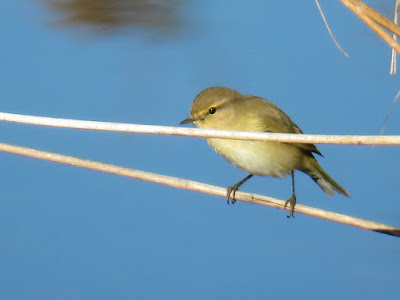
Chiffchaff Mosquitero Comun Phylloscopus collybita
Looks like I missed out on the opportunity to see my first Merlin since 2017.

Bird seen:
Mallard, Shoveler, Teal, Pochard, Ferruginous Duck, Little Grebe, Cormorant, Cattle Egret, Heron, White Stork, Marsh Harrier, Booted Eagle, Kestrel, Spotted Crake, Moorhen, Purple Swamphen, Coot, Red-knobbed Coot, Snipe, Yellow-legged Gull, Rock Dove, Collared Dove, Hoopoe, Crag Martin, Grey Wagtail, White Wagtail, Robin, Bluethroat, Black Redstart, Stonechat, Blackbird, Cetti's Warbler, Great Tit, Spotless Starling, House Sparrow, Waxbill, Serin, Goldfinch.
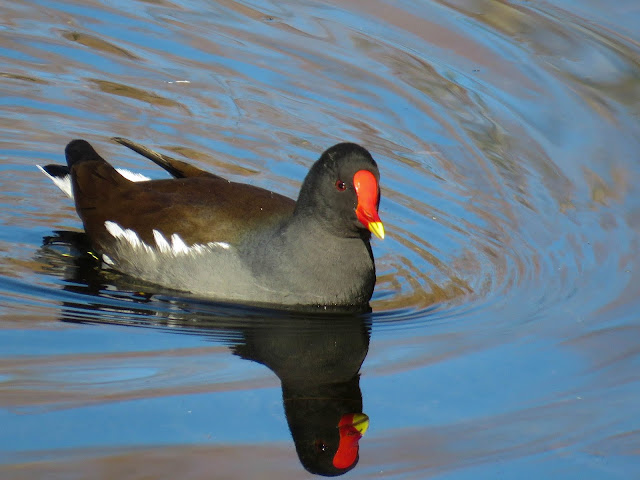
Moorhen Gallineta Comun Gallinula chloropus

Check out the accompanying website at http://www.birdingaxarquia.weebly.com for the latest sightings, photographs and additional information

Thursday, 10 January 2019

Bluethroat Luscinia svecica (PHOTO: David Elliott-Binns)
9 January 2019

Not just a day out at Cabo de Gata with the Arboleas Birding Group but an extended visit to take in a visit to the Charca de Suarez reserve on the western outskirts of Motril.  Ant it would appear that the visiting Spotted Crake is still about so something to look forward to when I visit on Saturday morning.  Nevertheless, some good bids seen at both visited sites.


Cabo de Gata walking & Charca de Suarez:Tuesday 8th January
Cabo de Gata & Rambla Morales: Wednesday 9th January

I left Arboleas early on Tuesday morning and headed to Cabo de Gata.  After the indulgences of our pre - Christmas visit to the UK and over-eating during the festive period, I needed to get back on the diet and fitness horse!  I parked up near the lighthouse and began to walk up to the top of Vela Blanca, the small mountain/large hill heading towards San Jose. 
Thekla Lark Galerida theklae (PHOTO: David Elliott-Binns)
I soon saw White Wagtail, Stonechat and Black Redstart.  A bit further up I added Black Wheatear and Thekla Lark.  Chiffchaffs were also in abundance.  After about an hour I reached the highest point on the road, passed the chain barrier and began my descent on the rough track.  I added Red-legged Partridge, Crag Martin and Rock Bunting before I reached the gates at the bottom.  As I turned round a Dartford Warbler flew between two shrubs.   So it was back up to the top and back down to the truck.  The only new bird I saw was a Sardinian Warbler.  A round trip of 12 kilometres.
I then drove down the rear of the bird reserve.  I have to say I've never seen it so deserted.  I logged one Shelduck, some Greater Flamingos and Slender Billed Gulls, but not one wader! (16 species in total)
I then checked into the Hotel Blanca Brisa in Cabo de Gata village, my overnight accommodation.  I left there at about 14.00hrs and headed for the Charca de Suarez bird reserve at Motril.  I had to hang around for about half an hour before the gate was opened by the ranger at 4pm.  I'd already logged Blackbird, Black Redstart and Yellow-legged Gull before entering.  The first hide only added Mallard ducks, so I moved on.  The next hide was reeded up, so onto the third.  Lots of birds on the water...Coot, Moorhen, Shoveler, Common Pochard, Teal and Little Grebe.  Also saw Grey Heron, Little Egret and Cormorant.  The star birds were the half dozen or so Ferruginous Ducks and the Red-knobbed Coots.  The latter were very interested in the wooden nesting platform directly in front of the hide.  Littler birds included White and Grey Wagtails, Stonechat, Robin and, of course, Chiffchaffs by the 10's!  A Hoopoe flew past.
Teal Annas creca (PHOTO: David Elliott-Binns)
I saved the 4th hide till last. Only one Spanish photographer was there.  I'd only seen one other person wandering around, who definitely wasn't a birder.  I scanned the pool and reeds. All the usual suspects were present. Coot, Moorhen, Mallard, Teal and Stonechats. I spotted a Great Tit. The resident White Stork was curled up resting. I then saw movement in the far reeds.  Sure enough, unbelievably, the Spotted Crake was still here.   It eventually showed well distantly and then flew into the reeds to our left.  My companion left me to it.  He missed the 1st winter Bluethroat feeding just in front of the hide!  Ended up with 25 species.
Spotted Crake Porzana porzana (PHOTO: David Elliott-Binns)
I left the reserve 20 minutes before the exit time of 6pm.  I headed back to my hotel a satisfied but very tired man.
Ferruginous Duck Aythya nyroca (PHOTO: David Elliott-Binns)
Next morning, after a hearty breakfast in the hotel (included in the €31.50 price!), I met up with Val, Alan, John, Kevin and Troy at the Pujaire cafe. Suitably coffee and tostada'd up (not me!) we made our way to the first hide.  Kevin and Troy had already been woken up by a calling Chiffchaff outside their van and we'd logged Collared Dove, Kestrel and Spotless Starling before secretary for the day, Val (Thanks) put Greater Flamingo down.  24 Black-tailed Godwits were feeding next to the rocky causeway on which a Mallard sat.  Slender-billed Gulls dip fed amongst the flamingos.  Alan scanned the small number of waders to our right.  Redshank, Little Stint and Dunlin.  A bit further round I found a Little Egret.
Driving round towards the 2nd hide we added Black Redstart and Cormorant.  A check out to sea, we saw flying Black-headed, Lesser Black-backed and Audouin's Gulls plus Sandwich Terns and Gannet.  As we walked to the hide a couple of us thought we heard a Raven and some heard a Crested Lark.  We saw Thekla Larks.  At the hide a Sardinian Warbler was spotted.   John found a Black-winged Stilt and some distant Shelduck.  Alan eventually found a lone Stone Curlew on the steppes.  Also seen were Greenfinch, Corn Bunting and Meadow Pipit.  Six or so Spoonbill suddenly showed themselves on or beside the little island opposite.  At least two were ringed.  I spotted a Dartford Warbler which gave good, but very brief, views.
Driving on from there, me leading, I noted the others had stopped.  I came across a small flock of Trumpeter Finch on the beach side of the road.  I kept my distance for the others to catch up, only to discover they'd also seen other  Trumpeter Finch.  At the public hide we added Sanderling, Kentish Plover, Greenshank and Avocet to the list.  Seventeen more Spoonbill and 35 Shelduck were noted. Lots of Lesser Black-backed Gulls both in front of the hide and on the rocky causeway to the right.
Not being able to find an open cafe for a coffee, we made our way along the beach side track towards the Rambla Morales.  I spotted 3 Kentish Plover on the savannah, the others find a flock of Meadow Pipits.  At the estuary there were some Coots.  Troy found a Little Grebe.  Val spotted a Shoveler and some flying Crag Martins.  We headed for the "hump".  Kevin scanned the opposite reed line and rolled off Shoveler, White Headed Duck, Coot and a Wigeon.
Trumpeter Finch Bucanetes githagineus (PHOTO: David Elliott-Binns)
Way in the distance I spotted a large flock of flying wader type birds which I thought must be Golden Plover.  We heard Cetti's Warbler.  John the spotted a flying Oystercatcher.  Alan then confirmed my suspicions by finding a small number of walking Golden Plover together with some Spotless Starling. A Trumpeter Finch flew over.  Troy had seen a White Wagtail.  A medium-sized flock of Lesser Short-toed Larks flew up concluding our list for the day.  We all noticed that some of the Shovelers were diving, a behaviour we hadn't seen before.  Alan check up and this is what he discovered :-

I looked in Collins, online at Wikipedia and RSPB and there is no mention of Shoveler diving.  In fact, all sites make much of the dabbling feeding action with emphasis on the large, spatulate bill. Only one site, Audubon, said that it rarely dives so we were treated to something special today! 
We ended up with 51 species. As usual we had good birding in good company.
Regards,
Dave

Red-knobbed Coot Fulica cristata (PHOTO: David Elliott-Binns)
A very sleepy White Stork Ciconia ciconia (PHOTO: David Elliott-Binns)
 
Check out the accompanying website at http://www.birdingaxarquia.weebly.com for the latest sightings, photographs and additional information

Tuesday, 8 January 2019

El Fondo, Elche

8 January 2019


Hardly recovered from Wednesday's day post than Dave and his Arboleas Birding Group took the long journey up to El Fondo for the very early visit to the closed reserve.  It must have been very frustrating after many hours driving to be confronted with driving restrictions upon arrival - but at least it finally got rid of the surplus fat built up be eating all that turkey, goose, duck and chicken; no wonder we have a shortage of birdlife!  But I see no mention of Marbled Duck, where have they all gone?


El Fondo, Elche   -   Saturday 5th January

It was very cold at 05.30hrs as I waited at the Overa hotel to be picked up by Alan, John and Val to be conveyed to the El Fondo Bird Reserve near Elche.  Mike, Diane and Richard followed in Mike's car. We headed initially to the Cox Service Station for a coffee and tostada.   Suitably refreshed we made our way to the North gate entrance.  We were first in the ever-growing queue.  As we waited for the first barrier to be lifted, we managed to see Little and Cattle Egret, squadrons of Cormorants, a single Glossy Ibis and some Marsh Harriers.  We saw the first of 100's if not 1,000's of Chiffchaff.  The first barrier was lifted we drove down to the 2nd gate, seeing Snipe and Lapwing on the way.  We were let through by the ranger, telling us we had to park up and walk from thereon.  As it is about a mile and a half (almost 3km) to the far end this cuts our 3 hour birdwatching window down another hour.  A decision difficult to understand.  Fortunately the ranger agreed that Mike could drive down due to Richard's mobility problems.

We all met up at the first elevated hide, a good half mile walk!  First birds noted were Black-necked Grebes.  We then spotted a gull/tern flitting over the surface.   After much discussion (and Diane going back to their car to get their Collins!) it was confirmed to be a 1st winter Little Gull.  To the right I found a huge flock of flying Glossy Ibis.  There were huge numbers of wildfowl....Teal, Common Pochard, Shoveler and Shelduck.  Alan found some Gadwall.  Also seen were Black-winged Stilt, Little Grebe, Coot, White Wagtail and a Kestrel.  I spotted a Common Buzzard flying by.  We heard Cetti's Warbler. 

Mike, Diane and Richard had already left to go down to the far elevated hide.  As space is limited, I began to walk to the 2nd hide down.  On the way I saw an Osprey flying to the left of where Alan, John and Val were.  They didn't see it as another birder had found a Spotted Eagle on a distant palm tree.  

Distant Spotted Eagle Aguila pomarina (PHOTO: David Elliott-Binns)
At the 2nd hide I added Red-crested Pochard.  Outside whilst fiddling with my camera which was playing up, I was met by Val.  She'd seen a Robin and Black Redstart on the way down.  Meeting up with Alan and John, they had also seen Dunlin, Kentish Plover and Ferruginous Duck.  I hastily returned to the first hide, where the other birder pointed out the Spotted Eagle for me.  We met up with Richard, Mike and Diane at the third hide. They didn't see much from the 4th hide.  Moorhen and Great Crested Grebe.   Sharp eyed Richard spotted a Kingfisher.  Alan found a Water Pipit.  We moved to the 4th elevated hide.  As already stated, not much on the water, but Alan did find a distant Great White Egret and a Grey Heron.  Also seen were Crag Martins, Blackbird and Stonechat. 

Over-flying Great White Egret Egretta alba (PHOTO: David Elliott-Binns)
I alone wandered to the small 5th hide.  Nothing much here either, only Coot and Grey Heron.  On the walk back I managed to get a shot of Alan's Great White Egret in flight.  Whilst away I'd missed a Purple Swamphen sighting.  As it was approaching 10.45 hrs we needed to head back the mile and a half to the exit gate.  On the way we spotted a Sparrowhawk and "my" Osprey flying back over.  Alan also found a Booted Eagle.  Mike, Diane and Richard obviously got back first.  Diane had spotted a Little Bittern in the water-filled channel to their left.  It flew off as we arrived, but very obligingly returned to what must be a favourite feeding point some 10 minutes later.

Little Bittern Ixobrychus minutus (PHOTO: David Elliott-Binns)
Having been released by the warden we drove to the Information Centre.  We in the leading car saw what we thought was a Little Owl on an abandoned building.  Richard in Mike's car thought it was an eagle.  When we passed over an hour later the bird had predictably gone, so who knows who was right!
Once parked up we checked out the first pool.  A Purple Swamphen was showing well.  Alan found a Common Sandpiper and I spotted a Bluethroat.  Also seen were Snipe, a Black Wheatear, Coot and Black-winged Stilt.  Despite a large King's Day eve picnic going on in the area overlooking the Information Centre pool, there were still a few Red-knobbed Coot to be seen.  Our final bird on the list happened to be a House Sparrow spotted by Alan!  Walking along the raised wooden walkway, I spotted another Bluethroat which gave good but distant views.  The far hides were very disappointing.  Only Coots basically, but the last hide did produce another Bluethroat.

Bluethroat Luscinia svecica (PHOTO: David Elliott-Binns)
All in all a very successful day. 56 species in total in glorious weather.  Great company and a good work-out with all the walking!
Regards,
Dave

More photos from El Fondo - all by David Elliott-Binns


Black-winged Stilts Himantopus himantopus (PHOTO: David Elliott-Binns)
White Wagtail Motacilla alba (PHOTO: David Elliott-Binns)
Purple Swamphen Porphyrio porphyrio (PHOTO: David Elliott-Binns)
Red-knobbed Coot Fulica cristata (PHOTO: David Elliott-Binns)


Check out the accompanying website at http://www.birdingaxarquia.weebly.com for the latest sightings, photographs and additional information

Barbate and La Janda

8 January 2019

Well, here we go again as John and Jenny Wainwright take off to the south-west in search of the recently seen Red-breasted Merganser, Rose-coloured Starling and Sociable Plover.  Two out of three is better than nothing and only dipped on the starling!


Barbate: 31st December2018

A bright but intermittent misty patches, strong winds.

We arrived at Huerta Grande earlier than expected due to lack of traffic, so this gave us time to get to Barbate marshes.  Apparently there was a huge rainstorm last night (30th), so the water levels are very high everywhere.

Plenty of Meadow Pipits and Goldfinches in the grasses and thistles respectively.  A few Stonechats and Crested Larks about the track, while on the islands we found Audouin´s, Black-headed, Lesser Black-backed and Yellow-legged Gulls and just two Sandwich Terns.   As we got out of the car at least forty Stone Curlews rose up from the foreshore and headed to one of the islands, a few stragglers were noted but out of reach of our cameras.  A small flock of Ringed Plovers were logged as was a single Kentish Plover, lots of Little Egrets and Grey Herons about though.  Then a Redshank flew in to the front of the Stone Curlew island and was joined very quickly by another then a single Greenshank.  As we drove further down the track Spanish and House Sparrows were logged as were Grey Plovers.  In the trees here we located Chaffinches,Black Redstarts, White Wagtails, Robins and Linnets, while above us Lesser Kestrels and Crag Martins were noted.

A few of the two-score Stone-curlew Burhinus oedicnemus (PHOTO: John Wainwright)
We then drove down towards Barbate stopping at all the watery mud flats.  Cormorants were in good numbers as per usual, but not much else we then went down to the estuary by the road bridge, but no sign anywhere of the Red-breasted Merganser, that had been reported.

On the drive back a male Hen Harrier and a Common Buzzard put in and appearance.
Lots of Large Whites, Painted Ladies and a single Pale Clouded Yellow butterfly today.
Tomorrow its La Janda.

La Janda: 1st January 2019

A chilly wind but warmed up later.

We headed for La Janda to search for a lifer - that being the Sociable Plover - that had apparently been at La Janda for a while now.  On the way logging Great Tit, Griffon Vultures, White Wagtails and House Sparrows.  As we approached Tahivilla village, Cattle Egrets, Spotless Starlings, Collared Doves, two Ravens and a Stonechat were noted.

As we entered the La Janda area three separate flocks of Lapwings rose off the fields and landed three fields away.  But not to be out done we did get good views of Spanish Sparrows and Corn Buntings, while on the harvested rice paddies we saw Spoonbills, Great White Egrets, White Storks and nearly a dozen Common Cranes.  On the plough we logged Linnets, Corn Buntings, Crested Larks and Stonechats, atop a pylon a Common Buzzard was seen and on the power lines two Lesser Kestrels were noted.

We started on the main track whereupon the Lapwings rose up again, it seemed to me that every time the Spotless Starling flock flew up it disturbed the Lapwings also, but I digress, after ten minutes of scanning the flocks we spotted the Sociable Plover - this is the juvenile/first winter bird not the adult, but it was still a good find for us.  On the right of the track a female Marsh Harrier appeared and put up even more Lapwings, but this time they included at least thirty Golden Plovers.  More Common Cranes were spotted here also, well over a hundred this time.  A Purple Swamphen was seen walking through the reeds and a Kingfisher passed us going downstream.

Sociable Plover Vanellus gregarius (PHOTO: John Wainwright)
Moving on Green Sandpipers were seen in the rice paddies and a group of Glossy Ibis flew over.  In the bushes and grasses Chaffinches, Chiffchaffs, Zitting Cisticolas, Stonechats and Linnets were seen and a covey of Red-legged Partridges flew out also.  Common Kestrels were noted on the pylons as we turned right onto the track for the dam.  As we passed through "Egret Alley", a Little Owl was spotted on the  irrigation frame and Goldfinches flew off the water pools and a Blackcap started singing.  Further along close to the farm we logged two male and two female Pheasants, Jackdaws and a Sparrowhawk. We drove down to the bottom of this track seeing Great White Egrets, Black-winged Stilts, Buzzard, Ravens, Red Kite and a Blackbird.

Retracing our steps we headed for Barbate marshes, on the way four Egyptian Mongoose ran across the track to our front.

Barbate Marshes:
We have only come down here, to get our year ticks as we were here yesterday 31/12/2018.  But we did get and unexpected surprise, the Red-breasted Merganser was on an island among a group of Cormorants, not at the fishing village as we were informed. 

Red-breasted Merganser Mergus serrator, centre front (PHOTO: John Wainwright)
Also about were Mallard, Stone Curlews, as well as Audouin´s, Black-headed, Yellow-legged and Lesser Black-backed Gulls, Redshanks, Dunlin, Ringed Plovers, Kentish Plovers, Black-winged Stilts, Sandwich Terns and Grey Plovers, while in and around the area we found Stonechats, Blackcaps, Corn Buntings, Chiffchaffs, Meadow Pipits, Crested Larks, Robin, Wren and Goldfinches


Sounds like an incredible couple of days John and Jenny with lots of good sightings.  Now if only I can get out and about I might improve on my resent year total of 4 - yes four!


Check out the accompanying website at http://www.birdingaxarquia.weebly.com for the latest sightings, photographs and additional information

Rambla de Almanzora & Vera Playa

8 January 2019


The New Year is with us and already I have three reports to published received whist I was away in the bitter cold, little snow and much rain of northern Germany; should have stayed in the Spanish sunshine.  As expected birding is underway again with teh Arboleas Birding Group with tis first of the year and , later, a nother report form dave to thaat wondeful hotspot of El Fondo up near Elche.  For me, yet to make a start but I have already seen both Feral Pigeon and Monk Parakeet this year!


Rambla de Almanzora & Vera Playa: Wednesday 2nd January
 
A Happy New Year to you all.  To clear the celebratory cobwebs, I decided to ease in the new year with a visit to our local patch, the Rambla de Almanzora.  I picked up Richard and joined the rambla just past the Desert Springs golf complex.  We'd already seen some Jackdaws and a possible Little Owl, but added little as we headed towards the ford.  Mallard and Moorhen were seen on the only areas with water.  Small birds included Crested Lark, Stonechat, Black Redstart and White Wagtail. We had fly overs by Magpie, Hoopoe and Yellow Legged Gull.   The rambla from the water treatment plant to the road bridge had been cleared of virtually all vegetation and small channels created for the water. There was a small amount of water near the ford.  Hopefully it will recover in time.

Scraped area around the ford (PHOTO: David Elliott-Binns)
We were met by Adrian, Kevin, Alan and John.  John had already seen Woodpigeon and Northern Starling.  Large numbers of the latter and Spotless Starling were seen as we began to walk towards the sewage works.  Richard was first to see a Grey Heron followed by a Robin.  A Bluethroat made a brief appearance, but the majority of the small birds seen were Chiffchaff.  A Green Sandpiper shot along one of the channels.  Kevin spotted a female Teal on some water on the far side.  Also seen were Serin and Greenfinch.  We were joined by Brian and Mary.
On the large pool there was a small flock of Common Pochard with some Mallard, a pair of Little Grebe and a male Teal.  Alan found a Grey Wagtail and a Common Sandpiper on the water's edge.  I missed a Blue Rock Thrush on the far side, but did see the overflying Little Egret.  Also seen were Black Wheatear, Black Redstart, Stonechat, Goldfinch and Sardinian Warbler.  Val joined us as we got back to the cars.
After a reviving cup of coffee in Villaricos village, Alan and John had a scan over the promenade wall and added Gannet and Sandwich Tern.  Richard spotted a resting Kestrel as I was driving.  There were anglers on the beach so initially we only saw a Cormorant on the rocks until sharp eyed Kevin spotted a Kingfisher thereon.

Record shot of the distant Kingfisher Alcedo atthis  PHOTO: David Elliott-Binns)
On the land side of the estuary we added Coot, but also saw Grey Heron and Mallard.  A Blue Rock Thrush was eventually showing well atop a tree.
On the beach end of the estuary, there was a flock of 16 Audouin's Gull in a raft.  On the sea were Black Headed Gull and Cormorant.  Kevin spotted a Black Necked Grebe with the help of Alan.  He then added a Turnstone. I saw a trio of Sanderling flying past.  There were more on the rocks together with Dunlin and Kentish Plover.
We made our way to the dual carriageway opposite the Consum Supermarket behind Vera Playa. Richard thought he'd seen a Marsh Harrier en route.  Alan said he thought it was a Booted Eagle and sure enough two were seen soaring above the shop.  Shortly afterwards at least three Marsh Harriers were seen, confirming Richard's sighting.  In the distance was a large flock of Crag Martins.  On the water there were huge numbers of Black Headed Gulls with some Mediterranean Gulls as well.  There were Mallard, Coot, Moorhen, Teal and Shoveler as well as Little and Cattle Egret.  We then moved down to the newly constructed concrete platform opposite the Aqua-Park car park.  The height gave us good views over a medium sized pool. I  immediately spotted a single male Ferruginous Duck.  We also added White Headed Duck.  Richard and I left, but Alan , John and Val wandered round to another pool.  Here they added Common Snipe and Water Pipit to the day list.
A lovely days birding in glorious sunshine and in good company to start the year off.   A highly respectable 57 species seen!
Regards, Dave


Check out the accompanying website at http://www.birdingaxarquia.weebly.com for the latest sightings, photographs and additional information