Sunday, 15 November 2015

Sierra loja with John and Jenny

A quick report from John Wainwright re his visit up the Sierra Loja with wife, Jenny but it seems that they might have been bettered by the fog at lower levels and then a mixture of Sunday shooters and the massed hordes at the higher levels!  But at least they managed to find some Ring Ouzels.

Sierra Loja 15th November

A chilly, foggy start, with a brisk breeze (12C).

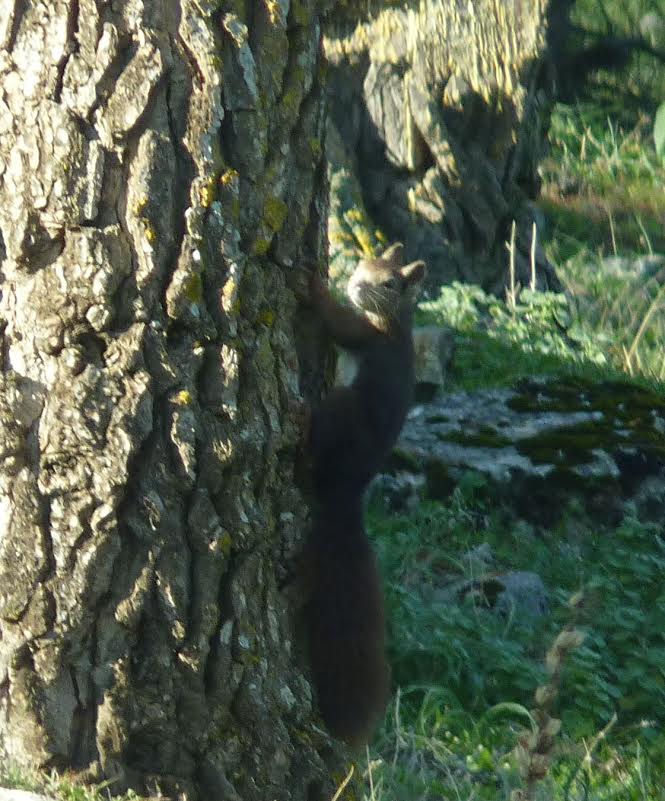
After coffee and toast at our regular spot we started up the mountain.  Due to the light fog, we couldn´t see anything much until we hit the tree line.  Here the fog had dissipated quite well and we saw Crossbills, Coal and Great Tit, Chaffinches, Robins, Mistle Thrushes and a very obliging dark-phase Red Squirrel.

Red Squirrel Sciurus vulgaris (PHOTO: Jenny Wainwright)
The cliff areas were barren, not even a Jackdaw to be seen (or heard), so we moved up to the substation valley.  Here we found two Chough, Thekla Larks, Red-legged Partridges, Stonechats, a Black Wheatear, Meadow Pipits and a Southern Grey Shrike was noted atop the bare tree here.

Thekla Lark Galerida theklae (PHOTO: Jenny Wainwright)

Lots of "shooting" about here today so we made our way up to the Charca de Negra ponds area.  This was swamped with people and all we had here were Goldfinches.  Along at the Fossil Cave a single Crag Martin and more Meadow Pipits were spotted, so we moved further along to the hawthorn bushes.  Here we found over a dozen Ring Ouzels, four Mistle Thrushes, Rock Buntings, Black Redstarts, Sardinian Warblers, Robins, Blackbirds, House Sparrows, Chough, a Dartford Warbler and a single Hoopoe.


Male Ring Ouzel Turdus torquatus (PHOTO: John Wainwright)
All things worth waiting for judging by John's report.  It just shows that you have to keep right on till the end of the road, or track in this case, if you want your share of the birds to be seen.


Check out the accompanying website at http://www.birdingaxarquia.weebly.com for the latest sightings, photographs and additional information.

Friday, 13 November 2015

Axarquia Bird Group visit to the Guadalhorce, Malaga

Little Egret Egretta garzetta
Thursday 12 November

Wonderful morning out with the Axarquia Bird Group at the Paraje Natural de Desembocadura del Guadalhorce reserve in Malaga with a total of sixteen present including Danish and Scottish visitors as well as long-time friends.  As ever, I am grateful to John wainwright also sending in a report on the visit so I have been able to add any missing birds to the following report.  In the end, great company with a finally tally of over fifty species and, on returning home, found that Jenny had slept through much of the morning as she recovers from her broken wrist and had then been visited by friends so not on here own.  Even better, she was well enough for us to attend the local Torre del Mar cinema and enjoy a performance of  Verdi's "Aida" from La Scala, Milan.  What a wonderful way to end the day!

The morning started surprisingly cool with much cloud instead of the promised full sun but it certainly made for better birding as, when the cloud finally cleared, it became very warm indeed.  Welcomed by a good number of Blackbirds and a foraging Sardinian Warbler along with a pair of White Wagtails on the road and both Cetti's Warblers and a Mistle Thrush as we awaited the remainder of the the group.   A rapidly departing Green Sandpiper was seen overhead along with the usual screeching of the marauding Monk Parakeets which kept us awake as we made our way to the entrance footbridge.  A pair of Grey Wagtails disappeared down stream and there was no shortage of either Black Redstarts or Zitting Cisticolas about and these were to be found all over the reserve.

Black Redstart Phoenicurus ochruros (PHOTO: Steve Powell)
Crossing the footbridge the river seemed completely deserted save for a handful of the resident Rock Doves on their usual perch under the motorway bridge.  But John Wainwright managed to find the lone Kingfisher resting in the reeds below a small tree upstream of the above bridge and, I think, seen by many.  Then it was on towards the Laguna Casillas passing a Great Tit, Greenfinch and more Zitting Cisticolas.  As walked we were aware of the movement to and from the Laguna Grande by the wintering Cormorants and there was always a Grey Heron or two to be seen plus small, isolated flocks of Yellow-legged Gulls.

All in a frazzle Little Egret Egretta garzetta
As expected and fore-warned, the water level in the lagunas was very high but, unexpectedly, very few birds about.  Jut the one Coot and a Little Grebe albeit a pair of Mallards flew over.  However there was a dozen or so Crag Martins feeding above along with a handful of Barn Swallows, so somebody is still finding sufficient food to put off the long migration south to furthest South Africa for at least a few more days.  In the tamerisks below a little movement and a pair of Blackcaps were revealed along with  very small charm of Goldfinches in the bushes neighbouring the hide.  Naturally at this time of the year, it was not long before we started to add regular sightings of Chiffchaffs to the list.

Little Grebe Tachybaptus ruficollis (PHOTO: Jenny Wright)
Walking on down to the Wader Pool it was not so much the pair of Collared Doves passing overhead that caught our attention as the single Whimbrel which seemed to appear out of nowhere.  The pool itself contained very few birds but we did manage to locate a pair of Snipe and then a rather lovely Reed Bunting immediately in front of us and only partly obscured by the covering reeds.  Steve thought he had found a second individual only to discover to his, and the rest of us, surprise that it was a juvenile Bluethroat he had photographed.  The beautiful shot by Steve can be seen.

Juvenile Bluethroat Luscinia svecica (PHOTO: Steve Powell)
Better seen from the track overlooking the old river, Rio Viejo, was the resting Osprey along with scores of Cormorants and then a single Booted Eagle.  A couple of Hoopoes, seen by Ivan and his wife, passed low near the river bank and, at the far end of the now large pool, were four Greenshanks and a single Common Sandpiper whilst near the far bank we found a pair of Shovelers just when we began to think we were not going to see a single duck on the waters!  A pair of Moorhen made their way across the water and beyond the trees we caught sight of a Marsh Harrier drifting by. no doubt looking for a little light refreshment.  Robins were also seen as we walked in both directions but the amazing site was that of a total of 31 Grey Herons arriving in the area en masse from, what appeared to be, off the sea.  In addition, a Common Redshank was heard but not located.

Common Sandpiper Actitis hypoleucos
The open ground towards the Sea Watch produced a number of Stonechats and Crested Larks along with at least a pair of Lesser Short-toed Larks.  The odd Blackbird and a handful of Goldfinches were forever swapping sides and then the first of a few Meadow Pipits to add to the list.  More Black Redstarts and, looking out to sea, a fair number of both Yellow-legged and Black-headed Gulls plus a single Gannet but, even better, the Osprey had decided it was time to go a fishing and it passed immediately overhead as we all suddenly remembered that we had cameras somewhere or other.  The return walk towards the Lagunas Escondida and Grande produce both a point of discussion and an amazing surprise in terms of raptors.  First, resting well up the ladder on the side of the left-hand tall chimney, what appeared to be a Kestrel or could it possibly be a Peregrine Falcon from way it was posed?  It took at least another two observations from further along the track to confirm the former as it s colouring became more evident and no sooner had we resolved the matter than the cry went up from John that there was a Short-toed Eagle overhead.  There was indeed and a very late specimen it most certainly was.

And then the Osprey Pandion haliaetus suddenly appeared overhead
Arriving at the Escondida we were greeted by a school party of over forty youngsters so decided to give it a miss and head straight to the Grande, thus making sure that we had the seats and uninterrupted views.  Perhaps a little spiteful on our party as we were soon joined by the teenagers and some were quite interested and enjoyed the opportunity to share our experience and look at the birds through our scopes and binoculars.  What did we see?  Apart from the Osprey which had now returned to its previous resting place, and the Booted Eagle there were numerous Cormorants and Grey Herons along with very many Shovelers and a smaller number of both Pochard and White-headed Ducks and just the single Gadwall.  There were very few Mallards on view but a small number of Coot could be seen.  Whilst looking the other way a pair of the original five Great White Egrets flew overhead to add to the couple of Little Egrets that had been noted in the adjoining water.

A pair of Shovelers Anas clypeata (PHOTO: Jenny Wainwright)
Making our way back to the footbridge, we managed to add both Serin and Linnet whilst our Danish friends called in at the Escondida and found a single Black-necked Grebe.  Anything else to report?  A quick visit upstream, by car via the road through the airport to Zapata in order that others might discover Derek and Barbara Etherton's "home patch" revealed a good number of Common Waxbills, a first sighting for some.

Resting Osprey Pandion haliaetus (PHOTO: Jenny Wainwright)
All in all a splendid day which I hope others enjoyed as much as i did despite not still having recovered from whatever bug it was that I picked up at the beginning of the week.,


Birds seen:
Gadwall, Mallard, Shoveler, Pochard, White-headed Duck, Little Grebe, Black-necked Grebe, Gannet, Cormorant, Little Egret, Great White Egret, Heron, Osprey, Short-toed Eagle, Marsh Harrier, Booted Eagle, Kestrel,  Moorhen, Coot, Snipe, Redshank, Greenshank, Common Sandpiper, Black-headed Gull, Yellow-legged Gull, Rock Dove, Collared Dove, Kingfisher, Hoopoe, Lesser Short-toed Lark, Crested Lark,  Crag Martin, Barn Swallow,  Meadow Pipit, Grey Wagtail, White Wagtail, Robin, Black Redstart, Stonechat, Blackbird, Mistle Thrush, Sardinian Warbler, Chiffchaff, Great Tit, Spotless Starling, House Sparrow, Serin, Greenfinch, Goldfinch, Linnet, Reed Bunting.


Check out the accompanying website at http://www.birdingaxarquia.weebly.com for the latest sightings, photographs and additional information.

Wednesday, 11 November 2015

Sierra Loja

Tuesday 10 November

A early start and taking the direct, motorway route accompanied by Paul Coulthard, we were gone by 7.45 and at the first, lower quarry which is a now a picnic area before 9 o'clock to start our day's birding.  Should have left mu jumper on, but at least I was not wearing shorts, as the temperature was only just into double figures and there would be sign of the warming sun until we would be well up the mountain.

Entering the service station to take the track up to the picnic area we had White Wagtail, House Sparrows and a couple of Collared Doves and even a lone male Blackbird ut in an appearance.  Arriving at the picnic area we had first a Black Wheatear and then a Wood Pigeon flew over.  So on and up to the main quarry but no sign of the Eagle Owl and its nesting hole very vare.  But we did find both Black Redstart and Stonechat with Choughs, Jackdaws and Crag Martins overhead.  However, perhaps the best sighting from Paul's point of view was a clear shot of a male Crossbill in the scope.

Rock Bunting Escribano Montesino Emberiza cia
Continuing on up with very few birds seen but we did eventually have both Thekla and Crested Lark along with a close Hoopoe.  A Southern Grey Shrike posed rather nicely and we were to see a second individual at the top.  From this point on we began to see the occasional Red-legged Partridge and the first of the Rock Buntings.  No shortage of Chaffinches, the most numerous species to be seen, and occasional small charms of Goldfinches.

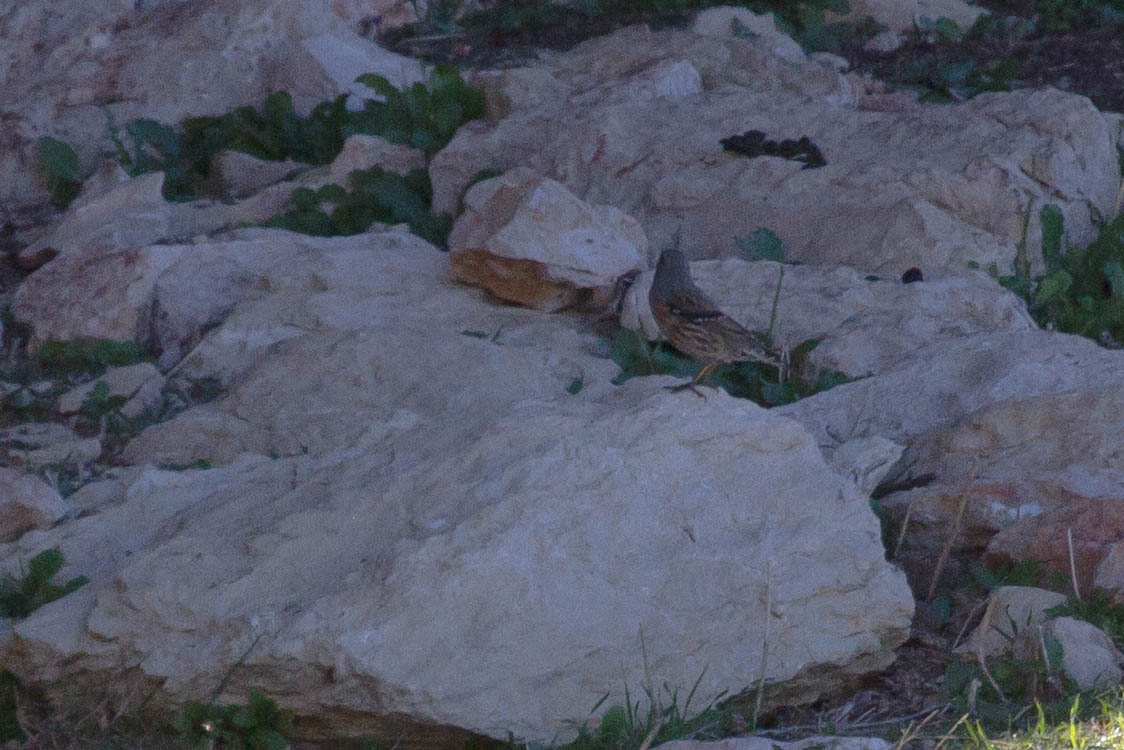
Now on the top and as we moved alongside the Charco del Negro barn we had more Spotless Starlings and the first Corn Bunting.  At the small pond, very little water, we had our first Meadow Pipit followed by a second and third as well as more Chaffinches and Black Redstarts.  Then it was round the back to see if we could find the newly-arrived Ring Ouzels.  There were probably at least twenty individual but well spread out and very flight giving poor views in terms of trying to get a photograph.  On the other hand, there were some very handsome males showing off their white chest crescent.  But before this, almost in front of the fossil cave, we had good but distant views of a pair of Alpine Accentors.  In addition to the Ring Ouzels we also recorded a couple of Blackbirds and a single Song Thrush plus a solitary Blue Tit.

Distant record shots of our Alpine Accentor Acentor Alpino Prunella collaris
More Corn Buntings before we made ou way back to Charco del Negro and then up to the top and the long track down to Salar.  Just a glimpse of a single Ring Ouzel at the alternative site but we did find a trio of Tawny Pipits.

From Salar we took the mountain road back towards Venta de Zafarraya and made use of the recently restored road.  Common Kestrel and more Mistle Thrushes and Corn Buntings were added along with a pair of Magpies and a what looked like a very large black Rock Dove.  Initially thought from its behaviour that it might have been a Raven but considerable white on the underside.  Stopping to check out the ploughed fields for Calandra Larks we actually had a lone Grey Heron drift away.  Finally, just when we had given u all hope, the final hundred metres or so of the "Magpie Woods" as we started our descent to the fertile growing field produced about a quintet of Azure-winged Magpies moving slowly over the ground and with a few inches of the surface.


Birds seen:
Red-legged Partridge, Heron, Kestrel, Rock Dove, Wood Pigeon, Collared Dove, Hoopoe, Crested Lark, Thekla Lark, Crag Martin, Meadow Pipit, Tawny Pipit. White Wagtail, Alpine Accentor, Black Redstart, Stonechat, Black Wheatear, Ring Ouzel, Blackbird, Song Thrush, Mistle Thrush, Blue Tit, Southern Grey Shrike, Azure-winged Magpie, Magpie, Chough, Jackdaw, Spotless Starling, House Sparrow, Chaffing, Goldfinch, Crossbill, Rock Bunting, Corn Bunting.


Check out the accompanying website at http://www.birdingaxarquia.weebly.com for the latest sightings, photographs and additional information.

Arroyo del Marin with John and Jenny

Tuesday 10 November

Whilst I was having a somewhat disappointing drive up the Sierra Loja John was bust writing up his report re Monday's visit to the Arroyo del Marin with wife, Jenny.  Whilst I dipped on all three of my potential target birds I, with much envy, noted that John had a Hawfinch fly over.  Me thinks I will have to drive over again come mid-December.


Arroyo del Marin: Monday 9th November

A very warm day with very little wind.

As we entered the area several Goldfinches left the grasses and thistles, and a few House
Sparrows were noted also.  Down the track we saw Azure-winged Magpies, Serins, Chiffchaffs and a few Robins.  As we turned off the track by the ruin two Great Tits were seen in the bushes and as we got out of the car Hawfinches were heard passing overhead.

Making our way down the upstream path - lots of Large Whites and Speckled Wood butterflies about
here - we heard the Greater Spotted Woodpecker, followed by a sighting a few minutes later. Blackbirds were numerous as were Chaffinches, Great Tits but only one Blue Tit seen all day. A Green Woodpecker called several times from across the stream but no sightings were had, but more sightings of the Greater Spotted Woodpecker were logged. A Short-toed Treecreeper was spotted leaving one of the bare trees to be superceded by a Nuthatch and above the latter a Blackcap began singing.  Just a bit further down a Wryneck called, but then flew off to the other side of the stream into the oak trees on the hillside.

The downstream paths held the same varieties as the upstream with the exception of a Black Redstart, so we moved down to the second ford where we had Long-tailed Tits, Serins, a Sardinian Warbler, Goldfinches and a Grey Heron emerged out of the tall reeds a little downstream of the ford - we never came upon it again.  Coming back up the track at the pull-in just prior to the first ford, we walked up to the ford and here another three Hawfinches were seen, also a male Siskin, two Cirl Buntings and a Wren.  A movement on the cliff face gave us our one and only Blue Rock Thrush of the day as well as a small group of Crag Martins. 

On the way out of Archidonna a Common Kestrel, Collared Doves, Spotless Starlings and a Mistle
Thrush were see.  Not a bad number for three hours -quite hard - birding, and not a single photo to be had.

Certainly interesting to see that there are Hawfinches still about and the first Siskins are starting to arrive. 


Check out the accompanying website at http://www.birdingaxarquia.weebly.com for the latest sightings, photographs and additional information.

Saturday, 7 November 2015

From sea level to mountain top

Wryneck Jynx torquilla (PHOTO: Derek Etherton)
Friday 6 November

I was all excited last week-end as Derek and Barbara Etherton along with Linda Roberts and Mick Smith planed a super day to take in Zapata followed by the upper reaches of the Rio Grande and then a drive over to El Torcal for the wonders of that fabulous and iconic mountain top.  All seemed a great idea until I remembered that Friday morning was our monthly dance club and 'er indoors would not be best pleased if I disappeared birding yet again!  Whilst the dancing was fine I must admit I was a bit peeved to receive the following report from Derek on what seems to have been a fabulous day.  Ah well, next time I suppose.


Well as advised, shame you were dancing, we met up with Linda Roberts and Mick Smith for a day out birding, poignant in that Linda returns to the UK next week and will no doubt miss the wonderful Spanish scenery that holds our birds.  However we like to think we did her proud.

Starting as the sun burnt through the early morning mist in the Guadalhorce valley at Zapata we made straight for the ford.  Feeding on the edge was a Common Sandpiper soon to be joined by a couple of Grey Wagtails. Looking low in the tamarisk bushes for the usual Bluethroats seen here, we both noticed an unusually marked small bird facing us.  It flew and luckily we tracked it to the top of nearby bamboo and, lo and behold, a Wryneck!  A first for us here and fabulous views it afforded all of us,  posing long enough for a 'scope to be set up and for all four to enjoy a prolonged view - not bad for 08:30hrs in the morning!  Then Barbara noticed a Bluethroat close to where the Wryneck had been, what a start to the day it was proving to be.  Chiffchaff, White Wagtails, Meadow Pipits, Cetti's Warbler and Linnets were everywhere.  
A lovely view of the back striping on the Wryneck Jynx torquilla (PHOTO: Derek Etherton)
A couple of Cormorants and Jackdaws flew over along with a Cattle Egret and a couple of Barn Swallows. Crested Larks scampered around and Serins were singing and a Kingfisher posed obligingly. With plenty of water now covering the summer dry areas, plenty of birds are enjoying the habitat, we all agreed that we could spend a couple of hours just staying here.  But this was not what the timetable allowed, so it was back up the track and round to the reed bed and 'Short-toed Lark corner' to park.  Stonechats, House Sparrows, noisy Monk Parakeets and Zitting Cisticolas were to the fore and as we tracked a solo Snipe flying we all became aware of an Osprey that had started fishing where we had just left. 
Watching the bird we then became aware of a Common Kestrel and Marsh Harrier flying close by. Several Red-legged Partridge crossed the track and a lone Cattle Egret seemed reluctant to fly from the track very close to us.  Linda wanted Common Waxbill and a few minutes later she had her wish, first a solo bird sitting out asking to be viewed and a little later a 'gang' of 10+ going about their business.  Grey Heron And Little Egret flew in and there were many Gold and Greenfinches feeding busily, joined by House Sparrows and countless Black Redstarts.

We had been here only 90 minutes and recorded a list of 39 species, not bad as a starter.  So off for breakfast at our usual venta and then on to the upper reaches of the Rio Grande - en route we clocked up Common Buzzard.  Plenty of birds to be found here, but the only additions were Great Egret, Green Sandpiper, Crag Martin, Greenshank and Chaffinch.
Great White Egret Egretta alba (PHOTO: Derek Etherton)
Linda had privately expressed a wish to visit El Torcal, a favourite for us and never experienced by Mick, so on we travelled.  Glorious weather, bright sun, 22c, dropping to 17c at the top,  the only trouble was that it appealed to many others and not birders, but noisy tourists and school children.  We, therefore, took a different route around and first of all found a Great Tit at the picnic tables.  So many Black Redstarts sat up on the low rocks and it took a while to find the first Blue Rock Thrush.  Whilst admiring the Griffon Vultures floating by we became aware of a pair of Bonelli's Eagles treating us to a magnificent display before disappearing down the valley.  Robins were 'ticking' and several Ibex were seen on the rocks. Crossing the road and taking the 'red route' we soon picked up an Iberian Grey Shrike, but parties of loud school children rather spoilt the scene.  One has to ask what do they get out of the day and experience? Certainly not studying flora or fauna!  However, after they passed by we waited a few minutes and then tracked back to the car to be rewarded with superb views, albeit in the shade, of a Cirl Bunting feeding in the grass.
Always Ibex Capra pyrenaica  to be found on the rocks of El Torcal (PHOTO: Derek Etherton)
A quick bite to eat and then round to the other small road that leads to the satellite/telegraph towers.  It's here in the past that  we have found Dartford Warblers and Alpine Accentors.  Whilst waiting and hoping, we viewed a large flock of Choughs on the opposite hillside.  Moving on a little we found a Dartford Warbler, another Iberian Grey Shrike and eventually listened to an Alpine Accentor singing [we checked our phone Apps!] but could we see it?  No!
This Cirl Bunting Emberiza cirlus may be hiding but we can still see you! (PHOTO: Derek Etherton)
So back down and a plan to return via Laguna Dulce.   OK we know there's no water here but the Common Cranes are back and pleasingly some 60+ birds obliged.  A couple of Corn Buntings were in the nearby field and a single Yellow-legged Gull flew over.

On the return back to Alhaurin de la Torre we had Jay and Raven pass over us so that our final tally for the day amounted to 59 species......how I dislike odd numbers!

A long, nearly 10 hours of driving and birding, but super birds, weather & company made it all worthwhile.
Not sure which to mention first, the late Barn Swallow, feeding Osprey, pair of Bonelli's Eagles, the Wryneck, etc.  Whichever, it certainly seems as if the quartet had a fabulous day's birding.

Check out the accompanying website at http://www.birdingaxarquia.weebly.com for the latest sightings, photographs and additional information.

Thursday, 5 November 2015

Fuente de Piedra with John and Jenny

Wednesday 4 November

The rain and storms have come and gone and now we are back to sun, glorious sunshine and lots of lovely warm weather.  All the more reason, therefore, for John and Jenny Wainwright to drive over to Fuente de Piedra to check on water levels and what might be about as can be seen from John's report.


A very warm day with lots of cloud.

We arrived at Fuente de Piedra at about 11am and immediately noticed how dry the place was even after the rain that we had been told that had descended in and around the area.  Still, as we were here we decided to look around.  Plenty of Stone Curlews were noted as we drove into the reserve as well as Crested Larks, Lapwings and a few Meadow Pipits.  Jackdaws were in good numbers but the usual House Sparrow population was not too be seen.
Stone Curlews Burhinus oedicnemus at Fuente de Piedra (PHOTO: Jenny Wainwright)

The boardwalk area had plentiful White Wagtails and also a smattering of Meadow Pipits, Crested Larks and in the reeds, Stonechats and Chiffchaffs.  A Common Kestrel was noted overhead here also.
The scrape held absolutely nothing bar two male Stonechats quarreling and a lone Moorhen.
Up to the mirador, and  looking out over the laguna in the far distance several hundred Greater Flamingos were seen as well as several rafts of gulls - mostly Yellow-legged with only three Black-headed Gulls noted.  In the bushes below the mirador male and female Blackcaps, Chiffchaffs, Cetti´s and Sardinian Warblers, House Sparrows, Black Redstarts and Goldfinches were seen.

Black Redstart Phoenicurus ochruros (PHOTO: Jenny Wainwright)
So moving along to the Laguneta hide, where some water was to be seen, although the bird-life here was pretty mundane with just a few Shovelers, Mallard, two Teal, Lapwings, three Common Snipe and lots of Moorhens.  Meadow Pipits and White Wagtails were plentiful feeding along the shoreline - of which very little was in view - due to the reeds and the bushes along the foreshore - but a female Common Redstart paid a very quick visit here as did a Corn Bunting. 

The open hide had more of the latter varieties,but in very much smaller numbers. Just a note; not one Common Coot was seen here anywhere, where have they all gone?

Jackdaw Corvus monedula (PHOTO: Jenny Wainwright)
We then moved on to the Mirador Cantarranas which is also completely devoid of water but we were looking for the Common Cranes which have been reported to have arrived a week ago.  No sign of them but we did locate a beautifully marked male Hen Harrier which flew across the whole of the area but never stopped and was last seen circling in the far distance.

We then drove round to the main Campillos road hoping that Laguna Dulce might have benefited from the rains, but no!!  Although we did get about thirty or forty Common Cranes feeding in the fields to the right of the hide.

On our way to Antiquera a Black Kite was spotted which closed the day on quite a good note.


Interesting, especially about the (still) lack of water following the recent torrential rain.  But at least the Cranes are back even, as yet, if in very small numbers.  Let's hope it drastically improves before the visit of the Axarquia Bird Group in December.


Check out the accompanying website at http://www.birdingaxarquia.weebly.com for the latest sightings, photographs and additional information.

Sunday, 1 November 2015

Isla de las Palomas with the Andalucia Bird Society

Saturday 31 October

An earlier night than of late then up, up and away before 6am with Barbara and Derek Etherton to collect Micky Smith and on down to Tarifa for a special meeting of the Andalicia Bird Society.  Fifteen of us were met by the representatives of the "Birdiug the Strait" company to attend the private meeting they had arranged on behalf of the Society at the Isla de las Palomas, the most southerly point of mainland Europe.  dark when we left with the promise of a little sun at first light followed by cloudy and eventually rain by mid-afternoon we were very presently surprised to not only enjoy more sunshine than cloud but, in the event, a rather  warm and pleasant day until late afternoon, albeit a little on the breezy side, and the eventual rain turned out to be no more than a light drizzle and by which time we had almost completed a circuit of La Janda and just about ready to start our return journey having recorded over seventy species during the day.

Whilst waiting for the Guardia Civil to unlock the gate to the site and let us in for our 3 1/2 hour sea-watch, we were able to record Cormorant, Yellow-legged and Mediterranean Gulls along with a number of Spotless Starlings.  Once inside what resembled an abandoned fort, still not sure whether the lighthouse was in working condition or not, with its bare soil centre and rusted goalposts one wondered whether it had been an army base in a previous life.  In the event, I presume, all the security was probably for the benefit of the illegal immigrants who were house in  restored barrack on the inside western corner of the site.

Enough pondering and on to the rocky coast where a rather lovely sea-watching facility had been built and certainly offered good shelter.  A[art from the numerous resting Yellow-legged Gulls it was obvious from the very start that something special was on-going out to sea and conformed when we informed that this was the best week for sea-watching for shearwaters.  And shearwaters there were too.  Thousands of Cory's (Scopoli's) Shearwaters were streaming westwards out into the Atlantic whilst travelling in the opposite direction there was always the occasional Balearic Shearwater.

Cory's (Scopoli's) Shearwater Calonectris diomedea diomedea
Nearer to the coast, and often within twenty metres or less, were scores of Gannets in all stages of development and almost a s many Sandwich Terns.  We even had a couple of Arctic Skuas pout in an appearance plus the briefest of glimpses of a Whimbrel.  On the rocks below both a Turnstone and a Redshank whilst above us regular passages of small charms of Goldfinches along with Serin and the occasional migrating Sand Martin and even more Barn Swallows.  Just one Greenfinch and also single Little Egret and a Black Redstart.


2nd calendar year Gannet Morus bassanus
3rd calendar year Gannet Morus bassanus
Meanwhile, way out in the Strait, whilst watching the streams of Cory's Shearwaters flying eastwards the sudden distraction of watching a large container ship heading towards the Mediterranean as a pod of, presumably, Bottle-nosed Dolphins entertained each other, and we watchers, as they bow-surfed their way eastwards.

Adult (winter) Gannet Morus bassanus

All too soon our time was up and we made our way back passed the roosting Yellow-legged Gulls to the locked gate and await our captors, the Guardia Civil, to let is out and off the site.  House Sparrows and a Collared Dove noted and then, for many of us, it was the short ride, after taking our farewells and thanks to our guides, to head up to  a nearby car park and successfully locate the resident, very small, population of Common Bulbuls.

At this point most split up but seven off us took off to unsuccessfully find the Lesser Crested tern that had been recently seen at Los Lances beach.  Here we managed to add Kentish and Ringed Plovers along with Sanderling, Little Stint and Cattle Egrets.  Before long we had found our first Meadow Pipits of the day along with Crested Larks, Stonechat and even a Red-rumped Swallow.  A few managed a distant Black Kite whilst nearer home in the shallows waters was a trio of Flamingos.  By the time we had returned to our cars we had also added Zitting Cisticola, White Wagtail and Common Kestrel.

A slight problem reaching Zahara on our way to Barbate as the road was blocked by the Guardia Civil as NATO exercises were still in progress and an enforced half-hour wait.  What to do?  Derek remembered that a couple of years ago he had been taken to a relatively nearby housing estate by John Cantelo where Little Swifts were breeding so off we all went.  Not only a few Little Swifts showing their white rumps and squared tails but also Barn Swallows, House, Crag and Sand Martins.  In addition we had a single Blue Rock Thrush, Blackbird, Robin and Sardinian Warbler.

Back to Barbate as the afternoon hours quickly disappeared where we discovered good numbers of small waders with Sanderling being the most numerous.  Lots of Flamingos and a good-sized flock of resting Audouin's Gulls before finding a few Spoonbill, Dunlin and Redshank.  Further round the water we were to also find a trio of Stone Curlew, a single Grey Plover and Greenshank along with a handful of Grey Herons and distant Mallards.  Smaller birds included Corn Buntings, Crested Larks, Linnets and a small flock of Calandra Larks.  On ;leaving we managed to see a quartet of Griffon Vultures overhead and found a couple of the local Bald Ibis.

Bald Ibis Geronticus eremita

Our final point of call, just the one car of four now, was a reverse drive around the main track of La Janda. Chiffchaffs, Corn Buntings and Goldfinches early on along with very many Little Egrets before finding the single Great White Egret.  Then, no sooner had we had our first couple of Marsh Harriers, than a rather handsome male Hen Harrier crossed low in front of the car and later we were also to see a female (ring-tailed) Hen Harrier.  Numerous Common Kestrels resting on the electricity pylons and more Marsh Harriers whilst, overhead, a very large flock of Glossy Ibis drifted across the skies.  No Red-legged Partridges on this occasion but we did see at least three Pheasants.

In addition to the Grey Herons, as the light departed on the final stretch of the track alongside the canal, we saw both Coot and Moorhen on the track as they scurried safely down to the neighbouring water and then thousands, literally thousands of White Storks resting and moving towards us to their evening roost.  At the same time the same was happening with the hundred s of Cattle Egrets who use this site as their autumn roost.   A Cetti's Warbler was heard along with a Kingfisher and we even managed a single Buzzard.   The other extremely large flock was that of Jackdaws who, presumably, might have been making their way towards a potential roost in the neighbourhood of the smelly farm.  Cranes were reported to have arrived during the week but we were unable to find any but, as a consolation, had the privilege of recording our last bird, a Black-shouldered Kite.

White Stork Ciconia ciconia

As we finally made our way back to the N340 and the drive home with just a little light drizzle and now almost dark we could look back on a wonderful day in great company and, for us, over 70 species recorded.

Birds seen:
Mallard, Pheasant, Cory's Shearwater, Baearic Shearwater, Gannet, Cormorant,cattle Egret, Little Egret, Glossy Ibis, Bald Ibis, Great White Egret, Grey Heron, White Stork,Spoonbill, Flamingo, Black-shouldered Kite, Black Kite, Griffon Vulture, Marsh harrier, hen harrier, Buzzard, Kestrel, Moorhen, Coot, Stone Curlew, Ringed Plover, Kentish Plover, Grey Plover, Sanderling, Little Stint, Dunlin, Redshank, Greenshank, Turnstone, Mediterranean Gull, Black-headed Gull, Audouin's Gull, Yellow-legged Gull, Sandwich Tern, Arctic Skua, Rock Dove, Collared Dove, Little Swift, Kingfisher, Calandra Lark, Crested Lark, Sand Martin, Crag Martin, Barn Swallow, Red-rumped Swallow, House Martin, Meadow Pipit, White Wagtail, Common Bulbul, Robin, Black Redstart, Stonechat, Blue Rock Thrush, Blackbird, Cetti's Warbler, Zitting Cisticola, Sardinian Warbler, Chiffchaff, Jackdaw, Spotless Starling, House Sparrow, Spanish Sparrow, Serin, Greenfinch, Goldfinch, Linnet, Corn Bunting.


Check out the accompanying website at http://www.birdingaxarquia.weebly.com for the latest sightings, photographs and additional information.