Tuesday, 15 December 2015

Sierra south of Ronda

Saturday 12 December

On airport duty so unable to attend this month's Andalucia Bird Society field visit to the Serrania de Ronda but was able to meet up with members afterwards when I attended the committee meeting in Juancar, the "Blue Village" in the middle of no-where.

A rather lovely, if lonely, Little Egret Egretta garzetta
Having dropped my son off at Malaga for his return flight to Bristol I made my way, passing a Cormorant flying into the Guadalhorce, to the Parador in the hope of seeing the one remaining Superb Starling named "Pepe" by the locals.  White Wagtails, Monk Parakeets, Collared Doves and Spotless Starlings but no Pepe.  I later learnt that he died back in July so our only site, as far as I know, in Europe to see this beautiful bird is now gone.  Carrying on along the coast my next stop was the lighthouse at Fuengirola where, all being well, I might pick up the Purple Sandpiper.  Again, out of luck but this time I added about a dozen Turnstones, a handful of Sanderling, single Black Redstart and Ringed Plover and a very small flock of Serin.  There was also a single Little Egret feeding in the shallows and a trio of Audouin's Gulls resting on a large rock just off the shore.  Out at sea, but relatively close to the shoreline, both a Lesser Black-backed Gull and adult Gannet passed eastwards.

Turnstone Arenaria intrpres with Sanderling Calidris alba

My final stop was up in the mountains above Ojen at the Refugio de  Jaunar where I hopped to find my third target bird of the day, the Bullfinch.  Again, much searching during which I saw Blackbird, Robin and Great Tit but the Bullfinch was proving most elusive until I heard two individuals whilst walking the valley trail.  The only thing I can say is that one out of three is better than none out of three - just!

Sanderling Calidris alba
Passing a Raven as I climbed higher and higher and then, just a couple of kilometres away from my destination at Juancar, I cam across a few of the members checking out a high peak and neighbouring fields where, I too, recorded Griffon Vulture, Chiffchaff, Stonechat, Choughs and Thekla Lark, before continuing onwards to the village where I also picked up a Blue Tit and , needless to say, a number of House Sparrows.  On the other hand, not best pleased to hear that during the morning the group had found Brambling, Hawfinch, Redwing and Fieldfare, all four of which could have been added to my year list!

If you fish in the surf it can make a mess of your hair!

Birds seen:
Gannet, Cormorant, Little Egret,Griffon Vulture, Ringed Plover, Sanderling, Turnstone, Audouin's Gull, Lesser Black-backed Gull, Collared Dove, Monk Parakeet, White Wagtail, Robin, Black Redstart, Stonechat, Blackbird, Chiffchaff, Blue Tit, Great Tit, Chough, Raven, Spotless Starling, House Sparrow, Serin, Bullfinch.


Check out the accompanying website at http://www.birdingaxarquia.weebly.com for the latest sightings, photographs and additional information.

Wednesday, 9 December 2015

Barbate and La Janda

Black-shouldered Kite Elanus caeruleus
Wednesday 9 December

Whether it was the thought of Lesser Crested Terns at Los Lances or the possibility of catching up with the visiting lesser Spotted Eagle at La Janda whilst the dry weather continued I do not know but certainly Derek and Barbara Etherton decided to make the most of the opportunity and took themselves off down to Cadiz Province on Sunday rather than stay at home and enjoy the holiday-making Spaniards as they enjoyed Constitution day.  They even managed to get a room at their favourite hotel and then enjoyed a second visit to La Janda on Monday morning having enjoyed the birds of Barbate on the Sunday.  And judging by Derek's report that follows they certainly had some very good birds if not the two I identified above.  Bur then again, who can argue against half a century of Stone Curlews, hundreds of Cranes, loads of Common Kestrels and those delightful Marsh and Hen Harriers found at La Janda?  All the photographs are by and courtesy of Derek Etherton

Sunday & Monday, 6 & 7 December: Tarifa area, Cadiz including Barbate and La Janda

Leaving early on Sunday we clocked up Little Owl, Buzzard, Common Kestrel, Blackbird, White Wagtail & Sparrowhawk whilst travelling on the motorway.  First stop was at Apollo 11 for coffee before heading to Barbate, a favourite place for us.  A handful of Auduoin's Gulls were joined by a single Yellow Legged, plenty of Sanderling, Ringed Plover and Kentish Plover were busy feeding, mixed among them were Redshank and Black Winged Stilt.  A couple of Cormorants lurked with Grey Heron across the first pool along with a solitary Greenshank.  Crag Martins, Meadow pipits, Spotless Starlings, House & Spanish Sparrows joined Crested & Lesser Short Toed Larks feeding on the ground.

Moving up a little Mallard, Little and Cattle Egret, a group of 6 Spoonbill were spied and panning the 'scope round a Kingfisher was found.  A little further up the Stone Curlews were located closer to the bank than normal, and in greater numbers, 53 counted by us bur probably more camouflaged.  On the waters edge a couple of Grey Plovers and a single Curlew Sandpiper were in the same 'scope view as the Stone Curlews.  A distance away a couple of Griffon Vultures were wheeling around and then, from nowhere, an Osprey appeared, but stayed down the far end from us.  
What a lot of Stone Curlews Burhinus oedicnemus to be seen at Barbate
Lunching half way along the track we were to view a solo Barn Swallow, Linnets, Serins, Goldfinches and a Sardinian Warbler, the Corn Bunting turned up later.  Of course several Stonechats were posing in their normal manner.

Very little new was to be spied at the top end except for Calandra Larks in the nearby fields and so we drove back down to move onto the bridge area.  En route back down a Raven and a couple of Lesser Black Backed Gulls had arrived along with 3 Bald Ibis.  Deciding to go via the horse and cow fields on the way back to the road we counted a total of 9 of this 'ugly' bird - well their mothers must love them.
Cattle Egrets Bubulcus ibis
At bridge area we added Curlew, a smashing Marsh Sandpiper and some more Grey Plovers, other than that it was just more Kentish and Ringed Plovers.

Grey Plover Pluvialis squatarola

So around to La Janda and driving in the 'back' way.  Plenty of Marsh Harriers, male & female, hundreds of Common Crane, more Corn Buntings and Stonechats.  Dozens, yes dozens, of Common Kestrel and of course White Storks.  It took a good hour to record our first Hen Harrier, female, and even longer for a male.  No sign of a Black Winged [or shouldered if you like] Kite but plenty of Egrets, Cattle, Little and a couple of Great White.  Both Pheasant & Red Legged Partridge were on the track, some Zitting Cisticolas braved the windy conditions. A Robin viewed and 'ticked' at us whilst we watched Jackdaws and Wood Pigeons.
Many feeding opportunities for the Cattle Egrets Bubulcus ibis
Driving out past the rice field stubble we saw several more Harriers, countless White Storks, Cranes, Cattle Egrets and Grey Herons, but the funniest was watching, by accident, some Purple Swamphens with their bottoms and legs up and busy feeding in the stubble.
When a White Stork Ciconia ciconia needs to stretch, it has to stretch
So back to the hotel to be greeted with a Tawny Owl calling outside our room.

Female Common Kestrel Falco tinnunculus
Day 2 dawned and our plan after breakfast was to bird La Janda the normal way and exit at Benalup, travel the A2226 to the Jerez - Algeciras road.  But first of all we called into Los Lances to see what was about. Auduoin's Gulls, Sandwich Terns, a solitary Greater Flamingo and a Curlew were close to the hide.  Many Sanderling and Ringed Plover scampered about and another Grey Plover lurked in the reeds in front of the hide.  Each side of the boardwalk had Goldfinch, House and the odd Spanish Sparrow.  Meadow pipits, Crested Larks and Chiffchaffs were plenty.  
Plenty of Common Cranes Grus grus at La Janda

Driving on to La Janda they were busy ploughing the field to the left of the track, much to the delight of several hundred Cattle Egret following the tractor and the many, literally hundreds of Sparrows mainly Spanish, the Serins, Corn Buntings and Linnets were also not to be outdone.  A little further down Jackdaws, Lapwings, White Storks and Common Cranes kept a little distance from the ploughing activity.  A couple of Common Buzzards were noticeable engaged in arguments with Marsh Harriers.  Most of yesterdays birds were present but we managed to add a single Green Sandpiper, and a close Marsh Sandpiper amongst the draining fields. Past the 'smelly' farm with the usual close by Red Legged Partridge and Pheasant we viewed a male & female Hen harrier busy searching the fields.  Further on past the farm 2 Little Owls were found a fair distance from the track but looking stunning in the morning sunlight.   Even further on we found the first of 2 Black Winged Kites that performed for us, even managing a distant photo of one.  Plenty of Common Kestrels here along with more Jackdaws, a single Raven and Moorhens in the wet fields.  The little water on the left produced Purple Swamphen and Spoonbills and an odd Coot.
Can you spot the pair of Little Owls Athene noctua?
I forgot the lovely view of the Water Pipit at Barbate, I'll put it down to being age related!
Still some Spoonbills Platalea leucorodia to be found at Barbate

Sounds like a fabulous week-end and then back home in time to find all the shops shut on the morrow and the day looking more like a Sunday as the local bank holiday continued!

A very small group of the hundreds of White Storks Ciconia ciconia at La Janda along with a few Grey Herons Ardea cinerea feeding on the recently harvested rice crop

 
Check out the accompanying website at http://www.birdingaxarquia.weebly.com for the latest sightings, photographs and additional information.

Saturday, 28 November 2015

Fuente de Piedra

Friday 27 November

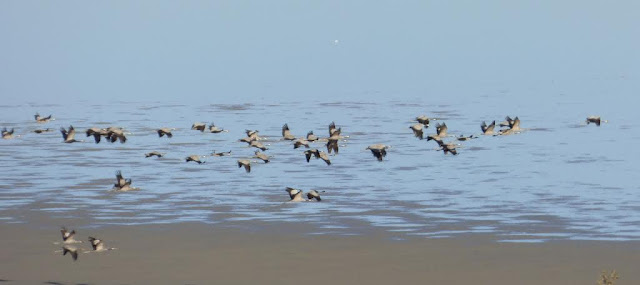
The Common Cranes Grus grus are back in force at Fuente de Piedra (PHOTO: Derek Etherton)


Please to read that whilst I am back in the UK enjoying the cold winds of the North Norfolk coast and the multitude of ducks at Rutland Water, friends Derek and Barbara Etherton enjoyed a day's birding at Fuente de Piedra, calling in at the Teba Gorge on the way, with their old neighbours Paul and Muriel from Yunuera.  Whilst I may have enjoyed the sunshine on my local visits I am sure that my daytime temperature was probably less than half of the night temperature in Andalucia.  Anyway, lovely report from Derek to confirm that water has returned to the Laguneta at Fuente de Piedra and with it the birds and in the surrounding area the wintering Cranes are returning in their hundreds so something to look forward to when the Axarquia Bird Group visits in mid-December.  And, as Derek reports, they also had a good sighting of yet another Wryneck so, perhaps as last year, there will once again be some over-wintering individuals.


Fuente de Piedra: 27 November

We had a lovely day today with our old friend Paul and Muriel from Yunquera, where we used to live. Neither of them are 'real  birders', but she has binoculars [that I arranged for her] and when she uses them the right way round she see things, and Paul likes taking photos.  We met for coffee at Zalea, mid way for us both, and continued up to Fuente de Piedra, dropping into Teba rock en route.  Not much at the rock except for a lone Griffon Vulture that eventually rested on their nesting area and meanwhile plenty of Crag Martins flew around.  A small flock of Rock Doves seemed very active but no reason, such as Peregrine, seemed to be the cause.
You may try and hide but the Marsh Harrier Circus aeruginosus was still found! (PHOTO: Derek Etherton)
So on to Fuente via the back road, always the most interesting way we find.  Lots  of finches, Gold, Chaff and Green, large flocks of Serin, Stonechats, Linnets and Sardinian Warblers were busy at the side of the road.  It's here that the joys of birding in Spain come to the fore, i.e. just stop and watch!  Turning right to do an anti clockwise circuit we stopped at the ruined casas to look across the lakes.  A large, some 200+ flock of Common Crane flew in from Sierra Yegas direction to land. Searching amongst the olive grove we soon found the usual flock of Stone Curlew affording excellent 'scope views for all.  The verges here were noisy with the chatter of Serin and Goldfinch feeding in the seeded fennel, but then our eyes were drawn to a ploughed field where among the White Wagtails some Calandra Larks were on view.  Around the back road to the Visitors Centre, wow that road's improved somewhat, and an Iberian Grey Shrike posed beautifully for us.  Chiffchaffs littered the tamerisk by the sewage works and Robins sat up to be viewed.  
Stone Curlew Burhinus oedicnemus (PHOTO: Derek Etherton)
On to the centre and a little stroll round to the hides via the viewpoint.  Little to see from the viewpoint except some very distant Greater Flamingo, Yellow Legged Gull, 6 Shelduck and a couple of patrolling Marsh Harriers.   Around to Laguneta hide and there is water here!  Loads of Shoveller and Mallard, some Moorhen and Coot, plus a couple of Little Grebe.  In front of us Linnet, Goldfinch and Stonechat posed on the scrub top.  Casting an eye to the waters edge a Snipe was enjoying a bath and a preen and a Green Sandpiper likewise on the other side of a stand of reeds.  Whilst watching these my eye was alerted to movement in the nearby scrub, thinking another Linnet I just casually looked only to be rewarded with a Wryneck busy feeding on ants.  Now I hadn't seen this species for years in Spain and this year I've seen 3, 2 of these in the past month.  Paul and Muriel had never seen [or heard of] this bird and to be able to 'scope it for everyone get a super view was rather special.  I got a couple of pics, poor quality as it was so camouflaged in the scrub, but it's a record.
Record shot of the Wryneck Jynx torquilla hidden among the sticks (PHOTO: Derek Etherton)
Rather elated we all walked back to the car and into nearby Fuente for a Menu del Dia.  After a somewhat 'patchy'  meal we continued the 'circuit' of the lake, I use that term loosely, desert would perhaps be better.  Not much en route except for a couple of Common Buzzard, some Lapwing, plenty of Spotless Starlings and House Sparrows.  The bottom end with the 'dry marsh' area is somewhat depressing.  Just desert conditions and some very distant Greater Flamingo [about a hundred].  Moving down to Las Latas flocks of Common Crane flew low over us to land on the mud that was once a lake.  Walking up to the viewpoint a couple of Lesser Short Toed Larks were on view along with their Crested cousins, nice to view 3 lark species around the lake.  Looking down from the viewpoint the Common Cranes were restless and noisy, soon they started to rise, presumably as it was an hour to sunset, and flew off in batches beautifully illuminated by the low winter sun.
More Common Cranes Grus grus flying in to feed (PHOTO: Derek Etherton)
Time to leave,  and no point calling into Laguna Dulce as it's dry,  we had an uneventful drive back home, for Paul & Muriel  a special day - always is when you get a first!
Many thanks Derek for a very enjoyable and descriptive report.  I shall have to make sure, now that the water is promising a return, that I check closely for any lesser Flamingos arriving at the old salinas. 

Check out the accompanying website at http://www.birdingaxarquia.weebly.com for the latest sightings, photographs and additional information.

Friday, 27 November 2015

More Rutland Water

Thursday 26 November 

With my expected parcel arriving late last night and jenny out for the day with her friend, what better opportunity to slip over to Rutland Water and try out the new Kowa scope.  But first a quick call at the feeding station where very little activity going on, still very mild, but in addition to the Great and Blue Tits I actually also observed both Marsh and Coal Tit along with a Robin and Moorhen. In the trees near the feeders I managed to find a small number of Greenfinches.  As usual, there were plenty of Wood Pigeons and Jackdaws about with the occasional Magpie and both Crow and Rook observed as I approached the site.  Also on the neighbouring field was a pair of Egyptian Geese.

Egyptian Goose Alopochen aegyptiacus
Looking out over the lagoon from the Visitors Centre I could see one of the Great White Egrets along with Cormorants, Mallard, Teal, Shoveler and Gadwall.  A Shelduck hove into sight and then a few Mute Swans, Pintails and Coots.  Still plenty of Black-headed Gulls to be seen along with a couple of Great Black-backed Gulls.  Similarly, there were plenty of Lapwings to be seen before I took myself off to check out the inflow to the water but very little to add other than a freshly-killed (hit by a car - not mine) Kingfisher which had been laid out on the bridge parapet.


Then it was up to the Northern Arm to find the geese and anything else.  Still very many Greylag  along with a good number of both Canada and Egyptian Geese.  here I was able to add many of the missing ducks including Tufted Duck, Pochard and Wigeon.  A pair of Goosander were also on the water and the main reservoir and, unlike Tuesday, were not accompanied by the female Smew so no chance of mixing up the photographs.  Unfortunately, by the time I took the photograph the female had disappeared and the male decided it was time for a late morning nap!  The main water held a good number of Great Crested Grebe along with a few GoldeneyeStarlings were moving about and on the far bank a number of Rooks were feeding.  Then, at last, the first sighting of a Common Gull.The sighting of both a Pheasant and Collared Dove took the total up to a round 40 species in the allotted two hours.

Sleeping male Goosander Mergus merganser


Birds seen:
Greylag Goose, Canada Goose, Mute Swan, Egyptian Goose, Shelduck, Wigeon, Gadwall, Mallard, Shoveler, Teal, Pintail, Tufted Duck, Pochard, Goldeneye, Goosander, Pheasant, Great Crested Grebe, Cormorant, Little Egret, Heron, Moorhen, Coot, Lapwing, Black-headed Gull, Common Gull, Great Black-backed Gull, Wood Pigeon, Collared Dove, Kingfisher, Robin, Blackbird, Marsh Tit, Coal Tit, Blue Tit, Great Tit, Magpie, Jackdaw, Rook, Crow, Starling, House Sparrow, Greenfinch


Check out the accompanying website at http://www.birdingaxarquia.weebly.com for the latest sightings, photographs and additional information.

North Norfolk

To the land of the Brent Geese Branta bernicla
Wednesday 25 November


With a parcel arriving from Amazon tomorrow and the good weather forecast moved forward a day, this seemed like to good an opportunity to miss.  So, up in the dark and away with all lights burning before 6.30 and arrived at RSPB Titchwell at 8 o'clock and before the staff.  I even got the best spot in the car park and then set off in the early morning light in the hope that i would pick up Bearded Tits, Bramblings and a good selection of ducks and geese.  The sky was clear and the day was to be full sun and no cloud but with a cold breeze coming out of the north-west.  But before arriving I had already had some of my birding dreams come true.  Not the fort birds of the day which were Crow, Rook, Wood Pigeon and Blackbird but  that silent white ghost, the Barn Owl.  Not having seen a Barn Owl since my last one in Norfolk almost three years ago, this individual swept slowly past the front of the car and even managed to kiss the windscreen leaving a weird impression on same.  Fortunately, the bird did not go to ground and managed to recover, no doubt with a severe head ache, and managed to fly off on its dreamy flight.  Not only this ghostly apparition but a large flock of Fieldfares almost immediately afterwards who appeared to be tucking into a breakfast of juicy red Hawthorne berries.

Pink-footed Goose Anser brachyrhynchus
A small flock of Pink-footed Geese were seen as I approached the reserve but no Bramblings as the feeders had been removed over a week ago in a bid to try and restrict the rat problem with the said rodents enjoying their free feast.   But there were the friendly, welcoming Robins along with a couple of Moorhen, Magpies and a couple of Pheasants.  Similarly, no Bearded Tits as the the breeze was too strong so off in the cold to the hides and eventually the beach.  From the first hide I had a view of what was to follow with numerous Lapwing and ducks and by the end of the visit I must have seen just about every member of the tribe.  No shortage of Mallards and Gadwalls and plenty of Tufted Ducks to be seen.  A couple of Marsh Harriers drifted over which put up the first of the Brent Geese and then it was back to more ducks including Shelduck, Shoveler, Teal and Pochard.

Brent Goose Branta bernicla
Shelduck Tadorna tadorna
 Also present were a few Curlews and Whimbrels along with Herons, Redshank, Greenshank and Green Sandpipers plus a handful of Dunlin.  A single Grey Plover was a welcome surprise and on the beach numerous Oystercatchers and Sanderlings.  Walking the path between Visitors Centre and beach I saw a couple of Wrens and a Reed Bunting plus a Little Grebe, Little Egret and many of the recently-arrive Common Starlings.  There were indeed many Brent Geese and I also managed to find a pair of Ruff before encountering Great Tit, Chaffinch and Dunnock.

Redshank Tringa totanus (above) and Curlew Numenius arquata (Below)
A stop at Holkham produced thousands of Pink-footed Geese, in the air and on the ground.  Those feeding were inter-mixed with hundreds of Wigeon whilst, on the opposite side of the drive, a large flock of Jackdaws were also searching the grassy fields for the odd grub or two.

Only a few of the thousands of Pink-footed Geese Anser brachyrhynchus
Just the short stop before continuing on to Cley with brief stops at both Brancaster Staithe and Morston where more Redshanks, Brent Geese and Turnstones were recorded along with a single Ringed Plover at the latter and a Kestrel during the journey.

Turnstone Arenaria interpres turning stones!


Cley seemed very exposed with a handful of Avocets on Pat's Pool along with a Curlew, the latter not a common sighting at this site.  I eventually braved the sea breeze and walked the beach to the ruined hide but very little to see.  A flock of about an hundred Golden Plovers were resting on the grass near the beach along with more widespread Lapwings and I though my luck had changed and picked up Snow Buntings feeding on the beach but, no, turned out to be a small charm of Goldfinches with a number of Linnets inter-mixed with their cousins.  But I did pick up a couple of Blue Tits and a handful of House Sparrows at the nearby Cley Spy shop before starting out on the return journey to Stamford.  Sixty birds for the day so not too disappointed.

Almost a hundred Golden Plovers Pluvialis apricaria resting near the coast
Birds seen:
Pink-footed Goose, Brent Goose, Shelduck, Gadwall, Wigeon, Mallard, Shoveler, Teal, Tufted Duck, Pochard, Pheasant, Little Grebe, Little Egret, Heron, Marsh Harrier, Kestrel, Moorhen, Coot, Oystercatcher, Avocet, Ringed Plover, Lapwing, Golden Plover, Grey Plover, Sanderling, Dunlin, Whimbrel, Curlew, Ruff, Black-tailed Godwit, Redshank, Greenshank, Green Sandpiper, Turnstone, Black-headed Gull, Herring Gull, Rock Dove, Wood Pigeon, Barn Owl, Wren, Dunnock, Robin, Blackbird, Fieldfare, Redwing, Blue Tit, Great Tit, Magpie, Jackdaw, Rook, Crow, Starling, House Sparrow, Chaffinch, Goldfinch, Linnet, Reed Bunting.

Check out the accompanying website at http://www.birdingaxarquia.weebly.com for the latest sightings, photographs and additional information.

Tuesday, 24 November 2015

Rutland Water

Smew Mergellus albellus
Tuesday 24 November

A calm, dull day with much damp on the ground but still able to get in almost three hours at Rutland Water before the light rain arrived.  I say "Rutland Water" but when you see both Little and Great White Egret you get a touch of deja view and feel as if you are birding back in southern Spain!  Still, almost every duck going was seen along with all the local corvids and a rather lovely supply of passerines.  No Fieldfares this morning but I did have a quartet of Redwings.

Distant Great White Egret Egretta alba
In addition to seeing a rather fine female Bullfinch I also had a flock of about eighty Greylags Geese accompanied by a score or so of Canada Geese and a couple of Barnacle Geese.  Strange to say, having only seen the one Egyptian Goose at the main reserve the Northern Arm turned up not only the above geese but at least a score of the former including a pair perched high in a bare tree.

Male Goosander Mergus merganser (above) and female below
Lots of Blue and Great Tits to be seen but just the single Longtailed Tit.  A couple of Robins but no Dunnock although I did have Greenfinch, Chaffinch and Goldfinch.  Two Jays flew across the track but I suspect it was the same bird seen on the return walk to the car park.

A pair of the many Pintails Anas acuta
Whilst it was lovely to see so many handsome Pintails and their bright cousins, the Wigeon along with scores of Gadwall, I think pride of place goes not so much to the Goldeneye but the Smew.  Indeed, I even found a second individual and this, along with a male and three female Goosanders and a single female Scaup quite made my morning.  On this occasion no Red Kites were seen and the female Kestrel was the only raptor noted all morning.

Female Smew Mergellus albellus

Goldeneye Bucephala clangula
If you ignore the hundreds of Lapwings then waders were conspicuous by their absence.  A small flock of about sixty Golden Plovers was a distant surprise but the I only had a single Greenshank, a couple of Green Sandpipers and about a dozen Redshanks to add to the ten or so Dunlin seen from the Visitors Centre.

Redshank Tringa totanus
All in all a very satisfying time with a final total of 54 species.  Come the morning, if dry, then I shall venture forth over to Norfolk and see if I can add a few more species to this month's UK list.

Female Teal Anas crecca
Birds seen:
Greylag Goose, Canada Goose, Barnacle Goose, Mute Swan, Egyptian Goose, Shelduck, Gadwall, Wigeon, Mallard, Shoveler, Pintail, Teal, Pochard, Tufted Duck, Scaup, Goldeneye, Smew, Goosander, Pheasant, Great Crested Grebe, Cormorant, Little Egret, Great White Egret, Heron, Kestrel, Moorhen, Coot, Lapwing, Golden Plover, Dunlin, Redshank, Greenshank, Green Sandpiper, Black-headed Gull, Great Black-backed Gull, Wood Pigeon, Collared Dove, Pied Wagtail, Robin, Blackbird, Redwing, Long-tailed Tit, Blue Tit, Great Tit, Jay, Magpie, Jackdaw, Rook, Carrion Crow, Common Starling, Chafinch, Greenfinch, Goldfinch, Bullfinch.

Mute Swan Cygnus olor

Time for the Wigeons Anas penelope to depart


Check out the accompanying website at http://www.birdingaxarquia.weebly.com for the latest sightings, photographs and additional information.

Sunday, 15 November 2015

Sierra loja with John and Jenny

A quick report from John Wainwright re his visit up the Sierra Loja with wife, Jenny but it seems that they might have been bettered by the fog at lower levels and then a mixture of Sunday shooters and the massed hordes at the higher levels!  But at least they managed to find some Ring Ouzels.

Sierra Loja 15th November

A chilly, foggy start, with a brisk breeze (12C).

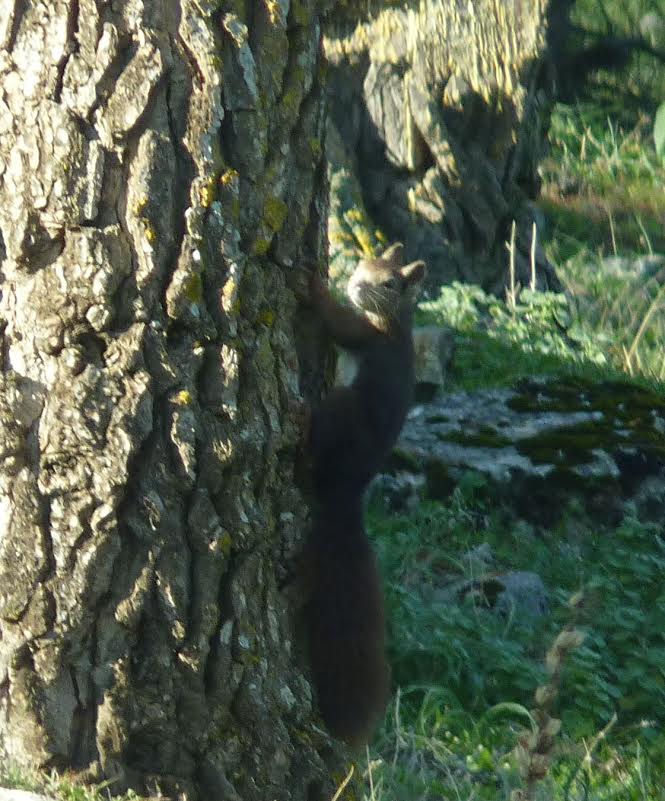
After coffee and toast at our regular spot we started up the mountain.  Due to the light fog, we couldn´t see anything much until we hit the tree line.  Here the fog had dissipated quite well and we saw Crossbills, Coal and Great Tit, Chaffinches, Robins, Mistle Thrushes and a very obliging dark-phase Red Squirrel.

Red Squirrel Sciurus vulgaris (PHOTO: Jenny Wainwright)
The cliff areas were barren, not even a Jackdaw to be seen (or heard), so we moved up to the substation valley.  Here we found two Chough, Thekla Larks, Red-legged Partridges, Stonechats, a Black Wheatear, Meadow Pipits and a Southern Grey Shrike was noted atop the bare tree here.

Thekla Lark Galerida theklae (PHOTO: Jenny Wainwright)

Lots of "shooting" about here today so we made our way up to the Charca de Negra ponds area.  This was swamped with people and all we had here were Goldfinches.  Along at the Fossil Cave a single Crag Martin and more Meadow Pipits were spotted, so we moved further along to the hawthorn bushes.  Here we found over a dozen Ring Ouzels, four Mistle Thrushes, Rock Buntings, Black Redstarts, Sardinian Warblers, Robins, Blackbirds, House Sparrows, Chough, a Dartford Warbler and a single Hoopoe.


Male Ring Ouzel Turdus torquatus (PHOTO: John Wainwright)
All things worth waiting for judging by John's report.  It just shows that you have to keep right on till the end of the road, or track in this case, if you want your share of the birds to be seen.


Check out the accompanying website at http://www.birdingaxarquia.weebly.com for the latest sightings, photographs and additional information.