Sunday, 22 September 2013

Bermejales with John and Jenny Wainwright

Whilst Jenny and I were driving down to the deep south to take in the raptor observation points between Algeciras and Tarifa followed by a short stop at the Los Lances beach and a quick drive round La Janda before lodging in Barbate overnight, John and Jenny Wainwright were off birding to the Emblase Bermejales.  This is a large water that I always seem to find devoid of many birds but, obviously, judging from the following and previous reports to this site from John, I have been looking in the wrong place.  perhaps too much concentration on the water rather than the surrounding land.  I must speak to John and Jenny about remedying this situation.  Here follows John's report.


Bermejales 20th September
Cormorant Cormoran Grande Phalacrocorax carbo (PHOTO: John Wainwright)
Cool for a start, then very hot & muggy.  We thought we would take our lunch out today so headed for the Embalse Bermejales.  We took the A92 then off at Morelada.  The journey was quite uneventful until we got to Buenavista then we saw a few Southern Grey Shrikes, Wood Pigeons, Collared Doves, Spotless Starlings, Magpies and a Bonelli´s Eagle.


Short-toed Treecreeper  Agateador Comun Certhia brachydactyla (PHOTO: John Wainwright)
After getting Jenny settling in her chair I went on my walk, firstly seeing several Cormorants perched in their individual bare trees, a Grey Heron was heard but not seen, and two small flights of Crossbills passed overhead.  White Wagtails were feeding on the edge of the embalse as were a few Crested Larks.  As I approached the point a huge flock of Spotless Starlings and Wood Pigeons lifted off.
 

Common Sandpiper Andarrios Chico Actitis hypoleucos (PHOTO: Jenny Wainwright)
Crossing the road and heading up in the direction of the road bridge a group of at least seven Short-toed Treecreepers were flitting from tree to tree to my front also about here were Great Tits, Coal Tits, Magpies, and a Firecrest was spotted.  In the open areas here I saw Spotted and Pied Flycatchers - one male of the latter the rest females.  The odd Blackbird was noted as were House Sparrows.

Back to the car and a piece of cake before continuing in the direction of the dam, not before watching a Common Sandpiper coming into feed directly to our front.  On the next walk a family of Long-tailed Tits were about and I disturbed a lone Collared Dove that was feeding in the grasses.  A Grey Wagtail was seen in this area as well as Linnets, Great Tits, Goldfinches and more Crossbills.


About 3pm we packed up and drove down the rough road to the Cacin/Turro lake. En route we saw a Booted Eagle being mobbed by a Common Kestrel, a Sardinian Warbler and our first hirundines in the shape of House Martins.  At the lake we found another Common Kestrel perched on the pylons and in the fields below Magpies were feeding.  On the thistles just in front of the lake we found a male Stonechat and two female Whinchats.
Stonecat Tarabilla Comun Saxicola torquatus (PHOTO: Jenny Wainwright)
On the lake three Teal were seen as well as Mallard, Little Grebes, Shovelers, then a Red-rumped Swallow flew across our front and looking around we found - on the power lines - a huge mass of hirundines including Barn and Red-rumped Swallows and House Martins, a good proportion of these birds were juveniles. I kept hearing Bee-eaters but couldn´t locate them.

Down this track we saw countless Egyptian Grasshoppers, three Common Swallowtails, several Large Whites, Striped Graylings, Cardinals and Common Blues.


Another great report John with lots of fabulous birds recorded.  Look forward to meeting up soon and perhaps joining you at the Embalse Bermejales where I have not been birding for, probably, a couple of years now. 


 Check out the accompanying website at http://www.birdingaxarquia.weebly.com for the latest sightings, photographs and additional information. 

Thursday, 19 September 2013

A Guadalhorce "quickie!"

Marsh Harrier Circus aeruginosus harrying gull
Wednesday 18 September


Jenny dues back from the UK about 8pm so, having completed jobs in the house, I took myself off early so that I could spend about ninety minutes at the Guadalhorce, Malaga arriving about 6 and leaving at 7.30pm.  A very pleasant, warm and sunny evening as I made my way straight to the main hide overlooking the Laguna Grande.  The first thing I noticed, using binoculars as I walked up the slope to the main track above the western arm of the river, and confirmed when I arrived at the Laguna Grande, was that the Cormorant numbers had trebled since last week; there were now three birds resting on the tall pole!

A half-dozen Little Egrets on the river along with the odd Moorhen and a Heron as I made my way into the reserve and then, walking along the track from the other side of the bridge on the direct path to the Laguna Grande, for a pair of Sardinian Warblers followed by quite a sizable flock of Greenfinches in the adjacent bushes, a single Zitting Cisticola and a couple of Crested Larks.  Approaching the turn towards Esondida and I was able to watch a Booted Eagle glide over in an easterly direction whilst more and more Herons made their way towards the main water.   The first arm of water held a juvenile White-headed Duck and then to the Laguna Grande itself where there was a good-sized flock of mixed Gulls, mainly Black-headed and Yellow-legged, including immatures of the latter, plus singletons of both Audouin's and Mediterranean Gull.

Marsh Harrier Aguilucho Lagunero Occidental Circus aeruginosus complete with computer orange tint!
On the water a smaller number of Coots and very few Mallards but a handful of Shoveler.  At least a score of Black-winged Stilts and more than a dozen Ringed Plovers including a number of juveniles.  Other waders included a single Little Ringed Plover, at least five Common Sandpipers and a solitary Turnstone.  It was also rather lovely to have a Greenshank drop in right in front of the hide.  In addition to the trio of Cormorants there were increasing numbers of Grey Herons present, at least ten, plus a smaller number of Little Egrets.  Only a couple of Little Grebes were noted.

Greenshank Archibebe Claro Tringa nebularia
I was joined at the hide by a delightful pair of birders from Branston near Coventry who were now volunteers at a site I first visited back in the mid-to-late seventies when Colin Potter had just taken over.  Strange to say, upon arriving they asked if I wrote a blog, must have recognised my photograph, as they has been reading it only the night before.  As you can imagine, much reminiscing took place re the wonders of birding the Midlands almost forty years ago!  Sad to say, I forgot or make a note of their names or their friend (David?) with whom they were staying in Mijas.  Well, if you are reading this blog, then please do email me/make contact so that I can pass on the latest news, etc.

Back to the birding.  In addition to the regular toing-and-froing of both Spotless Starlings and Monk Parakeets we also had a wonderful aerial display from a female Marsh Harrier ans she regularly put up the gulls and anything else below her at the time.  I wonder if I managed to get a half-decent photo and, if so, whether or not it will let me treat it and post without gaining the dreaded orange tint.  If this blog has an accompanying illustration you will know the answer!  Looking at the back of the water there seemed to be a regular passage of Collared Doves beyond the trees abut then, to make it all worthwhile, a pair of Greater Flamingos, what looked like mother and juvenile; probably two of the three individuals that seem to have been here for weeks.

Time to think about setting off for the airport so a very quick visit to the Laguna Escondida where I duly recorded both Little Grebes and more Coots.  Duck wise, in addition to a quartet of White-headed Ducks I also picked up a handful of Common Pochards.  Making my way back to the footbridge, only the odd Greenfinch but a pair of feeding Red-rumped Swallows were watches along with a small number of Goldfinches.  And that was it; I made the airport pick-up venue with a minute to spare - which was when "S**s Law" rather than "Murphy's Law kicked in and the plane arrived forty minutes late!


Birds seen:
Mallard, Shoveler, Pochard, White-headed Duck, Little Grebe, Cormorant, Little Egret, Heron, Flamingo, Marsh Harrier, Booted Eagle, Moorhen, Coot, Black-winged Stilt, Little Ringed Plover, Ringed Plover, Greenshank, Common Sandpiper, Turnstone, Mediterranean Gull, Black-headed Gull, Audouin's Gull, Yellow-legged Gull, Rock Dove, Collared Dove, Monk Parakeet, Crested Lark, Red-rumped Swallow, Zitting Cisticola, Sardinian Warbler, Spotless Starling, House Sparrow, Greenfinch and Goldfinch.


 Check out the accompanying website at http://www.birdingaxarquia.weebly.com for the latest sightings, photographs and additional information.

Laguna Dulce & Fuente de Piedra


John and Jenny Wainwright were back on the road on Wednesday and seem to have had a very successful and enjoyable time visiting Fuente de Piedra and nearby Laguina Dulce.  Most jealous that they managed to find a Whinchat, a bird that seems to have eluded me all year!  Fuente de Piedra still seems to be full of Greater Flamingos on the main water and still a great variety of waders on the small laguneta at the rear.  As for the Dulce, it seems once more to be in its element and well worth a visit (to both that is) whilst the situation is most favourable.


Fuente de Piedra & Laguna Dulce: 18th September 2013

A cool start 14C but warmed up very gradually to 24C.  A few sightings en route such as Collared Dove, Spotless Starlings, Wood Pigeons and a Hoopoe.  As we approached the site the lack of water in the first flood meadows and the boardwalk was very obvious, but we still walked down to that area in hope.  A couple of Stonechats, a Zitting Cistocla and a Grey Wagtail were seen.

More Grey Wagtails on the dry scrape and opposite a Sardinian Warbler and more Stonechats were singing.  A flock of Goldfinches in all stages of plumage and age were raiding the thistle heads both sides of the track.
 

Gadwall Anade Frisa Anas strepera (PHOTO: John Wainwright)
At the centre´s mirador we looked over the laguna and here we saw Greater Flamingos - adults and juveniles - Black-necked Grebes, Mallard, Teal, Black-headed Gulls, Avocets, Little Egrets and Common Coots.  Hirundines were Barn and Red-rumped Swallows, House Martins and a lone Common Swift.

On towards the lagunetta hide; water again in short supply but what pools were here were packed with waders in the shape of Little Stints, Ruff, Black-winged Stilts, Green Sandpiper, Wood Sandpiper, Common Sandpiper, Lapwing, Avocets, Kentish and Ringed Plovers, Redshank, two Dunlin and a few Snipe.  Gadwall, Mallard and Pochard were the duck representatives and a few Greater Flamingos were also present along with Coots and Moorhens.  The bushes held Goldfinches, Sardinian Warblers, Common Redstarts, an Orphean Warbler and a Cetti's Warbler was calling from the reeds.


Snipe  Agachadiza Comun Gallinago gallinago (PHOTO: Jenny Wainwright)

Leaving the reserve towards the Mirador Cantarras we found Southern Grey Shrike, more Red-rumped Swallows and great views were given to us by a female Whinchat.  At the mirador a pair of Marsh Harriers put on a show for us and also here we found Great Crested, Black-necked and Little Grebe, Black-headed Gulls, Mallard, Pochards and Cetti´s Warbler.

Female Whinchat  Tarabilla Nortena Saxicola rubetra (PHOTO: Jenny Wainwright)

We then had lunch and then onto Laguna Dulce.  A Common Buzzard was seen on one of the telegraph poles close to the laguna.  And at the hide - which was full of small midges and flies for a few minutes - until a breeze sprang up and they all disappeared (thankfully).

We settled in, to the calling of the Cetti´s Warbler and the scratching of a Reed Warbler, and on the water were some eighty plus Black-necked Grebe, White-headed Ducks, Mallard, Shovelers, Teal and a few Pochard.  Lots of Little Grebe, Great Crested Grebe, Common Coots, Moorhens, Gadwalls and in the distance were about twenty Greater Flamingos.


Marsh Harrier  Culebrera Europea Circaetus gallicus (PHOTO: John Wainwright)
Two Marsh Harriers were seen quartering the back reed bed and while they were doing so put up a Little Bittern.  The two Marsh Harriers were joined by another three and in turn these birds put up the ducks and twelve Little Egrets, shortly to be joined by a Squacco Heron which dropped into a dead bush alongside two Grey Herons.  Also in and around the reeds I came across two Purple Swamphens.

I then came across two Common Buzzards searching in the fields and these in turn were put up as a Booted Eagle came across them.  All across the laguna were masses of House Martins and Barn Swallows, and as a Marsh Harrier flew closer to the hide, this time it put to flight a Purple Heron.

A lot of dragonflies about, mainly Red-veined Darters also three Lesser Emperors.
 

Lesser Emperor  Anax parthenope dragonfly  (PHOTO: John Wainwright)
 Nothing extra was seen on our homeward journey.


Check out the accompanying website at http://www.birdingaxarquia.weebly.com for the latest sightings, photographs and additional information.

Wednesday, 18 September 2013

Charca de Suarez

Tuesday 17 September

Having spent the afternoon working in Velez de Benaudalla I let both Steve Powell and Gerry Collins know that I would call in for the evening opening at the Charca de Suarez reserve on the western outskirts of Motril.  Imagine my surprise when not only both Steve and Gerry were already there but also Louise Gray and her badminton partner, Peter.  Shame we did not have such a variety of birds to accompany the visit.

Red-nobbed Coot Focha Moruna Fulica cristata with neck collar tab "29" and "28" seen below
Having recorded a lone Kestrel outside the reserve along with a good number of Carttle Egrets, the first bird seen on entry was a male Blackbird followed by a single Zitting Cisticola as I made my way the main pool.   A short stop at the Laguna del Taraje had produced a small mixed group of Mallards and Coots plus a pair of Little Grebes but lots of tall vegetation around the water so no chance of seeing what might have been at the far end.


The (main pool) Laguna de las Aneas was awash with Common Coots and Mallards in a mixed state of moult plus a good number of Little Grebes and Moorhens.  A couple of Little Egrets sheltered on the island a single Heron was seen at the back of the water.  No sign of a "Bog-hen" so I wandered round to the Laguna del Trebol where a Purple Swamphen duly obliged by wandering across in front of me and a pair of "neck-collared" Red-knobbed Coots were in full view.  Also more Mallards a Common Coots.  A single Little Bittern flew in and rapidly disappeared in the tall reeds at the back of the water.  It was lovely to watch the dragonflies, especially the delicate blue of the Lesser Emperor.


Whilst I had seen a Pied Flycatcher on the track leading up the hide overlooking the Laguna del Trebol, we also had a pair of Spotted Flycatchers at the Laguna del Lirio along with another Purple Swamphen close to the hide.  Then, having stayed barely ninety minutes at the reserve, we all made our departures to be home and in time to see Manchester United score a comfortable win over their German rivals in the first match of the Champions League.


Birds seen:
Mallard, Little Grebe, Little Bittern, Cattle Egret, Little Egret, Heron, Kestrel, Moorhen, Purple Swamphen, Common Coot, Red-knobbed Coot, Black-headed Gull, Yellow-legged Gull, Collared Dove, White Wagtail, Blackbird, Zitting Cisticola, Spotless Starling, House Sparrow, Goldfinch.


Check out the accompanying website at http://www.birdingaxarquia.weebly.com for the latest sightings, photographs and additional information.

Saturday, 14 September 2013

Ventas de Zafarraya, Alcaucin and Home

Saturday 14 September

It seemed like a good idea to pop up to the old railway line at Ventas de Zafarraya and then drive down the mountain track past the two picnic sites above Alacaucin.  No at home to worry about, plenty of time for a shave and shower before going to the monthly dance; what could possibly go wrong?

Travelling down our mountain track I had the usual Thekla Larks and Serins and on reaching the village the low cloud base had encouraged all the local House Martins to come down in search of their morning feed.  How many?  Well in excess of 250 and just like driving through a cloud of mosquitoes.  Then, approaching the lake, a couple of Red-rumped Swallows.  Talking of cloud, that was what greeted me on arrival at the mirador at the pass and the only bird seen on the upwar jurney was a single male Stonechat at the side of the road.  So bad I could barely see the edge of the car park never mind the track itself.  Obviously no point in walking the old railway track so decided to check-out the nearby growing fields starting at the former "Muck Heap" where, all being well, there might be better visibility.

Male Crossbill Loxia curvirostra
All that was to be seen was a solitary Blackbird followed a little later by a couple of Serins and a handful of Goldfinches.  A drive around the back of the area produced a Collared Dove and a number of Spotless Starlings before encountering some very large flocks of House Sparrows feeding on the recently cropped fields.  I even came across a pair of Mallards and, I suspect, feral Greylag Geese on one of the isolated village ponds.

Nothing for it but to head over to the Sierra Tejeda and take the mountain track down to Alcaucin.  Still dull weather that made seeing anything, always assuming that any bird might want to be seen.  A large flock of Chaffinches early on and then the top picnic area produced another plus a quartet of Crossbills, the latter again producing a nearer lovely male.  And that was it as the cloud closed in reducing visibility to less than ten, if not five, metres.  A very slow drive down the mountain, thank goodness I know where all the severe bends are, hugging the nearside at less than 10km per hour.  It was either that or take the magic mushrooms and trust that the car would sprout wings as it took off into the sky!

Honey Buzzards Perbnis apivorus on their way south
But the adventure was not finished.  Nearing the lower picnic site and the visibility jut as bad I was suddenly confronted with a grey 4 x 4 about three metres in front of me.  He may have seen both me headlights and fog lamps and knew that I was approaching but did he have any lights turned on?  Of course he did not; he and his two passenger were as happy as sand boys as they drove up the hill towards me.  And another thing whilst I think of it, if we had touched guess who the local police would have believed?  Only in Spain!

Then in the clear when I hit the road and made my back top Los Romanes.  A stop at my neighbours for a coffee at about one o'clock and forget the Barn Swallows and House Martins that were flying around the house, forget the Bee-eaters that arrived and even the Kestrel that came to perch on the nearby radio mast; it was the huge numbers of Honey Buzzards that had decided it was time to carry on southwards with, at a minimum, at least 250 passing directly overhead that got our attention.  Now I wonder if the computer will behave itself and let me get the images onto the blog?


Birds seen:
Greylag Goose, Mallard, Honey Buzzard, Kestrel, Collared Dove, Bee-eater, Thekla Lark, Barn Swallow, House Martin, Red-rumped Swallow, Stonechat, Blackbird, Spotless Starling, House Sparrow, Chaffinch, Serin, Goldfinch, Crossbill.

ALL BEING WELL, MORE PHOTOGRAPHS TO FOLLOW

Check out the accompanying website at http://www.birdingaxarquia.weebly.com for the latest sightings, photographs and additional information.

Villanueva del Trabuco

Common Redstart Collirojo Real Phoenicurus phoenicurus
Friday 13 September

No sooner home from a day at the Guadalhorce than John and Jenny Wainwright were out once more on their next birding venture.  So much for a quick nip down the road; no such thing once the birding bug gets into the system as can be seen from John's report.


All photographs by and courtesy of John Wainwright


Villanueva del Trabuco


Had to go to Villanueva del Trabuco today so took a trip into the mountains in the area over towards Alfanate.  A very windy day here which kept the temperatures down.  After our visit to Trabuco village, we headed for the one hundred pipes area (SE of the village), but instead of going to the "pipes" we continued up to the very top of the mountain.  Here there was still a good amount of water in the depression.  We saw Sardinian and Dartford Warblers, Chaffinches, Common Kestrel, Willow Warblers and three huge flocks (possibly 200 +) of Goldfinches, mostly juveniles.  We also saw nine Griffon Vultures heading south.


Swallowtail Butterfly Papilio machaon
We went over the top and about 200m further down we had to make a nerve racking U-turn as the road has been closed off.  A few butterflies here including The Hermit (Chazara briseis), Common Swallowtail (Papilio machaon) and a few Marbled Skippers (Carcharodus alceae).  A huge Bush Cricket was found; I haven´t ID'd it yet but have included the picture.


Saddle-backed Bush Cricket  Ephippiger ephippiger
We went over the top and about 200m further down we had to make a nerve racking U-turn as the road has been closed off.  A few butterflies here including The Hermit (Chazara briseis), Common Swallowtail (Papilio machaon) and a few Marbled Skippers (Carcharodus alceae).  A huge Bush Cricket was found; I haven´t ID'd it yet but have included the picture.
 

Pied Flycatcher papamoscas Cerrojillo Ficedula hypoleuca
We headed down until we reached the access track for the old camping site.  Just after entering we could hear Crossbills and further down the track past the wire slides etc. we came across Nuthatch, Pied and Spotted Flycatchers, Great Spotted Woodpecker, Great and Blue Tits, a Mistle Thrush and Chaffinches. At the end of the track a large clearing was found and here we had terrific views of Male and female Common Redstarts, Short-toed Treecreeper and more Spotted Flycatchers.  In the firs surrounding the clearing were two Common Buzzards, also a Jay and House Sparrows.


Sub-adult Golden Eagle Aguila Real Aquila chrysaetos
Back down to the main road towards Loja (A341) we saw more Common Redstarts and Pied Flycatchers, Wood Pigeons, Spotless Starlings, Chough and two sub-adult Golden Eagles.
This was only supposed top be a short trip instead of the eventual four hours.

Seems to me like a very good way to spend four hour. Great report, John and lots of good birds seen.


Check out the accompanying website at http://www.birdingaxarquia.weebly.com for the latest sightings, photographs and additional information.

Friday, 13 September 2013

Axarquia Bird Group Visit to the Guadalhorce, Malaga

Thursday 12 September


Normal service has resumed and it was lovey to welcome fifteen of the group to the first monthly meet of the Axarquia Bird Group.  And we were not to be disappointed, despite the clear, hot and sunny weather, with well over sixty species recorded including five raptors, fourteen waders and all three (major) swifts.  After a few months absence it was great to see Patrick Raines back with us from Canillas de Albeida. Also present were Liz and Marcus Rootes from Competa, Steve and Elena Powell from Frigiliana, John and Jenny Wainwright from Salar, Janet and David Fisher from Antequera and old (not so much of the "old" I hear him say) friend Andy Paterson from Torremolinos.  Then there were our visitors and it was certainly lovely to meet up again with Ian Templeton staying in Furengirola and hear about his latest musical exploits and once again we were also able to welcome Graham and Susan Knight presently holidaying in Alcaucin.  Best surprise was finally meting up with Chris Bell from Worksop in Noottinghamshire, who I have been corresponding with for the best part of a year, and his friend Rosie.  I trust that all had an enjoyable and worthwhile morning.

Black-winged Stilt Himantopus himantopus  with Dunlin  Calidris Comun (PHOTO: Steve Powell)

Setting off form the church where we had all parked we were at the entrance to the reserve b 9.30 and had soon recorded most of the regulars including House Martin, Blackbird, Collared Dove, Barn Swallow and even Little Egrets, Coots and Rock Doves on or near the river.  Indeed, John even managed to find a Little Grebe skulking away on the edges and a lone Jackdaw passed over his head.  Above the footbridge at least a pair of Red-rumped Swallows were busy feeding and they were also regularly seen during the morning.  Above us, quite high, a number of Common Swifts were also feeding and building up reserves in readiness for their coming migration down to Africa.  Continuing on to the far, eastern, bank we had the continuous calling of Cetti's Warblers and a number of Zitting Cisticolas.  Above us a regular supply of single Grey Herons moving to and from the reserve and small flocks of Spotless Starlings.  Similarly, there also seemed to be a steady movement of gulls, almost certainly mainly Yellow-legged and Black-headed Gulls that we were to see at closer quarters a little late on in the morning.  A small flock of Greenfinches landed to our left and then, pushing away the "greenies", the arrival of a handful of noisy Monk Parakeets, the first of very many sen during the coming hours.

Monk Parakeet Myiopsitta monachus

At first the Laguna Cassilas seemed somewhat quiet with just a few Coots but gradually we recorded a number of Little Grebes and a pair of young Mallards.  Below the hide a Reed Warbler was busy in the bushes and a Melodious Warbler flew past.  No sooner had a Little Bittern dropped in below us to the right with other members of the group trying to locate the bird when we had the first of many sightings of that beautiful flash of blue, the Kingfisher.  A single Moorhen paddled across the water in front of us.  Meanwhile, whilst continuing to check-out the Common Swifts overhead, we did finally manage to locate at least two Pallid Swifts.

Booted Eagle Aguililla Calzada Hieraetus pennatus over the Wader Pool
And so it was on to the Wader Pool which, again, seemed very quiet on arrival save a couple of Little Egrets.  But then not only one but a second Booted Eagle overhead followed a little later by a very high Short-toed Eagle.  Another Melodious Warbler and then the first of many Sardinian Warblers that were to be seen before  we also recorded both Goldfinches and a number of wandering House Sparrows.  Marcus picked up the first Crested Lark behind the hide and then, at last, some waders with three Little Ringed Plovers.  Whilst at the this hide we were entertained by a Moorish Gecko that decided it was time he took a walk up the end panel.  Meanwhile, whilst the rest of us continued on from here to check out the old river, the Rio Viejo, and the Sea Watch, Jenny and Liz had stayed behind at the Casillas hide where they were joined by a visiting couple of British birders and, unlike we, were able to watch an Osprey in the air behind them; perhaps our wintering friend has finally arrived back.
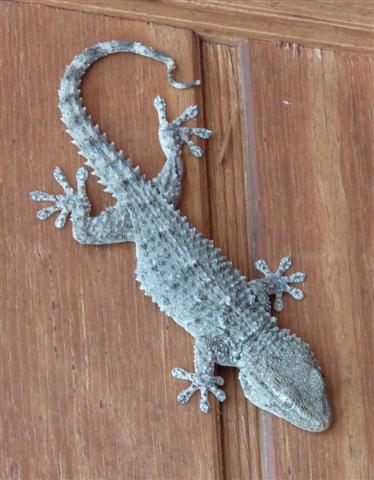
Moorish Gecko Hemidactylus turcicus (PHOTO: John Wainwright)
So, on to the old river, and still with plenty of water, where we found a good selection of waders along with Yellow-legged, Black-headed, Lesser Black-backed and a couple of Audouin's Gulls.  This water held the Black-winged Stilts and we were also able to find a pair of Avocets to join the Grenshank, Redshank and Wood Sandpiper.  A small number of Little Ringed Plovers were joined by Kentish Plovers along with single Sanderling and Dunlin.  Best of all, not the the pair of Ruffs but the single Whimbrel that dropped in whilst we were watching.  No sooner had we bemoaned the scarcity of Marsh Harriers here over the past months when Steve looked up to find a lovely specimen passing over in front of us!  Back to the water and we manged to record a pair of Little Terns departing seawards.
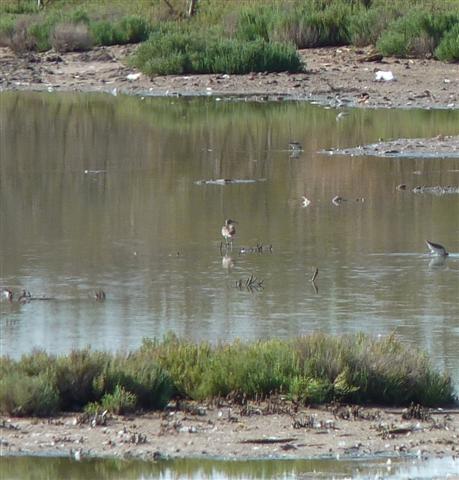
The lone Whimbrel Zarapaito Trinador Numenius phaeopus (PHOTO: John Wainwright)
Arriving at the Sea Watch, the small number of resting gulls off-shore were mainly of the Black-headed variety but we did find a lone Black-necked Grebe and then a pair of Sandwich Terns following the shore line from east to west.  Most managed to see the Cattle Egret that cam to rest on the western bank of the nearby river and then all eyes were focused on finding the single Northern Wheatear in the plover breeding area.  Steve set off to the fence to try and get a closer photograph and was joined  by all bar three of the group to continue walking along the beach and then on to the Laguna Grande.  John, Susan and I retraced our steps and were immediately rewarded with, presumably, the same Northern Wheatear on the other side of the track and, just as earlier, no sooner had I said to John that we had not seen a Serin all morning than one nipped across the track immediately in front of us.  More Sardinian Warblers before arriving back a the Wader Pool where more Little Egrets and Little Ringed Plovers had arrived along with a couple of Green Sandpipers. The same with the Cassilas but still no more sightings of the Little Bittern although the Kingfisher was still "flashing" about.

Northern Wheatear  Collalba Gris Oenanthe oenanthe (PHOTO: Steve Powell)
Arriving at the Laguna Escondida we met up with some of the group, discovered that others had made an early start for home to attend other business but also came across Chris and Rosie who had arrived late at the reserve.  A couple of White-headed Ducks to add to the list and I decided to head off to the Laguna Grande.  No sooner had I departed than the Black-headed Weaver of which we had bee speaking was seen and John managed to get a photograph.  Good and bad news when I looked at the shot; not the weaver but a Yellow-crowned Bishop.

Record shot of Yellow-crowned Bishop Tejedor Amarillo Euplectes afer  (PHOTO: John Wainwright)

Things are changing at the Laguna Grande.  The single juvenile Flamingo is still present but gull numbers are receding.  However, we were still able to see both Audouin's and a couple of Mediterranean Gulls. The first Comorant I have seen this winter was present and, certainly, Heron number are beginning to build up nicely.  In addition to a juvenile White-headed Duck we recorded a handful of Common Pochard and the a pair of Gadwall.  The Black-necked Grebes were conspicuous by their absence until we found a trio just before our departure.  Still Common Swifts and Barn Swallows overhead but then, surprise surprise, wonder of wonders, a single Alpine Swift made its way across the water towards us in the hide and passed on overhead.  Probably about this time John turned round in time to see a pair of Turtle Doves head off over the tall grass towards the western river.
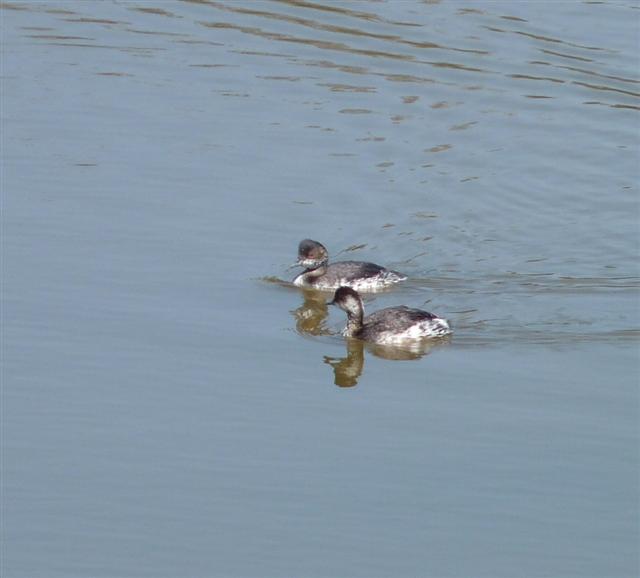
Black-necked Grebes Zampullin Cuellinegro Podiceps nigricollis on the Laguna Grande (PHOTO: John Wainwright)
Meanwhile, in front of us, we had both a pair of Common Sandpipers and a few Ringed Plovers.  Yes, tere were also Little Ringed and Kentish Plovers and, yet again, another Kingfisher.  One of the Booted Eagles had obviously spent enough time in the air and we found it resting, well concelaed, in a large tree near the tall feeding post.  Finally, at last, we found a Common Kestrel and it was joined by a second as they rested in the tall trees at the back of the water.  The end of a very rewarding morning spent in friendly and pleasant company so time to make our way home.

Wood Sandpiper Andarrios Bastardo Tringa glarecia on the Rio Viejo (PHOTO: Steve Powell)

Birds seen:
Gadwall,Mallard, Pochard, White-headed Duck, Little Grebe, Black-necked Grebe, Cormorant, Little Bittern, Cattle Egret, Little Egret, Heron, Flamingo, Osprey, Short-toed eagle, Marsh Harrier, Booted Eagle, Kestrel, Moorhen, Coot, Black-winged Stilt, Avocet, Little Ringed Plover, Ringed Plover, Kentish Plover, Sanderling, Dunlin, Ruff, Whimbrel, Redshank, Greenshank, Green sandpiper, Wood Sandpiper, Common Sandpiper, Mediterranean Gull, Black-headed Gull, Audouin's Gull, Lesser Black-backed Gull, Yellow-legged Gull, Sandwich Tern, Little Tern, Rock Dove, Collared Dove, Monk Parakeet, Alpine Swift, Common Swift, Pallid Swift, Kingfisher, Crested Lark, Barn Swallow, House Martin, Red-rumped Swallow, Northern Wheatear, Blackbird, Cetti's Warbler, Zitting Cisticola, Melodious Warbler, Sardinian Warbler, Jackdaw, Spotless Starling, House Sparrow, Serin, Greenfinch, Goldfinch and Yellow-crowned Bishop.


Check out the accompanying website at http://www.birdingaxarquia.weebly.com for the latest sightings,  photographs and additional information.