Tuesday, 24 September 2024

Warsash Birding

Tuesday 24 September

A dry day forecast before rain for the rest of the week and after a week stuck in the house waiting for my bursa (swelling above the hip joint) to do down or at least let e walk in some form of comfort, decoded to take the relatively short walk u the Hamble River to the conservation area and back. After all, what harm could it do!

Pied Wagtail Motacilla alba

Both Black-headed and Herring Gulls on the first mudflat before the ferry crossing and then working my way up the meadow a couple of Curlew and the first of a good number of Black-tailed Godwits.  Even a handful of Ringed Plovers and a quartet of Dunlin feeding near the water's edge on the incoming tide.  To be expected, I also picked up a couple of Turnstone and then the first of four Little Egrets to be seen during the walk.

Ringed Plover Charadrius hiaticula

Making my way on yup the river I soon found a small number of Redshank and even a Pied Wagtail on the path in front of me.  Stopping to check the far, exposed island the two white "blobs" turned out to be resting Greenshank.

Distant resting Greenshank Tringa nebularia
Distant record shot of the Wheatear Oenanthe oenanthe
Little Egret Egretta garzetta

Approaching the conservation I noticed the Wheatear on the beach when then flew to the new fencing before disappearing onto the ground in the conservation area.  A check of the are found 43 resting Wigeon at the back, the first seen this autumn, and nearer to me both another Greenshank and a Little Egret.  The same species were also seen on the return journey along with a Woodpigeon and trio of Carrion Crows.

The Wigeon Anas penelope have once again returned to Warsash

With the legs not reacting to the sudden exercise following all that resting up at home, I returned to the house for a quick drink and change from sleeveless to my birding coat and headed off down to the village harbour before continuing along the boundary path to the Spit and on to the Scrape behind Southampton Water before finally turning for home at the Meandering Pools.

Black-tailed Godwit Limosa limosa

Leaving the harbour behind, my first sighting was of a Little Egret before finding a few Black-headed Gulls.  Once up alongside the Strawberry Fields a Carrion Crow and a pair of Magpie on the grass to my left and a Robin crossing the path in front of me.  Then, down on the shore itself before the slowly incoming tide, a large flock of Black-tailed Godwits accompanied by a number of Redshank, a couple of Turnstone, Ringed Plover and a few Oystercatchers.

Curlew Numenius arquata

Once past the pier, where I saw a very distant resting Cormorant, the sight of a trio of Mute Swans near the end of the Spit and many more Black-tailed Godwits, Redshank, CurlewBlack-headed and a couple of Herring Gulls. In the lea of the Spit 21 resting Wigeon and more gulls. On the Solent side of the Spit at lest 85 feeding Oystercatchers on the exposed mudflat.

Redshanks Tringa totanus

Reaching the Scrape I immediately found three Avocet and more Little Egrets along with a heron on the main island.  On the water and near the islands at least thirty Mallard plus about eight Teal.  Just the one Little Grebe but also a pair of Shoveler confirmed on the return visit as I made my way home.  Also on the main island a visiting Moorhen.

Avocet Recurvirostra avosetta

Moving on down to the Meandering Pool I came across a flock of forty plus Linnets in the gorse area but not a single bird at the pool itself.  So slowly back home checking the Scrape on the way with a final total of 28 species for the morning but, as yet, still no sign of any Brent Geese to re-appear for the winter.

Part of the Linnet Carduelis cannabina flock

Birds seen:

Mute Swan, Wigeon, Mallard, Shoveler, Teal, Little Grebe, Cormorant, Little Egret, Moorhen, Oystercatcher, Avocet, Ringed Plover, Dunlin, Black-tailed Godwit, Curlew, Redshank, Greenshank, Turnstone, Black-headed Gull, Herring Gull, Woodpigeon, Pied Wagtail, Robin, Wheatear, Magpie, Carrion Crow, House Sparrow, Linnet.


Herring Gull Larus argentatus

Juvenile Black-tailed Godwit Limosa limosa

Feeding Dunlin Calidaris alpina
Ringed Plovers Charadrius hiaticula
Wigeon Anas penelope

Little Egret Egretta garzetta with Black-tailed Godwits Limosa limosa and Redshanks Tringa totanus

For the latest news follow the Axarquia Birds and Wildlife Facebook page for more photos and comments and the opportunity to share with the wider birding world.

Friday, 20 September 2024

Hayling Island

Wood Sandpiper Tringa glareola with Little Egret Egretta garzetta

Friday 20 September

The hip feeling slightly better I decided to drive over to Hayling Island and observe the birds in the harbour from the car.  Pleasant weather with occasional sunshine breeze but rain expect around midday.  However, upon arriving with the tide just on the turn one a handful of Herring Gulls, a Carrion Crow and a party of 14 Shelduck feeding near the water's edge. So, what the heck, put up with a little pain and walk across to the old "Billy Line" to check out the inland lagoon.  Again, very little to be seen other than a few Black-headed Gulls and six Little Egrets on the beach side empty lagoon.

Having got this far thought there might be no problem walking just a little further to check out the former oyster beds alongside the beach.  A trio of Starlings flew over and then many more Little Egrets with the visit's total finally reaching 19.  A single  Barn Swallow above and then, checking the far side near the water entrance thinking there would sure be a Redshank or two (there was not), I found alone Wood Sandpiper, first of the year, preening at the water inlet with a Little Egret resting on the bank above.  Very distant so only a record shot and then the bird seemed almost headless or cleaning its feet.

Wood Sandpiper Tringa glareola

Continuing on to the final bed and island lake to the left I found more Herring and Black-headed Gulls along with a single Cormorant and a pair of Curlew.  A quartet of Barn Swallows flew over and I decided to return on the same path.  Arriving back at the last oyster bed the Wood Sandpiper and Little Egret were still present but had now been joined by a half-dozen Shelduck.  Almost immediately the Wood Sandpiper moved off to my left as the water depend and rested long enough to get a good view of its long, yellow legs, white underside and  slightly diffused upper chest area before moving on again and disappearing into a deeper channel.

Shelduck Tadorna tadorna

Finally, reaching the main track along the old "Billy Line", a resting Woodpigeon, a couple of Robins and the same number of House Sparrows feeding on the ripe blackberries.  Just the 90 minutes birding but certainly worth the little discomfort to see the Wood Sandpiper.

Shelduck Tadorna tadorna with Little Egret Egretta garzetta ( above right) and Wood Sandpiper Tringa glareola (centre)

Birds seen:

Shelduck, Cormorant, Little Egret, Oystercatcher, Curlew, Wood Sandpiper, Black-headed Gull, Herring Gull, Woodpigeon, Barn Swallow, Robin, Carrion Crow, Starling, House Sparrow.

More of the the three species


Wood Sandpiper Tringa glareola

For the latest news follow the Axarquia Birds and Wildlife Facebook page for more photos and comments and the opportunity to share with the wider birding world.

Thursday, 19 September 2024

Cabo de Gata & Rambla Morales

 Wednesday 18 September

Another excellent report on the activities of his Arboleas Birding Group - and this time at my favourite Almeria site, Cabo de Gata.  I certainly like the thought of forty plus Black-necked Grebe where here it is a pleasure and surprise just to find one!  And what about a trio of Bar-tailed Godwits.  Again, scores and scores of Black-tailed but just the one sighting of a Bar-tailed Godwit for me this year.  Still Red-rumped Swallow and Iberian Shrikes about so please hang on a little longer until I arrive at the start of next month!

Cabo de Gata & Rambla Morales: Wednesday 18th September

As I left home, my decision to head south rather than north to the Sierra de Maria was correct as the sky to the north was very grey!  So instead I headed to Cabo de Gata.  I picked up Trevor from Los Gallardos.  Sadly on the way down, below Sorbas, we passed the body of an Eagle Owl on the hard shoulder.  From the motorway to Retamar we only saw one Jackdaw.  In the outskirts of the town we added Collared Dove and a House Sparrow.  Not an auspicious start!  We followed Kevin and his friend, Dan, to the first hide.  A scan of the reasonably high water revealed hundreds of Greater Flamingos.  I spotted some Mallard as Kevin called out a flying Eurasian Curlew and some Black-winged Stilts. There were Avocets, Black-headed Gulls and a Kentish Plover on the rocky causeway.  Further along were some Slender-billed Gulls, Little Egrets and Yellow-legged Gulls. The odd Barn Swallow and Sand Martin flew by.  Kevin added a Spotless Starling on the distant Guardia tower.  More were on the plant building behind us.  I found an Iberian Grey Shrike on a distant post and some Greenfinch on the powerline.  Kevin found a Red-rumped Swallow and a Little Tern.  He spotted a distant bird of prey flying towards the church.  I glimpsed its back pattern; a Booted Eagle.  I then spotted a bird flying from right to left near the village.  A Peregrine Falcon.  Also seen were a Thekla Lark and a Redshank.
After a coffee in Cabo village we made for the second hide.  There was nothing of note out to sea, but the sea daffodils were out.  We saw more Little Terns, Little Egrets and Black-winged Stilts, so we didn't add anything to the list.

Sea Daffodils (PHOTO: David Elliott-Binns)

At the public hide the water was quite high but shallow enough for groups of waders to feed.  There were Sanderling, Dunlin, some still in breeding plumage, Redshank, Greenshank, Black-winged Stilts and Avocets.  There were large groups of Slender-billed Gulls.  Kevin then found a Ringed Plover, followed by at least 40 Black-necked Grebe....not easy to see due to the choppy water and finally three Bar-tailed Godwits.

Slender-billed Gulls (PHOTO: David Elliott-Binns)

We exited via the church track but didn't see any birds.  We headed for the Rambla de Morales.  There were walking tourists at the estuary and down the far reed line but it didn't deter the Avocets.  I spotted a female Shoveler in front of more Greater Flamingos.  Kevin added a Coot.  As we reached the hump we saw about a dozen White-headed Ducks.  Some other ducks flew off which included Shoveler and at least one Ferruginous Duck.  There was a family group of Little Grebe.  Also seen was a Black-necked Grebe. Kevin found some Turnstone by the estuary.  Our count was concluded with a Mediterranean Gull as we got back into our cars!

We ended with 36 species with some very good birds seen.  The sun shone.  No rain and good company!
Regards
Dave

For the latest news follow the Axarquia Birds and Wildlife Facebook page for more photos and comments and the opportunity to share with the wider birding world.

Saturday, 14 September 2024

Hayling Island and Titchfield Haven

Friday 13 September

A beautiful sunny day with a cloudless sky and quite warm when out of the shade. Arriving at Hayling Island at 10 am we started in the car park overlooking the bay and recorded a single Curlew along with an Oystercatcher, Carrion Crow and a few Black-headed Gulls. Moving on the the "Billy Line" we added many Oystercatchers and a Great Crested Grebe before concentrating on the pond on our left.  here we found a handful of Black-tailed Godwits plus a a few Common Redshanks, a single Dunlin and one of our target birds, a Spotted Redshank still showing many spots albeit no longer in its breeding black plumage.

Spotted Redshank Tringa erythropus with Black-tailed Godwit Limosa limosa on left 
Spotted Redshank Tringa erythropus

Time to check the distant island over towards Farlington Marsh where we noted the lone resting Peregrine Falcon on the shingle but no sign of the local Osprey.  The nearby bushes along the track produced Robin, Linnet, Chiffchaff, House Sparrow and Starling.  Eventually we were to see a huge flock of Starlings well exceeding 300 in number.

Oystercatcher Haematopus ostralegus (Bottom) with Heron Ardea cinerea

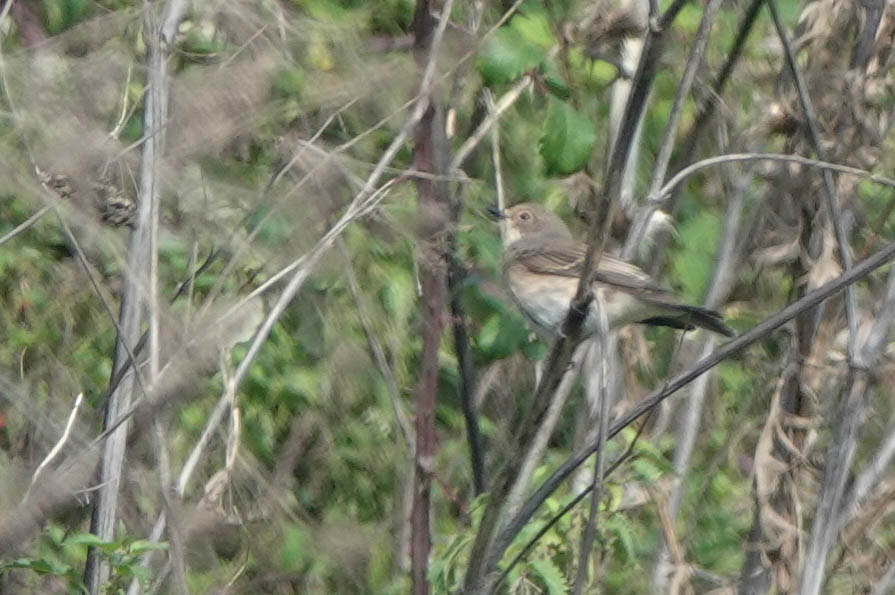
The walk alongside the oysterbeds produced many more Starlings and on the oysterbeds a number of Curlew and many Oystercatchers.  Another three Curlew plus eight Little Egret and a Heron added to the morning's observations. A Cormorant flew over and Richard picked up a couple of Magpie before a (true) pair of Sparrowhawks were seen inter-acting above us as they moved westwards. Turning north to head back along the Billy Trail towards the Car park we encountered another Magpie before stopping to watch both a Chiffchaff and Spotted Flycatcher in the bushes ahead of of us.  Whilst photographing the Chiffchaff our second target bird, a Lesser Whitethroat, landed immediately above the former.  Nothing else added as we headed back to the car.

Spotted Flycatcher Muscicapa striata 

Richard wanting to see where I had seen the Wryneck yesterday, we set off for a short stop at Titchfield Haven on our way home arriving at 1pm. First a look at the shore where the receded tide produced good number of both Black-headed Gulls and Oystercatchers.  A couple of Redshank a handful of Herring Gulls were also noted.

Redshank Tringa totanus

Just the three of us on site and a couple of very high Buzzards pointed out.  Nothing seen and as we made our way back on the small path running parallel to the road we stopped as the Wryneck flew overhead and landed atop a nearby bush showing a rear view.  Almost immediately it moved to the nest bush and this time showing a front elevation as I indicated to other birders to come and join us.  As we finally decided to move on and take a look at Titchfield Haven's South Scrape the Wryneck disappeared into the vegetation below a small tree in the reedbed.  By this time over twenty birders were on site trying to find the bird!

Wryneck Jynx torquilla

A short stay in the hide provide a number of species including two very close Common Sandpipers.  Most of the Avocets and Black-tailed Godwits were at the back of the water along with  handful of Teal and a similar number of Canada Geese plus a couple of Greylag Geese.  Also on the water and islands a number of Mallard and Lapwing plus a Heron and many Coot and Moorhens. Both Woodpigeon and Magpie passed overhead and then the arrival of a small flock of Starling.

Common Sandpiper Actitis macularius

Finally, a look at the lagoon as we approached the car produced both Shoveler and Gadwall along with resting Cormorants and a number of Black-headed Gulls.  Then, passing through Titchfield village on the way home, once again the sight of many local Jackdaws.

Wryneck Jynx torquilla

Birds seen:

Greylag Goose, Canada Goose, Mute Swan, Gadwall, Mallard, Shoveler, Teal, Great Crested Grebe, Cormorant, Little Egret, Heron, Buzzard, Sparrowhawk, Peregrine Falcon, Moorhen, Coot, Oystercatcher, Avocet, Lapwing, Dunlin, Black-tailed Godwit, Curlew, Redshank, Spotted Redshank, Common Sandpiper, Turnstone, Black-headed Gull, Herring Gull, Woodpigeon, Wryneck, Robin, Blackbird, Lesser Whitethroat, Chiffchaff, Spotted Flycatcher, Magpie, Jackdaw, Carrion Crow, Starling, House Sparrow, Linnet.

Common Sandpiper Actitus macularius

Common Sandpiper taking off

Common Sandpiper Actitus macularius

Curlew Numenius arquata

Robin Erithacus rubecula


Wryneck Jynx torquilla

For the latest news follow the Axarquia Birds and Wildlife Facebook page for more photos and comments and the opportunity to share with the wider birding world.

Thursday, 12 September 2024

Titchfield Meon Shore

Wryneck Jynx torquilla (PHOTO: Becky Hitchcock)

Thursday 12 September

Lovely sunny day  with clear skies but still a cold breeze blowing in as I set off to the Meon shore at Titchfield haven once more in search of the long-staying Wryneck, albeit only seen by a few. On site by 10.45 and a short stay with other birders failed to produce any results so continued on up to Cliff Road, park the car and walk back down checking the shore east of the harbour on the way. Below me many Oystercatchers on the mud and the shingle with the tide almost fully out along with a handful of Redshank and a couple of Turnstone.  Good numbers of gulls, mainly Herring but also a Lesser Black-backed a a dozen or so Black-headed Gulls.  Just the one Little Egret on show but the Mute Swan family was out on the water and this time seven cygnets noted with the two adults.  Away to the east a half-dozen Cormorants sunning themselves.

Reaching the Meon harbour a good number of Mallards and a score more Turnstone. Then to the observation area overlooking the lagoon to find seven basking Cormorant and a few Black-headed Gulls.  On the water  a good number of Coot along with a Moorhen,  pair of Shoveler and a single Gadwall.  Both Woodpigeon and Magpie flew over before my departure.

Resting Cormorants Phalacrocorax carbo

Making my way round to the western entrance to Titchfield Haven I walked as far as the first hide to see what was really on the water rather than the odd Avocet flying over. Over a score of Avocets present plus, probably, twice as many Black-tailed Godwits. On the nearest island a Lapwing and the grassy island to the left held a pair of Snipe with a third individual way over on the far left bank.  A handful of Moorhens were moving around and right at the back of the water a quartet of Canada Geese and a Heron.  Carefully checking the feeding Black-tailed Godwit I found the Curlew Sandpiper that had been previously seen nearer to the hide and next to it a Common Sandpiper. Further back in the next pool a resting Great Black-backed Gull and a pair of Tufted Duck. Also present a flock at least forty Starlings. Finally, as I left the hide to make my way back to the road and on to my parked car, a Cetti's Warbler was added to the morning's list.

Snipe Gallinago gallinago

However, reaching the road I decided to take once last walk along the parallel narrow path to the road to see if anyone had actually seen the visiting Wryneck this morning.  Three birders present and replied in the negative.  On mention the Curlew Sandpiper the couple departed to see if they could find the bird and I explained to the remaining birder where the Wryneck was more likely to be rather than in the long, grassy reeds.  Would you believe it, almost immediately I located the bird low down on the bare branches of a small tree just the other side of the stream.  Having quickly retrieved my camera for a record shot I then help my fellow birder, Becky Hitchcock, to find the bird, finally taking over her camera to try for her.  However, she almost immediately found where I was indicating and took back her long-range camera for a shot.  No time for me to have a second try as the bird departed westwards low over the reeds and out of sight.  Not until I reached home did I discover that I had been successful and Becky also kindly forwarded a copy of her shot.  What a way to end the morning and my first sighting of a Wryneck in the UK.

Wryneck Jynx torquilla

Needless to say  the resident Jackdaws were still to be seen atop the roofs as I got to the end of Posbrook Lane on my home; same as on the outward journey.

Gadwall Anas stepera with Moorhen Gallinula chloropus

Birds seen:

Canada Goose, Mute Swan, Gadwall, Mallard, Shoveler, Teal, Tufted Duck, Little Grebe, Cormorant, Little Egret, Heron, Moorhen, Coot, Oystercatcher, Avocet, Lapwing, Curlew Sandpiper, Snipe, Black-tailed Godwit, Redshank, Common Sandpiper, Turnstone, Black-headed Gull, Lesser Black-backed Gull, Great Black-backed Gull, Herring Gull, Woodpigeon, Wryneck, Cetti's Warbler, Magpie, Jackdaw, Carrion Crow, Starling.

Fox in, Avocets up!

Avocet Recurvirostra avosetta

Immature Herring Gull Larus marinus

Lapwing Vanellus vanellus

Moorhen Gallinula chloropus

Shoveler Anas clypeata

Snipe Gallinago gallinago

Wryneck Jynx torquilla uncropped, etc)

For the latest news follow the Axarquia Birds and Wildlife Facebook page for more photos and comments and the opportunity to share with the wider birding world.