Thursday, 2 July 2015

Did I find the Greater Yellowlegs?

Thursday 2 July


The simple answer is "No."  Having read that a Greater Yellowlegs had taken up residence at nearby Titchfield Haven, near Hill Head on Southampton Water, I look myself off there this afternoon to see if the bird really was an easy sighting.  Should have checked the tide times as, upon arrival, I was there about an hour after high tide and it seems that the bird takes itself off up river (the Meon) at this time.  I did venture forth towards Titchfield to check out the old, overgrown canal where it is reputed to sometimes spend its time but to no avail.  So back to the reserve to see what else was about as well as the numerous breeding Black-headed Gulls, Mallards and even a few Mute Swans.

The graceful Avocet Recurvirostra avosetta
Loads of breeding Black-headed Gulls Larus ridibundas  
What did strike me. apart from the numerous Black-headed Gulls, was the number of successfully breeding Avocets, always a delight to watch.  Collared and Rock Doves and especially scores of Wood Pigeons to be seen.  The woods also held Magpies and, along the shore, a handful of Common Starlings to accompany the water birds.

Three of the quartet of Mediterranean Gulls Larus melanocephalus in with their Black-headed cousins
In addition to the Avocets and Mallards I recorded a few Gadwall and a couple of Shelduck along with about three pairs of Canada Geese complete with well-grown goslings.  Why so many Black-tailed Godwits with some looking like "old" juveniles and yet others in full breeding plumage?  Are these birds on their way north or south?

Black-tailed Godwits Limosa limosa by the score


Also present at least ten Common Terns,  two pairs of Oystercatcher,  couple of Lapwings and a dozen or so Moorhens.  All the way north from Spain and I also found a quartet of Mediterranean Gulls on the nearby island.  I was only at the site a relatively short time with even less time to look at the water given that the adjoining track is mainly through woodland but on returning to the car parked on the waterfront, with the tide now rapidly receding, I noticed both a single Little Egret and a Lesser Black-backed Gull on the seaside rocks and a pair of Crows working the shingle.  So, the real question is will I have time (nevermind permission!) for a return visit in the morning before setting off for the eldest son's wedding?

Oystercatcher Haematopus ostralegus with Common Tern Sterna hirundo (above) and on nest below


Birds seen:
Canada Goose, Mute Swan, Shelduck, Gadwall, Mallard, Little Egret, Moorhen, Avocet, Lapwing, Oystercatcher, Black-tailed Godwit, Back-headed Gull, Mediterranean Gull, Lesser Black-backed Gull, Rock Dove, Wood Pigeon, Collared Dove, Crow, Starling.

Eventide with the Avocets Recurvirostra avosetta


Check out the accompanying website at http://www.birdingaxarquia.weebly.com for the latest sightings, photographs and additional information.

Thursday, 25 June 2015

Sierra Loja with John and Jenny

Thursday 25 June 2015

It would appear that whilst we were driving back to the UK yesterday as part of the Channel fracas, albeit we were booked from Dunkirk to Dover so only had a long lorry queue to contend with which saw us miss our boat whilst actually watching it depart from about a couple of kms away, John and jenny Wainwright's birding scene was done to mechanical problems with the usually reliable car.  As can be seen from John's report all now seems to well and under control.  By the way, our farewell to Belgium was the delight of Jenny seeing a Hobby drift by the first-floor kitchen window, less than an hundred metres away.  The bird is often seen by Marieke in the field further back but this would appear to be the closest to the house recorded by her so well done (my) Jenny.

Back to John's report for yesterday where readers will note the large numbers of Hoopoes recorded along with an extremely large flock of Choughs, not to mention a range of warblers, all three wheatears and both Rock and Blue Rock Thrush.  Sounds like a great day for John and Jenny.


Sierra Loja:  Wednesday 24 June

A hottish day with a very nice ( and welcome) breeze

Hi there, after a very exacerbating fortnight whereupon the radiator and water pump went , we have finally managed to get up to our favourite area, the Sierra Loja.  After coffee we drove up the track to the left of the Guardia Civil barracks and as soon as we entered the tree line, a Spotted Flycatcher flew off a low branch and disappeared into the firs.  Lots of Serins about here as well as a few Collared Doves, Spotless Starlings and House Sparrows.  Also here an Orphean Warbler was singing.

Juvenile Black-eared Wheatear Oenanthe hispanica (PHOTO: Jenny Wainwright)
As we progressed under the autovia bridge the trees were full of Spotted Flycatchers but from here to the hidden quarry nothing bar a few Wood Pigeon were seen.  In and around the hidden quarry we saw Black Redstart, Bee-eaters, Jackdaws, Goldfinches but no sign of the Eagle Owl at its "local roost". Lots of House Martins about today as well as a few Crag Martins and Barn Swallows, while in the firs Serins were very vocal.

Little Owl Athene noctua (PHOTO: Jenny Wainwright)
We moved on to the tree-line where in several stops we noticed Crossbills, Wood Pigeons, Great Tits, more Spotted Flycatchers, Azure-winged Magpies, a Greenfinch, Short-toed Treecreeper, two Rock Buntings and a Sparrowhawk.  Moving on to the cliff areas, three Black Wheatears were noted along with  a Northern Wheatear, Hoopoe, several Linnets and Goldfinches  Also a Rock Sparrow and as we pulled away from here a Wood Pigeon and a Sardinian Warbler were noted. 

Black Wheatears Oenanthe leucura (PHOTO: John Wainwright)
As we moved onto the flat area above the cliffs more Black Wheatears, a family of Thekla Larks and Stonechats were seen as well as Spotless Starlings, a Southern Grey Shrike and - our first of the day - Little Owl.  Down into the sub-station valley where another two Little Owls were noted along with lots more Black-eared-Wheatears, a couple of Blackbirds, Red-legged Partridges, Stonechats and a single Red-rumped Swallow.  In the bare tree a total of six Hoopoes were in constant flow in and out of the tree, along with a Woodchat Shrike and two more Blackbirds, and to the left of the tree a few dozen Chough were feeding in a cultivated area.  As we left the valley another Little Owl was spotted on the opposite side of the road.  Not much seen on the way to the Charca de Negra but as we pulled in at the lower pond, a Rock Thrush flew off the ground and onto a large bush opposite, and another one was spotted on the fence posts by the pond.  Lots of Linnets and Goldfinches, House Sparrows and Stonechats were seen as well as a single Greenfinch, a Black Redstart, two Crag Martins and one Barn Swallow.

Rock Thrush Monticola saxatilis (PHOTO: Jenny Wainwright)
After a bite to eat we moved over to the fossil cave area where the predominant bird was the Rock Sparrow.  Also about were several more Black Wheatears, a few Chough and a Griffon Vulture graced the sky for at least two minutes, before it dropped out of sight.  Further along this track we found a female Spanish Ibex and her young  In a small hawthorn bush a Spectacled Warbler was spotted.  Above us more Crag Martins and a large number of House Martins.  A Mistle Thrush and a Blue Rock Thrush were spotted on the rock face with another three Hoopoes passing across the same face.

Southern Grey Shrike Lanius meridionalis (PHOTO: Jenny Wainwright)
Looking up at the Sierra Gordo viewpoint a huge flock of Choughs took off, I guess somewhere in the region of two to three hundred.  It was certainly one of the largest flocks I have seen here in the time I have been birding this area.

Onto the fir copse where another five Hoopoes were seen along with Mistle Thrushes, Woodchat Shrike, Goldfinches, Rock Sparrows and more Blackbirds.  And as we made our way down we managed to find two more Blue Rock Thrushes.

Woodchat Shrike Lanius senator (PHOTO: John Wainwright)
What a fabulous day's birding.  Now, in all the rushing about here will I get chance to visit Rutland Water and/or even Titchfield Haven when we arrive in the Southampton area?   "Watch this space" as they say.


Check out the accompanying website at http://www.birdingaxarquia.weebly.com for the latest sightings, photographs and additional information.

Monday, 22 June 2015

The raptor day!

Monday 22 June

After last night's excitement in the woods, today was very quiet and turned out to be one of three raptors following the early morning rain.  The sight of a lone female Kestrel crossing the neighbouring field was good, a very early Barn Owl as we took a (relatively!) short walk following an evening meal was better but, certainly, best of all was the juvenile Goshawk devouring its late morning breakfast.  As can be seen from the accompanying photograph, not so much a "bird's eye view" but rather more of a "bum's eye view!"

Rear end view of a juvenile Goshawk Accipiter gentilis

The longest day of the year

Sunday 21 June

Nightjar460.jpg
Nightjar Caprimulgus europaeus (from Internet)
For me it certainly was the longest day of the year with little more than six hours in bed - and that also being in two countries!  The first two and a half hours were spent at the wedding reception near Overath, about thirty kilometers east of Cologne, before finally getting to bed.  Then it was up and a late breakfast in sunny weather before starting our, now very wet most of the time, journey westwards to our dear friend Marieke in Wuustwezal, Belgium.

Following lots of chat and a lovely early dinner and the weather outside calm and almost clear (there had only been a slight drizzle very early in the day), Marieke and I set off for the nearby military fields where she undertakes her Goshawk and Honey Buzzard observations and studies to see if the Common Nighjars would put in an appearance.  We were not to be disappointed.

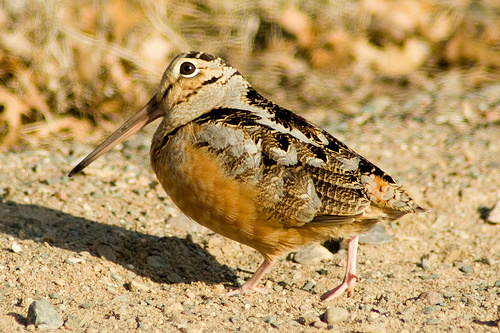
Leaving the car in the small parking area we crossed the road and set off about 200 metres down the track before taking to the heathered fields to find shelter near a group of large trees in order to watch the open space in front of us. Just on thirty minutes later at about 10.30 we had our first "churring" and a very brief glimpse of a fleeting Nighjar across the centre of the field.  All was then quiet until suddenly out of the blue, well not so much blue as it was by now a distinct grey colour, a silhouetted appeared from our right and passed immediately overhead and which we were immediately able to identify as a Woodcock doing its early evening rounds, probably visiting one of his many (?) concubines in the area.  So close and clear that had I taken my camera then most certainly I should have been able to get a reasonable shot.

Woodcock or Snipe?
Internet gathered shot of a Woodcock Scolopax rusticola
Thirty minutes after our first hearing, at about 11pm, we had more churring and wing-clapping along with a "queek, queek" which may well have been a territorial or love call, from another Nightjar to our left as we looked out into the field.  And then the bird was in view, arriving form our left and passing behind us quickly followed by a second individual.  That would have been great for most but barely ten minutes later both birds flew immediately in front of us at about two metres from the ground, swerved and turned behind us as if using us as a roundabout.  So close that the white wing flash was blinding and also seeming to illuminate some of the wing barring.

European nightjar - stock photo
Nightjar Caprimulgus europaeus (from Internet as above)
What a sight!  And then it was back to Marieke's home arriving about 11.30 and managing to get to bed just before midnight.  Two beds in one day in two separate countries!  And what was Jenny doing whilst Marieke and I were up in the woods?   Sensibly, she decided to have an early night to catch up on the missing sleep but was then woken by a visit from two policemen making enquiries about a grey Corsa seen parked in the military car park in the nearby deserted woods.  "Do you live here?  No, I am only visiting.  Do you have a grey Corsa?  No, I think that it may be the owner's and she is up at the military with my husband looking for Goshawks - no, I mean Nightjars.  Oh, that's all right then."  What does this tell us about Belgian police?  They fluently speak and understand English, they know all about the local avifauna and they expect most guests to take their hostess up to the woods for the evening and leave their wives behind to guard the house!  Never let it be said that Belgium is a boring country.

Sunday, 21 June 2015

Fieldfares in June

Sunday 21 June

Not quite what you expect in Britain, a summer Fieldfare, never mind a June sighting.  On our way from Spain to the UK we saw relatively little in the north of Spain, other than our morning visit to the Ebro delta and, in some ways, the same could be said of France.  Yes, we had sightings on White Stork and both Red and Black Kites.  The occasional Wood Pigeon and Magpie reminded one of a journey from a British airport to home and, as expected, once north of the Pyrenees we saw regular sightings of both Crow and Rook along with Jackdaws to add to the corvid list for the year.
But it was our five day stay with friends in Overath, Germany (about 20km east of Cologne) that really produces some excitement.  Having already recorded both kites, as above, along with Common Buzzard I soon added numerous Crows and Rooks plus more Jackdaws in the towns .  Again, evenings especially brought sightings of Common Swift and Barn Swallow never mind a few House Sparrows and the everywhere Common Starling.  Even Collared Doves could be seen and heard with Wood Pigeons whenever we approached any sign of woodland – and this is a very much a wooded area!

Our reason for being here in the first place was to attend the wedding of the elder daughter of a school-day penfriend that we have maintained contact with for well over fifty years.  It turns out that in small village communities in this area it is the custom for the neighbours to decorate the marital home of the newly-weds to be.  So off we went up into the hills and the small village where the neighbours duly turned up carrying lengths of spruce along with white flowers, etc.  Having completed the decorations we all resorted to the garage where drink and hot dogs had been prepared and a most convivial time was had by all.

The happy couple to be outside their newly decorated entrance
But I was taking an interest on the large grassed area in front of the house.  Not just the feeding Blackbird that worked its way back and forth but the Fieldfare.  Trying to get a photograph with my little “Micky Mouse” camera jenny happened to mention that a second bird was also feeding less than ten feet away.  Both birds stayed all the time we were present, probably near to a couple of hours, so obviously plenty of insect/grub life near the surface.  How strange to see the birds feeding just like a pair of Blackbirds when we are so used to seeing Fieldfares feeding, in large flocks, on berries and fallen apples during the winter months.

Record shots of the local, feeding Fieldfares Turdus pilaris


Not content with the Fieldfares and the occasional passing of both Crow and Rook, we also had a Jay fly across the open land and proceed to feed in a close by tree.  One of the neighbours with a good grasp of English and some birding knowledge informed me that the Fieldfares are regular summer breeders but they disappear during the winter.  Yes, they are over in the UK or even thinking about a winter holiday down in Andalucia awaiting my return to the Sierra Loja!  Even more amusing, from his point of view, was the fact that the Jay had such a small name compared to its lengthy German equivalent, the “Eichelhäher.”

Friday, 19 June 2015

Up and down the mountain with Derek and friends

Thursday 18 June

I might be in Germany on the first leg of my European wedding tour but it is still great to receive birding reports from friends and so keep in touch with what is happening back home (but still no sign of the house sale being completed).

The following from my friend Derek Etherton who seems to have had a very long day out with the boys!

Hi Bob....hope the journey is progressing well.  Jerry Laycock, Mick Smith, Luis Alberto and myself had a 'boys' day out today.  Meeting early at Plaza mayor we were at Loja by 0815hrs.  The Eagle Owl was showing for 2 minutes before deciding enough is enough!  By the time we reached the top, it's 1600mtrs here, it was trying to rain and the temperature was a 'balmy' 10c!  Felt more like zero with the wind chill factored in.   Brief glimpses of [Rufous-tailed] Rock Thrush for Mick and myself the others 'dipped'.  The cold weather, jeez it's Southern Spain in flaming June, made life difficult for both birds and some birders so after a good list, had Wryneck at the high copse, we descended.

Displaying P1000899.JPG
A hungry Night Heron Nycticorax nycticorax with a meal bigger than its belly!  (PHOTO: Derek Etherton)
Returning back down for a warming coffee and 14c we returned home via Laguna Dulce where it was a wonderful 24c; how things change so quickly.  Not an awful lot there so retuning to Malaga we went via Zapata to find this Night Heron struggling to eat its fish supper.  Took it a full 30 mins from when we arrived, goodness knows how long before it was struggling.  A juvenile was the other side of the bank watching in awe.  As we left we had good sightings of Short-toed Lark and the Tawny Pipit was still showing well.  (Luis Alberto was here early in the morning [first light] to watch the Red necked Nightjars.)  

Back to Plaza Major at 2030 hours, a long but very satisfying day with approximately 80 species.

Now that is what might be correctly called a great day's birding.  And I missed out!

Sunday, 14 June 2015

Ebro Delta - First Visit

Sunday 14 June

Squacco Heron Ardeola ralloides
Up early, and when I say "early" I mean very early, and out of the hotel and on the road by 6am. (When was the last time you had breakfast delivered to your room at 5.30 am?)  With empty roads we arrived at the Ebro delta by just after 9 o'clock and had a very enjoyable three hours exploring some of the more well-known sites where we found the extensive rice paddies under water and the fresh green shoots standing at about 20cm.  A lovely, pleasant morning in calm conditions and quite sunny, which was a little bit of bad luck as we always seemed to be looking in to the sun when it came to taking photographs.  As an aside, having placed the dusty car in a private garage below our Egyptian-themed apartment last night it missed out on the heavy shower so was still "grubby" this morning. Then, guess what, we paid the extra 5 Euros for private underground parking in the locked garage rather than spend hours unpacking, left the car in its still dirty exterior condition and watched the rain absolutely poor down in a couple of very heavy storm showers.  What chance we might get the car wet tomorrow before we arrive in Germany?

Whiskered Tern Chlidonias hybridus
As soon as we arrived in the delta we were greeted by the usual House Sparrows, Collared Doves, Blackbirds and Spotless Starlings but within minutes had added numerous Little Egrets, Grey Heron and the first of at least a handful of Squacco Herons along with the plentiful supply of Magpies.  Coots and Barn Swallows were in good numbers and then the terns started to appear.  Numerous Whiskered and a small number of Gull-billed Terns which we continued to see everywhere but, perhaps, the best sighting was the single Black Tern.  A single Moorhen took some time in exposing itself but once recorded they cropped up at very regular intervals.

Magpie Pica pica
Following a narrow track alongside a main water canal we stopped to admire the single Sedge Warbler and, on getting out of the car to check out the main laguna, found the first Great Crested Grebe and a Great Reed Warbler happily sang to us from a nearby reed. Opposite, the Whiskered Terns seemed to be building/strengthening their water-bound nests and Mallards came out to greet the sun and introduce their ducklings.  Next up, not only the first Purple Heron flying over but also a single Glossy Ibis.  Meanwhile, Jenny was busy listening to a couple of Golden Orioles on the opposite side of the water amongst the Eucalyptus trees.

Little Egret Egretta garzeta
As with the Moorhen, once we had seen our first Black-winged Stilt we were suddenly being plagued by these long-legged screamers as they tried to drive us away from their, presumably, breeding territory.  A trip to the southern Information centre and a look at the nearby water produced, in addition to many of the above, our first Shelduck, a small flock of Glossy Ibis and a number of Herring Gulls, albeit most of the gulls were of the Black-headed variety.

Black-headed Gull Larus ridibundus
Returning in order that we could drive to the beach and look at the distant water we recorded both Crested Lark and Common Kestrel but little else other than more terns and a small flock of Flamingos.  On the other hand we did find a lone Great White Egret and there was a handful of Sanderling running up and down the beach and I almost forget to mention the trio of Redshank, a single Oystercatcher and the lone Collared Pratincole seen by Jenny.


Common Tern Sterna hirundo and at nest and in flight
Working our way north to cross the Ebro we stopped at a small reserve managed by SEO and came across not only good numbers of Tree Sparrows making use of the provided nest boxes but three pairs of Barn Swallows nesting in the large hide.  Below the hide, in addition to the Whiskered Terns we found breeding Common Terns, Moorhens, Little Grebe and more Mallards along with a pair of Shoveler. The paddy field opposite contained numerous Purple Swamphens along with a young Night Heron and a single Little Bittern.  Almost made me forget to look at the Grey Herons and Little Egrets!

Great Reed Warbler Acrocephalus arundinaceus
And that was just about it.  A lot of driving to cover much of the souther side of the Ebro delta and a final total of 41 species.  An interesting area and probably more productive in the winter months but I still prefer the combination of the Donana National Park and nearby Odiel Marshes.

Redshank Tringa totanus


Birds seen:
Shelduck, Mallard, Shoveler, Little Grebe, Great Crested Grebe, Little Bittern, Night Heron, Squacco Heron, Little Egret, Glossy Ibis, Great White Egret, Grey Heron, Purple Heron, Flamingo, Kestrel, Moorhen, Purple Swamphen, Coot, Oystercatcher, Black-winged Stilt, Collared Pratincole, Sanderling, Redshank,Black-headed Gull, Herring Gull, Gull-billed Tern, Common Tern, Whiskered Tern, Black Tern, Rock Dove, Collared Dove, Crested Lark, Barn Swallow, Blackbird, Sedge Warbler, Great Reed Warbler, Magpie, Golden Oriole, Spotless Starling, House Sparrow, Tree Sparrow.


Check out the accompanying website at http://www.birdingaxarquia.weebly.com for the latest sightings, photographs and additional information.