+(Small).jpg) |
| The first sight of the Great Bustards Otis tarda |
After five days we have finally arrived back home in our mountain top home above Lake Vinuela. This time not for us the usual three full-day non-stop driving but rather a slower pace so that we could enjoy both the scenery and make both cultural and birding sops on the way back. Monday took us from home and via the Dover - Dunkirk ferry to our evening destination in Boulogne-sur-Mer. Tuesday was a long, non-stop journey down to Angouleme in central France arriving just after 8.30 in the evening. Job done, we could now look forward to the interesting part and an early morning start saw us in Bordeaux by 9am. Then it was south towards Bayonne to take the inland turn towards Mont de Marsan and Pau in preparation for the Pyrenees crossing. And what a glorious route in turned out to be. Not really a lover of the French countryside but this seemed like a mixture of driving into Swiss valleys or the Bavarian countryside.
+(Small).jpg) |
| Plenty of juvenile Goldfinches Carduelis carduelis everywhere |
First Orthez, then Navarrenx and Oloron Ste Marie as we looped west of Pau and so up to the summit where we joined a convey to be escorted through the 8,500 m tunnel and so into Spain for the descent down to Huesca and our evening hotel in the beautiful city of Zaragosa. These French towns were a delight to pass through, and as Jenny said, a "must return" location so that we could spend more time to explore. the usual birds, mainly
Black Kites,
Magpies and
Wood Pigeons on the journey but a stop for a comfort break in the woods approaching the summit resulted not only an opportunity to watch the local
Nightingale but also a
Jay fly across the road. The same was true of the small towns and villages on the Spanish side with each appearing to have its own castle and fortified walls to their respective old towns. Perhaps a week based in Pau and Zaragosa would produce both excellent historical and birding opportunities.
Wednesday evening was spent looking at the city and at dinner the local waiter informed us that there was very good birding site (relatively!) close by. Decision immediately made to forgo the motorway route to Madrid and then south to Manzares near Daimiel to take in this site. After all, what could possibly go wrong? Well, to start with we had severe thunder and lightning after dinned and the heavens really opened! Therefore, we spent Thursday morning looking at the magnificent cathedral accompanied by large numbers of both Common and Pallid Swifts before setting off at noon for the hour's drive south-east to the
Laguna de Gallocanta recording many
Buzzards and
Griffon Vultures. This detour, including very little motorway would probably mean a late evening arrival at our hotel but check-in was open till midnight.
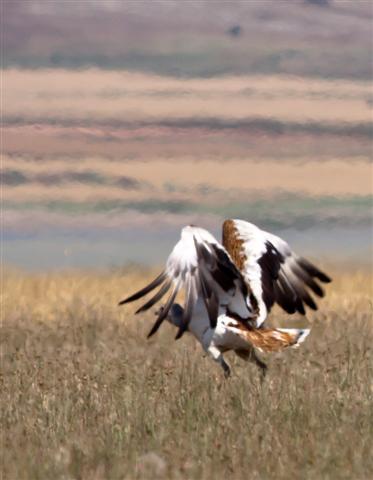 |
| And then at least 40 Great Bustards Otis tarda took to the air |
 |
| Is it an Airbus 380 or a Boeing 787 Dreamliner? Neither but this Great Bustard Otis tarda certainly seems to have a massive bulk in common with its metal equivalents! |
 |
| What a magnificent sight! |
Maps provided at the reserve, we then had a
Menu del Dia before setting off on the track that led round the reserve to a number of hides and viewing points. We had been informed that there was a resident population of
Great Bustards in the area and where might be the best place to search the neighbouring steppes. No sooner had we set off than we had a
Stonechat followed by the first of scores of
Blue-headed Wagtails (Flave iberiae). Both
Commion Swifts and
House Martins feeding overhead with a smaller number of
Barn Swallows.
Turtel Doves were out in force with a pair here and a pair there and many, many
Corn Buntings. In addition to the
House Sparrows seen on arrival, we also managed to record
Spanish Sparrow plus a small number of
Rock Sparrows during the drive around the lake.
Whiskered Terns and many
Wood Pigeons and
Magpies were also seen.
Barn Swallows were feeding overhead as we approached the first hide where, without a scope to hand, we quickly recorded
Little Egret,
Spoonbill,
Heron and
Glossy Ibis.
Further on from the next hide we also recorded a
Black Redstart and then a good number of
Gull-billed Terns before finding the resident
Black-winged Stilts and a couple of
Avocets. Driving along the ploughed fields on the far side
Carrion Crows were everywhere - but no Ravens. At last a raptor with a distant
Montagu's Harrier followed by a
Kestrel, a
Northern Wheatear and a rather lovely female
Cirl Bunting. At this point, in the area suggested that we search the neighbouring steppes, we suddenly had a pair of
Great Bustards fly over the car and drop into the corn field between the car and the water. Out of the car like a shot to see if the birds could be located, I had nor sooner found a concealed group of three when the birds, once more, took off and were joined by all the others already on site. Whilst Jenny managed to count in excess of forty, at this point the memory card came up "Full" so necessary to make as quick a change as possible. Well, at least I did get some shots and the sight of so many lovely birds at close quarters made our tour to this wonderful reserve all the more enjoyable and worthwhile.
 |
| Having drunk from the puddle of life this Quail Coturnix coturnix casually wandered back into the corn |
Job done, so we turned on the barrow track and made an exit to take in a recommended corner about five km along the road on our proposed route to try and find the local Dupont's Larks. But first, as an added bonus, the pool on the track produced a
Quail bust drinking. The shots through the windscreen were blurred record shots but the bird did remain long enough for me to fire off one shot from outside the car. What a very pleasant surprise and addition tot he list.No sound recording device in the car, I do not know the call of the bird and my hearing not being what it once was, readers will not be surprised to read that we were unsuccessful. However, not far into the journey and we did have an
Egyptian Vulture pass overhead plus
Chaffinches and a
Jay.
+(Small).jpg) |
| Spoilt for choice photographing this Marbled Duck Marmaronetta angustirostris |
And so on to our final hotel in Manzanares so that the final day might be spent at the
Tablas de Daimiel. A very strange noise from the back of the car like a folding chair rattling about for the next 100 or so km until, whilst stopped at a junction, an on-coming motorist indicated that something was amiss under the car. Closer inspection revealed that the engine protection plate had come apart, fortunately at the rear end, and was bouncing on the road with the affixed nut giving off the metallic sound. No garage, no nothing in the area so a case of carrying on at a slower speed and the likelihood that we would now not arrive until, probably, at least 10.30pm. We should be so lucky, even though I took over the driving and increased speed. Being stopped by the Guardia Civil as left a small village did not help, even if the inhabitant were all out in the streets an gone eleven enjoying some celebration or other. Once we explained our predicament and it was obvious that we passing through rather than passing liquids through our bodies, we were happily sent on our way. Next, on arrival in the correct area we could not locate the hotel and it was now midnight. Helped by some young lads who very kindly led us round back streets and goodness knows where else, we finally located the correct hotel at about half past midnight where the night porter let us in and gave us the keys. What a day in all senses of the phrase.
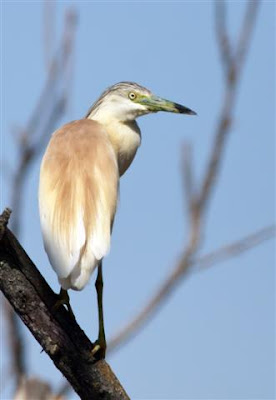 |
| Lovely to come across a trio of Squacco Herons Ardeola ralloides immediately in front of the car |
And so to our final day. Having made a point of wanting to visit the
Tablas de Damiel it seemed a shame to give it a miss whilst seeking repairs to the Citroen Compromise. We decided to visit the nearby
Laguna Navaseca for about an eye so that, at least, we would have seen some birds. The water levels were beginning top drop on the right-hand side so we were able, without scope, to see
Flamingo,
White Stork,
Spoonbill and
Black-winged Stilts. Numerous
Barn Swallows and
Sand Martins were feeding overhead and there was a smattering of both
Serins and
Goldfinches. A drive along the stone causeway through the main water, including many track-wide puddles, produced a trio of
Squacco Herons with
Coots,
Moorhens and
Little Grebes on the water. On a fence to the side we had both
Spanish Sparrow and
Reed Warblers. On the far side a couple of
Bee-eaters were resting on the wires with ample food in their beaks plus a single
Redshank and then a couple of
Glossy Ibis flew over. There were also more
Blue-headed Wagtails.
+(Small).jpg) |
| Two for the price of one with a Ferruginous Duck Aythya nyroca above and a Greylag Goose Anser anser below |
So, we thought, birding ended for the day and drove to the nearby Citroen garage for repairs to be undertaken. The young mechanic came out, took a look and then moved other cars out of the way, drove our car into the garage and onto the lift to check and repair the damage. Just under thirty minutes later all had been repaired and, when asked, said there would be no charge! What a gentleman. However, placing the note in his coat pocket I told him to go and have a few drinks on us as we very much appreciated what he had done. And it was still only 11.30 so we carried on to the
Tablas de Daimiel for a tour along the "Yellow Trail" before taking a
Menu in the town itself and, departing at 3.15 were back at
Casa Collado by 7.45.
+(Small).jpg) |
| At least two Purple Herons Ardea purpurea at the Tablas de Daimiel |
The reserve itself produced numerous ducks but no waders. I my previous four visits I have never seen so much water.
Hoopoes came to greet us and, as before, lots of
Magpies and
Wood Pigeons. Again, there were
Blue-headed Wagtails all over the place and this is always, as today, a good site to find
Tree Sparrows. A couple of
Purple Herons flew over and even a
Little Bittern made a sudden dash across the reeds having been disturbed by site-seers on the far side of the water. Only a single
Marsh Harrier but there were lots of
Little Egrets and
Cormorants about. It would appear that the local
Red-crested Pochards had had a good breeding season along with the
Mallards judging by the number of ducklings about. This site was also awash with butterflies and dragonflies. Lots of the "little white" jobs which I must stop calling "Cabbage Whites" and the dragonfly identification will have to wait until the photos have been processed and checked with the field guide.
+(Small).jpg) |
| Not sure which of these two has the bigger problem; the aggresive Red-crested Pochard Netta rufa above or the drunk-looking Tufted Duck Aythya huligula below and I know how they both feel! |
In addition to the birds, as indicated above there was a great number of butterflies and dragonflies about. Most of the former were of the small white variety and the dragonflies seemed evenly split between the blue and red as shown below. I suspect that the "green" specimen was a female of one or the other. There you go Mick, Steve and John; see if you can identify them all before I get chance to work the Field Guide!
+(Small).jpg) |
| (Above and below) Great Banded Grayling Kanetisa circe |
+(Small).jpg) |
| (Above and below) Male Black-tailed Skimmer Orthetrum cancellatum |
+(Small).jpg) |
| (Above and below) Red-veined Darter Sympetrum fonscolombii |
 |
| Male Ruddy Darter Sympetrum sanguineum |
+(Small).jpg) |
| Female Ruddy Darter Sympetrum sanguineum |
Many thanks to both Steve Powell and Mick Richardson for identifying the above butterflies and dragonflies.
FOOTNOTE:
Making a start on the green-coloured swimming pool the first day back and the mobile decided it was too hot to sit in my shirt's breast pocket so took a perfect dive into the deep end! Despite the use of brush, covering myself up to enter the dirty lava-infected water and walking the whole pool , five feet at the deep end, the mobile refused to show itself. Therefore, for the time being, I am incommunicado. To reach me you will either have to email, ring the house (951321613) or wit until further notice. All being well, the pool may be clear enough by midweek to reveal where the little blighter is so that it can be retrieved and given a good talking to!!!
+(Small).jpg)
+(Small).jpg)


+(Small).jpg)

+(Small).jpg)
+(Small).jpg)
+(Small).jpg)
+(Small).jpg)
+(Small).jpg)
+(Small).jpg)
+(Small).jpg)
+(Small).jpg)

+(Small).jpg)


+(Small).jpg)


