Sunday, 16 June 2013

Spanish journey: 10 - 11 June


With only jut over a week in Spain during June and having reached the hundred bar two species thanks to the previous week's five days in Extremadura, I decided to call in at the old railway track at Ventas de Zafarrya on our journey north as we set out for the drive to Dunkirk and onward ferry to Dover.  After all, you could guarantee that you would record both Chough and Black Wheatear almost as soon as you got out of the car so job done.  Or so I thought!  But first, no sooner had I left the house to drive down the mountain than we had first a Great Tit and then a female Red-legged Partridge with a handful of chicks in toe.  Thekla Larks were all over the place along with Serins and a pair of Ravens passed overhead before we encountered the Barn Swallows once into Los Romanes.

Arriving at the mirador above Ventas de Zafrarraya I was welcomed by a most handsome Black Redstart but then the bird life, just after 9.30 in the morning, seemed to dry up.  Approaching the tunnel I had a quartet of Rock Sparrows (one new for the month) and then, just on the other side, a Subalpine Warbler.  Not many Crag Martins about so, complying with strict instructions, I started to make my way back to the car so that we could continue on with our long journey.  However, re-emerging from the tunnel it soon became obvious that the Alpine Swifts were once again in residence in the nearby large cave and totalled at least a score.  A female Blue Rock Thrush put in an appearance followed by a Goldfinch.

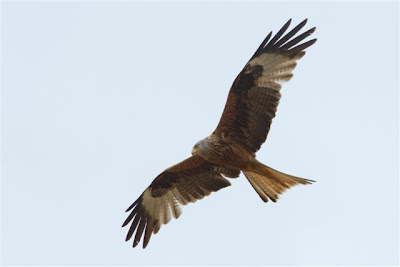
One of many Red Kite Milvus milvus seen on the journey north
So on with the journey following the back road towards Granada and then the motorways north, picking up the A4 to the outskirts of Madrid followed by the A1 to Burgos and  just beyond Vitoria where we found a hostal for the night at Alsasua.  On the way, apart from Hoopoe and Jackdaw, we had regular sightings of Wood Pigeon and even an Azure-winged magpie before encountering the regular sightings of both Black Kite and Buzzard.  Similarly, there were regular sightings of both Blackbirds and Corn Buntings along the way.  Finally, east of Burgos, we had our first Carrion Crows (100) and a Red Kite.  Soon we had also added both Booted Eagle and Griffon Vulture and one or two of the villages on the old N1 between Burgos and Miranda del Ebro had White Storks nesting on church towers.  We also noted more Common Kestrels than we had the previous week in Extremadura.  Alsasua had its resident Common Swifts in town for the breeding season and the last bird of the day was a single Grey Heron making its way down river to its overnight roost and/or nest.

Mute Swan Cygnus olor with Gadwall Anas strepera
The following morning, Tuesday, was calm and still with dampness in the air following the very heavy rain that had recently fallen and a walk alongside the river produced a lone Red Kite drying itself out in the top of a dead tree before setting off on the hunt for breakfast.  Then it was on to the Spanish border arriving in time at Irun to spend and hour at the last Reserve before leaving the country.  The monthly count increased as we picked up some norther Rooks on the way and increased again by the time we had left the reserve.  The water levels were very high so very few waders to be seen though we did encounter a couple of Little Ringed Plovers and two pairs of Whimbel were seen on the estuary "woodwork" and a pair of Curlews seemed to be nesting on a small grassy island.

A pair of "nesting" Curlew Numenius arquata our on the marshy estuary
How lovely to listen to the song of the Melodious Warbler Hippolais icterina

On the pools themselves we recorded both Mallard and Gadwall plus Moorhen and Coot along with Mute Swan.  Melodious Warblers were singing and showing themselves next to the path and everywhere feeding Blackbirds with, no doubt, chicks in the nest waiting for food.  We even had a very busy Song Thrush on the athletics field with a beak full of worms to feed its young somewhere in the immediate vicinity.  Nearer the river's edge we picked up Little Egret, Grey Heron and Cetti's Warbler along with House Sparrow, Spotless Starling and Greenfinch.

And then a single Squacco Heron Ardeola ralloides dropped in to feed

Visiting the last hide overlooking a very sheltered pool we came across three Grey Herons and then a Squacco Heron flew in to pay us a visit.  Meanwhile, the "black lump" sleeping on a gravel island in the centre did eventually wake up and stretch itself long enough for a better photograph and reveal itself as a Black Swan.  So ended our journey  through Spain and now all must be put aside until we once more re-enter the country and start the southern journey back to Casa Collado.  But at least I did get my June total well over the hundred mark in just eleven days.


A lone Black Swan Cygnus atratus sleeping on the lagoon


Birds seen in Spain:
Gadwall, Mallard, Mute Swan, Black Swan, Red-legged Partridge, Little Egret, Squacco Heron, Grey Heron, White Stork, Griffon Vulture, Red Kite, Black Kite, Booted Eagle, Buzzard, Kestrel, Moorhen, Coot, Little Ringed Plover, Curlew,  Whimbrel, Yellow-legged Gull, Rock Dove, Wood Pigeon, Collared Dove, Common Swift, Hoopoe, Thekla Lark, Crag Martin, Barn Swallow, Black Redstart, Blue Rock Thrush, Blackbird, Song Thrush, Cetti's Warbler, Melodious Warbler, Subalpine Warbler, Great Tit, Azure-winged magpie, magpie, Jackdaw, Crow, Rook, Raven, Spotless Starling, House Sparrow, Rock Sparrow, Chaffinch, Serin, Greenfinch, Goldfinch, Corn Bunting.


Check out the accompanying website at http://www.birdingaxarquia.weebly.com for the latest sightings, photographs and additional information. 

Pictorial reminiscence of Extremadura

Five days in Extremadura: 3 - 7 June 2013

Following our five days in Extremadura where we did manage to record both Great Bustards and Rollers along with many other wonderful birds, the following is a selection of photographs taken during the visit by Steve Powell.  More of his wonderful photos can be found on his personal website, "Wild About Spain" by CLICKING HERE.  The group photo at the end was taken by myself using the lady wife's camera and Steve can be found second from the back on the right.

Cormorant Phalacrocorus carbo with enough fish to last the day!


One of a few Great Bustards Otis tarda seen on three of the days
Griffon Vulture Gyps fulvus on the prowl

Common Buzzard Buteo buteo of which there were many
Three shots of one of Steve's favourite raptors, the delicate Lesser Kestrel Falco naumanni
Purple Swamphen Porphyrio porphyrio
The diminutive and delightful Little Owl Athene noctua
Common Cuckoo Cuculus canorus posing for the camera

The ever-popular Roller Coracius garrulus, perhaps the endemic species of Extremadura
 
Jenny's right; I do need to lose some weight!  No; I think it must be Steve's camera!
Our happy band of pilgrims - Left to right:  Liz Rootes; Marcus Rootes; Ellie Wallbank; David Jefferson; Ann Jefferson; Janet Fisher (at top) Eric Lyon; Steve Powell; Pat Lyon; David Fisher; Jenny Wright.


Check out the accompanying website at http://www.birdingaxarquia.weebly.com for the latest sightings, photographs and additional information.

Thursday, 13 June 2013

Guadalhorce, Malaga with John and Jenny

John and Jenny Wainwright managed to spend an interesting morning down at the Guadalhorce, Malaga on Tuesday and, in addition to the selection of birds, managed to record a number of "creepy-crawlies" as per the following description and photographs.


11th June 2013

A very hot day but mercifully a nice breeze and after dropping our friends off at the airport we headed for the reserve.  Only one car here today so plenty of room to park.


Little Bittern  Isobrychus minutus (PHOTO: Jenny Wainwright)
On the track our first sighting was a Moorhen followed by Zitting Cisticola, Barn Swallows, House Martin and House Sparrow. We headed for the "Sea Watch" area and en route stopped at Laguna de la Casilla; here we saw two Little Bitterns, Common Swift, Mallards, White-headed Duck, Reed and Sardinian Warblers, Common Coot, Black-winged Stilts, Goldfinches, Greenfinches, Yellow-legged Gull, Bee-eaters, Crested Lark and Monk Parakeets.

Little Ringed Plover Charadrius dubius (PHOTO: John Wainwright)
At the Rio Viejo we found Little Ringed and Ringed Plovers, Little Egrets - over a dozen of them, all being hassled at some time or other by the Black-winged Stilts as their chicks were feeding in the shallows, a Turtle Dove, Jackdaw, Cattle Egret and the lame Spoonbill.


Juvenile Black-winged Stilt  Himantopus himantopus (PHOTO: John Wainwright)

As we headed towards the Sea-Watch we saw Avocets, Black-headed Gulls, Sardinian Warbler, Collared Dove.  A Short-toed Lark was put up as a Common Kestrel swooped low over its resting place.

Short-toed Lark  Calandrella brachydactyla  (PHOTO: John Wainwright)

The sea-watch area was deserted not even a gull was seen there, so we back tracked round to the Escondida hide.


Egyptian Grasshopper Anacridium aegyptium (PHOTO: John Wainwright)

Here again very little to speak of although we did get good views of a Ladybird Spider (Eresus cinnebarinus), Egyptian Grasshopper (Anacridium aegyptium) and a Moorish Gecko (Tarentola mauritanica).


Grasshopper Acrida ungarica (PHOTO: John Wainwright)

At the entrance to the Laguna Grande hide we saw the very handsome Acrida ungarica (grasshopper with blade antenna) and from the hide Little Ringed Plovers, two Gull-billed Terns, Wood Pigeon, Redshank and a Yellow Wagtail (Iberiae).


Ladybird Spider Eresus cinnebarinus (PHOTO: John Wainwright)


Check out the accompanying website at http://www.birdingaxarquia.weebly.com for the latest sightings, photographs and additional information.  
 

Sunday, 9 June 2013

Five days in Extremadura


Red Kite Milvus milvus (PHOTO: David Jefferson)
What a five days!  The weather was perfect as we drove up to Trujillo on Monday 3 June and it remained that way for the following two days.  Thursday turned out a little on the cloudy and cool side but did, eventually warm up by mid-afternoon.. Some justification, therefore, for turning out in shorts and no jumper to put on!  By contrast, Friday was promised to be cloudy but, having already packed the cases, etc and loaded the car, I did not expect the heavy rain showers during the morning!
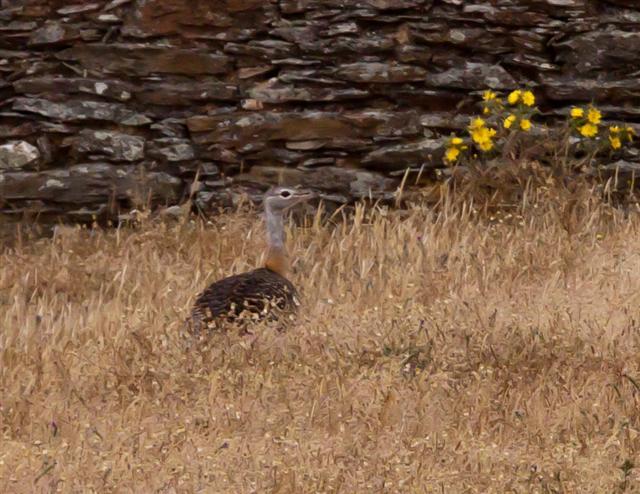
Great Bustard Otis tarda
The week started with a total of five cars making their way up through Cordoba Province to meet up at the convent just inside the Extremadura boundary for a midday lunch and the opportunity to watch the good number of Montagu's Harriers as we waited for each other.  Needless to say, on this occasion my car was the last to arrive so only a limited time to eat our packed lunches before setting off to try and find the Rollers and Great Bustards before our early arrival in Trujillo itself.  I think we all managed to record a number of Black Kites on the way up through Andalucia but Marcus and Liz, I think, were the only ones to see a Black-winged Kite.  All the more disappointing as this was one expected bird that did not reappear for the whole week.  Lots of Iberian Grey and Woodchat Shrikes and, for our car, the close sighting of a Golden Oriole as it passed immediately in front of the windscreen and circled to our right before disappearing into the neighbouring trees.
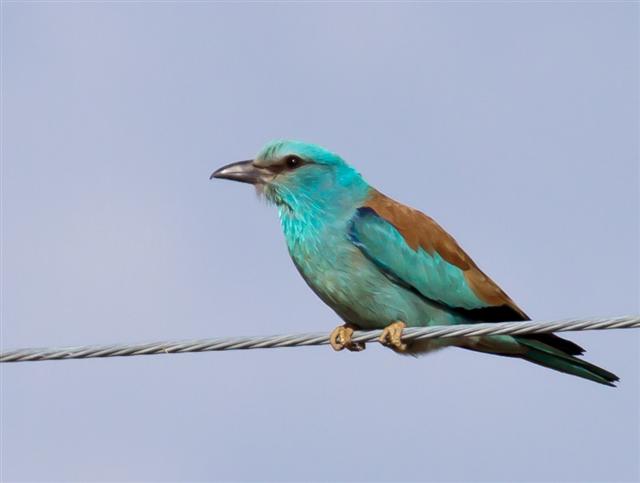
Roller Coracias garrulus
What a disappointment in terms of the targeted birds; no Great Bustards and we were up at the old railway station before we found our first Roller, and then late on n the afternoon.  The close sightings of about three individuals cam so suddenly as we started the last leg of the outward journey that they were unable to be photographed.  On the other hand, we did have lots of Azure-winged Magpies, Spanish Sparrows, a Short-toed Eagle and the sight of our first Little Bustard.
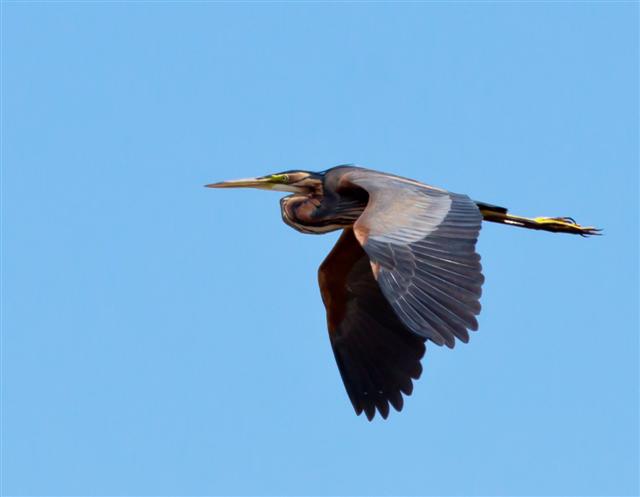
Purple Heron Ardea purpurea
Tuesday saw us off to the Arrocampo Reservoir to the north-est of Trujillo and, again, no Black-winged Kite but we did have loads of Purple Herons and a Little Bittern. Raptors included Black and Red Kites plus the first of very many Lesser Kestrels.  The water produced a few Cormorants and our only ducks; Mallard, Shoveler and Gadwall.  Near to the hides we had very good views of Little Egret, both Little and Great Crested Grebes, Great White Heron and a couple of Purple Swamphens.  Both Gull-billed and Whiskered Terns were hunting over the water but , for me, the sound and then fleeting views of a Savi's Warbler was a particular joy.  The journey out to the reservoir also produced a Nightingale and the sound of our first Common Cuckoo.  In addition, both Great and (common) Reed Warblers were also seen.
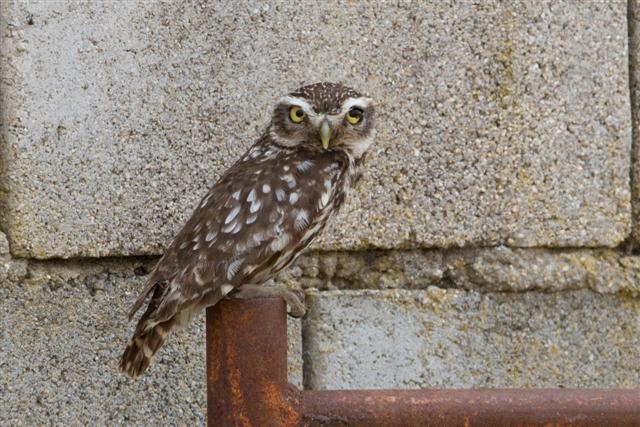
Little Owl Athena noctua (PHOTO: David Jefferson)
Wednesday was the day of the Griffon Vultures as we drove over and through the Monfrague National Park.  Not only Griffons but a small number of Black (Monk) and a single Egyptian Vulture.  Raptors also included numerous Black Kites, Buzzards and Lesser Kestrels with the occasional Common Kestrel.  Whilst at the Mirador we also enjoyed the spectacle of a Peregrine Falcon trying to chase off the Griffon Vultures whilst, at the bottom of the cliff face there were two Black Stork nests, both with young albeit probably at least a week's difference in the ages of the respective youngsters.  Here also we recorded Blue Rock Thrush, Black Redstart and Short-toed Treecreeper.  meanwhile, at the long river bridge, there were scores of nesting House Martins; most feeding over the water along with both Barn and Red-rumped Swallow and also in the company of all three larger Swifts, Common, Alpine and Pallid.
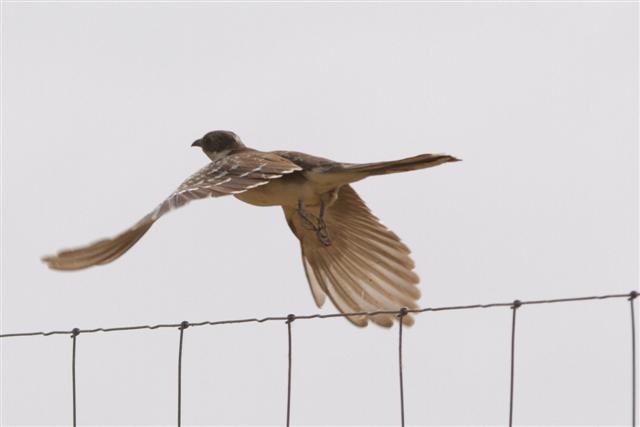
Great Spotted Cuckoo Clamator glandarius (PHOTO: David Jefferson)
With it being much cooler (cold?) on the Thursday we had made an earlier start and arranged to return to the apartments in the early afternoon.  This was the day to try and find both Great Bustards and Great Spotted Cuckoo.  We were successful with the former and a group of six mainly males but it was left to David and Ann, who stayed out all day, to find not only a Great Spotted Cuckoo but a pair of Common Cuckoos.  A Booted Eagle was an added bonus and, for some of us, a gathering of well in excess of an hundred Black Kites was somewhat spectacular, even if by then we had grown tired of seeing so many at the expensive of other raptors.  Lots of Calandra Larks, Hoopoes and Bee-eaters about and then an over-flying Little Bustard was a special delight.  Of course, we could not forget the quick sight of a Little Owl, though David and Ann were able to get a better sighting later on, and who would say no to the Pintail Sandgrouse that passed overhead.
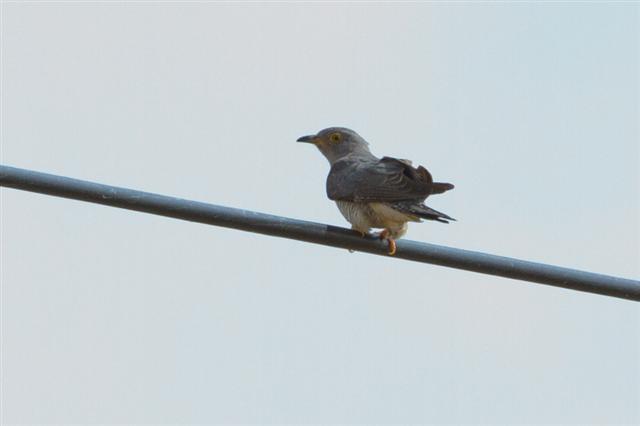
Common Cuckoo Cuculus canorus (PHOTO: David Jefferson)
So we came to the last day and our individual return journeys.  With David and Ann having found the Cuckoos it would appear that at least two cars had another tour of this area before setting off south, in our case not leaving until gone 1pm.  Yes, we found the Common Cuckoos along with loads of Rollers between the showers - but not a many or as near as David and Ann had the previous afternoon.  Strange to say, we even came across a flock of over thirty Ravens (collectively "an unkindness of Ravens") which was rather unexpected.
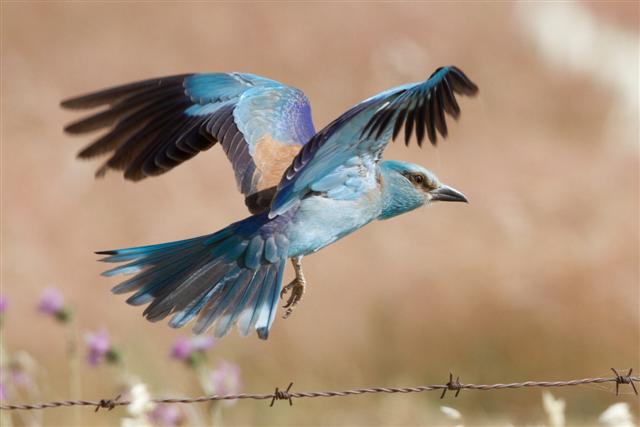
Roller Coracias garrulus (PHOTO: David Jefferson)
So, we all duly arrived back in Malaga Province, all bar Ellie, Janet and David in the Axarquia.  Totting up the lists for each day and comparing with additional birds seen by the other cars, it would seem that the dozen of us eventually recorded 103 species for the five days.  Amazing when you think that the high water levels reduced wader species to less than a handful and only three ducks were recorded.  But what a great introduction to the wonders and potential of Extremadura for this making their first visit to the region and such lovely company.  Even the apartments were a joy to behold and so very reasonably priced considering wee were staying in the centre of the town.


Birds seen during the five days:
Gadwall, Mallard, Shoveler, Red-legged partridge, Little Grebe, Great Crested Grebe, Cormorant, Little Bittern, Cattle Egret, Little Egret, Great White Egret, Black Stork, White Stork, Black-winged Kite, Red Kite, Black Kite, Griffon Vulture, Black Vulture, Egyptian Vulture, Short-toed Eagle, Marsh Harrier, Montagu's Harrier, Booted Eagle, Buzzard, Lesser Kestrel, Kestrel, Peregrine Falcon, Moorhen, Purple Swamphen, Coot, Little Bustard, Great Bustard, Black-winged Stilt, Collared Pratincole, Little Ringed Plover, Gull-billed Tern, Whiskered Tern, Pintail Sandgrouse, Rock Dove, Wood Pigeon, Collared Dove, Common Cuckoo, Great Spotted Cuckoo, Little Owl,  Alpine Swift, Common Swift, Pallid Swift, Kingfisher, Bee-eater, Roller, Hoopoe, Calandra Lark, Short-toed Lark, Crested Lark, Thekla Lark, Crag Martin, Barn Swallow, House Martin, Red-rumped Swallow, Pied Wagtail, White Wagtail, Wren, Nightingale, Black Redstart, Stonechat, Northern Wheatear, Black-eared Wheatear, Blue Rock Thrush, Blackbird, Mistle Thrush, Cetti's Warbler, Zitting Cisticola, Savi's Warbler, Reed Warbler, Great Reed Warbler, Melodious Warbler, Subalpine Warbler, Sardinian Warbler, Blackcap, Spotted Flycatcher, Blue Tit, Great Tit, Short-toed Tree-creeper, Golden Oriole, Southern Grey Shrike, Woodchat Shrike, Jay, Azure-winged Magpie, Magpie, Jackdaw, Raven, Spotless Starling, House Sparrow, Spanish Sparrow, Chaffinch, Serin, Greenfinch, Goldfinch, Linnet, Rock Bunting, Corn Bunting.


A selection of pictures form the visit:

Tree-nesting White Storks Ciconia ciconia
But Black Stork Ciconia nigra on the cliff base immediately below the Griffon Vulture nests

Great White Egret Egretta alba
 
Black (Monk) Vulture  Aegypius monachus
Egyptian Vulture  Neophron percnopterus

Record shot of a distant Peregrine Falcon Falco peregrinus following his battles with the local vultures
 
Little Ringed Plover  Charadrius dubius
 
Short-toed Treecreeper  Certhia brachydactyla

Blue Rock Thrush  Monticola solitarius

Calandra Lark  Melanocorypha calandra
Yet another departing Roller Coracias garrulus
 
Montagu's Harrier Circus pygargus on the prowl


Check out the accompanying website at http://www.birdingaxarquia.weebly.com for the latest sightings, photographs and additional information.


Saturday, 1 June 2013

John and Jenny at the Rio Velez in Torre del Mar

Friday 31 May

"Very interesting!" as the little man used to say on "Rowan and Martin's Laugh-in" back in the way distant past, probably late 1960s.  Even Goldy Hawn was a very young scatter-brain back then; mind you, forty years on her condition is still probably the same!   Anyway, having found a Roller at the Guadalhorce yesterday I thought that it was perhaps just an odd late bird passing through.  Considering we saw ours as late as 12.30 it may be too much of a coincidence to assume that the same bird had travelled up the coast to the mouth of the Rio Velez in Torre del Mar in time to be seen and photographed by John and Jenny Wainwright on their visit to my local patch.  If not the same bird, does this mean tat we are actually experiencing a late movement of these lovely birds and, if so, will there be any to see when I get to Extremadura next week?  I certainly hope that there will be a good number in residence to greet us.

Here follows John's report plus the sightings made at the follow-on site at the Alcaucin picnic area as the couple made there way back home to Salar via the Sierra Tejeda.  Compared with my visit to the river a couple of days earlier there was obviously much more about so, presumably, the drop in wind may have helped reveal more activity.


Velez-Malaga 31st May 2013

A very warm day with a light breeze.  As we drove in the direction of Alhama de Granada we saw Bee-eaters, seven Lesser Kestrels, Collared Dove, Calandra Lark, Azure-winged Magpies and Woodchat Shrike.

One of many Spotted Flycatchers Papamoscas Gris Muscicapa striata to be seen at the Rio Velez
After we had been to Velez-Malaga to sort some things out, we headed for Torre del Mar and the Rio Velez.  We parked just away from the road bridge and looked over the river where we saw Redshank, Spotted Flycatcher, Nightingale, Moorhen, Cetti´s Warbler and Wood Pigeon.  Also along the river we saw Barn Swallows, Red-rumped Swallows, House Martins, more Spotted Flycatchers, Ringed and Little ringed Plovers, Grey Heron, Herring Gulls, Little Stints, Goldfinches, Monk Parakeets, Common Swifts, Spotless Starlings, Grey Wagtails, Greenfinches, House Sparrows, Black-winged Stilts, Reed Warblers, Zitting Cisticola, a lone Kentish Plover, three Hoopoes, White Wagtails, Serins and as we drove back down the track to leave the area a Roller flew onto the power lines - stayed long enough for a few photos - then flew off in the direction of Malaga.

A freshly-arrived Roller Carraca Europea Coracias garrulus - from the Guadalhorce in Malaga?
Leaving Tore del Mar, we then turned off at Alcucin and the mountain track through the Tejadas.
Our first bird as we hit the dirt track was a beautiful Booted Eagle patrolling the edge of the forest, but he turned off and headed for Vinuela.  Also here we saw Serins, Crested Tits, Blackbird, Short-toed Treecreepers, Chaffinches and a Green Woodpecker.

At the first picnic site we found Grey Wagtails, Blackcap, Short-toed Treecreeper, Great Tits and Spotless Starlings.   Onto the Protection Civil area where we saw Crossbills, Coal Tit, Chaffinches, Jay, Mistle Thrush and a very strange looking albino Blackbird.

Melanistic Blackbird Mirlo Comun Turdus merula with apparent red eyes suggesting an albino.

As we proceeded to the La Alcaúca picnic site we could here the Golden Orioles in the valley - the only birds we saw here was a Short-toed Treecreeper.  The rest of the journey to the main Zafaraya road yielded Cuckoo, Melodious Warbler, Great Tits, Sardinian Warbler, Wren, Corn Bunting, two Subalpine Warblers, Common Magpie, Stonechat, Nuthatch, Crested Lark, Woodchat Shrike and a Jay.

Western Marbled White Melanargia occitanica butterfly
 
Lots of butterflies here including Small White, Provence Orange Tip (formerly Moroccan), Knapweed Fritillary, Cleopatras, Painted Lady, Spanish Gatekeeper, Meadow Brown, Speckled Wood, Western Marbled White and Common Blue.  Also a very wonderful looking Assassin Bug_Rhinocoris iracundus.


Assassin Bug  Rhinocoris iracundus
 All photographs by John and Jenny Wainwright


A wonderful report full of great birds.  The "albino" Blackbird is interesting as there should be no pigment, an all white bird.  There are many occurrences of birds, especially Blackbirds, bearing a varying degree of white feathers and often giving a "pied" appearance.  However, these birds usually have normal coloured eyes whereas the picture John has taken certainly seems to suggest that this a red-eyed bird which, I imagine, would make it an albino.  Birds with "normal" coloured eyes are known as leucistic, a genetic mutation that prevents pigments from being deposited normally in its feathers.  Sometimes these birds are also referred to as partial albinism.

A true albino has no colour pigment at all; it appears completely white and with red eyes.  This condition can appear in all animals including humans.

It just seems so strange.  Come back in ten years time and we will find a whole flock of white-marked Blackbirds!

Plumage description:

  • Leucism is often confused with the rarer condition albinism, a genetic condition that prevents the production of melanin in the body; in leucism, these colouring chemicals are present in the body, but are not deposited in feathers
  • Some colours in birds' plumage come from other pigments such as carotenoids, so birds can be albinistic and still have some colour
  • Leucistic birds may be completely white and still have melanin in their bodies; such animals will have dark eyes and white feathers
  • Albino birds and animals also have pink eyes, as the only colour in the eyes comes from the blood vessels behind the eyes
Here endeth the science lesson for today!


Check out the accompanying website at http://www.birdingaxarquia.weebly.com for the latest sightings, photographs and additional information.