Friday, 12 April 2013

You've got sun; I've got rain!


Friday 12 April

Heard that there were Waxwings in Bourne yesterday so I popped over before going on to Rutland Water.  Straight to the "mistle toe tree" mentioned on the Lincs Bird report where I did find Collared Dove, Wood Pigeon, Common Starling, Jackdaw, Goldfinch and Dunnock in the said tree - but, alas, no Waxwings.  So retraced my steps, or car journey in this case, back to Stamford and on to Rutland Water where, already, a light drizzle was falling and the promise of a sunnier afternoon couple with heavy showers.

Seeing how much water there was, I decided to check out the Information Centre, the nearby feeding station and the Manton Bay entrance stream but first to the South Arm where, at worst, I would be able to check out the water from the car if the heavens opened.  Tufted Duck, Mallard and Wigeon quickly noted along with a pair of Mute Swans and both Greylag and Egyptian Goose.  A few Coots and a couple of Little Egrets along with the same number of Cormorants plus about forty resting Black-headed Gulls.

Then it was on the main entrance where I picked up Great and Blue Tits, Chaffinches and Goldfinches on the feeders with scavenging Blackbirds and Dunnocks below.  Loads of Jackdaws about along with a good number of Pheasants of both sexes with the males looking particularly handsome along with their navy-coloured "stick up ears" and vivid red cheek wattles.  Even the females looked most splendid in their delicate shade of fawn.  Meanwhile, on the water in front of the Centre I added a handful of Gadwall, a pair of Shelduck plus both Little and Great Crested Grebe.  Only a few Greylag Geese here but they were in the company of a number of Canada Geese.

Finally down to the bridge over the entrance stream from where you can look into Manton Bay and there, sorting out her nest, was the first of the returning Ospreys including, according to the information board, R5.  Now it was decidedly more than damp so I ate my packed lunch and drove back home in the hope that the weather might improve so that I can return in the morning.

Here, having opened up the emails, I noticed that you are all enjoying some lovely warm sunshine in our part of Spain and John and Jenny Wainwright managed to explore the old Loja to Ventas de Zafarraya road yesterday.  If I get back Sunday evening and find that next week is not going to be more of the same I shall be than slightly cheesed off!

John's report follows:

Corn Bunting Miliaria calandra (PHOTO: John Wainwright)

Old Zafaraya Road 11 April 2013

A very warm day, perhaps Summer is on its way!!


Hoopoe  Upupa epops  (PHOTO: John Wainwright)
As we left the village - in the direction of Alhama de Granada - two Jackdaws were seen on the telegraph wires, also Corn Buntings, Bee-eaters, Southern Grey Shrike and a Common Cuckoo.  On the old road we saw Chaffinches, Great Tits, Bee-eaters, a few Woodchat Shrikes, Thekla, Short-toed and Calandra Larks, Jays, Hoopoes, Blue Tits, Cirl Buntings and Wood Pigeon.  Lots of House Sparrows at the ford - and around the farm buildings we saw White and Yellow Wagtail, Black Redstart and Lesser Kestrels.  The amount of Northern Wheatears here today is phenomenal, they are everywhere, only one Black-eared Wheatear though.


Northern Wheatear Oenanthe oneanthe  (PHOTO: John Wainwright)
 We didn´t venture much further up the mountains but we did find a Little Owl, Sardinian Warbler and Mistle Thrush.


Woodchat Shrike Lanius senator  (PHOTO: John Wainwright)

On the way back to the village a Fox took its life in its paws as it hurtled across the road in front of me..

Plenty of hirundines about, mostly Barn Swallows with the odd House Martin, Pallid and two Common Swifts.

Lots of butterflies including Small Heath, Large White and Common Swallowtail, plus a few orchids namely Fan-lipped, Yellow Ophrys and Mirror.  Also three Ocellated Lizards were seen.

Very quiet but a pleasant couple of hours.


Sounds like the sort of couple of hours most of us would enjoy! 


Check out the accompanying website at http://www.birdingaxarquia.weebly.com for the latest sightings, photographs and additional information

Thursday, 11 April 2013

Whilst the cat's away, etc!

I may be over in England for the week and have experienced rain, cloud, wind and, yesterday, thick fog driving from Southampton to Devizes before the sun eventually came out and today I have been promised April Showers followed by more rain at the week-end but, at least, no snow whilst you all enjoy a warm and sunny week out in the Axarquia.  On the other hand, it might be dry tomorrow so I shall spend most of the day at Rutland Water, always assuming that I have completed the garage repairs.

Meanwhile, whilst I am away others have been able to continue birding.  John and Jenny Wainwright spent Tuesday last up on the Sierra Loja whilst Ivan and Inger Zink-Nielson having returned from "Arctic" Denmark for a few months had a very profitable morning down at the Guadalhorce in Malaga, finally ending up with a magnificent 58 species by way of their "Welcome back to Spain."  Up in the mountains, John would appear to be back in charge of the camera and he has forwarded photos for your perusal.  Similarly, good to see what is about in preparation for my own visit to the Sierra Loja next Wednesday with the Andalucia Bird Society.  Who knows, we might even find an early-arrived Rock Thrush.

Ivan and Inger's report:

Finally back after a very cold winter in Denmark.

Here is the report of today's visit to Guadalhorce with a total of 58 species:

Mallard; Gadwall; Shoveler; Pochard; Red-crested Pochard; White-headed Duck; Little Grebe; Cormorant; Night Heron; Little Egret; Grey Heron; Purple Heron; Flamingo; Booted Eagle; Marsh Harrier; Kestrel; Peregrine Falcon; Moorhen; Coot; Black-winged Stilt; Collared Pratincole; Little Ringed Plover; Ringed Plover; Kentish Plover; Common Sandpiper; Redshank; Greenshank; Black-headed Gull; Yellow-legged Gull; Lesser Black-backed Gull; Whiskered Tern; Rock Dove; Collared Dove; Swift; Pallid Swift; Bee-eater; Crested Lark; Barn Swallow; Red-rumped Swallow; House Martin; Yellow Wagtail; Nightingale; Wheatear; Blackbird; Blackcap; Sardinian Warbler; Cetti's Warbler; Reed Warbler; Willow Warbler; Pied Flycatcher; Woodchat Shrike; Raven; Spotless Starling; House Sparrow; Goldfinch; Greenfinch; Corn Bunting; Monk Parakeet.

Inger and Ivan

Interesting to see that the Night Heron is still about along with a passage Willow warbler and the first report I have seen this year for a Pied Flycatcher.

John and Jenny's report:

Rock Bunting  Emberiza cia
 Sierra Loja  9th April 2013

A very sunny day but  a very cold wind over the 700m mark.  The wooded areas held a few birds, including Azure-winged Magpies, Wood Pigeon, Collared Doves, Serins, Song and Mistle Thrushes.  As we approached the cliff area, Jenny spotted two raptors soaring above a dozen or so Chough, they turned out to be Bonelli´s Eagles.  Lots of Jackdaws feeding in the grassy area of the cliffs along with Spotless Starlings and Rock Buntings whilst a Common Kestrel dashed across the cliff face.
 
Thekla Lark  Galerida theklae

On the way to the sub-station valley we saw Black-eared Wheatear ( these are the predominant birds at the moment), Great Tit, Sardinian Warbler, Thekla Larks, several Northern Wheatears and Mistle Thrush.  In the substation valley two Little Owls were seen as well as more Black-eared and Northern wheatears, Rock Buntings, Chough and Thekla Larks.

Little Owl  Athene noctua
Instead of going directly up to the ponds we kept left;  here we found Goldfinch, a Hoopoe, Chaffinch, Woodchat Shrike and our first glimpse - we have heard it once before - of the new seasons Common Cuckoo.  We then turned back to the Charca del Negro area , the pond level is still very high and no bird life to speak of.  So onto the fossil cave, here we found Black Wheatears, Wren, Blackbirds, Chough, Crag Martins, Spotless Starlings and just round the corner from the caves we came across a huge herd of Ibex, some fifty-five individuals including adult and juvenile bucks and a few females- the most we have ever seen up here in ten years is thirteen individuals.

Part of the large group of Ibex on the slopes of the Sierra Loja
On the way down we called in at the hidden quarry where we saw two Lesser Kestrels, Wood Pigeons, Azure-winged Magpies, Short-toed Treecreepers, Long-tailed Tits, Red-legged Partridge, Chaffinches, Great Tits, Blackbirds, Chough, Serins, Greenfinches and Stonechats.

Northern Wheatear  Oenanthe oenanthe
Black-eared Wheatear  Oenanthe hispanica
As we parked up at home in Salar, five Bee-eaters flew over the house.

All right, so there are some wonderful sightings in the above two reports but I have not been without a sighting or two myself.  Whilst at my brother-in-law Chris's house on Monday afternoon I had both Common Starling and Dunnock and, on looking out of the kitchen window less than an hour ago, I had two very rare birds for me on my mountain back in Spain, a Common Magpie waking the long television aerial opposite and a pair of Wood Pigeons; one less than three metres away as it came to sample he delights of stagnant pond water!!!!!!   In addition, I also had Red Kite on both the outward and inward journeys but, sadly, the Partridge was of the Red-legged rather than Grey persuasion.  No doubt the former were feasting on the many Pheasant carcases that seemed to caress the country roads.  Which also meant that there were many Carrion Crows about along with another missing bird for our part of Spain, the Rook.


Check out the accompanying website at http://www.birdingaxarquia.weebly.com for the latest sightings, photographs and additional information.

Saturday, 6 April 2013

Great birds in the Zafarraya area

Saturday 6 April

Bonelli's Eagle Aguila-azor Perdicera Hieraaetus fasciatus

At last the weather had changed and we had beautiful blue skies and warm, sunshine - just a shame about the accompanying wind!  Off early to meet up with Steve Kitchen from Watford at Puente don Manuel so that I could show him some of our mountain birds.  And in this we were not to be disappointed for, apartment from dipping on an almost guaranteed Crag martin , we saw just about everything else including some birds that had not even figured on the radar when we set off for our extended morning to Ventas de Zafarraya and the the hinterland to the north-west.

Arriving at the mirador so that we could walk the old railway line until the old ruin about 800 metres beyond the tunnel, we found it to be very cold with the opposite cliffs blocking out the sun and very windy; a good job we had extra layers to put on.  The Choughs were already in the air with plenty to be seen and soon after starting we had first a Dartford Warbler quickly followed by a single Rock Sparrow.  The Black Wheatears were not as numerous as usual but they were there to be seen along with a female Black Redstart.

Through the tunnel and we had a gorgeous male Black Redstart along with regular sightings of Choughs and then a distant Bonelli's Eagle hove into sight.  Wonderful!  Returning to the car we had a couple of Rock Buntings and a handful of Goldfinches before a Booted Eagle passed overhead.  Finally, at the car, a most handsome male Blue Rock Thrush arrived and posed on a rock just beyond the car park.


Next of to the "Muck Heap" passing the local House Sparrows and Spotless Starlings on the way, where we not only found a pair of Crested Larks and at least five Thekla Larks but also a small number of Short-toed Larks - all larking about as they say.  Whilst here a first year marsh harrier passed close overhead - what was he doing here unless on migration?


Blue Rock Thrush  Roquero Solitario Monticola solitarius

Northern Wheatear  Collalba Gris Oenanthe oenanthe


Passing through the "Magpie Woods" we had to wait till the very end before glimpsing a handful of Azure-winged Magpies skirting the tree tops along with a closer Blackbird.  A Wood Pigeon made a hasty departure.  But we were to see many more Azure-winged Magpies as we took the old Loja road and then completed the anti-clockwise circuit.  This route produced a number of Corn Buntings, lots of Azure-winged Magpies and even a few Barn Swallows.  However, a stop at the lower fields once more produced the hoped for Calandra Larks and, although low in numbers and well concealed, we did manage to get some good views.  During this stop we found our first Northern Wheatear and a single Red-legged Partridge but, even more exciting, one  and then a second Great Spotted Cuckoo as the pair flew back and over the car closely followed by a Common Cuckoo.


Just after turning off the main road a Firecrest flew into the neighbouring tree whilst, within minutes, we found a pair of Linnets on the other side of the road.  Continuing on , and almost round the circuit, we stopped to watch more Azure-winged Magpies and were delighted to find a resting Hawfinch, albeit the twigs prevented a good photograph.  Then, with more sightings of Northern Wheatears, it was on and through Alhama de Granada in order to take the usual route back to Ventas de Zafarraya and, whilst we did not find our Little Owls on this occasion, we id pick up both Mistle Thrush and Woodchat Shrike.


Hawfinch  Picogordo Coccothraustes coccothraustes
Bonelli's Eagle Aguila-azor Perdicera Hieraaetus fasciatus


The final part of the journey brought us down the mountain and a stop to watch the Bonellis's Eagle that took off from a nearby pylon. Whilst here we also picked up House Martins and then a Collared Dove when back amongst the houses of Puente don Manue.  Finally, after saying goodbye to Steve, I drove up to Casa Collado passing a number of Serins as I approached Los Romanes and then, within minutes of returning home and emptying the car, a small flock of noisy Bee-eaters passed over the house.  Add on the Chaffinches I saw on the way down my mountain, it was a very respectable total of 37 species for the morning; a case of more quality rather than quantity.

Birds seen:
Red-legged Partridge, Marsh Harrier, Booted Eagle, Bonelli's Eagle, Great Spotted Cuckoo, Cuckoo, Bee-eater, Hoopoe, Wood Pigeon, Collared Dove, Calandra Lark, Short-toed Lark, Crested Lark, Thekla Lark, Barn Swallow, House Martin, Northern Wheatear, Black Redstart, Stonechat, Blue Rock Thrush, Blackbird, Mistle Thrush, Dartford Warbler, Firecrest, Woodchat Shrike, Azure-winged Magpie, Magpie, Chough, Spotless Starling, House Sparrow, Rock Sparrow, Chaffinch, Serin,Goldfinch, Linnet, Hawfinch, Rock Bunting, Corn Bunting.


Check out the accompanying website at http://www.birdingaxarquia.weebly.com for the latest sightings, photographs and additional information.  

Friday, 5 April 2013

Arroyo Marin with John and Jenny

Horrible wet day here with light rain following heavy overnight rain, low cloud and generally depressing.  Only in the late afternoon did the sun put in an appearance; presumably to dry everything up in readiness for my birding trip up to Zafarraya in the morning.  On the other hand, John and Jenny Wainwright stuck with it and made a detour over tot he Arroyo Marin to find some new birds for both the month and year.  So, well done them and here is John's report.


Arroyo Marin:  5th April 2013

Overcast and very wet at times. 
We were over in Trabuco, so we ventured over to the Marin at Archidonna. The rain had steadied to a drizzle and we never came off the main track as the fields and groves below were saturated and full of mud.


Our first views were of two Red-legged Partridges and several Chaffinches. A Wryneck called from my left but we never got to see it.  We drove down to the first concrete ford - here the mud and silt was across the road - but we did get Wren, Blackcap, Rock Bunting and Cirl Bunting here. 


Grey Wagtail Lavandera Cascadena Motacilla cinerea (PHOTO: Jenny Wainwright)

Then further down at the ruin on the bad corner Jenny found our first Nightingale of the year.  Also here we saw Grey Wagtail, Crossbills, Serins, Great Tits and a Blue Tit.  At the next ford the road has been washed away, so we retraced our steps to our usual picnic area - this is generally a
very good place for Hawfinches and we were not disappointed as we located three birds. Then a Nightingale started singing here, but this time we never found it.  A few Wood Pigeons and Collared Doves with a mixing of Azure-winged Magpies and our first Common Cuckoo was heard.
 

Hawfinch Picogordo Coccothraustes coccothraustes (PHOTO: John Wainwright)

With the heavens opening and the sky a menacing black we headed back for Salar, en route seeing Spotless Starlings, a Southern Grey Shrike, a Corn Bunting and several Barn Swallows.


Check out the accompanying website at http://www.birdingaxarquia.weebly.com for the latest sightings, photographs and additional information.  

Thursday, 4 April 2013

Guadalhorce, Malaga

Thursday
 
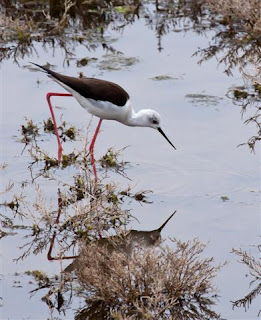
Black-winged Stilt

Up early and down to the Cruise Port in Malaga to collect the family Gillaspie; Tom and Jayma with their daughter, Jayla and Tom's sister, Joanna (I trust that I have correctly spelt all the names!).  Then it was straight off to the Guadalhorce ponds as rain was promise for noon despite the hint of a hazy sun in the sky.  And sure enough, the rain arrived ten minutes early and fell as a few isolated spots which we only picked up because we could see the occasional ripple on the lagoons.  All in all, a very pleasant day spent in wonderful company and, hopefully some happy memories for Tom and family to take back to the west coast of Florida once they eventually get to Rome on Holland America's Noordam, their final destination.
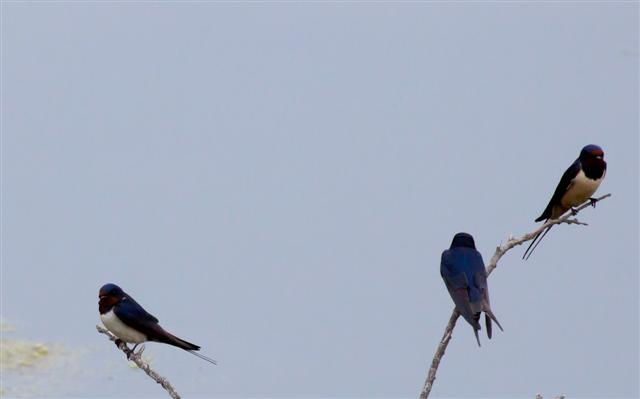
Resting Barn Swallows  Golondrina Comun  Hirundo rustica
Greeted by a couple of pairs of Collared Doves we had no sooner walked up the entrance tack to the reserve than we had a pair of Booted Eagles in the tree immediately in front of us; what a way to start the morning!  A male Sardinian Warbler was foraging around in the bushes below whilst overhead we had the first of very many Barn Swallows and House Martins.  Indeed, there were Barn Swallows everywhere; seen at all the lagoons and in the majority as far as hirundines were concerned but, arriving finally at the Laguna Grande there were probably as many Sand Martins, certainly the most that I have seen at this wonderful site.  Meanwhile, walking towards the eastern arm of the river wee had many Goldfinches at close quarters along with Spotless Starling and the usual Rock Doves below the motorway bridge.  A quintet of Little Egrets in a dead tree to our right was a welcome addition and gave us the opportunity to compare these birds, complete with their "Marigolds" to the American Snowy Egret.  Also seen walking the track was out first Blackbird of the day and an over-flying Grey Heron whilst a female Mallard waddled along the path in front of us.

White-headed Ducks  Malvasia Cabeciblanca  Oxyura leucocephala
Arriving at the Laguna Casillas we were rewarded with a good number of both White-headed Ducks and Common Pochards.  In addition, we had a few Moorhen and a couple of Coots then out came the two pairs of Gadwall to see what all the fuss was about.  Add on a small number of Mallard and a pair of Black-winged Stilts along with a well-exposed singing Reed Warbler and we just about ready to move on to the Wader Pool.  However, just as we were leaving a single Purple Heron flew across the pool.
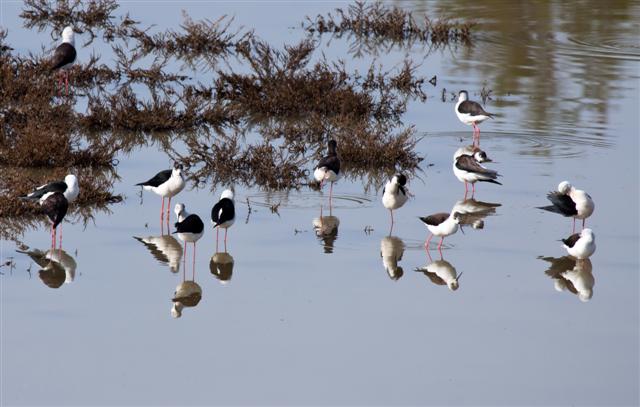
Black-winged Stilts Ciguenuela Comun Himantopus himantopus on the Wader Pool
Other than the occasional Moorhen, the Wader Pool was full of Black-winged Stilts with at least thirty present, and another forty plus on the Rio Viejo next door.  We did have another handful of Pochards and a pair of Gadwall along with a female Teal but they were not the centre of attraction.

Gadwall  Anade Friso  Anas strepera
The walk down to the Sea Watch not only produced the above Black-winged Stilts but also a good number of Common Swifts to add to the Barn Swallows feeding overhead.  These were accompanied by the regular sight of the odd Cormorant or two passing between the reserve and the sea.  Greenfinches were about in small numbers and then a quartet of Linnets before we found the pair of "hiding" Redshanks.  A couple of Black-headed Gulls were seen along with a small party of Mediterranean Gulls resting at the far end of the water towards the sea.  The sudden movement of the Stilts led us to look up where we found the reason for their alarm as a Sparrowhawk turned above us and then moved away.  On the opposite bank of the river we had a good view of an Iberian race (flava iberiae) Yellow Wagtail which was soon joined by his partner.  Meanwhile, a dozen noisy Bee-eaters flew overhead and then we had a couple of Crested Larks on the waste ground to our left along the first Woodchat Shrike.  Before leaving this area we had recorded at least five individuals.
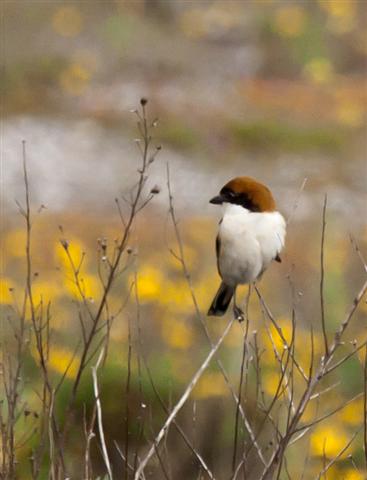
Woodchat Shrike  Alcaudon Comun  Lanius senator

 At first glance the Sea Watch seemed to produce nothing but empty beaches and lots of sea but closer inspection soon revealed a pair of Sanderling and a couple of Kentish Plovers to the western side.  The short stretch of unkempt beach to the east then produced a single, disappearing Common Sandpiper before a single Whimbrel walked into view.  Next up was a lone Ringed Plover in the company of eight Turnstones.  Turning our attention towards the sea, we were able to identify a small number of Yellow-legged Gulls along with even fewer Lesser Black-backed Gulls.  However, resting in their midst were at least twenty Common Scoter; where had the other hundred plus from last week gone?
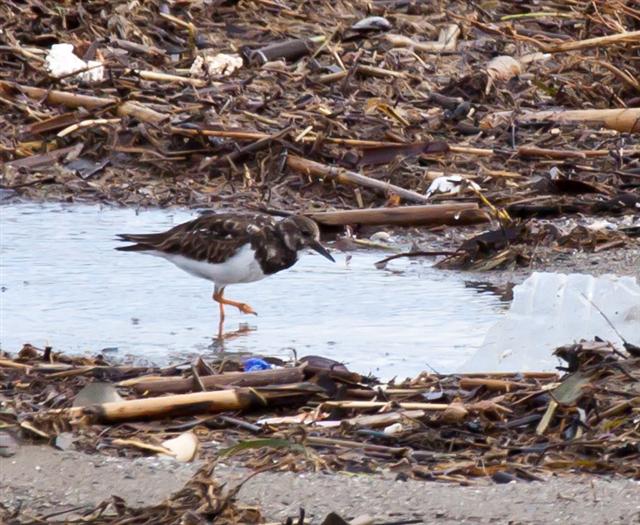
Turnstone  Vuelvepiedras Comun  Arenaria interpres
Time to make our way back with, apart from more hirundines, Woodchat Shrikes and a few screaming Monk Parakeets, nothing else of difference was noted.  Although we did pick up a single male Stonechat on the fence.  The Laguna Escondida was disappointing producing a few Pochard and White-headed Ducks plus the first Sand Martin of the day.
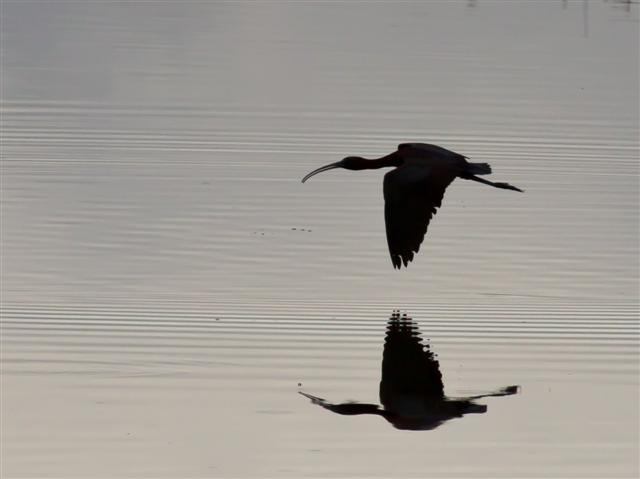
Ghost-like Glossy Ibis Morito Comun Plegadis falcinellus over the Laguna Grande
So onto the Laguna Grande with its remaining Cormorants, a single Grey Heron and a lone Black-necked Grebe.  However, this was the water that contained many Sand Martins,which almost outnumbered the Barn Swallows.  Excitement as a single (ringed) Glossy Ibis flew around and eventually landed in the water as it appeared to be trying to pick insects off the water whilst in flight.  At the back of the water a nervous flock of thirty plus Avocets were seen to rise and fly along the edge before dropping down only to reappear again for another short flight.
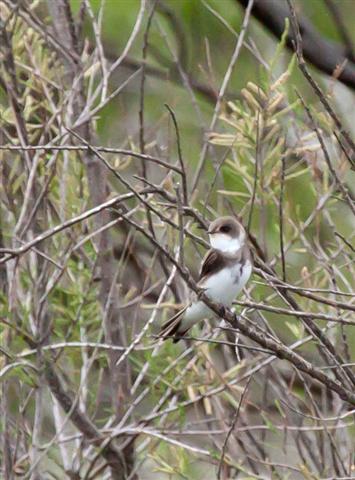
Sand Martin  Avion Zapador  Riparia riparia
 
A walk down the track to the path leading to beach produced a Night Heron on the return journey along with the Whiskered Tern that had arrived at the Laguna Grande in our absence.  Once more looking out over the water we also picked up a solitary Little Grebe and then a female Peregrine Falcon hiding behind crossing branches in the "Osprey Tree"; very difficult to see but we were told where to look by the Welsh birders who had recently arrived at the hide.  Cetti's Warblers were loudly singing and then our final bird at this water, a male Blackcap feeding amongst the daisies in front of the hide.
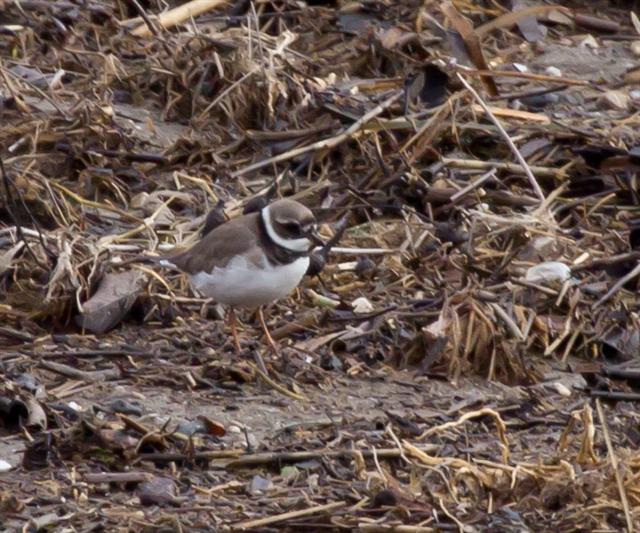
Ringed Plover Chorlitejo Grande  Charadrius hiaticula
Then, as we left the reserve to return tot he car, a single wind-swept Common Kestrel resting in a dead tree opposite the exit which managed to lift our final total for the morning to a very pleasing 57 species.

Whimbrel  Zarapito Trinador  Numenius phaeopus

Birds seen:
Gadwall, Mallard, Shoveler, Teal, Pochard, Common Scoter, White-headed Duck, Little Grebe, Black-necked Grebe, Cormorant, Little Egret, Glossy Ibis, Grey Heron, Purple Heron, Night Heron, Booted Eagle, Sparrowhawk, Common Kestrel, Peregrine Falcon, Moorhen, Coot, Black-winged Stilt, Avocet, Ringed Plover, Kentish Plover, Sanderling, Whimbrel, Redshank, Common Sandpiper, Turnstone, Mediterranean Gull, Black-headed Gull, Lesser Black-backed Gull, Yellow-legged Gull, Whiskered Tern, Rock Dove, Collared Dove, Monk Parakeet, Common Swift, Bee-eater, Crested Lark, Sand Martin, Barn Swallow, House Martin, Yellow Wagtail (Blue-headed Iberian race), Stonechat, Blackbird, Cetti's Warbler, Reed Warbler, Sardinian Warbler, Blackcap, Woodchat Shrike, Spotless Starling, House Sparrow, Greenfinch, Goldfinch, Linnet.

Monk Parakeet Cotorra Argentina Mylopsitta monachus


Check out the accompanying website at http://www.birdingaxarquia.weebly.com for the latest sightings, photographs and additional information.  

Fuente de Piedra

Wednesday

Whilst we were enjoying a reasonably pleasant morning above Lake Vinuela with increasing cloud cover throughout the morning leading to heavy rain in the afternoon, it looks very much as if John and Jenny wainwright managed to receive an earlier introduction to the wet stuff whilst they were over at Fuente de Piedra.  Not to worry, though, as they managed to find some good birds before having to give in to the rain as can be seen form the following account received from John.

A bright but blustery day, rain quickly followed.

As we approached the centre the sky was alive with hirundines mainly Barn Swallows and a few House Martins.  The flood pond on the left of the road was deserted all bar a few Whiskered Terns and Black-winged Stilts.


Ruff and two Reeves Combatiente Philomachus pugnax (PHOTO: John Wainwright)
 
At the boardwalk we found Ruff - one fine male obtaining his breeding plumage- and several Reeves, a good number of Wood Sandpipers, a Common Sandpiper and a few Curlew Sandpipers.  In the grasses we counted six Yellow Wagtails, of the iberia race, and a single Snipe took off from here also.


Curlew Sandpiper Correlimos Zarapitin Calidris ferruginea (PHOTO: John Wainwright)

The main scrape is still full of water although we did find a Red-crested Pochard here, Redshanks and Black-winged Stilts also. A couple of Jackdaws were noted as well as more Whiskered Terns.
Whiskered Tern Fumarel Cariblanco Childonias hybrida (PHOTO: John Wainwright)

From the Centre's mirador we located Shelduck, Shoveler, Mallard and Greater Flamingo.  At the Laguneta hide we were lucky enough to see the two Ocellated Lizards that have taken to living in the old rabbit burrow directly below the hide and, on the water, we found Common Pochard, White-headed Ducks, Little Grebes, Avocets, Common Sandpiper, Moorhen, Common Coots, juvenile Herring Gulls and Black-headed Gulls.  The area was awash with Barn Swallows, House Martins and one Sand Martin, and one Red-rumped Swallow, also Common Swifts were noted.  The bushes to our front held Goldfinches, a Sardinian Warbler, Spotless Starlings and some Corn Buntings.  A Zitting Cisticola was heard also.

Sardinian Warbler Curruca Cabecinegra Sylvia melanocephala (PHOTO: John Wainwright)

At the Palomas hide (the open hide) we saw Red-crested Pochard, Gadwalls and a Little Grebe. The rain was coming down quite strongly now, so we high-tailed it across to the mirador Cantarranas.
Here we saw Wood Pigeon, Black-headed and Yellow-legged Gulls also Gull-billed Terns, Great Crested and Little Grebes, Common Pochards and an Alpine Swift showed up among a small flight of Common SwiftsStone Curlews were heard calling but I couldn´t find them.


Wood Sandpipers Andarrios Bastardo Tringa glareola (PHOTO: John Wainwright)

The rain was now coming down with a vengeance, so we returned to Salar.

I am just hoping that the rains will hold off long enough for my visit this morning to the Guadalhorce in Malaga!


Check out the accompanying website at http://www.birdingaxarquia.weebly.com for the latest sightings, photographs and additional information.  

Wednesday, 3 April 2013

Lots of Terns

Monday 1 April

Just had an interesting email from Liz and Marcus Rootes following their visit to the Guadalhorce, Malaga on Monday where they found the water levels still high but lots of terns about but very few waders..

At Grand Laguna:

12 Whiskered Tern, Purple Herons, Redshank, Black-necked and Little Grebe, Sand Martin,
Marsh Harrier, Booted Eagle, Kestrel, Jackdaw, 6 pairs of Shoveller, Nightingale, Reed Warbler,
Yellow Wagtail of race unknown race (almost certainly the Blue-headed flava iberiae).

On the beach:

6 Sandwich Tern, 2 Whiskered Terns, 3 Kentish Plover and a Golden Plover,1.

I have left out the usual Hirundines, Warblers and Finches.

My only comment would be that there is no mention of any White-headed Ducks which have been streaming back to the site in readiness for the breeding season.  But that does not mean that they were not seen by Liz and Marcus.  Just goes to show that there is still much to be seen and that a visit to this site is always worthwhile.