Saturday, 12 October 2019

Birding Seville & Huelva Province: Day Three

Iberian Grey Shrike Alcaudon Real Lanius meridionalis
Day Three:  9 October - Castro Marim and Tavira Salinas

Portugal day!  Within thirty minutes we had cross the Guadiana and Spanish border to arrive at the Castro Marim reserve on the western bank of the river.  having already seen a Robin as we left our resort we looking forward to a selection of passerines.  Crested Lark and a few Common and Azure-winged Magpies as we awaited Gerry and Barbara then quickly added maybe thirty or more Red-legged Partridge.  A distant Heron and Cattle Egret and a small flock of Greenfinch passed by.  In the distance below the brow of the hill a passing quartet of Mallard and a quartering Marsh Harrier.

One of a dozen Red-legged Partridge Perdiz Roja Alectoris rufa

Moving slowly onwards up the track a number of Redshank were seen in the various lagoons and a pair of Hoopoe crossed in front of us so revealing a lovely Northern Wheatear.

Northern Wheatear Collalba Gris Oenanthe oenanthe

Also present were Black-winged Stilts and both Common and Green SandpipersKestrels overhead along with Spotless Starlings as we made our way to the Visitors Centre.  No water in the screened pool  so off towards the salinas where we found a mixed flock of Bar and Black-tailed Godwit along with Ringed Plover and Sanderling

Black-tailed Godwits Aguja Colinegra Limosa limosa
 A couple of pools up the main flock of Flamingo and at least forty Avocet and as we checked out the gull flocks we found Black-headed, Yellow-legged, Lesser Black-backed and a trio of Common Gulls.  Accompanying them were also at least three resting Caspian Terns. Our attention was also drawn to what looked very much like a sick Marsh Sandpiper.  A Cormorant flew past and then, closer to hand, we added Sardinian Warbler, Collared Dove and more Azure-winged Magpies.  Returning to the main road to check out the working salinas below the town we added White Stork and Moorhen.

Turnstone Vuelvepiedras Comun Arenaria interpres


And so onto the main salinas at Tavira where we were spoilt for choice in both quantity and variety.  Little Stint and many White Stork and then we found a good supply of feeding Little Egret and HeronTurnstones were working the edges along with Sanderling and Ringed Plover and with both Zitting Cistcola and Blackcap behind us.  Stopping for lunch we discovered a single Slender-billed Gull in the pool below us whilst on the other side of the track we had a small flock of Cormorant and Little Grebe working the waters plus a couple of Shelduck.  Once more back to the mixed gull flock and this time a trio of Mediterranean Gulls were recorded along with a small number of Audouin's Gull

Audouin's Gull Gaviota de Audouin Larus audouinii (centre right)

Almost some sort of record with seven gull species in the morning!  Then the Caspian Tern flew over and we also picked up a small number of Grey Plover.


Grey Plover Chorlito Gris Pluvialis squatarola (left) with Redshank Archibebe Comun Tringa totanus
Leaving the salinas we made our way to the water separating us from the long, narrow island for a rest and well-deserved beer.  And then the real fun started.  Not so much the four Turnstones that came to rest on the boat immediately in front of us or even the Whimbrel but the realisation that the gulls had be put up by a passing Osprey which having flown directly over us then turned and headed inland.  No sooner had we recovered and only just expressed the comment that we had yet toss this raptor all week than both Sandwich and Common Tern also put in an appearance.  Well refreshed and inspired we set out for home picking up Coot, Wood Pigeon and a Barn Swallow on the wires as we left the site.

A gathering of Spoonbills Espatula Comun Platalea leucorcdia

Check out the accompanying website at http://www.birdingaxarquia.weebly.com for the latest sightings, photographs and additional information

Birding Seville & Huelva Province: Day Two

Day Two:  8 October - Odiel Marshes

Visitors Centre with waiting Sandwich Terns Charran Patinegro Sterna sandvicensis
Off after breakfast to meet up with Gerry and Barabra Laycock at the Visitors Centre at the top of the Odiel Marshes, the Marismas del Odiel.  Leaving our resort we were immediately surrounded by Azure-winged Magpies along with a Chaffinch and a number of Spotless Starlings and House Sparrows.  kestrels seen both on the journey and upon arrival where we immediately noted the many Flamingos on the salinas.  Just a brief look at the river next to the Centre as the idea was to start at the far end, John Carlos car park, and then work our way back as the birds were driven in by the rising tide.  However, the river banks did produce both Common and Sandwich Terns, Yellow-legged and Black-headed Gulls plus Dunlin, Ringed Plover and Common Sandpiper.  Both Magpie and a feeding Pied Flycatcher found in the car park and then it was off down through the marismas towards the above car park.

Great White Egret Garceta Grande Egretta alba

A stop on the way produced almost a dozen Great White Egret along with Little Egret, Heron and a handful of White Stork.  An Iberian Grey Shrike was a welcome sight and then, again, more Stonechats. Once parked at the car park we could see both Whimbrel and Curlew on the mud flats along with many Redshank.

Curlew Zarapito Real Numenius arquata

Walking across the board walk to check out the large pool area between here and the sea we found our first Oystercatchers with at least five noted.

Oystercatcher Ostrero Euroasiatico Haematopus ostralegus

Amongst the resting gulls were at least four feeding Caspian Terns and closer inspection also found Little Tern as a Marsh Harrier worked the area.

Caspian Tern Pagaza Piquirrojo Sterna caspia

Then it was back to the cars and the mud flats where, in the distance, we found a Slender-billed Gull, Knot and Kentish Plover nearby.

Knot Correlimos Gordo Calidris canutus with Ringed Plover Chorlitejo Grande Charadrius hiaticula (above) and Kentish Plover Chorlitejo Patinegro Charadrius alexandrinus (right)

The scope produced distant Bar-tailed Godwits and leaving behind the Crested Larks and Willow Warbler we continued on our way south.  Both Hoopoe and Northern Wheatear.  Returning to the Visitors Centre we then walked down to the mirador where, along with the many Flamingo, we also found a large flock of both Grey and Golden Plover and a single Shelduck.  Close by were a few Sanderling to add to the Marsh Sandpiper, and Turnstones recorded just as we were heading back from the far end of the marismas.

Flamingo Flamenco Comun Phoenicopterus roseus with some of the Grey Plovers Chorlito Gris Pluvialis squatarola
There was sufficient shallow water in the small pool next to the Visitors Centre to attract a number of Black-winged Stilt along with Ringed Plover, Curlew Sandpiper and Little Stint.   LittleBlack-necked and Great Crested Grebes were identified.  Also present Moorhen and Black-headed Gulls.

Common Redshank Archibebe Comun Tringa totanus

We even had a couple of Wood Pigeon as we all set off for relatively nearby El Portil to check out the fresh water lake.  Once at El Portil we quickly added both Mallard and Gadwall, many Shoveler and then Derek found a trio of Wigeon on the far bank and then we had another female Red-crested Pochard along with a number of Common Pochard.   Not the Coot nor the nearby Robin in the bushes behind us or even the calling Cetti's Warbler but the fly-past of a single Collared Pratincole that gave us so much pleasure.  Even the Barn Swallows were almost an after thought.

Still a little water on the small pond for the Black-winged Stilts Himantopus himantopus , Dunlin Correlimos Comun Calidris apina and Curlew Sandpipers Corelimos zarapitin Calidris ferriginea.  Even a Little Stint Correlimos menudo Calidris minuta present.

Check out the accompanying website at http://www.birdingaxarquia.weebly.com for the latest sightings, photographs and additional information

Birding Seville & Huelva Province: Day One

Friday 11 October

Just back from four glorious birding days to the west on Seville and Huelva Province with friends Derek and Barbara Etherton, and we even met up with Gerry and Barbara Laycock for the middle two days, where we finally recorded over 100 species.  Glorious sunny weather with, mostly, clear blue skies and temperature never falling below the top twenties and usually around 31-33C.  Our visit took in some of the best sites of the area including the southern section of the Osuna Triangle, Braza del Este, Donana National Park and, just over the river into Portugal, the Castro Marim reserve and the Tavera salinas.  Wonderful birding based at Ayamonte on the Spanish/Portuguese border and excellent company.  The only down side cam on the last day as we made our way home and discovered that the lakes at both El Rocio and the Dehesa de Abajo were bone dry and deserted, not even a damp patch never mind a distant small puddle.  A full list of the species recorded will follow at the end of the last day, Thursday 10 October.

Day 1 Monday 7 October:  Osuna and Braza del Este

Away early to collect friends Derek and Barbara Etherton and then on via the A92 to Osuna for a deviation along the southern end of the "Osuna triangle" by which time we had already recorded Kestrel and Heron.  After a quick coffee we had hardly reached the country lane behind the Junction 80 venta when we found at lest a dozen Stone Curlew followed by a total of over 50 Red-legged Partridges before crossing the first of the high bridges.  Then quickly followed Crested Lark and a Buzzard followed y a small flock of Spanish Sparrows.  Both Jackdaw and Raven were seen near the second high bridge and then the first Iberian Grey Shrike.  Similarly, the first of very many Stonechat which were to be regular sightings for the coming four days.

Then followed a few more wonderful sightings including a most handsome Black-shouldered Kite and the first of a few Northern Wheatear.  Finally, to cap off our first site we had close views of a Red Kite as a Hoopoe flew across the road.

Mainly Black-winged Stilts Himantopus himantopus but many more
The it was the long drive down via Los Palios to explore the Braza del Este on the eastern side of the River Guadalquivir.  Upon arrival it was immediately obvious that the rice harvest was well under way and, possibly, as much as 65% completed; certainly earlier than we had expected.  Cattle Egrets as we entered the main track through the rice fields followed by a flock of Spoonbill.  The first large area of water produced a small flock of departing Flamingo and closer study produced Little Grebe, Mallard and Heron and a good number of Glossy Ibis.  The odd Cormorant was moving about and, naturally, many Little Egrets were present.

Spoonbills Espatula Comun Platalea leucorodia and a single Purple Swamphen Calamon Porphyrio porphyrio
At this point the real relevance of harvest time was experienced as a couple of large lorries approached us and a tractor and trailer were approaching from behind.  talk about a dust storm!  As the vehicles past us everything was obliterated and no windows opened for a few minutes till the air had cleared.  As one might imagine, all photographs taken here are going to have a "mistiness" about them.  And so this distraction continued for the whole of our time on site.  But in between lots of birds to be seen.

Snipe Agachadiza Comun Gallinago gallinago

The various ponds in this area produced a good number of Purple Swamphen and lots of Black-winged Stilt.  Many Lapwing were seen along with individual Green and Wood Sandpipers and Snipe.  Ducks included mainly Mallard but also Red-crested Pochard and Shoveler.

Wood Sandpiper Andarrios bastardo Tringa glareola

The next pool provided a selection of waders including both Black-tailed and Bar-tailed Godwits Ruff, Knot and Ringed Plover.  To Derek's great delight a male Black-headed Weaver flashed past him through the reeds whilst we other three watched a female Yellow-crowned Bishop.  The occasional Zitting Cisticola and even a couple of Willow Warblers were in the small bushes.  To the far side a regular appearance of a Marsh Harrier and on the bank a single Blue-headed Wagtail.  Also in the water both Moorhen and Coot along with a single Great Crested Grebe.  To be expected, many White Stork but also a couple of Black Storks which few directly over us.

Glossy Ibis Morito Comun Plegadis falcinelius and company
Whilst we did also record Magpie, a small number of Barn Swallow and a Black Kite, the real bonus was a great view of a Black-shouldered Kite.  And to end our first day, upon arrival at the Costa Esuri, Ayamonte on the bank of the Rio Guadiana which marks the border between Spain and Portugal we were welcomed by a handful of Azure-winged Magpies.


Check out the accompanying website at http://www.birdingaxarquia.weebly.com for the latest sightings, photographs and additional information

Friday, 11 October 2019

Sierra de Maria with the Arboleas Birding Group

10 October 2019

With Dave and Gilly now back in the UK until the end of November, the latest report from the Arboleas Birding Group comes from member Alan Fisher.  Presumably, whilst Dave and Gilly are enjoying the rain and wind, not to mention being on hand for the Brexit "bust up" at the end of the month, Alan and friends will still be exploring the local birding sites.  Recognising mention of the "Botanical Gardens" I am presuming that the group were visiting the Sierra de Maria and on Wednesday 2 October but I stand to be corrected and, if so, will amend the specifics.

Sierra de Maria: Wednesday 2 October
Apologies for the late arrival of this report. When my pal Jeff stays with us there's no time for anything other than birding but he went back to the UK this morning.
A large group of us met at the Maria cafe: Adrian with his two friends Gary and Sue, Albert and Jenny, Colman and Louise, John, Kevin, Peter, Richard, Trevor, Karen and Mike and Jeff and me. It was cold up there approaching ten o' clock and there was quite a strong wind. We decided, therefore, to do 'The Loop' first, lunch at La Piza and finish up at the Botanical Gardens. The first part of The Loop is the narrow minor road the A317 and with a convoy of eight cars, stopping to scan for birds was impractical. Nevertheless, a few brief halts and scanning whilst driving slowly did produce a few species, Kestrel, Carrion Crow, Whinchat, Northern Wheatear, Linnet, Corn Bunting, a perched Peregrine Falcon and Rock Sparrow. Ibex were also seen.
The Loop continues along a track which leaves the A317 just before the village of La Canada de Canepla. This is much easier to stop on as there is little traffic to worry about. After a few miles, adding just a few species on the way, we saw a group of Choughs that quickly dispersed to the left of the track. This marked the start of a remarkable period of raptor watching. Griffon Vultures appeared,in the air and in a large group on the ground, some distance away, feeding on a farm animal carcass (later identified as a sheep). Then, Jeff spotted a Golden Eagle flying along the hillside and, one by one, Booted Eagle, Sparrowhawk and Red Kite came into view. It was quite a spectacle.
Other species seen before La Piza were Sardinian Warbler, Spotless Starling, Goldfinch, Barn Swallow, Greenfinch, Magpie, Grey Heron, Wood Pigeon, Crested Lark, Thekla Lark, House Martin, Stonechat, White Wagtail and Raven. At La Piza there was Crossbill, Chaffinch, Great Tit, Coal Tit, Crested Tit, Blue Tit, Chiffchaff and a brief sighting of a yellowish Warbler, thought to be Melodious.
There was little at the Botanical Garden area and we added only Robin, Blackbird and Crag Martin.

A total of 39 species but a memorable day with good people.
Willow Warbler Phylloscopus trochilus (PHOTO: Alan Fisher)
Comment from Alan to Dave:
Thought you may like to see the attached photo, taken at La Piza. Two 'leaf warblers', presumed to be Willow Warblers, and not Chiffchaffs, because of the pronounced supercilium on both. But what a difference between the two in colouration. The top bird is practically grey but does have the 'right' legs for a WW, i.e. pale. The bottom bird is more like a Chiffchaff in colouration and it does have dark legs. Know anybody who might be able to comment (Patterson, Angel....?).

Editor's Response:
Just goes to show what a mixture of sun, shade and reflection can do to a photograph.  The top bird shows the longer wing, supercilium, orange legs and light breast of a Willow Warbler but appears to whereas the  apparent more likely colouration of the lower bird appears to have dark legs more akin to a Chiffchaff.  I think the dark legs can be put down to shadow (in the shade) whereas the upper photograph suggests that the breast is lighter as a result of the white ground being reflected upwards.  But if now a Willow warbler what other Phylloscopus warblers might they be?  Bonelli's for the top and Iberian Chiffchaff for the bottom spring to mind BUT not white enough for the former and not the cleaner yellow underneath for the latter. Some spring Willow Warblers a dull, greyish plumage and given that, at the present time, there are very many Willow Warblers passing through, I would stick to your original identification and bearing in mind my comment about shade and reflection.


Check out the accompanying website at http://www.birdingaxarquia.weebly.com for the latest sightings, photographs and additional information

Sunday, 6 October 2019

Birding the UK eastern coast based on Flamborough

Saturday 5 October

Received a detailed report form my UK birding pal, Chris Bell who lives in Worksop, not so far from my Midlands home in Stamford, Lincolnshire.  He loves to travel to all those UK hotspots that I am yet to visit and his report mirrors his expectations and sightings in the UK compared to my Spanish sites.  For those who have yet to explore the north-east cost of England you will not the many birds that might be considered somewhat scarce if not rare over here. Out here in Spain these wader reports remind me that we are yet to receive our Autumn/Winter visitors, whether staying or passing through, so lots of good sightings should now be well on their way south.  Indeed, for many I suspect a visit to the far north on the bay of Biscay/Atlantic coast might be a necessity if wanted to add to a Spanish list.

Flamborough, Yorkshire: Saturday 5 October


I had pencilled in a visit to Flamborough for Saturday and even when I was making my sandwiches at 6 AM in the morning having looked at the various weather forecasts once more, I was still debating whether I should instead visit Rutland Water.  Well it was Flamborough, having added an umbrella to my rucksack and going for an intermediate weight waterproof.

I had visited Newington with a scope and tripod on Thursday and not needed it, had followed that up with a 2 hour visit to Budby on Friday without a scope, and a stubble field with small birds had me regretting not brought it with me so I had to settle on 28 Red-legged Partridge ,a similar number of Pheasant, at least 6 Yellowhammer ,and a hand full of Skylark with bins . A pair of Stonechat and also a Raven on the common itself were some compensation.

I decided that a scopeless visit was the way ahead for Flamborough.  Having had a short look around Bridlington harbour (at high tide), Turnstone aplenty, a dozen Redshank, a few Purple Sandpiper, even a couple of Kittiwake, and Gulls, I started in Flamborough village making my way to “Old Fall Plantation” picking up on the way my first Redwing of the season and was to see more later.  I quickly picked up on the call of my target species.  Initial birds I could see were Wren, Chiffchaff, Blue Tit, Goldcrest, but always difficult I managed to view a couple or three Yellow-browed Warbler.   Whilst there a Great-crested Grebe over-flew.   I was almost sure I could hear 200 yards away on the sea an Eider Duck.

Yellow-browed Warbler Mosquitero Bilistado Phylloscopus inornatus  (eBird on Internet)
Making my way to the cliff top I immediately could see quite close in a Red-throated Diver.  First I walked south and then north picking up on Curlew and Oystercatcher, but starting to miss not having my scope.  I had my picnic lunch on a park-bench high over the lighthouse/fog station with views onto the sea.  Even distantly I could see birds on the water which were certainly divers and isn’t that an Eider?  I chatted to a pair of passing photographers who told me that they were going to try to photograph the Yellow-browed Warbler so I told them in detail where I had seen them and as they (so typical) didn’t know the call, I tried to help them on that score.  Best of luck to them of course, and luck they would need.

Down to the cliff edge after lunch and I was now really missing my scope as the more you looked the more birds you could see.  In addition to Red-throated Diver I could make out at least one male Eider Duck but what might the scope have revealed. Definitely Common Seal and even a Porpoise seen but I wasn’t able to id many, if not most, of the birds.

Male Eider Duck Eider Comun Somateria mollissima (From Internet)
A comfort stop, coffee and cake at the cafe from where the local Tree Sparrows were obliging, and then back to the cliff path travelling north and now appreciating not having my scope with me as there wasn’t too many species to view, Rock Dove with perhaps some real ones, Kestrel, Shag, Linnet, Crow, Jackdaw, Yellowhammer, Goldfinch, 100s of Gannet, HerringGreater-black backed and Black-headed Gulls as I made my to Thornwick Bay and then back to Flamborough North Landing to start my journey home. I did look in on the small Thornwick Pools which are being re-modelled to create some more diversity. All I saw was Moorhen and Coot, and the makings of a Starling murmaration with a couple of hundred birds.

All the weather forecasts proved pessimistic with not even a hint of rain, however the cloud did look threatening at times. After mid-afternoon the wind changed direction and I donned my waterproof to reduce the effect of windchill, 14C max I understand. It had been 9C when I left home.  The sea temperature at 13C would have made sure that you didn’t even think of making a big toe test, never mind even consider that you “might” take to the water.

Chris Bell

These recent wader reports that I have received form Chris illustrate the birds that each of us does not normally see, Yorkshire coast compared to that in Andalucia.  But though certainly scarce, if not rare, it would appear that many of our Autumn/Winter visitors are on their way.  Just imagine to where one have to travel to add some of these birds to a Spanish list, Atlantic coast/ Bay of Biscay?  Now what flights do we have from Malaga to San Sebastian, Santander, Bilbao, etc?


Check out the accompanying website at http://www.birdingaxarquia.weebly.com for the latest sightings, photographs and additional information

Saturday, 5 October 2019

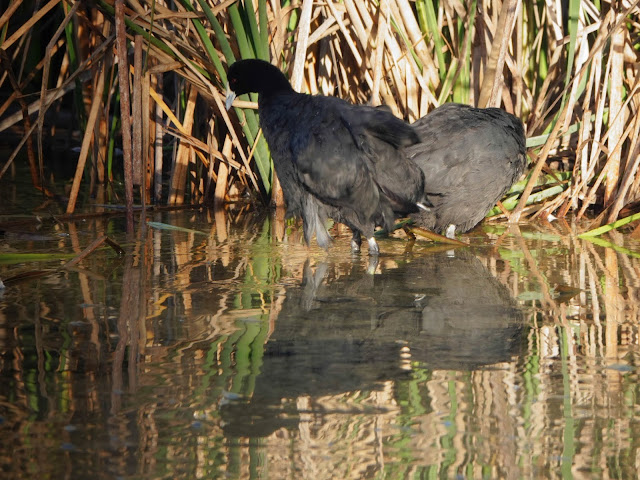
Red-knobbed Coots at the Charca de Suarwz

Saturday 5 October

Red-knobbed Coot Focha Moruna Fulica cristata

An illustrated account of the morning ablutions by this pair of Red-knobbed Coots at the Charca de Suarez.  Not sure where the bathing ends and the courtship begins - plus the stand off at the end!


What are you waiting for?


Don't forget behind the right ear.

And the left!

Are you done yet?

Headache; again?
I think I'll go down the pub


Make sure you're back in time for dinner!
Check out the accompanying website at http://www.birdingaxarquia.weebly.com for the latest sightings, photographs and additional information

Charca de Suarez

Kingfisher Martin Pescador Alcedo atthis
Saturday 5 October

Away early to collect visiting London birder Corinna Smart from Nerja and then on to the Charca de Suarez on the western outskirts of Motril for a lovely sunny and calm morning's birding.  Arriving early we were able to take the small diversion to travel along "Turtle Dove Alley" and well rewarded we were.  Not the Collared Doves on the wire as we turned off the main road but the numerous small finches feeding below the reeds and grasses at the sides.  First up a small mixed flock of Serin and Greenfinch followed by House Sparrows and then a brief sighting of the local Red Avadavats.  Within minutes we had also seen a Zitting Cisticola then very close views of a male Red Avadavat in full breeding plumage and looking most handsome.  Not content with one on the road we then had a pair posing close by in a small tree.  But our cameras were in the boot; we had only made sure that we had binoculars in the car at the start of the concrete road!  Then followed a Common Waxbill and more Serin before we made our way to the reserve's entrance noting the charm of Goldfinch on the way.

However, as we approached the end of Turtle Dove Alley we had the pleasant surprise of seeing a Sparrowhawk circle away and one suspects that the above would be on the raptor's breakfast menu.

Purple Swamphen Calamon Porphyrio porphyrio

Arriving at the Laguna del Taraje I was surprised by the lack of a Little Grebe and even more so by the single Purpe Swamphen that was happily feeding immediately in front of the bamboo hide.  A dozen or so Mallard and a couple of Red-knobbed Coots plus many feeding and squabbling Moorhen were also noted.  No sooner had a Great Tit moved in front of us than it was the first Kingfisher of the morning that spent a few seconds in a tree to our front before flying away to our left.  Meanwhile, the start of the continuous accompaniment of calling Cetti's Warblers as made our tour of the site.

Red-knobbed Coot Focha Moruna Fulica cristata

As we walked along to the Laguna del Alamo Blanco we were entertained by a feeding female Pied Flycatcher.  No sooner settled in the hide which was packed with photographers and not a scope in sight and only one pair of bins noted than we were able to see the presently resident White Stork along with a small number of Mallard and Moorhen plus a single female Shoveler.  A single Grey Heron posed on a bare perch towards the back and stirred the mass photographers into action as it took flight.
Grey Heron Garza Real Ardea cinerea

With so little birding activity and a full house at the hide we decided to move on to the main hide overlooking the Laguna de las Aneas.  here we found mainly Common Coot but were soon also identify a few Red-knobbed Coots.  Again, a number of squabbling Moorhen and a single, basking Cormorant.  At last, a couple of Little Grebe along with a Common Pochard.  Scoping the back of the water we were able to find a single Ferruginous Duck.  Corinna spotted the pair of Barn Swallows that passed overhead and having listened to the noisy Wren behind us an individual suddenly appeared in front of us, posing for seconds with tail held erect before disappearing into the reeds next to the hide.  Again, lovely to see close views of both Pied Flycatcher and Kingfisher, with the latter fishing immediately in front of us.  Leaving we also saw a couple of Blackbird.

Time to enjoy your catch Kingfisher Martin Pescador Alcedo atthis

Then it was on to the Laguna del Trebol passing a Robin on the way where we found more Common and Red-knobbed Coots plus Moorhen, two more Purple Swamphen and, at last, a visiting White Wagtail.

White Wagtail Lavandera Blanca Motacilla alba

As we made our way to the final pool, the Laguna del Lirio where we found yet another Purple Swamphen and a hunting Kingfisher, a small flock of Spotless Starlings was seen above us.

Little Grebe Zampullin Comun Tachybaptus ruficollis

having completed our cycle of the reserve we made a final return visit to both the Lagunas del Taraje and del Alamo Blanco before departing.  And as we travelled back along Turtle Dove Alley in the hope of another sighting of the Red Avadvats we found a pair of Barn Swallows and a female Stonechat but, alas, all the small finches had dispersed as the heat increased.  A wonderful morning in excellent company and time to relax back at home and enjoy the warm afternoon.

Pied Flycatcher Papamoscas Cerrojillo Ficedula hypoleuca
Shoveler Cuchara Comun Anas clypeata


Birds seen:
Mallard, Shoveler, Pochard, Ferruginous Duck, Little Grebe, Cormorant, Heron, White Stork, Sparrowhawk, Moorhen, Purple Swamphen, Common Coot, Red-knobbed Coot, Collared Dove, Kingfisher, Barn Swallow, White Wagtail, Wren, Robin, Stonechat, Blackbird, Cetti's Warbler, Zitting Cisticola, Pied Flycatcher, Great Tit, Spotless Starling, House Sparrow, Common Waxbill, Red Avadavat, Serin, Greenfinch, Goldfinch.

Our resident White Stork Ciguena Blanca Ciconia ciconia

White Wagtail Lavandera Blanca Motacilla alba  with attitude!

Check out the accompanying website at http://www.birdingaxarquia.weebly.com for the latest sightings, photographs and additional information