Friday, 13 September 2019

Once more to Sakhalvasho

Wednesday 11 September

Black Kites and Honey Buzzards on the move

After our visit to the coast north of Batumi it was one more back up the mountain to the Sakhalvasho raptor watch point for four hours.  Still plenty of migrating raptors but not the huge number yesterday in our absence.  Whilst we saw many Honey Buzzards there were far more Black Kites and we also saw one of the two Steppe Eagles recorded on the day.  In addition, a good number of Booted Eagles, over 300 recorded during the day, along with a couple of Short-toed Eagles.
Black Kite Milvus migrans

A passing Osprey over the sea was a welcome sight but, for me, it was more the sightings of Hobbies and Sparrowhawks at a closer distance that was more appreciated.  Just when all seemed quite the call went out and most "rushed" to the other side of the viewing platform to get a look at the silhouette of the passing Lesser Spotted Eagle.

Honey Buzzard Pernis apivorus
Honey Buzzard Pernis apivorus
Honey Buzzard Pernis apivorus 
As always, lots and lots of Bee-eaters and later joined by more migrating Barn Swallows.  Checking on the day's total I noted that Black Kites exceeded Honey Buzzards by almost six-fold with 7591 recorded compared with 1243 of the latter.  The total raptor count for the day was a splendid 10548.

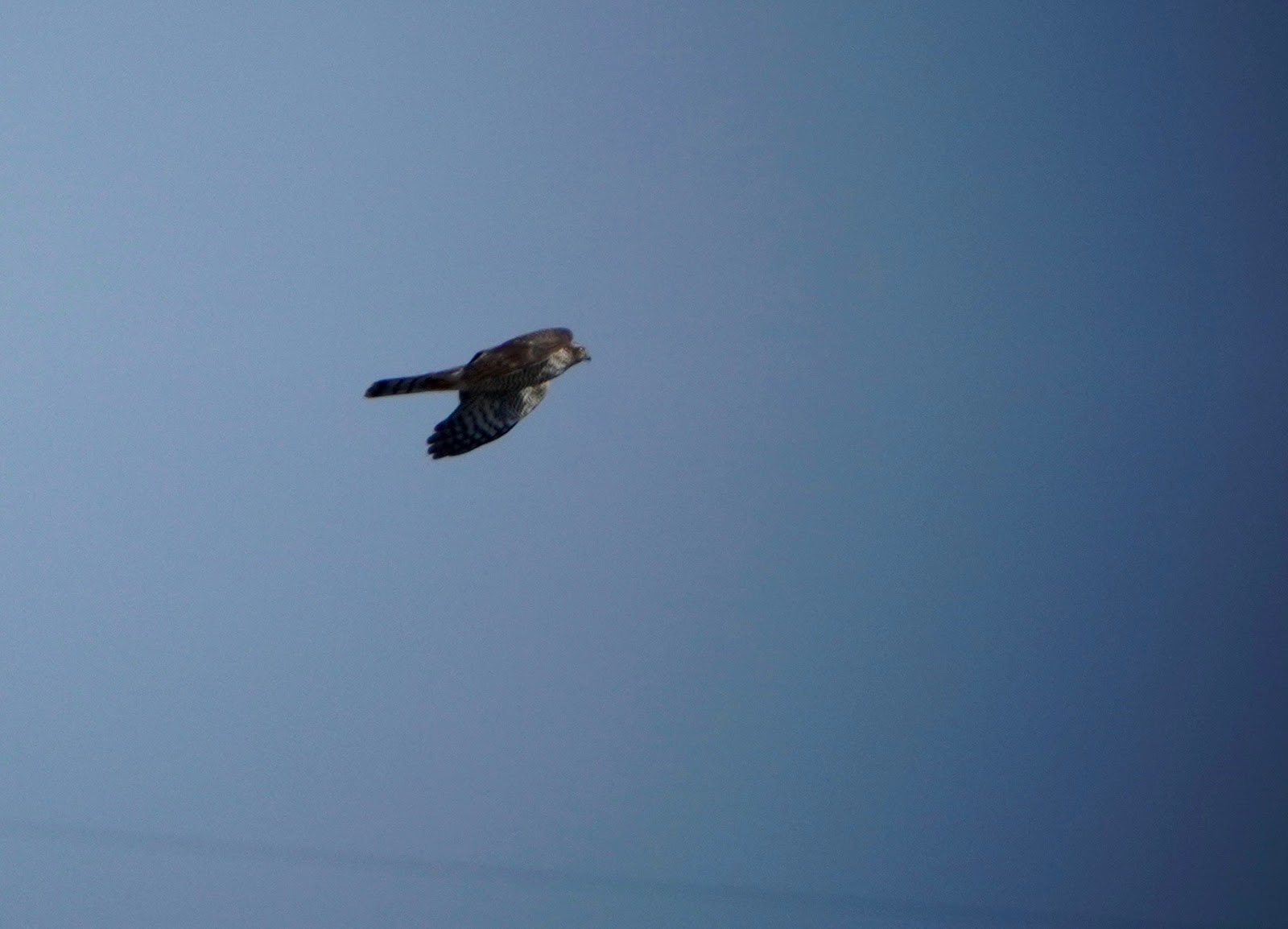
Sparrowhawk Accipiter nisus
Booted Eagle Aquila pennata
Birds seen:
Osprey, Honey Buzzard, Black Kite, Steppe Eagle, Lesser Spotted eagle, Short-toed Eagle, Booted Eagle, Sparrowhawk, Hobby, Bee-eater, Barn Swallow

Even time to study the small green lizard


Check out the accompanying website at http://www.birdingaxarquia.weebly.com for the latest sightings, photographs and additional information

Wednesday, 11 September 2019

Water birds a plenty

Tuesday 10 September

Whinchat Saxicola rubetra
Another beautiful sunny day and collected by our guide for the day, Jimshaw, in his large 4 x 4 to visit the beach and lakes near Poti about an hour north of Batumi.  (And by jove he needed the car as he drove kilometres over soft sand on the beaches and sandbars!). Once over the hills near Batumi and on the sea-level coastal road north, to our right (inland) we had a constant stream of, initially Honey Buzzards, but then thousands of Black Kites making their way south to the mountains above Batumi to pick up their thermals.  Most were flying from anywhere between tree-top and 100 metres and a few even nearer the ground.  To our left the occasional sight of a Sparrowhawk and Hooded Crow whilst on the road we stopped to inspect a recent road kill, a young Jackal (said to be about 18 months) and no sooner back in the car a couple of Roe Deer in the tall grass.

Sanderling Calidris alba
Upon arriving at the site we passed White Wagtails and then on to the beach where there were numerous small flocks of Sanderling plus a few Dunlin, Curlew Sandpiper and Turnstone.  It was only when we stopped to photograph a couple of "sitting" Sanderling that we noticed the long beaks (legs were below the birds) and realised that we had found our Terek Sandpiper.

Terek Sanderling Xenus cinereus

As well as a good number of Little Egret there was a score or more of Grey Heron and also maybe a dozen or more Hooded Crows feeding on the beach.  Out at sea we picked up a Great Crested Grebe and then started checking out the many Yellow-legged Gulls.  Also nearby, on the sheltered inland pools were a number of Black-headed Gull with a handful of Mediterranean and a few Slender-billed Gulls.

Immature Slender-billed Gull Larus genei 
But, perhaps, the better site was all the terns which included Little, Sandwich and Common Tern and we had already seen a White-winged Black Tern as we approached the turn off for the beach.  A lone Avocet watched as we approached and hen we found a female Curlew at the water's edge.

Curlew Numenius Arquata
Whilst we watched Black Kites and Sparrowhawks fly over we also had lovely views of Bee-eater, migrating flocks of Sand Martin and a Common Sandpiper.  On the ground a few Isabelline Wheatear and then a rather lovely Whinchat.  One of the final sightings was of a resting Osprey one the stick-covered sand and lovely to watch it take to the air and move away.

Sparrowhawk Accipiter nicus
Moving another 10km north we then took an uneven stony track to the shore just before the oil refinery with the linked railway line running alongside.  Another White Wagtail welcome and about half-way along our 5km bumpy ride we came across a Common Buzzard resting on one of the overhead wire supports.  Once on the deserted beach we began to think we had had a wasted journey but then Jimshaw spotted the Levant Sparrowhawk resting on a low twig at the back of the, duet again, stick-covered beach.  What a wonderful, distant sight.

Distant Levant Sparrowhawk Accipiter brevipes
Back to the water's edge to pick up more Sanderling, Turnstone and Curlew Sandpiper before seeing a flock of eight Mallard resting on the sea.  A small flock of Meadow Pipits flew low over the sand and we even found a handful or so of House Sparrows.

Isabelline Wheatear Oenanthe isabellina
Still the Black Kites and Sparrowhawk drifted past at relatively low level whilst we recorded another Isabelline Wheatear and a pair of Grey Wagtail on the track in front of the car.  Near the shore a short pier held a number off resting gulls along with a few Cormorant.  More Bee-eaters overhead and, we thought, a trio of Feral Pigeons to finish the visit to this, second, site and the day.  But it was not to be.  Jimshaw broke the journey south of Poti on the return drive to take a detour across the grass at the back of a beach close to some dense bushes.  hardly had we raised and we had a Red-backed Shrike posing on top and round the corner a pair of Hooded Crows.  The it was a male Black Redstart on the outskirts of Batumi and on driving up to the top entrance to the Botanical Garden in residues for Friday morning's visit we had a small flock of Chaffinches foraging at the roadside.
Grey Wagtail Montacilla cinerea
A long and enjoyable day in great company.  Roll on Thursday when we start all over again and this time visit the Chorokhi Delta for the morning before taking a scenic drive up into the mountains to visit the famous waterfalls.

Now sort out these gulls and terns!

Birds seen:
Mallard, Great Crested Grebe, Cormorant, Little Egret, Heron, Honey Buzzard, Osprey, Black Kite, Sparrowhawk, Levante Sparrowhawk, Common Buzzard, Avocet, Ringed Plover, Sanderling, Curlew Sandpiper, Dunlin, Curlew, Common Sandpiper, Terek Sandpiper, Turnstone, Mediterranean Gull, Black-headed Gull, Slender-billed Gull, Yellow-legged Gull, Common Tern, Sandwich Tern, Little Tern, White-winged Black Tern, Feral Pigeon, Bee-eater, Wood Lark, Sand Martin, Barn Swallow, Meadow Pipit, Isabelline Wheatear, Grey Wagtail, White Wagtail, Black Redstart, Whinchat, Red-backed Shrike, Hooded Crow, House Sparrow, Chaffinch.

Curlew Sandpiper Caladris ferruginea 
Turnstone Arenaria interpres
One of thousands of Black Kite Milvus migrans passing through during the morning 
Hooded Crows Corvus cornix on the prowl


Check out the accompanying website at http://www.birdingaxarquia.weebly.com for the latest sightings, photographs and additional information

Tuesday, 10 September 2019

Sakhalvasho Raptor Watch Point, Batumi

Sunday-Monday, 8-9 September

Ten days after visiting the Cazala raptor watch point above Tarifa on the western end of the Mediterranean Sea I find myself on a mountain top at Sakhalvasho about 16km north of the city of Batumi, Georgia on the eastern coast of the Black Sea.  What a difference.  Sakhalvasho is the now place to observe raptors by the thousands as they make their autumn return migration to Africa and amazing to think that the site was only really discovered as a birding hot spot about ten years ago.

From the watch point at Sakhlavasho

Our first visit was on Sunday, the day after arriving by train from Tbilisi, and the forecast was absolutely awful with the promise of torrential rain and storms.  However, arriving on the mountain top at 8.30 and greeted by Black Kite and Marsh Harrier along with calling Bee-eaters not a sign of rain.  Lots of cloud but quite calm.  And so it remained until we set off back to the old town of Batumi at 3.30pm.  On the other hand, the overcast weather of low cloud seemed to have held up most of the birds and looking at the final count for the day it was then lowest total since 23 August.  Indeed, check out the "Batumi Raptor Count" site for the day and you will see that the reporters actually use the word "boring!"

A passing Bee-eater Merops apiaster
Whilst we had regular passages of Bee-eaters and Barn Swallows and a good number of Rollers later on, most off the raptors, save for an early morning passage of harriers were very high and lost in the cloud.  To say that I was amazed by the eventual total is an understatement.

Of the birds seen, most were Black Kites followed by Honey Buzzard but it was lovely to see a number of Sparrowhawks and old Spanish favourites such a Booted Eagle, Short-toed Eagle and a Black Stork.  In addition, I did get to see my first Steppe Buzzard but only as a result of it being pointed out by one of the very experienced raptor recorders.

The "Official" count for the day (4691) was as follows (small birds are not counted):

A small kettle of raptors

Black Stork  1  
    
White Stork  2  
    
Osprey  2  
    
Honey Buzzard  2709  
    
Short-toed Eagle  1  
    
Lesser Spotted Eagle  1  
    
Booted Eagle  85  
    
large eagle sp  1  
    
Marsh Harrier  287  
    
Pallid Harrier  2  
    
Hen/Montagu's/Pallid Harrier  58  
    
harrier sp.  1  
    
Montagu's Harrier  9  
    
Black Kite  1101  
    
raptor sp.  1  
    
MediumRaptor  301  
    
Steppe Buzzard  70  
    
Woodpigeon  2  
    
European Roller  57  
    

Totals: 4691 individuals, 19 species, 11:05 hours commencing 06.45

The newly-constructed raptor watching shelter
During the early months of this year the local Tourist Board has built this impressive watch point rather than have the now many birders standing out on an exposed grassy area near the woods on the mountain side.  Not only shelter and toilets about to be added but the site owner has installed an industrial fridge holding cold drinks and his teenage children arrive everyday to prepare and sell coffee.  Coupled with chairs and tables how decadent is that!

So what did I make of this my first experience at Sakhalvasho?  Most of the passing birds are high, indeed very high and you certainly need a scope and experience in identifying raptors by silhouette and movement.  Very few came close enough for good sightings by binoculars never mind the naked eye.  Counting was undertaken by a good-sized group of experienced birders with set target areas to observe and then results are coordinated and collated for the final total.  On both days there were at least ten recorders and a combined total of at least twenty birders.

For me, migration of raptors at Sakhalvasho was about the actually movement of the birds.  You would see numbers gradually increase as raptors formed kettles (groups spiralling upwards on thermals) before achieving their desired height whereupon they would then stream southwards, usually just about the mountain summits but also passing through the valley below us.

And whilst the birds were above and around us, very close to hand, within a couple of metres, was a couple of dragonflies resting on cut stalks.  But what might they be?  Perhaps a reader with more expertise will let me know so that they can be properly identified.

Name these dragonflies!


Monday was a completely different kettle of fish (I wonder how that expression came about?) with lovely warm sunshine and increasing cloud over the mountain top.  The birds could now be seen settling and streaming southwards and even a few lower individuals for the benefit of birders like me with good views of both Sparrowhawk and Hobby plus a late low-flying Osprey towards the west and sea.  Again, hundreds of Bee-eaters along with a smaller number of Barn Swallows and even an early morning passage Sand Martins.

Honey Buzzard Pernis apivorus
In addition, more Booted Eagles and another Black Stork along with Pallid, Montagu's and Marsh Harriers.  However looking at the final total for the day it would appear that another visit by Crested Harrier had also been recorded.


Black Stork  15  
    
Osprey  3  
    
Egyptian Vulture  1  
    
Honey Buzzard  5802  
    
Crested Honey Buzzard  2  
    
Short-toed Eagle  4  
    
Lesser Spotted Eagle  6  
    
Booted Eagle  33  
    
large eagle sp  2  
    
Marsh Harrier  73  
    
Pallid Harrier  15  
    
Hen/Montagu's/Pallid Harrier  35  
    
harrier sp.  2  
    
Montagu's Harrier  15  
    
Black Kite  3320  
    
raptor sp.  2  
    
MediumRaptor  529  
    
buzzard sp.  254  
    
Steppe Buzzard  35  
    

Totals: 10148 individuals, 19 species, 12:16 hours

Osprey Pandion haliaetus
So what does this suggest to me as an individual?  If you want to see mass migration in large numbers, the spectacle rather than identifying every individual bird, then certainly Sakhlavasho is the place to be.  On the other hand, Tarifa will produce smaller numbers but a closer relationship giving far better opportunities to study the actual bird.  Perhaps I should reserve judgement until I have visited a few other local birding sites as to deciding whether or not a return visit might be on the proverbial cards!

Hobby Falco subbuteo
But, of course, this is only a brief snap shot based on two days.  I am sure that there must be occasions when the raptors do fly low just as in the same way, especially following bad weather when the birds are held up at the coast, when you can see streams of raptors and other birds making the relatively short crossing to Africa from the southern coast of Spain in the Algeciras - Tarifa area.

Sparrowhawk Accipiter nisus


Check out the accompanying website at http://www.birdingaxarquia.weebly.com for the latest sightings, photographs and additional information

Saturday, 7 September 2019

Batumi - Day 1

Saturday 7 September

Spotted Flycatcher Muscicapa striata
On the 8am train from Tbilisi to Batumi and arrive a minute after 1pm.  Told the forecast was to be very wet and certainly signs of what was to come as we moved westwards over the mountains and down too Black Sea coast.  However, met by our host and safely settled into our apartment for the next ten days before time to take an exploratory walk down to the beach and the nearby "Boulevard."

Reading our literature on the train journey we gathered that when it is wet one should visit the Botanical Gardens, Boulevard and any green area with cover as passing small migrants are more than likely to drop in for cover.  Well, it absolutely p***** down as we left the apartment and, obviously, took neither bins nor camera.  Yet walking through the nearby park we found White Wagtail, Hoopoe and Hooded Crow and on reaching the Boulevard saw a number of both Spotted Flycatchers and Common Redstarts plus a couple of Blue Tits.

Hoopoe Upupa epos feeding in the wet park
Spotted Flycatcher Muscicapa striata
Hooded Crow Corvus cornix 
Back to the apartment to dry ourselves but by then the rain had stopped and all seemed much calmer so back out again with camera and bins.  However, all the humans also came out to play so whilst we saw again all of the above, the numbers certainly seemed somewhat reduced.  Not to worry, record photos taken and now all set for our first visit to the famous raptor viewpoint at Sakhalvasho on the morrow.  The weather forecast is absolutely awful so it will be interesting to see what might turn up in the rain and then we can think about future repeat visits and also visits to both the Botanical Garden and nearby estuary about 5km to the south.

Female Common Redstart Phoenicurus phoenicurus (above) and male below

Birds seen:
Hoopoe, White Wagtail, Common Redstart, Spotted Flycatcher, Blue Tit, Hooded Crow, House Sparrow

Friday, 6 September 2019

The hills opposite Mtskheta, Georgia

Friday 6 September

Jvari Monastery
A Uber-type taxi this morning to 25km north-west of Tbilisi at the Monatery of Jvari on top of a hill on the opposite bank of the river Mtkvari to the (very) old capital of Georgia at Mtskheta.  Amazing to think that it cost us all of 4.50 Euros!  Tourists were already in mass attendance as the early morning rain had long since departed and the promise that the cloudy skies would become very warm by mid-afternoon.  But after a tour of this amazing building, having already recorded the local Hooded Crow, we left the public behind and set off to the relatively nearby lake in search of our birds for the day.  But, before departing, we were able to look down on the rove and record the many Yellow-legged Gulls, a couple of Grey Heron and at least a handful of Little Egret.  Above and below us a couple of small parties of calling Bee-eaters made their presence known and Marieke even recorded the few Common Swifts, I was to see them later in the day.

Juvenile Red-backed Shrike Lanius collurio
Once sorted on our way we stopped to see a couple of very close Isabelline Wheatear and making our way down to the now dried up small lake we had close views of juvenile Red-backed Shrike.  Also lurking in the low, thick gorse bushes was a small brown bird which was only identified in our returns a Nightingale.  Overhead we had our first raptors with the appearance, we're pretty sure, of a pair of Bonelli's Eagles.

Isabelline Wheatear Oenanthe isabllina
Truth be told, it was all very quiet which we much appreciated with more regular sightings of Red-backed Shrikes.  A Jay flashed through the nearby woods and much time was pent trying to identify what was obviously a family trio of buzzards.  A mixture of calling, sighting and eventual look at the distant shots taken on the Sony RX10 convinced us that we were looking at resident Long-legged Buzzards.

Long-legged Buzzard Buteo refines


And that was probably it till we arrived back at the car park to the monastery where we , as above, eventually identified the smallish brown bird as a Nightingale and had more views of the Isabelline Wheatear.  The Long-legged Buzzards were still up in the air and then, immediately below us, first a moulting White Wagtail followed by a pair of Hoopoe.

In a hurry Nightingale Luscinia megarhynchos
Hoopoe Upupa epopee
A rather scruffy White Wagtail Motacilla alba alba
Birds seen:
Little Egret, Grey Heron, Bonelli's Eagle, Long-legged Buzzard, Yellow-legged Gull, Common Swift, Bee-eater, Hoopoe, White Wagtail, Nightingale, Isabelle Wheatear, Red-backed Shrike, Jay, Hooded Crow


Check out the accompanying website at http://www.birdingaxarquia.weebly.com for the latest sightings, photographs and additional information

Thursday, 5 September 2019

Tbilisi, Georgia

Wednesday 4 September

Arrived in this fascinating, historic, crowded and crazy city of Tbilisi, capital of Georgia, about 5.30 this morning and after a few hours sleep was up and out to undertake some local exploring.  A visit to the park on top of the hill seen from our apartment window produced a Jay, Raven and Wood Pigeon and also the local House Sparrows.  But very much later before we came across our first Feral Pigeons and, as yet, no sign of a Collared Dove and/or Starling, Common or Spotless.  On the other hand, we did find Laughing Gull.

The late afternoon saw us take a short river cruise from below the "Bridge of Freedom" and there, sitting on the wall was a Hooded Crow which would appear to be the default member of this family.  Similarly, the almost a dozen gulls on or near the river would appear to be Yellow-legged Gulls.  As the small boat turns round to make a return journey upstream, the skipper stopped to point out a resting Cormorant in the riverside tree almost adjacent to his boat.

Cormorant Phalacrocorax carbo
What he did not notice was the juvenile Night Heron sitting not half a metre away and slightly obscured by a couple of then branches.

Juvenile Night Heron Nycticorax nycticorax
Continuing on we found another Juvenile Night Heron with 50 metres and more exposed was observation.
Female/juvenile Peregrine Falcon Falco peregrines
Leaving the river to walk back to our apartment I did came across a beautiful female Peregrine Falcon but I have to confess it was not a great wild sighting, rather a falconer's bird being used to attract customers to have their photograph taken with same.  Not at all happy with this aspect or, indeed, with the money dressed up in clothes or Macaw also being used for the same reason.  On the other hand, I did get a really good look at the face of this magnificent raptor.

So there you have it, our first experience of birding in Georgia with the delights of Batumi to follow come the week-end.  Today, all being well, a Uber-like taxi to about 20km upstream to explore the river.  But will were lucky bird wise?
Yellow-legged Gull Larus michahellis
Birds seen:
Cormorant, Night Heron, Yellow-legged Gull, Wood Pigeon, Feral Pigeon, Laughing Dove, Jay, Hooded Crow, Raven, House Sparrow


Check out the accompanying website at http://www.birdingaxarquia.weebly.com for the latest sightings, photographs and additional information