Friday, 31 July 2015

Guadalhorce again!

Friday 31 July

My insomniatic (is there such a word?) friends Barbara and Derek Etherton, having decided that there was no advantage in taking a middle-of-the-night swim in their uncovered pool with its temperature still recording the mid-thirties, opted rather for a very early morning visit to the Desembocadura de Guadalhorce in Malaga to see what might or might not be about.  Arriving in that special dark period immediately before day-break, sad to say neither Red-knecked Nightjar nor Barn Owl were about but, at least, by the time they returned to the car at about 10 o'clock they had recorded 46 species including a rather lovely Whimbrel.

Read on for Derek's version of events.


A change to our normal routine today.  Still up early but as you & Steve had an hour at Desembocadura yesterday we decided to do the same.  As forecast it was marginally cooler this morning and so it stayed until about 1000hrs. We arrived at the church to park at 0630hrs. and waited in the car for 15 minuets so a little light could break.  I have to admit I'm not sure of walking onto this reserve with no one else around and with expensive equipment 'dangling' in the dark.  I know at my age I could never give chase to an opportunist posing as a jogger!  

We waited on the bridge and watched the bats feeding and a couple of Cormorants roosting in the eucalyptus trees.  Dawn was starting to show over Malaga and a lot of cloud was a welcome relief keeping things cool.  Sardinian Warblers started to 'chunter' and soon Barn and Red-rumped Swallows were feeding over the scrub.  Common Swift fed high and there was quite a movement of Grey Herons, a few Mallard also flew over.  From the Casillas hide plenty of Black Winged Stilt were still dozing.  White Headed Duck, Moorhen, Common Coot, Little Grebe were mooching on the water and a Reed Warbler was feeding in front of the hide.  Barbara spied a Water Vole busy with it's morning ablutions and it stayed to allow us super 'scope views.  Moving down to the next hide (Wader Hide) three Greater Flamingo circled around eventually to land in the water and join the existing Little Egret, Black Winged Stilt and numerous Little Ringed Plovers.  A Great Egret flew around, thought about it, but then departed without landing.

White-headed Duck Malvasia Cabeciblanca Oxyura leucocephala  (PHOTO: Bob Wright)

Moving on down the track the half a dozen Audouin's Gulls were in company with a couple of Black-headed.  A lot of waders, mostly Ringed and Kentish Plovers had been joined by two Dunlin.  Just behind them were three Whimbrel and a couple of Curlew Sandpipers, soon to be joined by two Common Sandpipers.  Near the Sea Viewpoint two Hoopoes flew low over the track and there was mass feeding by a large flock of Greenfinches.  When we walked back up the track the Whimbrel took off from the left hand side, circled around and eventually landing over by the river.  By now plenty of Junta wagons were about and the Escondida hide was out of action with work taking place.

So off down to Laguna Grande and a rare, for this year certainly, Spotted Flycatcher posed for us on the Tamarisk trees.  From the hide Curlew Sandpiper still in their breeding plumage were right in front of the hide.  Several Dunlin were about.  Yellow Wagtail [blue-headed] showed well.  We were remarking on the amount of dead gulls on a couple of the islands when a Junta warden drove down, got out his vehicle dressed in waders!  He came and spoke to us apologising for the disturbance he was about to cause.  The reason?  His job was the undertaker!  So off he marched scattering the alarmed Black Winged Stilt, causing the Dunlin and Little Ringed Plover to suddenly develop broken wing syndrome.  He collected four bodies from one island [all gulls] and a few more bodies including a juvenile Avocet from the top of one facing the hide.  One presumes it is the lack of water quality that is causing the problem.

Black-winged Stilt Ciguenuela Comun Himantopus himantopus (PHOTO: Bob Wright)

Walking back up the track to return to the car, joggers and cyclists were now around but I think it's the first time ever I've spent three hours here without sight of a fellow watcher!

Back to the car by 1000 hours and a list of 46 species.

I have read this report at least four times trying to find the missing link that keeps nagging away at me.  Not the fact that there were no birders but then realised I needed to think in the negative.  Unless Derek chose deliberately to avoid naming the raucous rascals, could it be that he and Barbara actually managed three hour at the reserve without once coming across a Monk Parakeet?

Thursday, 30 July 2015

Guadalhorce et al

Wednesday 29 July

What a great day!  Collected by Steve and Elena Powell we drove into Malaga and "deposited" the ladies at a material shop for them to get really struck in with the rolls of whatever (not sure that this was a good idea!) whilst Steve and I spent about an hour at the Guadalhorce visiting (only) the main hide at the Laguna Grande.  Not too much damage to the credit cards when we retrieved the girls and then it was on to that well-know sports supermarket where Jenny got a chance to try out one of the many cycles on display.  Bike chosen and reserved and a pair of helmets and other bits and pieces purchased, looks like I'm going to be mounting a stead as well, we then made our way over to the eastern end of El Palo where we were able to enjoy a fabulous fish lunch under the direction of my great friend Mari Carmen whose father is the owner of El Tintero.  Not heard of this restaurant?  The you need to get over there as soon as possible and be both amazed and entertained, never mind filled with gorgeous freshly caught fish and crustaceans of every shape and size.  Am I advertising?  Yes, open seven days a week from midday to midnight and I guarantee you will not be disappointed.  (But finding somewhere to park can be a bit of a nightmare at times.)

back to the birding.  No camera so the opportunity to just enjoy the birds and there were some interesting species to be found.  Welcomed by the usual Monk Parakeets and occasional House Sparrow, we were soon on the river bank looking down on Mallards and Coots.  Good numbers of House Martins as we crossed the footbridge accompanied by occasional Barn Swallows.  A small mixed flock of Serin and Goldfinches playing about in the bushes along with the occasional Greenfinch as we made our way to the hide and a single Zitting Cisticola took off  - and probably wished he had not given the heat even before late morning.

As soon as we reached water we had many Black-winged Stilts with their now well-grown offspring and then the main water held well over an hundred gulls taking a well-earned rest.  Whilst mainly Black-headed, we did find a few Mediterranean Gulls rapidly moulting out their black head feathers and even managed a single Audouin's Gull.  Amongst the gulls was a small flock of about a score of Sandwich Terns and these were then joined by a single Little Tern, looking barely half the size as it posed alongside its larger cousin.  But, wait a minute, we then had another tern half-way between the two sizes.  Much observation and it turned out to be a juvenile Whiskered Tern.  To complete this group, we then managed to find lesser Black-backed Gulls after we left the reserve.

Also present were a few Mallards and a trio of Grey Herons plus an over-flying Little Egret.  Although we saw a single Hoopoe and Blackbird, there were a number of waders present including a pair of Common Sandpipers, a handful of Curlew Sandpipers and all three small plovers, a single Kentish with its diagnostic dark legs, perhaps a quartet of Ringed but mainly Little Ringed Plovers.

Considering we were only in the reserve for barely an hour it was most refreshing to see both water and a selection of birds.  And then, of course, we had that fish lunch to look forward to and, for jenny and I, the absolute look of surprise on the faces of Steve and Elena.  Al in all, a most enjoyable day.

Birds seen:
Mallard, Little Egret, Grey Heron, Coot, Black-winged Stilt, Little Ringed Plover, Ringed Plover, Kentish Plover, Curlew Sandpiper, Common Sandpiper, Black-headed Gull, Mediterranean Gull, Audouin's Gull, Lesser Black-backed Gull, Sandwich Tern, Little Tern, Whiskered Tern, Collared Dove, Monk Parakeet, Hoopoe, Barn Swallow, House Martin, Blackbird, Zitting Cisticola, Spotless Starling, House Sparrow, Serin, Greenfinch, Goldfinch.

Wednesday, 29 July 2015

Ospreys in July!

Tuesday 28 July

All I can say is if, at worst, you are and insomniac or, at best, an early riser, then it greatly helps if you are a birder with a local patch to explore.  This very much applies to my friends Derek and Barbara Etherton and their exploits yesterday morning as can be seen from the interesting email I received complete with photos.


Zapata on te Guadalhorce just north of Malaga Airport


We were on site by 0600hrs this morning and it was pitch black, you tend to miss the moonlight when it's not there!  Expecting the usual Red Necked Nightjars we were surprised to see Hoopoes taking their place.  Later we disturbed dozens of Crested Larks doing the same. 

Time to wake up, Mr Hoopoe(PHOTO: Derek Etherton)
As light gradually crept into the sky the first of 'reed bed roosters' began to stir. Reed Warblers, Yellow Wags, Barn Swallows, we notice the Red Rumps tend to stay in their nest overnight.  Common Waxbills, Linnets, Spotless Starlings, a large flock here now.  A Water Rail 'squealed' and a Purple Swamphen flew over. A Kingfisher was fishing in the reed bed opening.  Short Toed Larks were many joining in the feeding with Goldfinch, Serin & Greenfinch. 

Several Iberian Hares were in their usual area and as Barbara scanned round she picked up on a raptor down by the river.  Obvious that it was 'fishing' we hopped in the car and drove down there quickly in time to see the Osprey rise up from the water and with fish in talons.  Now it must be far too early for this to be the normal wintering bird so was this an early returnee?  Who knows but as far as I'm aware the nearest breeding site is Cadiz area.  Fortunately, I was able to take some pictures and when viewing through bins could not see any colour rings, couldn't make out the species of it's breakfast either!  We continued watching it as it eventually flew away heading up river and inland. 


The fishing (successfully) Osprey Pandion haliaelus (PHOTO: Derek Etherton)
Coming the other way, down the river' we picked up a Black Kite.  

Black Kite Milvus migrans (PHOTO: Derek Etherton)
The river area itself contained the usual, Little Ringed Plover, Yellow Wagtails, Linnets, Cetti's Warbler, etc.  However, there were numerous Turtle Doves ground feeding mixed in with the finch flock.

Just shows you never know what's going to be about when you head to 'your patch'!


Sounds like a great day and certainly one way to get ahead of the sun and the soaring temperatures.


Check out the accompanying website at http://www.birdingaxarquia.weebly.com for the latest sightings, photographs and additional information.

Monday, 27 July 2015

Charca de Suarez

Sunday 26 July

Feeling much better so after collecting friend Steve Powell we spent the morning at the Charca de Suarez reserve on the western outskirts of Motril.  My word how the site has changed in the last few months with the new hide overlooking the large scrape and two more hides that look as if thy may be up and running very shortly.  The good weather also helped and we were both more than pleased with the number and exciting range of birds recorded.

Arriving on site via "Turtle Dove Alley" where we found House Sparrows, Zitting Cisticola and Crested Lark, were greeted by a handful of Collared Doves and very quickly located the calling Turtle Dove.  Indeed, we to see regular sightings of Turtle Doves throughout the morning.  A quickly disappearing Blackbird as we made our way to the Laguna del Taraje where, having settle in, we soon found a Little Bittern and then the first Kingfisher of the morning.  Add on both Little Grebe and Coot before departing to the new hide overlooking the Laguna del Alamo Blanco and recording a juvenile Spotted Flycatcher and Goldfinch on the way.

And what might this be at the Laguna del Trebol?

What a great hide this is with views along the water and scrape from sensible sized windows with a large rest platform and seats that actually match the viewing window, so unlike many Spanish hides where the windows seem to have been made for those with very restricted heights!  Within seconds we were looking at Little Egrets and Mallards, the only ducks that seemed to be present at the reserve, along with Black-winged Stilts.  More detailed observation then revealed a single Little Ringed Plover and the trio of Common, Green and Wood Sandpiper.  Whist a Grey Heron flew over our upward gaze also picked up House Martin, Barn Swallow and Common Swift feeding on the wing whilst on the mud below first a White then juvenile Blue-headed Wagtails.

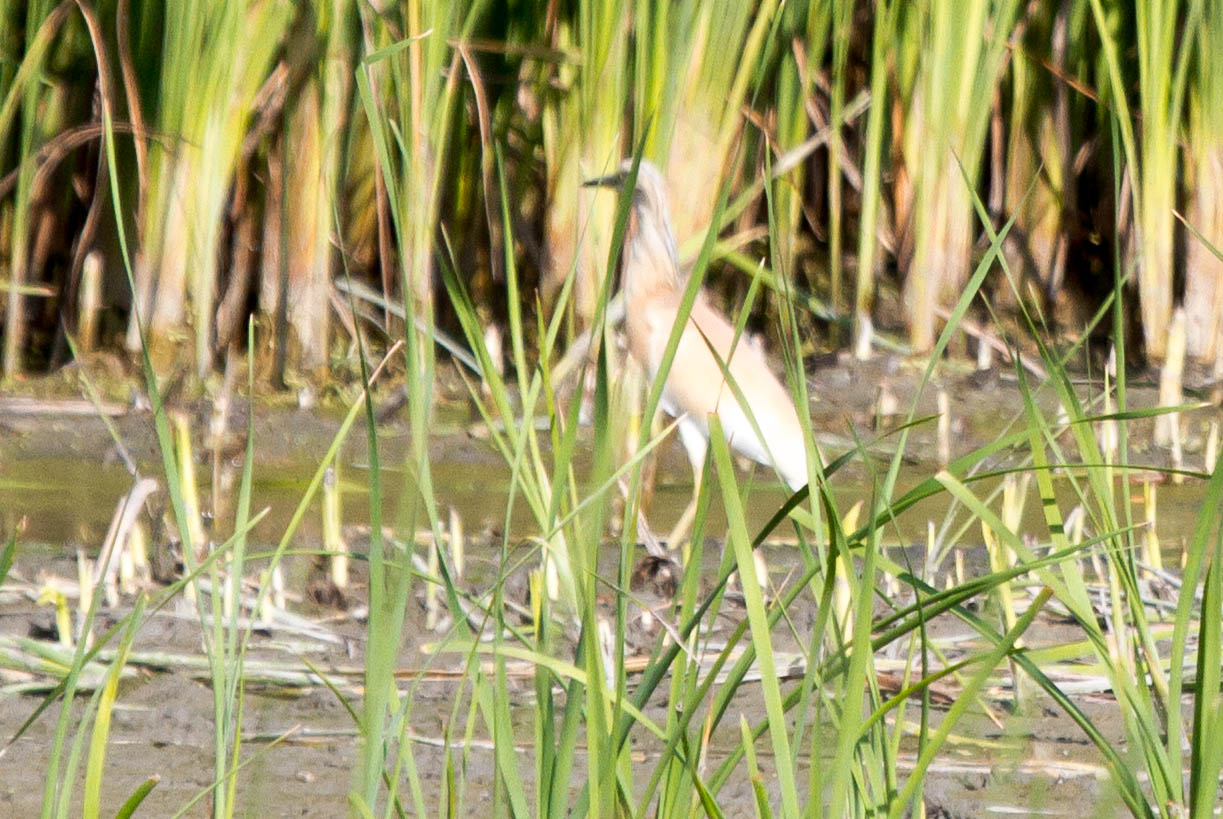
Th illusive Water Rail Rallus aquaticus (above) and record shot of the nearby Squacco Heron Ardeola ralloides (below)
But things got better when not only another Little Bittern presented itself but a Squacco Heron dropped in.  Whilst watching this pair, barely three metres apart, a Water Rail decided to come out from the reeds and wander, run at times, back and forth.  Also present were a small number of Red Avadavats, Moorhens and a single Redshank.  More visits from the local Kingfishers and then, hidden in the grass in front of us, a very small waxbill, not the usual "Common" variety by one of the local resident and breeding population of Black-rumped Waxbills Estrilda troglodytes. (Apart from the black on the rump also having a distinguishing white marking in the event area.)  Finally, our first Sand Martin of the morning then we were to see many more over both the Lagunas de las Aneas and del Trebol.

Kingfishers Martin Pescador Alcedo atthis everywhere and seen at 5 of the 6 pools
The Laguna de las Aneas as expected contained a good number of Coots and Mallards along with a quartet of Grey Herons and the usual Moorhens and Little Grebes.  Lovely also to see all the juveniles paddling alongside their parents but the the Kingfisher reappeared once more and gave some really close views.   More hirundines overhead and a very small number of juvenile Lesser Black-backed Gulls and Black-headed Gulls, the latter with their young of the year.

Grey Heron Garza Real Ardea cinerea

The final walk around the site calling in at both hides overlooking the Laguna del Trebol produced the expected Red-knobbed Coots and also provided a flock of Serins and a single Red-rumped Swallow.  The end to a lovely morning and good to feeling better and able to take up the binoculars once again.

A Red-knobbed Coot Focha Moruna Fulica cristala without a ring collar!


Birds seen:
Mallard, Little Grebe, Little Bittern, Squacco Heron, Little Egret, Grey Heron, Water Rail, Moorhen, Coot, Red-knobbed Coot, Black-winged Stilt, Little Ringed Plover, Redshank, Green Sandpiper, Wood Sandpiper, Common Sandpiper, Black-headed Gull, Lesser Black-backed Gull, Turtle Dove, Collared Dove, Swift, Kingfisher, Crested Lark, Sand Martin, Barn Swallow, Red-rumped Swallow, House Martin, Blue-headed Wagtail, White Wagtail, Blackbird, Zitting Cisticola, Reed Warbler, Spotted Flycatcher, House Sparrow, Red Avadavat, Black-rumped Waxbill, Serin, Goldfinch.


Check out the accompanying website at http://www.birdingaxarquia.weebly.com for the latest sightings, photographs and additional information.

Sierra Loja with John and Jenny

26 July 2015

All has been very quiet on the western front, well Salar anyway, not having heard from John and Jenny wainwright for a month or more.  And now i know the answer; a mixture of me being back in the UK and John having lost a battle with a wheelie bin!  Sounds intriguing, if somewhat painful, so look forward to catching up with John  and Jenny in the coming days and finding out more about this load of rubbish - every pun intended.  Whatever, great to hear that John is not only on the mend but able to get out and about once again and guess where?  yes, up to his favourite birding spot, the Sierra Loja.  And good to see that most of the summer regulars are still to be seen.  All photographs by John Wainwright.


Female Red-veined Darter Sympetrum columbei


Sierra Loja: Sunday 26th July
 
Hottish below (36C), but much cooler (28C) up top, with a nice breeze to boot. 
 
Nothing much to speak of until we got to the tree line area, where we saw Chaffinches, Great Tits, heard Coal Tits and Short-toed Treecreepers.


A lot of hirundines about at the cliff areas although mostly House Martins with a few Crag Martins, only one Red-rumped Swallow, a few Barn Swallows and several Common Swifts.  In the bushes in the lower slopes we found a single Spectacled Warbler, a family of Stonechats, two Woodchat Shrikes, Black Wheatear, Little Owl, Thekla Larks and a couple of Hoopoes.  At the water trough a small flock of Chough flew off at our approach.


Little Owl Mochuelo Comun Athene noctua

On the way up to the substation valley we saw plenty of Black-eared Wheatears (mostly juveniles), in fact only one adult was seen all day.  While in the valley itself a Northern Wheatear was found, a few Chough, more Hoopoes and Black-eared Wheatears.  In the old bare tree here we saw three Southern Grey Shrikes and another Stonechat and as we came out of the valley a Blue Rock Thrush was noted.
On to the pond area, where the water level was slimy green and no more than two inches deep by about six foot wide, the tadpole and froglets that were about were all at the surface and the edges had corpses of the unlucky ones upon them.  While we were here we saw Rock Buntings, Linnets, Rock Sparrows, Blackbirds, Black-eared Wheatears and another Blue Rock Thrush, also lots of Striped Grayling (Hypparchia fidia) butterflies about in the area.


Striped Grayling Hypparchia fidia
Moving along to the "fossil cave" area, good numbers of Crag Martins here as well as a large flock of Chough feeding on the down slopes.  Our first of three Black Redstarts (one male, two females), a Lesser Kestrel, Red-legged Partridges, Black Wheatear, Rock Buntings, Linnets and our third Blue Rock Thrush. 


Blue Rock Thrush Roquero Solitario Monticola solitarius

We made our way back and around to the fir copse, where we had a sandwich.  As I stepped out of the car to get a photo of a dragonfly, a large flock of Common Swifts flew past - at just over head height.  Lots of Goldfinches here as well as a Hoopoe, Chaffinches and another Blue Rock Thrush. We were just getting back in the car when a ring-tail Montagu's Harrier soared across our front.


Departing female Montagu's Harrier Aguilucho Cenizo Circus pygargus

On the way down we spotted four Spanish Ibex going for a drink at the trough and as we came to the autovia tunnel Serin, Wood Pigeon and Azure-winged Magpies were seen.


 Check out the accompanying website at http://www.birdingaxarquia.weebly.com for the latest sightings, photographs and additional information.

Monday, 20 July 2015

Finca Algaba, Ronda

Long-tailed Tit Mito Aegithalos caudatus
Monday 20 July

With the Andalucia Bird Society holding its annual Extraordinary meeting at the Finca Algaba just six kms south of Ronda on Saturday 18 July I decided to drive over the previous afternoon so that i could make use of the "Photography hide" both that evening and early the next day before joining other members of the Society for a little birding before the meeting proper.  And a very enjoyable time it was, too.

Friday 17 July

The weather was still very hot and the venue is set will inside a wooded area and way for everything and everyone, including shops and restaurants so necessitating a short drive later in the evening to but a small snack and a long drink with friend Olly from Roquetas de Mar in Almeria.

Awaiting transport up to the hide along with Olly, Barbara and Gerry Laycock and Frank Hair we had distant views of both Booted Eagle and Griffon Vulture and a few Collared Doves and House Sparrows busied themselves near the finca itself.  However, once ensconced inside the hide we were soon rewarded with a regular stream of visitors to make use of the shallow pools immediately in front.  All we had to do was sit, observe and photograph albeit the sun was immediately in front of us and conditions deteriorated as the sun dropped.

Wren Chochin Commun Trogladytes trogladytes
First on the scene were a number of Blue Tits and surprised to record that there appeared to be more moulting adults than juveniles.  In addition to a regular supply of Chaffinches we had a few Great Tits and then both adult and juvenile Sardinian Warblers.  The arrival of a couple of Bonelli's Warblers was most rewarding and then came the first of a couple of Subalpine Warblers plus a persistent Whitethroat that wanted to make much use of the water available.

Subalpine Warbler Currica Garrasquena Sylvia cantilans
Continuing with the warbler theme, we had a juvenile Orphean Warbler and then appeared a Wren.  Seeing these birds so close really gave a better perspective as to actual size, making both the Chaffinch and Wren appear larger the one might expect compared to the somewhat smaller Nightingale and Subalpine Warbler.  Towards the end of our session we were joined by a small family party of Long-tailed Tits with their colouration tinted by the evening sun.  Finally, we also had regular visits from a juvenile Robin which had almost moulted into its red waistcoat and a male Serin whilst, overhead, both House Martin and Common Swift were recorded.

Saturday 18 July

The following morning we were all in the hide by just after 7.30 and soon had our resident Robins and Blackbirds in front of the glass.  Once more we were joined by a good number of Blue Tits, more juveniles noticed this morning, and more Great Tits than last evening.  Still the presence of many Chaffinches but it was the Nuthatch that was to be the predominate bird of the morning.

Nuthatch Trepador Azul Sitta europaea
Lovely to see a newly-moulted Nightingale and the reappearance of both Sardinian and Subalpine Warblers.  once again we had the Long-tailed Tits with us and a couple of Short-toed Treecrepers put in a lengthy appearance, especially on the dead tree less than twenty metres away.  Whilst both Common and Pallid Swifts were joined overhead by Barn Swallows and House Martins, our Bonelli's Warbler once more graced us with its presence and the the arrival of a Jay.  First seen hiding in a neighbouring tree it was not long before it was right in front of us and filling our lenses.  Our final bird at the hide was a lone Wood Pigeon and then it was time to join the rest of the group for short drive up into the nearby Serrania de Ronda.

A very close of the beautiful Jay Arrendajo Garrulus glandarius
The way up ;ed to some fabulous warbler habitat and we managed to record Dartford and Spectacled Warbler along with Woodchat Shrike, Stonechat, Corn Bunting and both Northern and Black Wheatears.

Meanwhile, overhead, lovely view of a relatively close Goshawk and then a trio of Short-toed Eagles and a single Booted Eagle.

The delightful, mouse-like, juvenile Long-tailed Tit Mito Aegithalos caudatus
On a practical note, I had been ill most of the preceding week and really ought not to have travelled over to Ronda in the first place but glad that I did.  In photographic terms I had some wonderfully close views of a range of small birds that tend to be only seen at a distance but my settings appeared to be all wrong so somewhat disappointed.  I suspect a mixture of using wrong apertures through the glass an, at the same time, not really being in a fit state to actually be aware of what was going wrong to make the necessary adjustments.  But, on a positive side, it was lovely to both see the birds and make a reacquaintance with some lovely birding friends whose company I much enjoyed and appreciated.  Thank you all, you know who you are.


Birds seen:
Griffon Vulture, Short-toed Eagle, Booted Eagle, Goshawk, Wood Pigeon, Collared Dove, Common Swift, Pallid Swift, Barn Swallow, House Martin, Northern Wheatear, Black Wheatear, Wren, Robin, Nightingale, Stonechat, Blackbird, Dartford Warbler, Spectacled Warbler, Subalpine Warbler, Sardinian Warbler, Orphean Warbler, Whitethroat, Bonelli's Warbler, long-tailed Tit, Blue Tit, Great Tit, Nuthatch, Short-toed Treecreeper, Woodchat Shrike, Jay, House Sparrow, Chaffinch, Serin, Corn Bunting.


Check out the accompanying website at http://www.birdingaxarquia.weebly.com for the latest sightings, photographs and additional information.

Thursday, 16 July 2015

A day in the life of an Egyptian Vulture

Refers to Friday 10 July

First locate the source of the scent of the fresh carrion drifting in on the early morning breeze.


Is it here?

Or is it there?
Time to check out the source

Not found it yet
Yes, there it is.  But in a tunnel?

If I approach now I shall lose the high ground and aerial overview.
I think I'll go round again and think this one out!


Check out the accompanying website at http://www.birdingaxarquia.weebly.com for the latest sightings, photographs and additional information.