Sunday, 17 November 2019

Laguna Dulce and Fuente de Piedra

Saturday 16 November

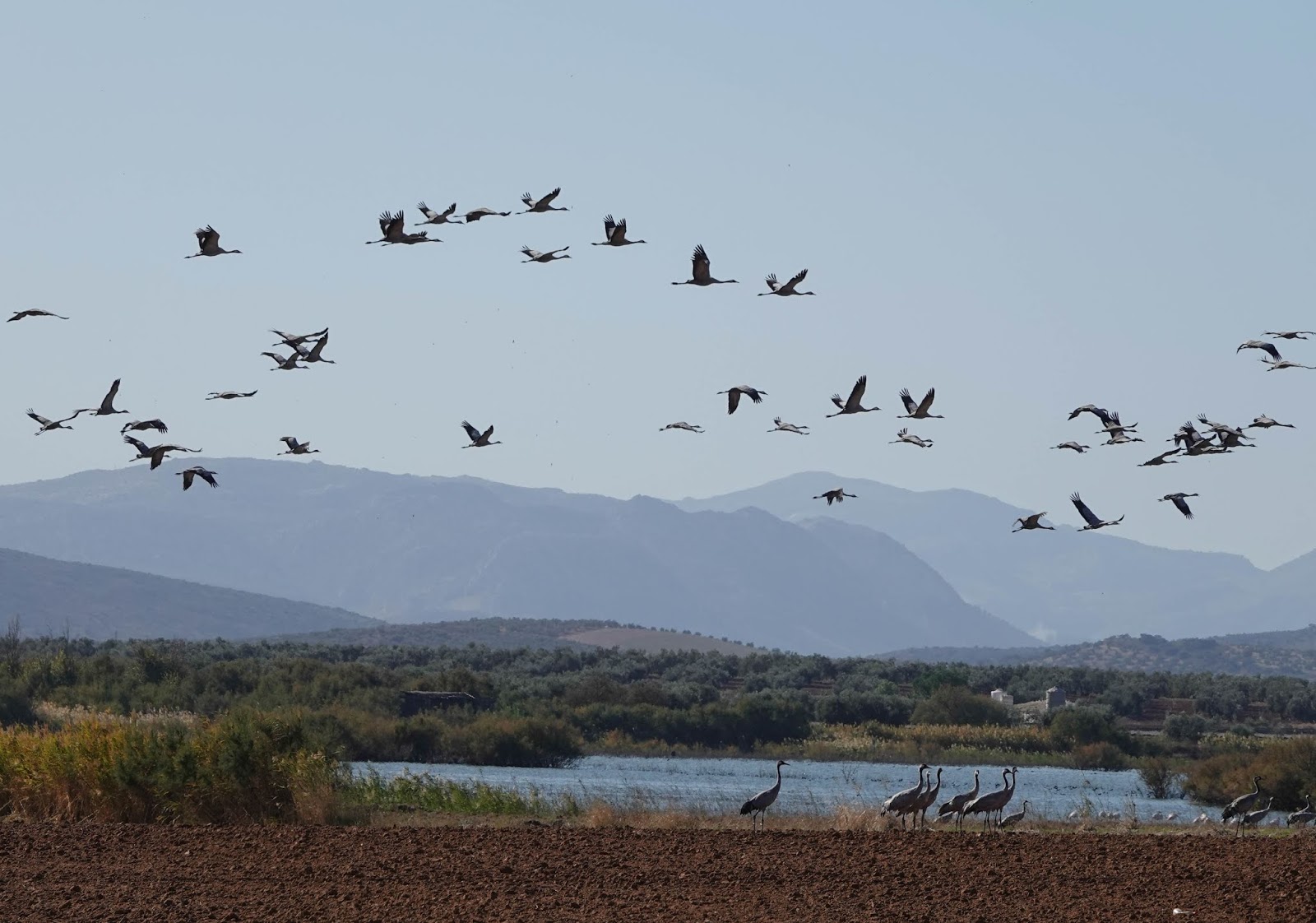
Common Cranes Grulla Comun Grus grus over Laguna Dulce
With the sun already shining in a clear blue sky and, at last, the wind abated I set off for a morning at the Laguna Dulce near Campillos just after 9 am.  Already up to 11C as I departed but upon arriving, having received a frost warning in the car when the outside temperature dropped to 3C at the top of the long climb up from Malaga, I arrived jut before 10.30 to be greeted by 5C, lots of birds on the water but very cold when standing at the hide as my hands gradually turned to ice.  But it was worth the effort and by the time I returned to Mezquitilla in mid-afternoon the temperature on the coast was up into the low twenties.

Checking out the water, try as I might I could not find a single Great Crested Grebe; scores of both Little and Black-necked Grebes but not a single sight of their larger cousin.  On the other hand, in addition to the hundreds of Coot, I had a marvellous selection of ducks.  Very many Mallard and Shoveler and diligent searching produced about a score of Common Pochard,  handful of Red-crested Pochard and a single Shelduck.  No Teal but a good number of Gadwall.  However, despite losing count at in excess of 250 White-headed Ducks my pride of place probably went to the score or more of Wigeon, not a bird I find that often in southern Spain, but then welcome sighting of a quartet of Garganey, my bird of the day.

Mainly Gadwall Anade Friso Anas strepera in this group of ducks
Whilst a good number of Crag Martins were feeding over the water and both Chiffchaff and House Sparrows were foraging below me in the greenery along with calling Cetti's Warblers, I looked up to watch the passing female Marsh Harrier.  This reminded me of the Black-shouldered Kite that I had just past on top of a wooden telegraph pole as I drove through Santa Ana just down the road.  A single Moorhen wandered out towards the hide whist on the opposite side of the nearby bay to my left an arriving Lapwing also drew my attention to Black-winged StiltRinged Plover and both Grey and White Wagtails working the shore. A little further behind them working both shore and hedgerow was a small flock of Meadow Pipits.

Flamingos Phoenicopterus roseus at Laguna Dulce in the company of Coot Fulca atra and, if you carefully, Crag Martin Ptyonoprogne rupestris
Next job to find the wintering Common Cranes.  To the very far right-hand corner a tight group of about thirty Flamingos were busy feeding and to their rear four Common Crane.  At that moment a half-dozen flew across the water, right to left, so I knew the main flock had to be somewhere in the immediate area.  Meanwhile, there was a presence of about 100 plus Black-headed Gulls to the rear of the water and as I looked I could still be not unimpressed by the huge swathe of White-headed Ducks which seemed to stretch right across the back of the water.  Time to drive over to the far side and take the farm track towards Fuente de Piedra but first a check in the shrubbery behind me where I duly found a lovely Zitting Cisticola.

About 30+ of the White-headed Duck Oxyura leucocephala with a few Shoveler Anas clypeata
Moving along the back of the water I quickly found both Crested Lark and Stonechat and the first of three good-sized flocks of Linnets.  A trio of Collared Doves were resting in trees near the farm to my left at the crossroad and, as I watched, a pair of Raven with a quartet of Jackdaws above the moved to the the left.  As the Ravens continued the Jackdaws joined a few more of their number also at the above farm.

Raven Corvus corax (above) and Jackdaws Corvus monedula (below)


 At about the same time I found the grazing flock of at least an hundred Cranes near the back of the water.  As I watched a good section moved away to the front of me and I discovered two further large flock so bringing the Crane total up to well over 300.


Common Cranes Grulla Comun Grus grus
Continuing on down the track nothing to record at the old ruin though I did pick up a solitary Buzzard resting on a relatively recently-ploughed field.  A good number of Jackdaws were seen at the "nesting tower" along with a few Spotless Starlings.  More Linnets and then both Serin and Goldfinches before re-joining the road and taking the anti-clockwise circuit to the salinas of Fuente de Piedra.

Female Linnet Carduelis cannabina (above) and Stonechat Saxicola torquatus (below)

Unlike the Laguna Dulce, Fuente de Piedra was almost devoid of water, just a couple of large puddles and the entrance fields and scrapes completely bone dry.  The only birds to be seen on the "lake" was a tight mixed flock of mainly Lesser black-backed and Black-headed Gulls.

Flamingos Flamenco Comun Phoenicopterus roseus at the laguneta

So round to the back and the laguneta where, even here, the water level was conspicuous by its dramatic fall in level.  Never mind islands, all we now had was a couple of small humps on the barren bed.  On the remaining water mainly a few Mallard, Shoveler and Coot along with little more than a handful of Flamingos.  A Lapwing walked the nearby shire and in the bushes the occasional Linnet and House Sparrow.

Northern Lapwing Avefria Europea Vanellus vanellus

Walking back towards the car both Goldfinch and a couple of Greenfinch were recorded then a male Sardinian Warbler and a number of feeding Blackcaps in the olive trees.  A female Black Redstart put in an appearance and a male Blackbird made a hasty retreat as a Kestrel drifted overhead, so bringing up the day's total to 45 species.

Female Black Redstart Colirrojo Tizon  Phoenicurus ochruros

Birds seen:
Shelduck, Gadwall, Wigeon, Mallard, Shoveler, Garganey, Red-crested Pochard, Common Pochard, White-headed Duck, Little Grebe, Black-necked Grebe, Flamingo, Black-shouldered Kite, Marsh Harrier, Buzzard, Kestrel, Moorhen, Coot, Crane, Black-winged Stilt, Ringed Plover, Lapwing, Black-headed Gull, Lesser Black-backed Gull, Collared Dove, Crested Lark, Crag Martin, Meadow Pipit, Grey Wagtail, White Wagtail, Black Redstart, Stonechat, Blackbird, Cetti's Warbler, Zitting Cisticola, Sardinian Warbler, Blackcap, Chiffchaff, Jackdaw, Raven, Spotless Starling, House Sparrow, Serin, Goldfinch, Linnet.


More Common Cranes Grulla Comun Grus grus

Check out the accompanying website at http://www.birdingaxarquia.weebly.com for the latest sightings, photographs and additional information

Sunday, 10 November 2019

Charca de Suarez, Motril

Sunday 10 November

Cloudy at first and a strong wind bu t the sun put in an appearance mid-morning and, for a time, the wind calmed down.  But, despite the weather, a very enjoyable visit, some lovely birds seen and most photographed, an eventual tally of 42 species for the morning.

Entering "Turtle Dove Alley" there were Rock Doves on the wires and a departing Cattle Egret along with a sizable flock of Spotless Starlings.  With the grasses blowing in the wind a good way down before a pair of Waxbill seen at the side of the road and, at the far end, a similar number of Red Avadavat.  Once inside the reserve straight to the bamboo hide overlooking the Laguna del Taraje, not just the expected Purple Swamphen and Red-knobbed Coot but a trio of ducks represented by Mallard, Teal and Shoveler.  A handful of Moorhen, a pair of Little Grebe and even a Robin in the nearby tree.


Purple Swamphen Calamon Comun Porphyrio porphyrio
Then it was on to the large hide overlooking the Laguna del Alamo Blanco where, on this occasion, the White Stork took some finding as it was hiding at the very back, low down behind the tall reeds.  To the front, more Shoveler and Teal plus lots of Mallard.  And to add a little flavour a single Shelduck was also noted.  Over all this a solitary Heron rested on a high support keeping watch.

Grey Heron Garza real Ardea cinerea

Noting the very many Chiffchaff and a couple of Blackbird on site as I walked round  to the main hide at the Laguna de las Aneas I was greeted by very many Common Coot and many more Mallard along with Moorhen, Little Grebe and a trio of Cormorant.  Just the one Yellow-legged Gull at the water and looking very smart.

Yellow-legged Gull  gaviota patiamarilla Larus michahellis alongside Cormorant Cormoran Grande Phalacrocorax carbo
A Cetti's Warbler was calling loudly and hidden away in the reeds to my left a lone Kingfisher.  A single Little Egret on the island in front of the hide and, feeding over the water, about a dozen Crag Martin.

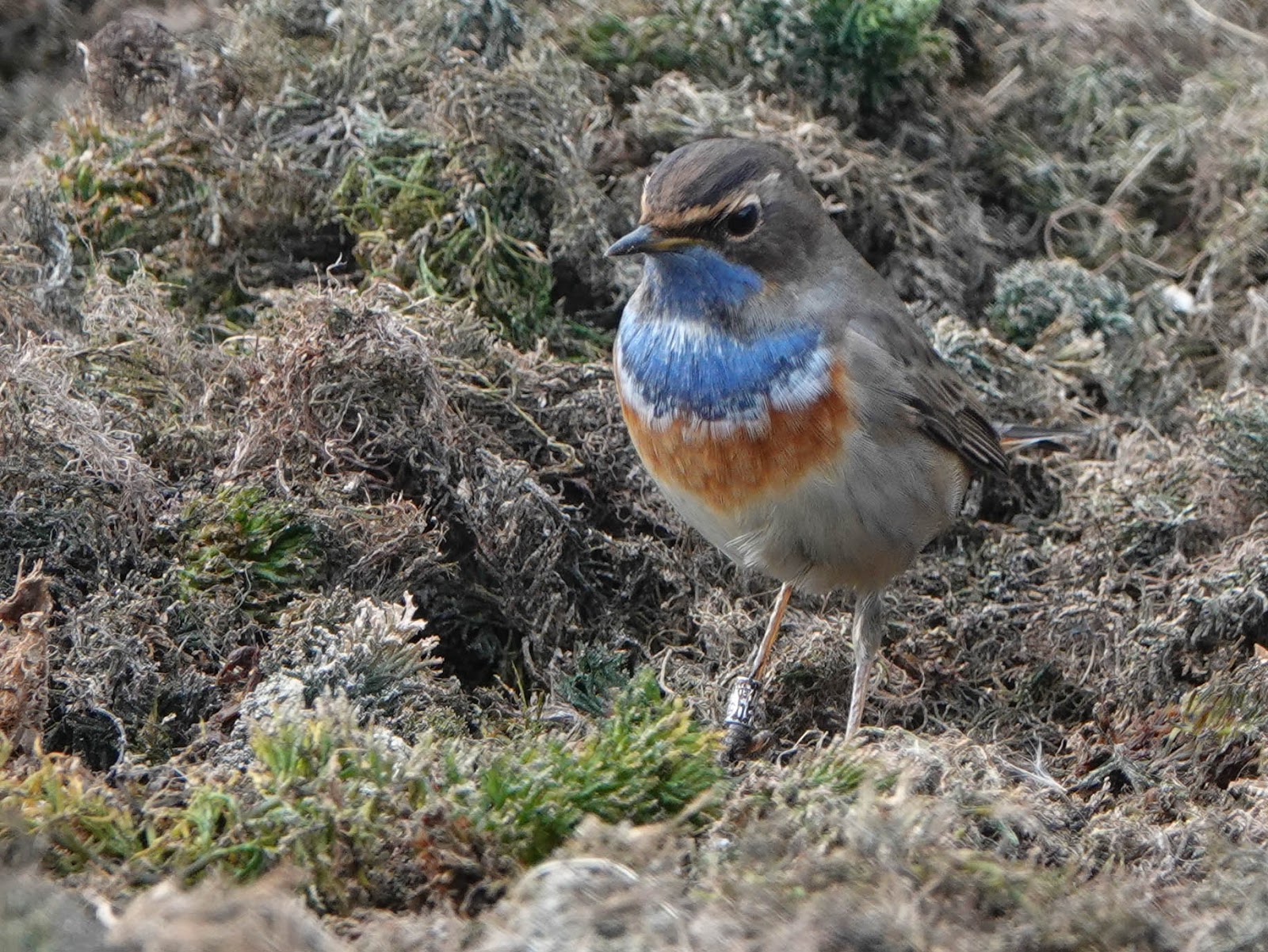
Bluethroat Ruisenor Pechiazul Luscinia svecica
The northern hide at the Laguna del Trebol managed to provide both a close Bluethroat and Grey Wagtail along with the resident Red-knobed Coots and Moorhens, excellent for the camera.  A male Stonechat also spent some time at the site and when the warden, Manola joined me he reported that there had been a double-special yesterday with the sighting of a Yellow-browed Warbler Phylloscopus inomatus in the avenue leading to the hide and another group of birders had found a visiting Little Bunting Emberiza pusilla whilst at the southern hide overlooking the same water.  On leaving the hide, I spent some time watching the many Chiffchaff feeding in the trees and also recorded Robin, Blackcap, Sardinian Warbler and a pair of Greenfinch.

Grey Wagtail Lavandera Cascadena Motacilla cinerea

Off then to the above-mentioned southern hide where I had more Red-knobbed Coots, another Purple Swamphen and a pair of Little Grebe

Purple Swamphen Calamon Comun Porphyrio porphyrio in late morning
A small number of House Sparrows visited the trees immediately on front of the hide and then close views of a quartet of Collared Doves.  Looking at a Moorhen at the back of the water I discovered the sleeping Snipe.  Then, amazingly, a small Chiffchaff-like bird landed for a split second immediately in front of me on a little reed on the water and was gone away to the left quicker than I can write this sentence.  But not before I had a good view of the double yellow wing bars and was able to identify the bird as a visiting Yellow-browed Warbler, presumably the same bird as seen yesterday.  Just a shame it did not stay the full couple of seconds to give me chance to lift the camera.

Sleeping Snipe Agachadiza Comun Gallinago gallinago

The final water on my circuit was the Laguna del Lirio where I found a couple of photographers.  Intrigued to discover on what they were concentrating, I moved across behind them to have a look and, sure enough, a family of five Ferruginous Duck were at the far end of the pool. Just to be obliging, the birds then paddled to our end and eventually were photographed alongside a handful of Mallard so giving a good size comparison.

Ferruginous Ducks  Porrron pardo Aythya nyroca and comparison for size with Mallard Anade Azulon Anas platyrhynchos

With time to spare I then worked my way back to the Laguna del Alamo Blanco with a look in at the new approach hide where I recorded a Little Egret with the visiting Mallards and noted the quartering Marsh Harrier above.  It was on this second visit to the water that I found the hiding White Stork and also a pair of newly-arrived Gadwall.

And so to my departure where I found a trio of Crested Larks on the large shingle beach on the opposite side of the road and returning via Turtle Dove Alley also added a Hoopoe and, finally, a Buzzard before reaching the motorway to journey home.

Ducks seen during the morning:

Gadwall Anade Friso Anas strepera

Male Teal Certa Comun Anas crecca

Shelduck Tarro Blanca Tadorna tadorna

Birds seen:

Shelduck, Gadwall, Mallard, Shoveler, Teal, Ferruginous Duck,Little Grebe, Cormorant, Cattle Egret, Little Egret, Heron, White Stork, Marsh Harrier, Buzzard, Moorhen, Purple Swamphen, Coot, Red-knobbed Coot, Snipe, Yellow-legged Gull, Rock Dove, Collared Dove, Kingfisher, Hoopoe, Crested Lark, Crag Martin, Grey Wagtail, Robin, Bluethroat, Black Redstart, Stonechat, Blackbird, Cetti's Warbler, Sardinian Warbler, Blackcap, Yellow-browed Warbler, Chiffchaff, Spotless Starling, House Sparrow, Waxbill, Red Avadavat, Greenfinch.


Bluethroat Ruisenor Pechiazul Luscinia svecica
Stonechat Tarabilla Comun Saxicola torquatus
Collared Dove Tortola Turca Streptopelia decaocto
Little Egret Garceta Comun Egretta garzetta

  
Check out the accompanying website at http://www.birdingaxarquia.weebly.com for the latest sightings, photographs and additional information

Alcaucin

Distant female Crossbill Piquituerto Comun Loxia curvirostra
Saturday 9 November

Up too late to spend the morning at the Charca de Suarez so I took a late morning driven up to the woods above the Alcaucin picnic area.  Not only very quiet but I got caught out by the sudden drop in temperature!  Out for little more than 90 minutes but at least recorded new new birds for the month.  Next time I must remember to wear a jumper or at least long sleeves!

Lonely Mistle Thrush Zorzal Charlo Turdus viscivorus

Both Robin and Chaffinch as  approached the picnic area and then standing quietly in the , then, deserted top area amongst the tall trees I recorded both Great and Blue Tits along with another Robin and a good number of Nuthatch.  A Mistle Thrush posed on top of a dead tree and then a couple of Blackbirds scuttled by.  Before leaving the area I also managed to find a handful of Crossbill and then both Sardinian Warbler and Goldfinch before leaving to complete the mountain track to the top above Ventas de Zafarraya and then, approachi9ng the end of the track, both Spotless Starling and Serin.

A very active Nuthatch Trepador Azul Sitta europaea

Very wind as I passed Ventas de Zafarraya and a quick drive along the old railway track only produced Crag Martin and Chough.  Finally home for a late lunch having just recorded a total of 15 species.

Birds seen:
Robin, Black Redstart, Blackbird, Mistle Thrush, Sardinian Warbler, Blue Tit, Great Tit, Nuthatch, Spotless Starling, Chaffinch, Serin, Goldfinch, Crossbill.


 Check out the accompanying website at http://www.birdingaxarquia.weebly.com for the latest sightings, photographs and additional information

Friday, 8 November 2019

Rio Velez, Torre del Mar

Friday 8 November

Long time since I visited my nearest wetlands at the Rio Velez on the western outskirts of Torre del Mar.  Clear and bright but very windy and quite cool, if not cold, when out of sun.  Poor start as engine warning lights on which necessitated a quick visit to a local garage to check all was OK then parked up down at the river by 9.10.  Looking green with  a few water pools but much overgrown bamboo and grasses giving restricted viewing.  In the even t not all that to be seen as I walked down to the beach.  A Cattle Egret perched in the top of a tree on the opposite side and fleeting visits of White Wagtail, Blackbird and Collared Dove.  A Cetti's Warbler let me know of its presence followed by a screaming flypast of a quartet of Monk Parakeet.  (Later this morning I was to come across a flock of 24 individuals feeding on the dry river bed next to my home.)  From the hide, now in much need of repair and cleaning, a few House Sparrows but that was it until I reached the shore, passing a group of eight Moorhen on the way, and was able to look back up the river there being no gulls whatsoever about.

White Wagtail Lavandra Blanca Motacilla alba

Up river ten Mallard and a single Heron and I decided to walk back up the western side of the river and, indeed, this proved far more productive quickly producing a trio of Hoopoe and a Robin.  In the fields to my left were both House Sparrows and a large Linnet flock.  Almost immediately afterwards it became very apparent that the area was alive with Chiffchaffs.  A Zitting Cisticola and another Cetti's Warbler were recorded and then the first Stonechat of the morning.  Add on a mixed flock of Goldfinch and Serin with a hovering Kestrel and the numbers were now certainly on the increase.  I even had a pair of Hoopoes as I crossed the river bed back towards the car.

Chiffchaff Mosquitero Comun Phylloscopus collybita

Next followed a short drive upstream to check out the growing fields where I recorded more Stonechats, White WagtailsBlack Redstart and a small flock of Spotless Starlings plus, finally, a couple of Crested Larks.  A pleasant surprise was to see a couple of Crag Martins flying low over what little water was to be seen in the river bed.  My last point of all was back to the southern side of the road to take an anti-clockwise circuit of the growing fields and this produced a large mixed flock of Goldfinches, Linnets and Meadow Pipits.  So, the final result 24 species in 90 minutes including travelling time.
Meadow Pipit Bisbita Pratense Anthus pratensis
Birds seen:
Mallard, Cattle Egret, Heron, Kestrel, Moorhen, Collared Dove, Monk Parakeet, Hoopoe, Crested Lark, Crag Martin, Meadow Pipit, White Wagtail, Robin, Black Redstart, Stonechat, Blackbird, Cetti's Warbler, Zitting Cisticola, Chiffchaff, Spotless Starling, House Sparrow, Serin, Goldfinch, Linnet.


Check out the accompanying website at http://www.birdingaxarquia.weebly.com for the latest sightings, photographs and additional information

Tuesday, 5 November 2019

Farewell Lincolnshire

Whooper Swan Cygnus cygnus
Monday 4 November

With Jenny needing a lift to Spalding and the forecast no longer predicting rain today, and only twenty minutes from Boston, it really was a "no-brainer". So camera, bins and scope into the car and after dropping off the ladies for the shopping adventure I carried on to RSPB Frampton Marsh. Arriving at 9.30 it was cold, overcast and generally very dull with poor light.  But by midday the skies were clearing and the sun was putting its hat on and coming out to play.  Indeed, leaving the site at 12.30 I made a diversion on the way home to spend an hour at Rutland Water before returning home. A sort of farewell to Lincolnshire until I return once more in late December. And, interestingly, I saw more birds in my hour at Rutland Water (north Arm and Visitors Centre only) than I did at the three hours on the coastal marsh.

Female Teal Anus crecca
Approaching the reserve I had Wood Pigeons and Rooks and as soon as I entered the site Magpie, Carrion Crow and Pheasant.    A Blackbird flew away as I made a very brief stop at the main car park to check out the flooded fields in front and was immediately aware pf the large number of Wigeon and groups of Greylag GeeseLapwings were everywhere and resting on a distant post next to the barn a Common Buzzard.  Straight on down to the small car park near the high bank to check out both sides of the road with the scope and I confirmed good numbers of Teal and Shoveler plus a few Mallard.  The occasional Mute Swan was seen and confirmed that there were thousands on Lapwing on site plus a very large flock of Golden Plover.  A couple of Redshank worked the nearby pools and even a trio of Moorhen.  I even found the well-concealed Snipe.  To my left on the recently worked grassland a quartet of Little Egret and so up the high bank to check out the saltmarsh.


Male (above) and female Wigeon Anas penelope
From the high bank I could see the three distinct flocks of feeding Brent Geese and the small number of birds on the worked field below where the site was having its ditches excavated.  I also managed through the dull light to find a Peregrine Falcon enjoying its breakfast a top a short post further out on the marsh.  At this point I had intended to return to the car and put away the scope before checking out the main hides.

A few of the very many Brent Geese Branta bernicla
However, meeting a birder waking towards me he informed me that the recently-arrived Long-tailed Duck was still on site and easily found, following his directions.  So onwards to said site and, indeed, the Long-tailed Duck was found busy feeding in a narrow channel accompanied by both Wigeon and Brent Geese - but working independently.  Despite the poor light I managed to get a record shot before deciding, having already covered most of the high bank, that I must just as well carry on and complete the anti-clockwise circuit back to the car.

The visiting Long-tailed Duck Clangula hyemalis. Record shot above and with Wigeon and Brent Geese.
Very little to see from the East Hide other than more Brent Geese, Shelduck and a few Dunlin plus more Lapwing.  A small flock of Greylag Geese and some Black-headed Gulls and Starlings along with a single Avocet were also recorded.  Then I found the resting Canada Geese flock on the far side.  So on to the Reedbed Hide and the track in a very muddy state following the activities of the digger in the area.  Upon arrival at the hide I quickly added Little Grebe and Pochard but the main delight was the pair of Whooper Swans.  No sooner had I got my first photograph than a further ten individuals dropped in to make a fabulous, slightly distant picture.

The arrival of the beautiful Whooper Swans Cygnus cygnus

Next up was the nearby 360 Hide but, again, rather disappointing following all the recent management work which had also necessitated the draining of the area.  A few Redshank and more Lapwing along with a handful or so of Teal but also a small flock of Dunlin accompanied by a single Turnstone.  A couple of Meadow Pipits were moving around in front of me and then it was back to the car so I could move it up to the main car park.

Dunlin Calidris alpina
From the Visitors Centre I noticed the large flock of House Sparrows and even had a Goldfinch on the feeders.  Finally, as I was departing the site I was seen off by a Collared Dove and a lone Kestrel watched my passing as I approached Spalding.  An interesting three hours, albeit in poor visibility but a final total of 39 Species.

Still only 12.30 and weather now much brighter and the promise of good, clear visibility during the afternoon under a shining sun so decided to head straight to Rutland Water for an hour to check out the North Arm and Visitors Centre before heading home in time to collect Jenny for her doctor's appointment at the local hospital. As soon as I reached the access to Burley Fishponds on the North Arm I was greeted by Rooks, Carrion Crows, Magpie and Wood Pigeons.  On the water a good number of Cormorant and mainly Great Crested Grebes and Wigeon.  A couple of Mute Swans drifted by long with the occasional Mallard and a small number of Coot.  On the grass a couple of Egyptian Geese were taking their rest with a small number of Greylag Geese nearby.  The main water, in addition to a handful of Mute Swan, held good numbers of Tufted Duck and a couple of Little Grebe with a Little Egret on the far bank.

Then on round to the Visitors Centre.  With the noisy wind blower in action outside the feeding station I entered the building to take a look at Lagoon 1.  Apart from the large numbers of Cormorant and almost as many Black-headed Gulls the water was relatively empty.  However, a good check of the area did produce Mallard, Pochard and Teal along with a single Great White Egret.  A Marsh Harrier settled below a marker pole and I then noticed a resting Heron sitting on its top.  Pride of place, however, went to the female Smew that just happened to make itself visible near the reeds away to my right.  meanwhile, a couple of Blue Tits were feeding in the well-berried tree in front of me and a Stonechat posed atop a bush near the water's edge.

Great White Egret Egretta alba on lagoon 1
So to the feeding station which, at first, appeared very quiet but soon returned to normal with a first visit from a lone Coal Tit then the regular arrival of both Blue and Great Tits and a single Marsh Tit.  Just a couple of Goldfinches but two Collared Doves also put in an appearance.  To my right the brief sighting of a skulking Wren then the arrival of a pair of Dunnock.  Next came the few Chaffinches and finally a single Robin.  Walking back to the car I had a large number of the resident Jackdaws overhead and also recorded both Blackbird and Starling.  Just the hour at Rutland Water but managed to record one more species than I had during the three hours at Frampton Marsh, so giving a total species for the day of 58.

Last chance to see the Dunnock Prunella modularis for a month or so.

Birds Seen:
Greylag Goose, Brent Goose, Canada Goose, Mute Swan, Whooper Swan, Egyptian Goose, Shelduck, Gadwall. Wigeon, Mallard, Shoveler, Teal, Pochard, Tufted Duck, Scaup, Long-tailed Duck, Pheasant, Little Grebe, Great Crested Grebe,Cormorant, Little Egret, Great White Egret, Heron, Red Kite, Marsh Harrier, Buzzard, Kestrel, Peregrine Falcon, Moorhen, Coot, Avocet, Golden Plover, Lapwing, Dunlin, Snipe, Redshank, Turnstone, Black-headed Gull, Wood Pigeon, Collared Dove, Meadow Pipit, Wren, Dunnock, Robin, Stonechat, Blackbird, Marsh Tit, Coal Tit, Blue Tit, Great Tit, Magpie, Jackdaw, Rook, Carrion Crow, Starling, House Sparrow, Chaffinch, Goldfinch


Check out the accompanying website at http://www.birdingaxarquia.weebly.com for the latest sightings, photographs and additional information
Friday, 1 November 2019

RSPB Frampton marsh

Thursday 31 October

Weather brighter than forecast so arrived at RSPB Frampton Marsh near Boston by 8.30 having recorded Rook and Pheasant on the narrow road approaching the reserve.  On arrival straight to the small car park near the high bank to check out the favourite sites.  What a surprise!  major conservation works have been ongoing since the stat of the month with the digging out of ditches, levelling ground, emptying the  northern lagoons to treat the weeds and preparing for the installation of "predator proof" barriers to keep out foxes, badgers etc from the breeding area of the Avocets and other waders.  Naturally, all this disturbance meant that very little bird life to the left of the road and the fields on the opposite side were well flooded - but lots of birds.  But the sun was shining from a clear blue sky even if the temperature was in low single figures.

A few of the hundred plus Greylag Geese Anser anser
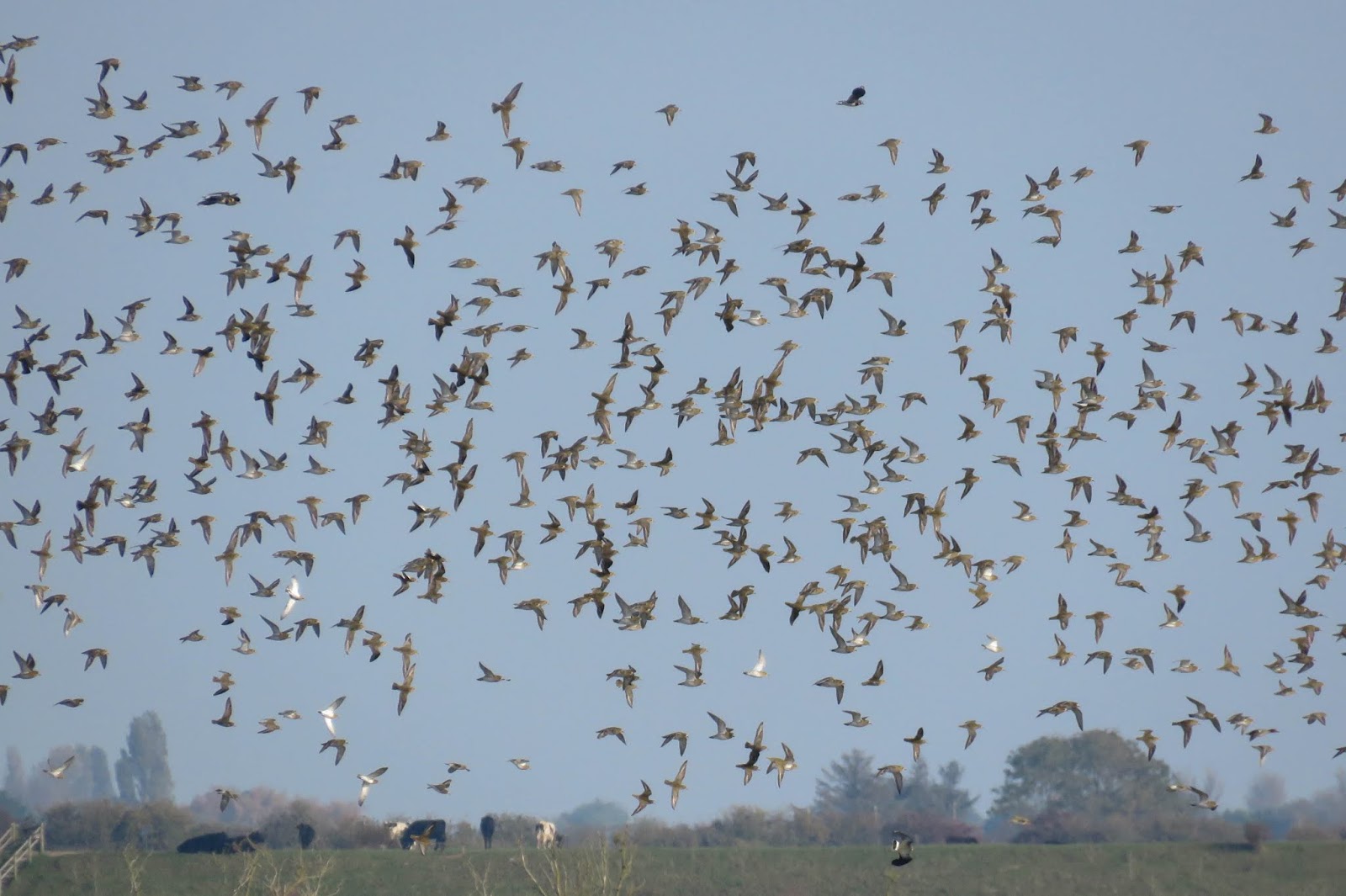
Looking over the workings to the north there was hardly a bird to be seen save for the occasional Lapwing then a single Avocet and a distant Little Egret.  A few distant Crows and Magpies were also noted before I turned my attention southwards over the flooded fields.  What a contrast.  Close at a hand small groups of mixed ducks including Wigeon, Teal and Shoveler.  But much more in abundance were the nearby large flocks of both Lapwing and Greylag Goose.  Given the additional numbers of both Wigeon and Teal on the reserve I would estimate flock sized of approaching 200 for Wigeon, Teal and Greylag but most likely more than 500 Lapwing.  However, all these species were far out-numbered by the huge flock of Golden Plover which, if not yesterday's high total, certainly exceeded 2,500.

Little Egret Egretta garzetta
Walking on down the lane and up the steps to the high bank I actually saw the amount of water on the saltmarsh with a high tide, certainly not the place to be caught unawares!  Over to my left a small group of Brent Geese and a Curlew with the first Redshank of the day on the edges below the bank.  making my way back to the car to return to the main car park I then picked up a good-sized charm of Goldfinches and a large flock of Starlings.  The nearby channel contained more Wigeon and Teal along with plenty of Mallards and a couple of Mute Swans.

Wigeon Anas penelope

Once inside the Visitors Centre I was able to check out the occupants of the main pool to the front.  Not as full of ducks as I might have expected but, again, mainly Wigeon and Teal along with a few mallards and more Shoveler.  A small group of Pochard were seen away to my right and in front of me a single feeding Little Grebe.  Only Goldfinches and a single Great Tit seen on the feeders.  On the other and, there was a quartering Marsh Harrier working the distant river bank.

Distant Meadow Pipit Anthus pratensis

No scope to cut down on weight as I set off on the anti-clockwise boundary trail, through the hedgerow path where I cam across a flock of House Sparrows and then on to the far side in the hope that I would get a better view of the Golden Plover flock with the sun behind me.  A handful of Meadow Pipits were recorded and then, meeting up with one of the voluntary warders, he pointed out the resting Little Owl on a pile of stones and I drew his attention to the posing Red-legged Partridge on the next such pile.  He also informed me that the four Whooper Swans he had seen opposite the main car park on arrival were now feeding with Mute Swans beyond the ruined barn away to the south beyond the Little Owl sighting.


A small selection of the 2500 plus Golden Plover Pluvialis apricaria flock
Having watched the Golden Plovers in flight and noted their large number along with very many Lapwing, I stopped further along the path and managed to get a view of 18 swans feeding away in the greenery to the south.  I thought I counted at least six Whooper Swans and the a group of four took off and flew back to the flooded field behind me; most probably the original four Whoopers.

Very distant record shot of Whooper Swan Cygnus cygnus

At this point I descended the steps to walk the newly-created "Berry Track" below the bank.  Rather wet under foot but with berry-laden bushed either side it was no wonder that I disturbed a number of feeding Blackbirds.  Back up on the bank top path and on towards the main sea bank.  A trio of Ruff in the pool below and many Black-headed Gulls.  Looking over the main sea bank a couple of Lesser Black-backed Gulls were noted along with more Brent Geese and, by now, the tide had receded and once more the saltmarsh had taken on its familiar picture.  Walking back along the road to the Visitors Centre I picked up a Greenfinch feeding with the Goldfinch flock and to my right a couple of Moorhen had put in an appearance.

Brent Goose Branta bernicla

Collecting my picnic lunch from the car I then headed off to the 360 Hide where I was informed a Long-tailed Duck had been observed.  Lots of Brent Geese along with Wigeon and Teal but no Long-tailed Duck.  A resident informed me that the bird was much nearer the saltmarsh.  Ah well, such is life! Towards the East Hide I could see a few waders and identified Redshank and Dunlin.  I also discovered that this was where the Canada Goose flock was feeding.  Then my attention was drawn to a Grey Plover and as I watched through the owner's scope it passed a single Ringed Plover; a sort of two for the price of one!  I concentrated on checking out the far water to the east of the hide where I found the feeding Black-tailed Godwits but, again, no Long-tailed Duck albeit I added a few Shelduck.

My final stop of the day was the Reedbed Hide.  Very few birds to be seen save for a Little Grebe the a handful of mallard making their way to the far corner of the water on my right and out of sight.  But I could not but notice that one of their number was a distinctive white about the head, could this be the Long-tailed Duck as I usually find single visitors associating with Mallards.  Camera to hand so just managed to get a couple f shots before the birds disappeared.  Looking at the individual and then the photograph I could see that this bird might well be mis-identified as a female Long-tailed Duck but it had a yellow beak, even if much narrower than a "normal" mallard's beak, and the colouring was not quite right.  Indeed, it had some Mallard-like patches.  Strange that this was the only hybrid-like duck I had ever seen here.  Calling in at the Visitors Centre I discussed my sighting and checked my photos against the various literature to hand but still not convinced.  Meanwhile, a couple of Chaffinch had arrived on the grass in front to the window.  At this point one of the wardens returned having been down towards the sea bank to take a photograph.  naturally, my homeward journey was slightly delayed as I, too, drive down to the far car park just in case the bird was still present.  A couple of birders were convinced that it had departed when one called me back to say he had one the bird in the far distance but, again, now departed.  I leave readers to pass comments on my hybrid photos.


The mysterious Mallard Anas platyrhynchos hybrid pretending to be a Long-tailed Duck Clangula hyemalis!

A cold but enjoyable morning's birding which also included a large number of feeding Wood Pigeon as I drove out of the reserve so bring up the day's total to 42.

Birds seen:
Greylag Goose, Brent Goose, Canada Goose, Mute Swan, Whooper Swan, Shelduck, Wigeon, Mallard, Shoveler, Teal, Pochard, Red-legged Partridge, Pheasant, Little Grebe, Marsh Harrier, Little Egret, Moorhen, Avocet, Ringed Plover, Golden Plover, Grey Plover, Lapwing, Dunlin, Ruff, Black-tailed Godwit, Curlew, Redshank, Black-headed Gull, Lesser Black-backed Gull, Wood Pigeon, Little Owl, Meadow Pipit, Blackbird, Great Tit, Magpie, Rook, Carrion Crow, Starling, House Sparrow, Chaffinch, Greenfinch, Goldfinch.


Check out the accompanying website at http://www.birdingaxarquia.weebly.com for the latest sightings, photographs and additional information